
Search engines are no longer limited to showing traditional blue links. For people who do business online, write articles, and market things, it is very important to know how to get a spot in search results that use artificial intelligence. The companies that figure this out first will often be seen by people who search for things online.
These new search engines do not just look for keywords; they try to understand what the content is really about. They want to know if it is good, if it is from a source, and if it is useful to people. So websites need to change how they do things so that the artificial intelligence can understand what they are about and show them to people.
How AI and Generative Search Are Changing SEO Rankings
Generative search engines depend on AI to detect user goals and blend answers from multiple sources. Instead of ranking pages purely based on keyword relevance, AI systems evaluate content completely. They assess context, clarity, trustworthiness, and real-world usefulness.
For users, this means search results are faster and more conversational. For websites, it means ranking is no longer just about appearing on page one; it is about being selected as a trusted source for AI-generated responses. Content that lacks depth or originality is increasingly filtered out, while authoritative, experience-based content gains more visibility.
Why Keyword-First SEO Is Losing Effectiveness
Keyword optimization is a part of SEO. Things are changing. Now we have these search environments that use computers to understand what we are looking for. These computers are really good at figuring out what we mean. They look for topics and things that are related, not exact words.
If you make a website that's too focused on keywords, it might get ignored. The computers that rank websites are getting smarter. They want to see content that answers our questions in a way that makes sense. It is not about using the right keywords anymore. It is about understanding what people are really looking for.
When you look at the market, you see that there are a lot of people trying to do the thing. The content that does well is the kind that sounds natural and helps people with their problems. It does better than content that is just written to impress search engines. Keyword optimization is still important. It is not the only thing that matters. Content that is helpful and easy to read is what people want. That is what keyword optimization should be about.
Understanding Search Intent in the Age of AI
Understanding what people are searching for has always been important. Now it's more crucial than ever because of AI. New search engines can figure out what someone is looking for, whether they want to learn something, buy something, go to a specific site, or make a transaction.
Content that is the same as what someone is searching for is more likely to show up in the answers given by AI. Pages that are not clear or are out of place struggle because AI can't be sure what they are for. To show up in search results, the content must clearly show that it understands what the user is trying to do.
Why Authority and Trust Matter More Than Ever
Generative search engines really like to use sources. When it comes to authority, it is not about the number of backlinks you have. It is also about how accurate and consistent your content is if you really know what you are talking about. AI systems look at your content to see if it is based on life and if it has good information.
Websites that just put out repetitive content will not be seen as much. On the other hand, brands that make really good content that is based on experience will be shown more in AI search results.
Things like how well-known your brand is, if your authors are credible, and if you always talk about the topics, help AI systems decide how to rank you.
Content Depth Is Now a Ranking Advantage
When you are looking for information, you want to find something that really gets into the details. AI search engines like it when a website talks about a topic in a way not just scratching the surface.
This kind of content is helpful to people who are searching for answers and to the AI systems themselves. Depth is not just about how long something is. It is about being clear, complete, and giving the context.
For example, a good website will explain things in a way that's easy to understand, answer questions that people might have, and give people practical ideas they can use.
The AI systems are more likely to use these websites as sources when they are generating answers.
How User Experience Influences AI Rankings
The way people experience a website is really important for search now. Computers that use intelligence look at how people interact with a page to figure out if it is good. If people stay on a page for a while, scroll down and come back to it, that means the page is useful.
If a website is hard to use, takes a long time to load, or is confusing, it is less likely to show up in search. Artificial intelligence likes pages that are easy to read, make sense, and work well on all devices. When artificial intelligence is in charge, how much people, like a website, directly affect how visible it is.
The Role of Structured and Contextual Content
The way we write things is changing. It is not about using big technical words. What is important is that our writing is easy to follow. We need to use headings that make sense. Our ideas need to flow logically. This helps artificial intelligence systems see how our ideas are connected.
When we write, we need to explain things in a way that makes sense. We need to say what something is. Also, why it is important and how it works. This kind of writing works with artificial intelligence search models. Artificial intelligence likes content that can be summed up quickly without losing its meaning. Artificial intelligence systems like it when we can get the points of something across in a simple way. This helps artificial intelligence understand what our content is about.
Why Original Insights Outperform Rewritten Content
Generative search engines are trained on vast amounts of information. As a result, content that merely rephrases existing ideas offers little value. AI systems prioritize original perspectives, data-driven insights, and experience-based explanations.
Websites that add unique interpretation or industry-specific context are more likely to stand out. This is especially important in the market, where competition for AI visibility is intense. Originality is no longer optional; it is a ranking factor.
Measuring Success in AI Search Rankings
Things like rankings and clicks are changing. When we talk about search engines that can create content, being successful also means that people use you as a source. You influence the summaries that artificial intelligence makes, and people still know about your brand even if they do not click on you directly.
The number of people visiting your website may go up and down. It is more important to have a good reputation and be visible in the long run. Companies that get used to the way that artificial intelligence ranks things will be more visible on the internet as search engines keep changing. The way we measure how well we are doing with search engines must also change as the ranking systems change.
Preparing Your SEO Strategy to Rank in AI Search Results
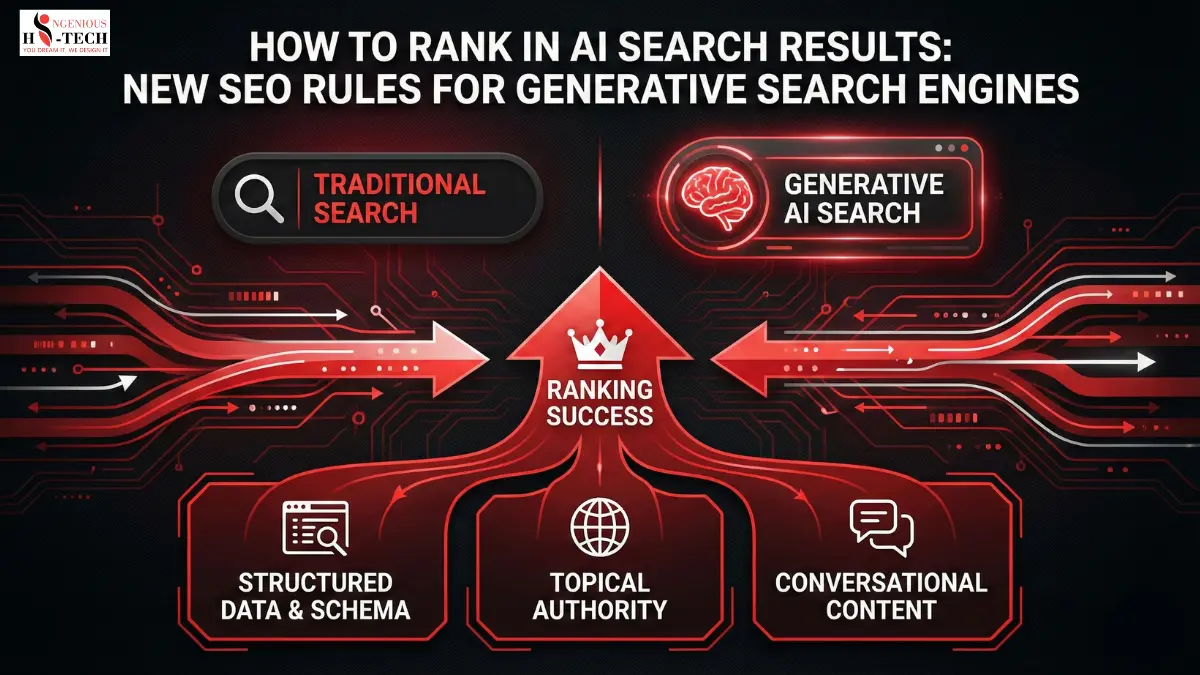
To rank high in AI search results, we need to change our approach. It's not about beating others with the keywords anymore. Now it's about giving users what they need. Clear, trustworthy, and helpful information.
The SEO strategies that will work focus on creating content that matches what users are looking for, being an expert in a particular area, maintaining high standards, and ensuring a smooth user experience. These principles fit well with how AI search engines work and present information.
Practical Steps to Rank in AI Search Results
- Create intent-focused content instead of keyword-focused articles
- Build topical authority with related content clusters
- Publish original research, examples, or expert insights
- Structure pages clearly using headings and summaries
- Improve readability and engagement metrics.
Final Thoughts: SEO Is Becoming More Human, Not Less
The thing about search engines is that they are changing. With all the talk about artificial intelligence, search engines are actually becoming more about people. When you search for something, the results you get are more likely to be from websites that really know what they are talking about.
Websites that use search engine optimization to help people rather than just to trick the system are the ones that will show up in search results. As search engines get better at understanding what people want, the companies that focus on being helpful will be the ones that everyone sees. Search engine optimization is about search engines, but it is also about people, and the companies that remember that will do well.
Key Takeaways
- AI search ranks usefulness, authority, and clarity over keywords
- Original, experience-based content gains higher visibility
- Structured and intent-focused pages perform best in generative search
- User experience and engagement influence AI ranking signals
Frequently Asked Questions:
1. What does it mean to rank in AI search results?
Ranking in AI search results means your content is selected, summarized, or cited by AI-powered and generative search engines as a trusted source, not just listed as a traditional blue link.
2. How is AI search different from traditional Google search?
AI search focuses on understanding user intent and generating direct answers using multiple sources, while traditional search primarily ranks web pages based on keywords and links.
3. Can websites still rank without using AI tools?
Yes. Websites can rank in AI search results without using AI tools as long as their content is original, authoritative, and aligned with user intent.
4. Do keywords still matter for AI SEO?
Yes, but keywords are no longer the primary ranking factor. AI search engines focus more on context, relevance, and how well content answers real user questions.
5. How can I optimize content for generative search engines?
You can optimize content by focusing on clear intent, in-depth explanations, natural language, strong topical authority, and a positive user experience.
6. Will AI search reduce website traffic?
AI search may reduce some clicks, but it increases the importance of brand visibility, authority, and being referenced as a trusted source in AI-generated answers.
7. What type of content performs best in AI search results?
Content that provides comprehensive answers, original insights, real-world experience, and clear explanations performs best in AI-powered search environments.
8. Are backlinks still important for AI search rankings?
Backlinks still matter, but they are no longer enough on their own. AI systems also evaluate content quality, trustworthiness, and user engagement.
9. How does user intent impact AI search rankings?
User intent is critical because AI search engines prioritize content that directly matches what users are trying to achieve at that moment.
10. How can businesses prepare for future AI-driven SEO changes?
Businesses should focus on creating high-quality, intent-driven content, improving user experience, and building long-term authority rather than relying on short-term SEO tactics.