
Google Search is not just about a blue link anymore. As AI search experiences are gaining traction, users are getting their answers, personal recommendations, and conversational responses without even visiting any site. How will this change impact the competition for visibility on the web? It will no longer be enough to optimise solely for search rankings to survive in 2026.
Now, what has really happened? What implications does it have for your business? We'll look into how Local SEO is transforming, debunk the myths surrounding the topic, and share the strategies to ensure that your business gets noticed in the era of AI search.
Introduction
If you've been doing SEO for more than a year, you already know the landscape looks very different today. Google's AI Overviews now appear at the top of millions of search results. ChatGPT, Perplexity, Gemini, and other AI-powered tools are answering questions that people used to Google. And ranking on page one is no longer the only game in town.
This is the new reality of search in 2026, and it demands a new way of thinking.
AI Search Optimisation isn't just a buzzword. It's a practical, evolving discipline that sits alongside traditional SEO and helps your content get discovered, cited, and surfaced by AI-powered search engines. Whether you're a business owner trying to get found locally, a marketer managing multiple websites, or an SEO professional advising clients, understanding how to optimise for AI search is no longer optional.
In this guide, you'll learn exactly what AI Search Optimisation means in July 2026, how it differs from traditional SEO, why local SEO still plays a critical role, and most importantly,y what you can do right now to make your content work harder across every search surface.
What Changed in SEO in 2026?
Search has never evolved faster than it has over the past 18 months. Here's what's actually different now compared to just two years ago.
Google AI Overviews Became the Norm
Google's AI Overviews (formerly Search Generative Experience) now appear for a significant portion of informational and transactional queries. Instead of ten blue links, users often see a synthesised AI-generated answer at the top of the page with citations. Getting cited in those answers has become a primary SEO goal.
AI Search Engines Are Stealing Traffic
Platforms like Perplexity, ChatGPT Search, and Google Gemini are handling hundreds of millions of queries that would previously have driven traffic to your website. Zero-click search is no longer just about featured snippets. Users are getting answers without ever visiting your site, which means your visibility strategy has to adapt.
E-E-A-T Signals Matter More Than Ever
Google's emphasis on Experience, Expertise, Authoritativeness, and Trustworthiness (E-E-A-T) has intensified. AI systems are also prioritising content from credible, established sources. If your site doesn't demonstrate real-world expertise, it struggles to rank on both Google and AI platforms.
Topical Authority Has Replaced Keyword Chasing
Targeting individual keywords in isolation no longer works the way it used to. Search engines now evaluate your entire website's topical coverage. Sites that comprehensively cover a subject area with well-structured topic clusters and strong internal linking consistently outperform sites that chase individual keywords.
Core Web Vitals and User Experience Are Table Stakes
Page experience signals, including loading speed, interactivity, and visual stability, are baked into rankings. A slow or frustrating website loses out, regardless of how well-written the content is.
What is AI Search Optimisation?
AI Search Optimisation is the practice of structuring, writing, and presenting your content so that AI-powered search engines can understand, trust, and cite it.
While traditional SEO focuses on helping search engine crawlers index your pages and rank them for specific keywords, AI Search Optimisation goes further. It focuses on making your content machine-readable, contextually rich, and authoritative enough that AI systems pull from it when generating answers.
Think of it this way. When someone asks ChatGPT or Perplexity a question, those systems scan the web for the most credible, clearly structured, and relevant content they can find. AI Search Optimisation is about ensuring your content is what they find.
Key Elements of AI Search Optimisation
- Clear, direct answers to specific questions
- Structured content using headings, lists, and schema markup
- Entity-based writing that helps AI understand who, what, and where
- Semantic depth that covers a topic comprehensively, not just superficially
- Strong E-E-A-T signals that signal trustworthiness to AI systems
- Conversational language that mirrors how people ask questions aloud or in AI prompts
AI Search Optimisation isn't separate from good SEO; it's the natural evolution of it.
Traditional SEO vs AI Search Optimisation
Understanding the differences between the two approaches helps you decide where to focus your energy.
|
Factor |
Traditional SEO |
AI Search Optimisation |
|
Primary Goal |
Rank on Google's first page |
Get cited by AI search engines + rank on Google |
|
Keyword Focus |
Exact-match and long-tail keywords |
Semantic intent + conversational queries |
|
Content Format |
Keyword-optimised articles and pages |
Structured, question-answering content |
|
Success Metric |
Page rankings and organic traffic |
Citations, brand mentions, and AI answer inclusion |
|
Link Building |
Backlinks from authority sites |
Backlinks + brand authority + entity recognition |
|
Technical Focus |
Crawlability, indexing, and site speed |
Schema markup, structured data, NLP-readiness |
|
Content Depth |
Covers the target keyword |
Covers the entire topic with context and nuance |
|
User Experience |
Core Web Vitals, mobile-friendly |
Conversational flow, direct answers, clarity |
|
Freshness |
Regular updates helpful |
Content freshness is critical for AI citations |
|
Local Signals |
Google Business Profile, citations |
GBP + structured local data + conversational local content |
The most successful websites in 2026 are doing both. Traditional SEO builds the foundation. AI Search Optimisation makes your content work across every surface where users are searching today.
Why Local SEO Still Matters
With all the focus on AI and large-scale content strategies, it's easy to overlook local SEO. That would be a mistake.
Local search is actually growing. More people are using voice search and AI tools to find nearby businesses, book appointments, and check business details. When someone asks Siri, Alexa, or Google, "find a dentist near me open on Saturday," local SEO is what determines whose business gets surfaced.
Google Business Profile Is Your Local Anchor
Your Google Business Profile (GBP) remains one of the most powerful local SEO tools available. In 2026, a well-optimised GBP does more than help you appear in Google Maps. It feeds structured business data directly into AI Overview results, Gemini's local answers, and voice search responses.
Make sure your GBP includes:
- Accurate business name, address, and phone number (NAP)
- Up-to-date opening hours
- High-quality photos
- Regular posts and updates
- Actively managed customer reviews with professional responses
Local Schema Markup Amplifies Your Visibility
Adding the LocalBusiness schema to your website gives AI systems a structured, reliable source of truth about your business. This includes your location, services, opening hours, and review data. Schema markup helps both Google and AI search engines surface your business in relevant local queries.
Conversational Local Search Is Rising
People don't just type "plumber London" any more. They ask, "Who's the best-reviewed emergency plumber in East London available tonight?" That conversational shift means your local content needs to answer specific, natural language questions,s not just target location-based keywords.
Write content that directly addresses local questions. Create FAQ pages for your service area. Use your location naturally in your headings and body copy.
How AI Search Engines Choose Answers
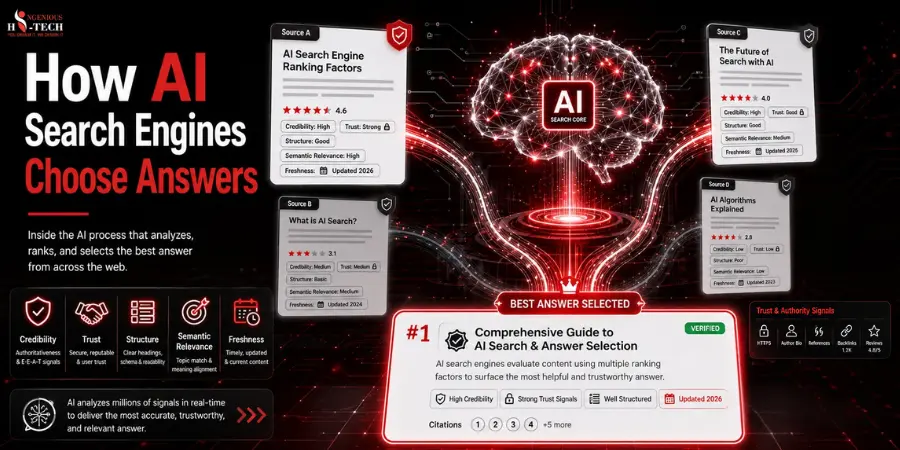
Understanding how AI search engines select and surface content is the foundation of effective AI Search Optimisation.
They Prioritise Credibility and Trust
AI systems are trained to identify authoritative sources. They look for signals like established domains, clear authorship, external references, consistent publishing history, and strong backlink profiles. A site with strong E-E-A-T signals is far more likely to be cited.
They Value Structure and Clarity
AI engines parse content differently from human readers. They look for clear headings that signal what each section is about, concise, direct answers near the top of each section, bullet points and numbered lists that are easy to extract, and schema markup that provides structured context.
If your content buries the answer in the middle of a long paragraph, AI systems may skip past it in favour of a more clearly structured source.
They Respond to Semantic Relevance
AI search engines use natural language processing (NLP) to understand the meaning behind queries, not just the keywords. This is why semantic SEO covering related concepts, synonyms, and subtopics comprehensively matters so much. A thin article targeting one keyword rarely gets cited. A comprehensive resource covering an entire topic cluster consistently does.
They Factor in Freshness
Particularly for fast-moving topics, AI search engines prioritise recently updated content. Publishing dates, last-updated timestamps, and fresh statistics all signal that your content reflects current information rather than outdated guidance.
10 Practical AI Search Optimisation Strategies
Here are ten proven strategies you can implement right now to improve your visibility across both Google Search and AI-powered search engines.
1. Match Content to Search Intent Precisely
Every piece of content should serve a clear purpose: informational, navigational, commercial, or transactional. Mismatched intent is one of the most common reasons content underperforms. Before writing anything, ask yourself what the person searching for this topic actually wants to achieve and then give them exactly that.
2. Write Genuinely Helpful Content
Google's Helpful Content Guidelines reward content that's written for people, not algorithms. AI search engines apply a similar standard. Write content that solves a real problem, answers a real question, or teaches something genuinely useful. Avoid padding your word count with vague statements that add length without value.
3. Build E-E-A-T into Every Page
Experience, Expertise, Authoritativeness, and Trustworthiness aren't just abstract principles. They're signals you can actively build into your content and website structure. Include author bios with credentials. Cite reliable external sources. Get coverage on credible third-party sites. Keep your About page, contact information, and privacy policy up to date.
4. Use Structured Data and Schema Markup
Schema markup is one of the clearest signals you can send to both Google and AI search engines. Use Article schema for blog posts, FAQ schema for question-and-answer sections, LocalBusiness schema for location pages, and Product schema for e-commerce pages. Implementing schema consistently across your site improves your chances of appearing in rich results and AI-generated answers.
5. Build a Strategic Internal Linking Structure
Strong internal linking does two things. It helps search engines discover and understand the relationship between your pages. And it signals topical authority by showing that your site covers a subject area in depth. Link from broader pillar pages to more specific cluster content, and vice versa. Use descriptive anchor text that tells both users and search engines what the linked page is about.
6. Create Topic Clusters, Not Isolated Articles
A single article rarely builds topical authority. Instead, plan your content in clusters, one comprehensive pillar page covering a broad topic, supported by multiple in-depth articles on specific subtopics. This structure makes it clear to both Google and AI engines that your site is a reliable resource on a given subject.
7. Maintain Technical SEO Fundamentals
AI Search Optimisation doesn't replace technical SEO, it builds on it. Your site still needs to be fast, mobile-friendly, secure (HTTPS), and free of crawl errors. Monitor your Core Web Vitals regularly. Fix broken links promptly. Submit updated sitemaps when you publish new content. A technically sound site gives your content the platform it needs to perform.
8. Optimise Your Google Business Profile
For any business with a physical location or local service area, your Google Business Profile is a direct feed into local AI search results. Update it regularly, respond to every review, add new photos, and use the Posts feature to share timely content. Treat your GBP as a living part of your SEO strategy, not a one-time setup.
9. Refresh Content Regularly
Stale content loses ground in both traditional search rankings and AI citations. Set a content audit schedule quarterly works well for most websites and update posts with new data, revised advice, and current examples. Add a "Last Updated" date to let both users and search engines know the content is current.
10. Design for User Experience First
A page that keeps users engaged tells search engines the content is valuable. Keep your design clean and uncluttered. Use short paragraphs, clear subheadings, and visual formatting to make content easy to scan. Reduce pop-ups and intrusive interstitials. Make sure your site loads quickly on mobile. All of these signals contribute to both search rankings and AI citation likelihood.
Common SEO Mistakes to Avoid in 2026
Even experienced SEO professionals make mistakes as the landscape shifts. Here are the most common ones we're seeing in 2026.
- Optimising only for keywords, not topics. Keyword density is far less important than comprehensive topical coverage. Build content that covers a subject thoroughly.
- Ignoring AI search surfaces. If your only SEO goal is to rank on Google page one, you're missing a growing slice of search traffic that goes through AI tools and voice assistants.
- Publishing thin or duplicate content. With Google's Helpful Content system and AI quality filters, thin content doesn't just underperform; it actively drags down your entire site's credibility.
- Neglecting schema markup. Structured data is one of the most underused SEO tools available. Skipping it means missing out on rich results, featured snippets, and AI citation opportunities.
- Letting technical issues fester. Slow page speed, broken links, and crawl errors are often left unaddressed for months. These issues compound over time and can significantly suppress rankings.
- Treating local SEO as set-and-forget. Your Google Business Profile, local citations, and local content need regular attention. Outdated information hurts your local visibility and damages user trust.
- Using AI-generated content without human oversight. AI tools can speed up content production, but AI-generated content published without editing, fact-checking, and genuine expertise often fails Google's quality standards and doesn't perform well in AI search citations.
July 2026 AI Search Optimisation Checklist
Use this checklist to audit your current SEO strategy and identify quick wins.
Content Quality
- Every page serves a clear, specific search intent
- Content answers the user's core question within the first two paragraphs
- Articles cover topics comprehensively with related subtopics
- Author bios and credentials are visible on key pages
- Statistics and claims link to credible external sources
- Content has been reviewed or updated within the last 6 months
Technical SEO
- Core Web Vitals pass Google's threshold (LCP, FID, CLS)
- Site loads in under 3 seconds on mobile
- HTTPS is enabled across the entire domain
- The XML sitemap is submitted and up to date in Google Search Console
- No critical crawl errors in Search Console
- Mobile-friendly across all key pages
Structured Data
- Article schema applied to blog posts and news content
- FAQ schema applied to pages with Q&A sections
- LocalBusiness schema on location and contact pages
- Breadcrumb schema implemented site-wide
- Product schema on all product pages (e-commerce sites)
- Schema validated using Google's Rich Results Test
Local SEO
- Google Business Profile is fully completed and verified
- Business name, address, and phone are consistent across all directories
- GBP reviews are responded to within 48 hours
- Local FAQ content addresses common community questions
- Location-specific landing pages are created for service areas
AI Search Readiness
- Headings are descriptive and question-led where appropriate
- Bullet points and lists are used to present key information
- Content written in a natural, conversational tone
- No keyword stuffing or unnatural phrasing
- Internal links connect related content logically
- Topic clusters built around core subject areas
Frequently Asked Questions
1. What is AI Search Optimisation, and how is it different from regular SEO?
AI Search Optimisation is the practice of structuring and writing content so that AI-powered search engines like Google AI Overviews, ChatGPT, Perplexity, and Gemini can understand, trust, and cite it. Regular SEO focuses primarily on ranking in traditional search results. AI Search Optimisation adds a layer focused on being surfaced in AI-generated answers across multiple platforms.
2. Does AI Search Optimisation replace traditional SEO?
No. AI Search Optimisation works alongside traditional SEO, not instead of it. Technical SEO, link building, keyword research, and on-page optimisation still matter. AI Search Optimisation builds on that foundation by adding structured data, conversational content, and topical authority signals.
3. How do I get my content included in Google AI Overviews?
There's no guaranteed method, but the most reliable approach is to create genuinely helpful, well-structured content that directly answers specific questions. Use clear headings, bullet points, FAQ sections, and schema markup. Build topical authority in your niche. Strong E-E-A-T signals also significantly improve your chances.
4. Is local SEO still important in 2026?
Absolutely. Local SEO is more important than ever, especially as voice search and AI tools surface local business results in direct response to conversational queries. A fully optimised Google Business Profile, consistent NAP data, and locally relevant content are essential for any business with a physical or geographic presence.
5. What schema markup types are most important for AI search?
The most impactful schema types for AI Search Optimisation are Article, FAQ, LocalBusiness, Breadcrumb, and Product. The FAQ schema, in particular, is highly effective because it directly feeds structured question-and-answer content to AI systems that are looking for ready-made answers.
6. How often should I update my content for AI Search Optimisation?
For most content, a quarterly review is a good benchmark. High-traffic pages, content covering fast-moving topics, and any pages citing statistics or data should be reviewed more frequently every one to three months. Freshness signals matter significantly to AI search engines.
7. Does my website need to be fast to rank well with AI search engines?
Yes. Page speed and Core Web Vitals affect your ability to be crawled, indexed, and ranked, all of which feed into whether AI systems reference your content. A slow site creates a poor user experience, which is a signal against quality that affects your performance across all search surfaces.
8. What is entity SEO, and why does it matter for AI search?
Entity SEO is the practice of making your content clearly associated with specific people, places, things, and concepts known as entities. AI systems understand the world through entities and relationships between them. By writing content that clearly identifies and discusses entities (your brand, your authors, your service area, your industry), you help AI engines understand and classify your content more accurately.
9. Can AI-generated content hurt my SEO?
AI-generated content that is published without editing, fact-checking, or genuine expert oversight can hurt your SEO. Google's systems are designed to reward helpful, original content. Mass-produced AI content that lacks real expertise or unique value is likely to underperform. Use AI tools to support your writing process, but always apply human judgment and editorial quality control.
Conclusion
SEO in July 2026 is more layered than ever, but also more rewarding for those who get it right. The businesses and websites that will win in this environment are the ones that treat AI Search Optimisation not as a separate discipline, but as a natural extension of doing SEO well.
Start with the fundamentals. Create genuinely helpful content that serves real user needs. Build topical authority through structured topic clusters and strong internal linking. Maintain your technical SEO so search engines can crawl and index your content efficiently. And don't underestimate the power of local SEO, your Google Business Profile and local content strategy can be a significant competitive advantage in an AI-driven search landscape.
Then layer in the AI-specific strategies: clear, question-led headings; comprehensive FAQ sections; schema markup on every key page type; and a writing style that mirrors how real people ask questions. These steps make your content machine-readable, citable, and discoverable across every platform where your audience is searching.
The shift toward AI search is real, and it's accelerating. But the core principle hasn't changed. Be the most helpful, trustworthy, and well-structured resource on your topic, and both humans and AI systems will find you.