
A website used to be a digital business card. In 2026, it's closer to a full-time member of your sales team one that never clocks out.
That shift is exactly why the debate over AI-powered websites vs traditional websites has become so important for business owners this year. Artificial intelligence has changed what a website is capable of. It's no longer just about looking polished. A modern site needs to think, adapt, and respond to each visitor in real time.
For small businesses, healthcare practices, law firms, home service companies, and e-commerce brands, the real question isn't which website looks nicer. It's which one turns more visitors into paying customers.
In this guide, you'll learn how AI-powered websites and traditional websites actually differ, how each one affects lead generation, and which approach makes the most sense for your specific goals and budget.
What Is an AI-Powered Website?
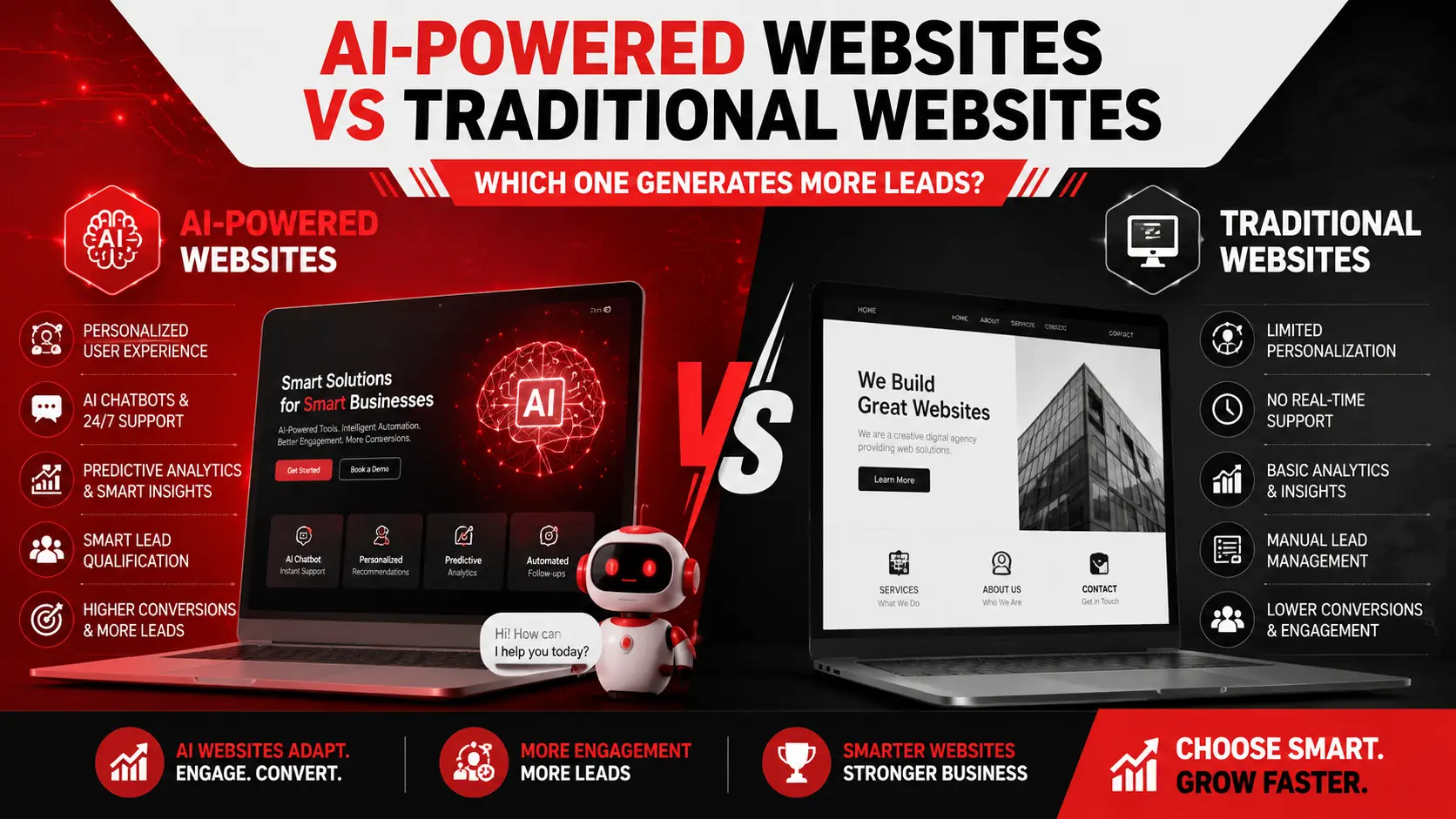
An AI website is a site built with artificial intelligence woven into its core functionality, not bolted on as an afterthought. Instead of showing every visitor the same static pages, it uses data and machine learning to adjust content, recommendations, and conversations in real time.
This is different from a simple AI website builder, which just uses AI to help you assemble pages faster. A true AI-powered website keeps learning and adapting long after launch.
Core capabilities typically include:
- AI chatbots that answer questions and qualify leads 24/7
- Personalised experiences that change based on visitor behaviour, location, or referral source
- Predictive analytics that anticipate what a visitor wants next
- Smart search that understands intent, not just keywords
- Automation that handles follow-ups, scheduling, and CRM integration without manual work
Consider a regional home services company that added an AI chatbot and dynamic service recommendations to its site. Instead of a generic "Contact Us" form, visitors now get instant answers about pricing and availability, and the site automatically routes urgent requests to the on-call technician. That single change turned a passive brochure into an active lead-generation tool.
What Is a Traditional Website?
A traditional website is built around static content. Pages are designed once, published, and typically stay the same until someone manually updates them.
Every visitor sees the same homepage, the same offers, and the same contact form, regardless of who they are or what they're looking for. Updates usually require a developer or a content management system edit, which means changes happen on a schedule rather than in real time.
Traditional sites work well for:
- Simple service pages
- Informational or brochure-style sites
- Businesses with straightforward, low-volume inquiries
The advantage is simplicity and lower upfront cost. The limitation is that a traditional website can't personalise the experience, qualify leads automatically, or adapt to user behaviour the way an AI-powered site can.
AI-Powered Websites vs Traditional Websites: Key Differences
The clearest way to compare AI-powered websites vs traditional websites is side by side. Here's how they stack up across the factors that matter most to lead generation and growth.
|
Factor |
AI-Powered Website |
Traditional Website |
|
User Experience |
Adapts in real time to each visitor |
Same static experience for everyone |
|
Personalization |
Content, offers, and recommendations shift by behaviour |
One-size-fits-all layout |
|
Customer Support |
AI chatbot available 24/7 |
Contact form or business-hours phone line |
|
SEO |
Structured data and AI-assisted content signals |
Manual, less adaptive optimisation |
|
Lead Generation |
Continuous qualification and nurturing |
Passive form submissions |
|
Conversion Optimization |
Ongoing, data-driven adjustments |
Occasional manual A/B testing, if any |
|
Automation |
Follow-ups, CRM syncing, scheduling built in |
Mostly manual processes |
|
Analytics |
Predictive, behaviour-based insights |
Basic traffic and pageview reporting |
|
Maintenance |
Self-learning, fewer manual updates |
Regular manual updates required |
|
Scalability |
Scales with traffic and data automatically |
Often needs redevelopment to scale |
|
Security |
AI-assisted threat detection |
Standard hosting-level security |
|
Cost |
Higher upfront, lower long-term cost per lead |
Lower upfront, higher ongoing marketing cost |
|
Future Readiness |
Built for voice search, AI search, and automation trends |
May need a rebuild to keep pace |
The takeaway: traditional websites can still get the job done for simple use cases. However, when lead generation, personalisation, and long-term scalability matter, AI-powered websites consistently outperform static sites. The difference isn't cosmetic; it shows up directly in conversion rates and cost per lead.
How AI-Powered Websites Generate More Leads
Lead generation is where the gap between AI-powered and traditional websites becomes most obvious. Here's exactly how AI moves the needle.
Personalised User Experiences
AI adjusts headlines, offers, and calls to action based on visitor behaviour and source. A visitor arriving from a Google ad for "emergency plumbing" sees different messaging than someone browsing maintenance tips, which keeps the experience relevant from the first click.
AI Chatbots
Instead of losing leads to slow response times, an AI chatbot engages visitors instantly. It answers common questions, books appointments, and hands off complex conversations to a human when needed, all without making the visitor wait.
Smarter Lead Qualification
AI can ask the right follow-up questions automatically, sorting serious buyers from casual browsers before a salesperson ever gets involved. That saves time and helps your team prioritise the leads most likely to convert.
Dynamic Content Recommendations
Just as an online retailer suggests related products, an AI-powered service site can recommend relevant services, case studies, or resources based on what a visitor has already viewed.
Predictive Customer Behavior
By analysing patterns like time on page, scroll depth, and click paths, AI can predict when a visitor is close to converting and trigger the right nudge a chat prompt, a limited-time offer, or a simplified form.
Automated Follow-Ups
When a lead doesn't convert immediately, automation keeps the relationship alive through personalised email or SMS sequences, supporting lead nurturing without extra manual work from your team.
Improved Conversion Rates
Together, these capabilities create a feedback loop: better personalisation leads to more engagement, more engagement produces more data, and more data improves future personalisation. That loop is a major driver of website conversion optimisation over time.
When a Traditional Website May Still Be the Better Choice
AI-powered websites aren't automatically the right fit for every business, and a balanced comparison has to acknowledge that. Traditional websites still make sense in several scenarios.
- Personal portfolios where the goal is simply to showcase work, not generate leads
- Informational websites for nonprofits, community groups, or resource hubs with minimal transactional intent
- Small brochure sites for businesses that rely on referrals rather than digital inquiries
- Budget-conscious startups that need an online presence now and plan to scale later
- Businesses with minimal digital requirements, such as a single-location shop with a stable, loyal customer base
In these cases, a well-designed traditional website with a responsive layout and clear contact information can meet the business's goals without the added investment in AI tools. The key is matching the website to the actual growth stage and needs of the business, not choosing a solution because it's trendy.
Essential AI Features That Improve Website Performance
Not every AI feature belongs on every website, but these are the ones delivering the clearest return for lead generation and user experience.
AI Chatbots
Provide instant, round-the-clock responses to visitor questions, reducing the drop-off that happens when people have to wait for a reply.
Smart Search
Understands what a visitor means, not just what they typed, helping users find the right page or product faster.
Content Personalization
Tailors messaging, images, and offers to visitor behaviour, location, and history for a more relevant experience.
Voice Search Optimisation
Structures content in natural, conversational language so it surfaces well when people search by voice on phones and smart speakers.
Predictive Analytics
Uses historical and real-time data to anticipate visitor needs, from product recommendations to the right time to offer support.
AI-Powered Forms
Shorten and adapt based on what's already known about a visitor, reducing friction and abandonment.
Recommendation Engines
Suggest relevant services, products, or content, increasing time on site and the odds of conversion.
AI SEO Insights
Analyse user behaviour and search trends to guide content updates, helping a site stay aligned with SEO optimisation best practices as they evolve.
AI Website vs Traditional Website: Cost Comparison
Budget is often the deciding factor, so it's worth breaking down where the money actually goes.
|
Cost Factor |
AI-Powered Website |
Traditional Website |
|
Initial Investment |
Higher, due to AI tools and integrations |
Lower, simpler build |
|
Maintenance Costs |
Lower over time, thanks to automation |
Ongoing manual updates add up |
|
Marketing Costs |
Often lower, since the site self-optimises |
Typically higher to compensate for lower conversions |
|
Conversion Potential |
Higher, from personalisation and instant engagement |
Lower, static experience for all visitors |
|
Scalability |
Built to scale with traffic and data |
May require a redesign to scale |
|
Long-Term ROI |
Stronger, especially for lead-driven businesses |
Adequate for simple, low-volume sites |
The upfront cost of an AI-powered site is real, and it shouldn't be dismissed. But for businesses that depend on website lead generation, the long-term math tends to favour AI: fewer manual hours, better conversion rates, and a lower cost per qualified lead over time.
Real-World Industries Benefiting from AI Websites
Certain industries are seeing especially strong results from AI web development, largely because their customers expect fast, personalised answers.
- Healthcare: AI chatbots handle appointment scheduling and pre-visit questions, easing the load on front-desk staff.
- Legal: Smart intake forms and chat tools pre-qualify potential clients before a consultation is ever scheduled.
- Home Services: Instant quotes and emergency-request routing help capture time-sensitive leads that would otherwise go to a faster-responding competitor.
- Real Estate: Personalised property recommendations keep buyers engaged based on their search history and preferences.
- E-commerce: Recommendation engines and predictive analytics increase average order value and repeat purchases.
- SaaS: AI-driven onboarding and in-app guidance improve trial-to-paid conversion rates.
- Education: Chatbots answer enrollment questions instantly, which matters most during peak application periods.
- Financial Services: Predictive tools help identify which visitors are ready for a consultation versus those still researching.
Best Practices for Building an AI-Powered Website
If you're planning to invest in an AI business website, these practices help ensure it actually performs.
- Focus on user experience first. AI should remove friction, not add complexity.
- Optimise for speed and Core Web Vitals. Google's current benchmarks call for Largest Contentful Paint under 2.5 seconds, Interaction to Next Paint under 200 milliseconds, and Cumulative Layout Shift under 0.1.
- Ensure mobile responsiveness. A responsive website is non-negotiable, since most traffic arrives on phones.
- Use structured data. Schema markup helps search engines and AI-driven search tools understand your content accurately.
- Combine AI with human support. Automation should escalate complex questions to a real person, not replace human judgment entirely.
- Track conversions consistently. Set up analytics that measure actions, not just traffic, so you can see what's actually working.
- Update AI tools regularly. Chatbot scripts and personalisation rules need periodic review to stay accurate and on-brand.
- Prioritise accessibility and security. Every AI feature should meet accessibility standards and protect visitor data.
Frequently Asked Questions
Are AI-powered websites better for SEO?
Generally, yes. AI-powered websites tend to load faster, personalise content more effectively, and use structured data more consistently all factors that support strong SEO optimisation and better visibility in search results.
Can AI replace a traditional business website?
Not entirely. AI enhances a website's functionality, but every site still needs solid design, clear messaging, and human oversight. Think of AI as an upgrade to the experience, not a replacement for good web development.
How much does an AI-powered website cost?
Costs vary widely based on features and complexity, but AI-powered sites typically require a higher upfront investment than traditional websites. Many businesses recoup that difference through lower long-term marketing costs and higher conversion rates.
Do AI websites improve conversion rates?
Yes, in most cases. Personalisation, instant chatbot responses, and predictive recommendations all contribute to website conversion optimisation, often producing measurable improvements over static websites.
Can small businesses benefit from AI websites?
Absolutely. Small businesses often see faster returns from AI features like chatbots and automated follow-ups, since these tools handle tasks that would otherwise require additional staff.
Are AI-powered websites secure?
When built correctly, yes. AI can actually strengthen security through smarter threat detection, but the underlying hosting, encryption, and data-handling practices still need to meet standard security requirements.
Final Verdict: Which Website Generates More Leads?
When it comes to AI-powered websites vs traditional websites, the evidence points in a clear direction for most growing businesses: AI-powered sites generate more leads, more consistently, because they personalise the experience and respond to visitors in real time.
Traditional websites still have a place, especially for portfolios, informational sites, and businesses with simple, low-volume needs. There's no reason to over-invest in AI tools a business won't actually use.
The right choice depends on your goals, your budget, and how much of your growth depends on your website specifically. If lead generation, customer engagement, and long-term scalability are priorities, an AI-powered website is worth the investment.
If you're weighing your options, the team at Ingenious HiTech can help you evaluate what makes sense for your business and build a website designed to convert, not just look good.