
Introduction
Ask ChatGPT, Gemini, or Perplexity about the "best project management tool" or "trusted accounting firm near me," and you will keep hearing the same small number of brand names over and over. At the same time, equally qualified companies don't even come up. This is not a coincidence. This is the effect of a completely new type of visibility-changing customer search for brands that we call AI brand visibility.
For almost 20 years, brands have been designed to appear on Google's results page. This remains relevant. However, an increasing amount of both research and purchasing activity takes place within conversations with AI assistants rather than via a list of blue links.
That is important since the inability to become visible for AI is not only about losing some clicks, but also about losing the entire conversation. Even a company that has a top-notch product and numerous positive reviews can fail to be mentioned when an AI-powered voice assistant is asked for recommendations in that area, while a competitor is getting featured every single time. This article will explain how AI decides which companies it should recommend, why some good companies are still invisible and how to deal with that problem in practice.
Why AI Recommendations Matter
A decade back, “Where do our customers find us?” revolved around Google, social media, and referrals. However, nowadays, it also involves "What does AI think about us?"
Here’s how people make decisions these days:
- The company's founder consults ChatGPT to compare different CRM solutions before scheduling demos.
- The parent queries an AI-based assistance tool regarding good pediatric dentists in the vicinity.
- The marketer asks Claude for suggestions regarding social media management tools.
- The buyer consults Perplexity regarding two competitive products' reviews.
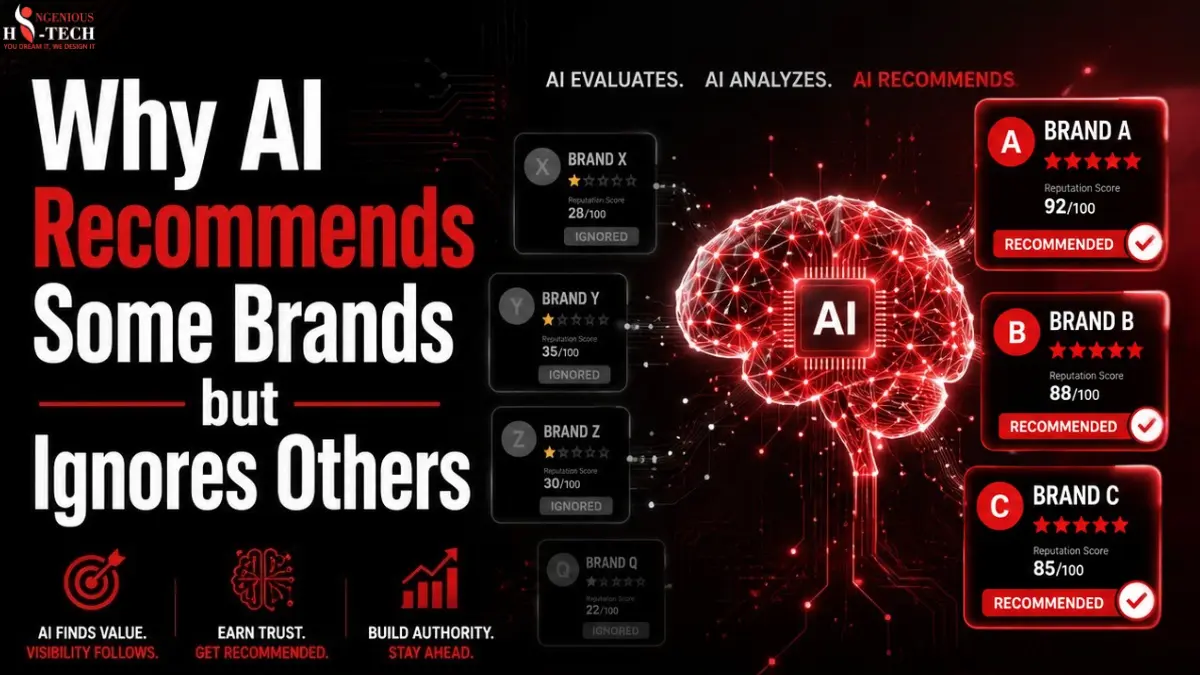
In both cases, the AI serves as the filter by bringing down hundreds of options to just two or three that need mentioning. The act of filtering is the actual competition at this stage. By the time the person lands on the site of a company, most of the filtering process may be completed.
It is a huge difference from how the old school search works. Google brings up ten-plus options for the user to decide from. However, an AI assistant brings up just one answer.
If your brand is not a part of this list, then the discussion is already over before you can get into it. This is the reason behind the emergence of AI search optimisation as a whole new field.
How AI Decides Which Brands to Recommend
There is no universal and published algorithm for the same. OpenAI, Google, Anthropic, Perplexity, etc. all build their systems differently, and most of them do not reveal their algorithms publicly. However, certain parameters tend to affect how often a brand gets mentioned.
- Brand authority: AI-based systems prefer those brands that are consistently and independently referenced in connection with the topic in question. It is related to entity SE, which enables AI-based systems to identify your brand as an entity, not as a website.
- Quality and depth of content: Shallow pages do not have many references from AI. Pages that provide thorough responses and deep knowledge on topics get referenced much more easily.
- Expertise on topics: Systems analyse not how the company performs on one particular page but the overall expertise of your company on the topic in question.
- Credibility of the website: An "About Us" page, clear contact information, authors' data, etc., make your website look more credible.
- Consistency of business information: The consistency of your business information in terms of your name, address, and description across your website, directory listing, and social media pages makes your business credible and helps establish your identity. Any inconsistencies will just confuse the system.
- Structured data: Structured data using schema markup provides an exact understanding of who you are and what you do for the machines to recognise you as a business entity in the ecosystem.
- Third-party mentions: Coverage in other publications and review websites acts as an outside source of validation that machine learning algorithms rely on more heavily than self-publication.
- Review signals: Sentiment and volume of reviews on platforms like Google Business Profile or G2 play a crucial role in determining a system's certainty about where one brand stands in relation to another.
- Freshness of content: Outdated business information makes your business seem inactive. Freshness helps show that your business is alive and thriving.
- Website quality: Poor page speed, broken links, and low-quality mobile experience hurt both visitors and crawlers.
There isn’t a dial for AI search ranking. Having a strong presence in many areas, as opposed to excelling in just one area, is often what it takes.
Why Some Brands Remain Invisible
If strong signals create visibility, weak ones account for invisibility, and in most cases, invisible companies are doing nothing out of the ordinary; they're simply failing to get the basics right.
- Thin content that merely exists because you "need to have a page" provides AI algorithms with nothing to refer to.
- Low topical authority: one-time content production versus a continually updated knowledge base are two very different things.
- Non-consistent brand messaging across all your web presences prevents the algorithm from forming any clear image about you.
- Technical issues will prevent crawlers from even getting access to your content in the first place.
- A stale website implies that the company might be inactive or simply behind the times.
- Lack of trusted references indicates that no external parties confirm your claims.
- AI-generated generic content tends to lack the level of detail that would indicate real-life expertise on your part.
- Bad UX, such as a poorly designed navigation system, leads to low engagement and poor signals overall.
Not a single one of these is a rare occurrence. These are simply the same basics that have been relevant since the dawn of digital marketing; their price has just increased.
Practical Strategies to Improve AI Brand Visibility
The point is not about hacking some algorithm and tricking the AI system. Your aim should be providing AI and people that depend on it with valid reasons why to trust your brand.
- Develop content clusters rather than isolated pieces. Create a well-structured content cluster dedicated to your main service fields, interlinked and constantly updated.
- Publish proprietary research or data. It may be a survey, some data from analysis or a case study based on client stories, which will add uniqueness to your content and will attract citations from other sources.
- Make content expert-driven. Make sure that the authors of your content have proper credentials and experience. The content checked by some named experts is much better than a general, anonymous one.
- Make sure of technical SEO correctness. Perform a technical audit of your website in terms of its crawlability, speed, mobile usability and proper meta tag usage.
- Improve your brand mentions. Get some coverage: guest posts, partnership stories, podcast interviews, press mentions.
- Add structured data markup. Add schema markup to your organisation description, your products, services, and reviews to make it clear for all systems.
- Update content regularly. Schedule content refreshment rather than just publishing new content.
- Be an expert. Mention specific examples and results; specific details are a clear sign of experience.
- Evoke trust signals. Show credentials, certifications, team bios, and policy information on your site.
SEO vs AI Search Optimisation
|
Aspect |
Traditional SEO |
AI Search Optimisation |
|
Primary goal |
Rank in search results pages |
Be cited or recommended in AI-generated answers |
|
Key signals |
Backlinks, keywords, page authority |
Topical depth, entity clarity, corroborated facts |
|
Content format |
Optimised for scanning and clicks |
Optimised for clear, self-contained answers |
|
User behavior |
Users compare multiple results |
Users often act on one recommended answer |
|
Measurement |
Rankings, traffic, click-through rate |
Brand mentions, citation frequency |
|
Technical focus |
Speed, crawlability, metadata |
Same basics, plus structured data and entity clarity |
These approaches aren't competitors; they're complementary layers of the same long-term strategy. Strong traditional SEO builds the crawlable, authoritative foundation; AI search optimisation builds on it with clarity and corroboration.
Common Myths About AI Recommendations
- Myth: AI will only suggest well-known brands. Scale plays its part, although not a key one, since smaller firms that have good topical authority and verification are frequently suggested before bigger and less credible companies.
- Myth: SEO is no longer alive. SEO has evolved, not vanished. Some AI technologies still rely on the presence of optimised and crawable content as an essential element.
- Myth: Content volume is equal to content quality. Sometimes volume can even weaken your authority.
- Myth: AI only needs backlinks. Backlinks matter, but so does the depth of the content and its corroboration by multiple sources.
- Myth: AI solely depends on Google ranking. AI tools use not only the information from Google ranking but also other data and knowledge sources.
AI Brand Visibility Checklist
- Conduct audits for page speed, mobile-friendliness, and crawlability
- Ensure the business name, address, and contact information are consistent
- Create content clusters based on important themes
- Apply schema markup for your organisation, services, and reviews
- Include author information on your key pages
- Get third-party citations within industry publications
- Manage your reviews on all major review sites
- Maintain your content through periodic updates
- Create at least one piece of research or a case study
- Include your “About,” contact, and credentials pages
- Check periodically what AI-based tools say about you and your competitors
- Monitor brand mentions and citations regularly
Future of AI Search
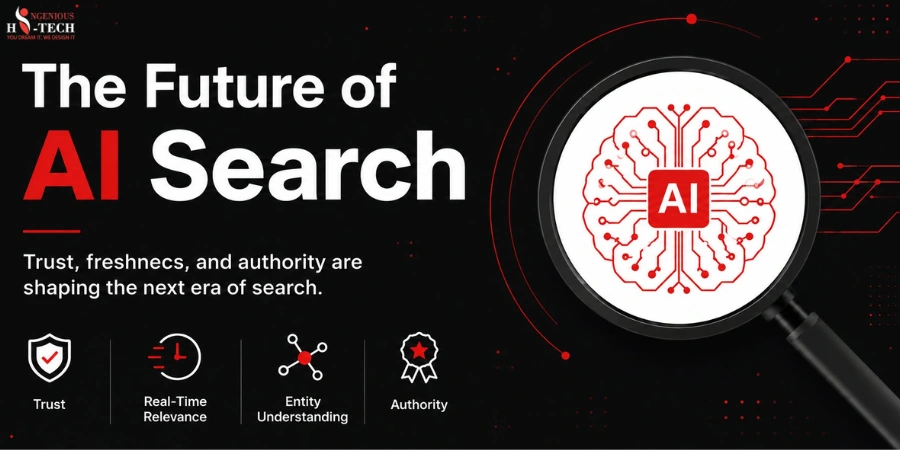
The search using AI technology is in its infancy stages. The boundary between regular search and the AI-driven answers is bound to get more blurred, as can already be seen in Google's AI Overviews and Perplexity that combine both regular search and synthesised answers.
The aspect of trustworthiness will become even more relevant as systems will probably have to rely more heavily on the expertise and proven history of the source due to the abundance of AI-driven content on the internet.
The aspect of real-time relevance will gain prominence as systems with web access will favour the brands that have up-to-date information. Also, there will be increased understanding of entities, and AI will start treating brands as entities with their histories and reputations.
Brands that develop technical authority now will be way ahead of those waiting for clearer guidelines.
Conclusion
There is no magic trick or ranking hack behind visibility in AI-based search engines. Rather, it is the result of operating a business that is an expert in its industry, keeps its information consistent, and receives genuine validation from unbiased third-party sources. The companies appearing in results for AI are most often those that have made their efforts to establish their authority rather than those who have discovered some shortcut.
In case your business is still invisible on AI-powered search, the remedy is to make a concerted and ongoing investment into basics, such as in-depth content, better technical foundations, trust signals, and a coherent digital reputation. Use the checklist provided above and view AI SEO as a part of your usual business practice.
Frequently Asked Questions
1. What is AI brand visibility?
It refers to how likely a business is to be mentioned or recommended by AI tools like ChatGPT, Gemini, or Perplexity when users ask relevant questions.
2. How is AI search optimisation different from traditional SEO?
Traditional SEO focuses on ranking in search results, while AI search optimisation focuses on being cited as a trustworthy answer within AI-generated responses.
3. Can small businesses compete with large brands in AI recommendations?
Yes. AI systems weigh topical authority and consistency, which smaller businesses can build through focused expertise.
4. Does a website still matter if customers use AI to search?
Yes, most AI systems draw on web-sourced training data or live search, so a credible, well-structured site remains essential.
5. How do reviews affect AI search ranking?
Reviews provide real-world signals about reputation that AI systems use to corroborate a brand's credibility.
6. Is structured data necessary for AI visibility?
It's not the only factor, but it helps systems clearly interpret your business details and reduces ambiguity.
7. How often should content be updated?
A regular review schedule every few months for key pages helps signal that your business is active and current.
8. Do backlinks still matter for AI search optimisation?
Yes, but they work best alongside content depth and third-party corroboration, not as a standalone tactic.
9. Can generic AI-generated content hurt brand visibility?
Yes, content lacking specificity often fails to build the trust associated with credible brands.
10. How can a business track its AI brand visibility?
By periodically querying AI tools with relevant questions and comparing results against key competitors over time.
Key Takeaways
- Visibility in an AI brand is dependent on factors like authority, depth of content, quality, and validation, not any ranking algorithm.
- Poor content, lack of branding consistency, and old websites are some of the factors that make capable companies invisible to AI.
- Interconnected structured content beats huge volumes of content that lacks substance.
- SEO and AI search are not mutually exclusive; rather, they complement each other.
- Mentions, citations, and original research are validations that both humans and AI need.
- Longevity will beat quick wins in AI search evolution.
Final Thoughts
What works best in a new age where search is being conducted through artificial intelligence? Businesses that make visibility a spin-off from authenticity rather than trying to achieve it separately will succeed. Build up your basics and be consistent, and the rest follows.