
A business can have a strong product, a knowledgeable team, and a well-built website, and still struggle to bring in new customers. Why? Because none of that matters much if people can't find the business when they're searching for what it offers.
This is a common problem for San Francisco businesses. The city is dense with competition from tech startups and SaaS companies to law firms, contractors, agencies, and local service providers, and most of them are trying to get in front of the same searchers on Google. Standing out isn't about luck. It's about showing up in the right place, at the right moment, for the right search.
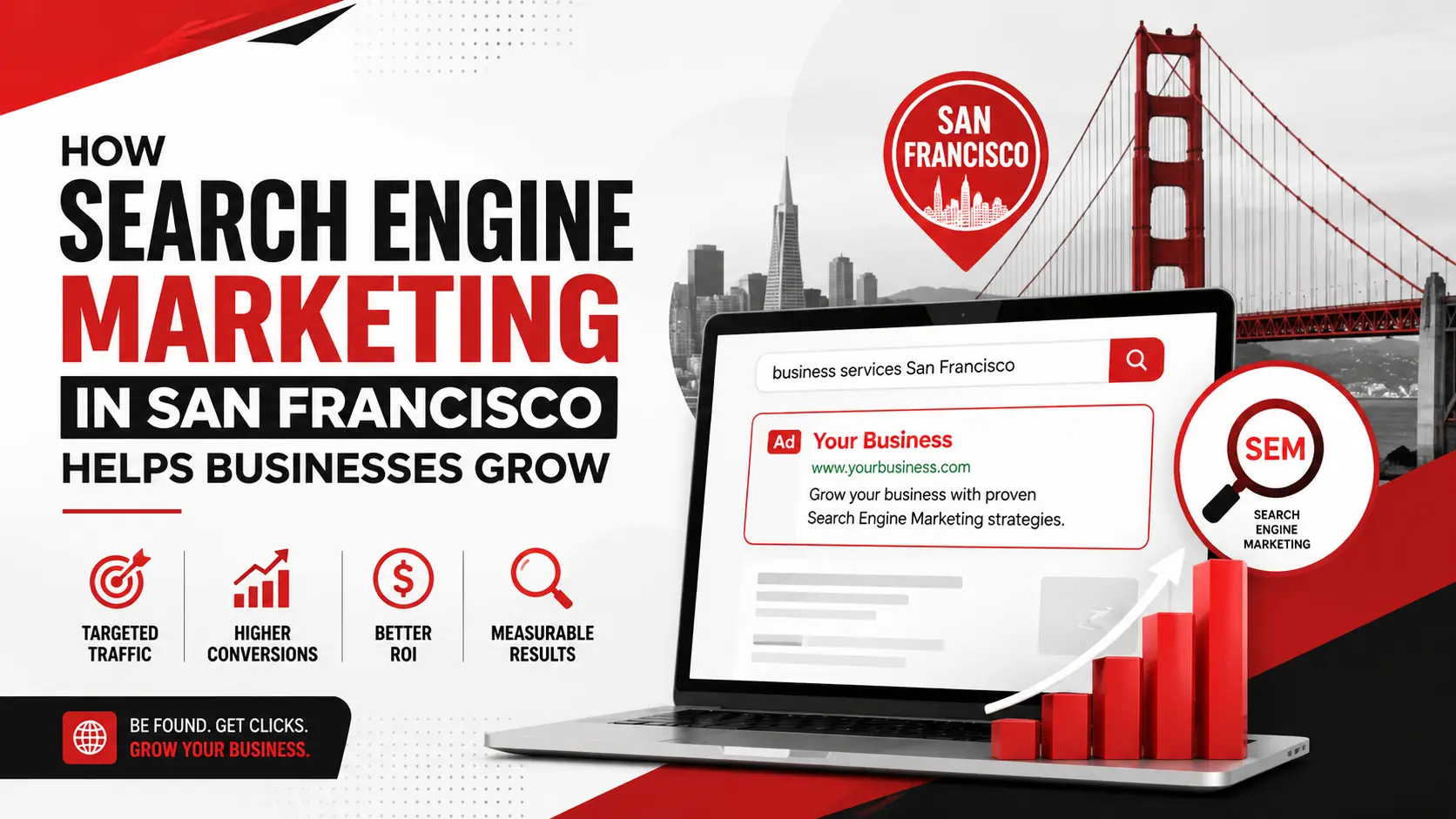
That's the role of search engine marketing in San Francisco. Done well, it connects a business with people who are already looking for what it sells, then guides those searchers toward becoming leads and customers. This article walks through what SEM actually means, how SEO and PPC fit together, why local search matters so much here, how to build a strategy, what commonly goes wrong, what it tends to cost, how to measure results, and how AI is starting to reshape search behaviour.
What Is Search Engine Marketing in San Francisco?
Search engine marketing is a broad term. Some people use it to describe paid search specifically, Google Ads and similar platforms. Others use it more broadly, covering both organic visibility (SEO) and paid visibility (PPC) together as one connected effort to be found on search engines. Both uses are common in the industry, and neither is wrong. What matters more than the label is understanding what each piece does.
For a San Francisco business, search engine marketing generally involves some combination of SEO, PPC advertising, local search optimisation, useful content, and landing pages built to convert visitors rather than just attract them.
The real value shows up in a progression: search visibility leads to qualified visitors, qualified visitors become leads, and leads become customers. A page that ranks well or an ad that gets clicks isn't worth much on its own. Search engine marketing San Francisco businesses actually benefit from is the kind that's built around that full path, not just the first step.
Why Search Engine Marketing Matters for San Francisco Businesses
Customers Are Already Searching
Someone looking for an accountant, a web development team, a dentist, or a marketing agency in San Francisco usually starts the same way: they open Google. These are high-intent searches; the person isn't just browsing; they're trying to solve a problem or make a decision soon. A business that isn't visible for those searches is effectively invisible to that customer, regardless of how good its service actually is.
Competition Happens on the Search Results Page
Search results are where businesses compete for attention before a customer ever visits a website. If three competitors show up and yours doesn't, the decision has already narrowed before you had a chance to make your case. That's a tough position to recover from later.
Search Can Reach Local and High-Intent Customers
Searches like "marketing agency San Francisco," "IT services San Francisco," or "web design San Francisco" carry strong local and commercial intent. Someone typing that phrase is often close to choosing a vendor, not just researching a general topic.
SEM Can Work for Different Types of Businesses
This isn't limited to storefronts. Local service businesses, SaaS companies, B2B firms, professional services, startups, e-commerce brands, and technology companies can all benefit from search visibility; the mix of SEO, PPC, and content just looks different depending on the sales cycle and customer type.
SEO vs. PPC: What Is the Difference?
This is one of the most common points of confusion for business owners exploring search marketing, so it's worth breaking down clearly.
SEO
SEO (search engine optimisation) is about earning organic visibility the unpaid listings on a search results page. It involves technical SEO (making sure a site is fast, crawlable, and structured well), content that matches what people are actually searching for, and building topical authority over time. SEO also includes local SEO, which helps a business show up for searches tied to a specific area. The tradeoff: SEO tends to take longer to produce results, but it can keep generating traffic without paying for every click.
PPC / Google Ads
PPC (pay-per-click), most commonly through Google Ads, is paid visibility. A business bids on keywords, sets a budget, and pays when someone clicks the ad. PPC can go live much faster than SEO and gives precise control over targeting, budget, and messaging, but the visibility generally stops when the spending stops. Its success also depends heavily on where that click lands, which is why conversion tracking and landing page quality matter as much as the ad itself.
Which Is Better?
Neither one is universally better; that depends on the business, timeline, and budget. SEO tends to build sustainable, long-term visibility. PPC tends to deliver faster, more controllable visibility for specific offers or campaigns. Many San Francisco businesses use both, letting each channel do what it does best.
|
Factor |
SEO |
PPC |
|
Time to visibility |
Longer |
Faster |
|
Traffic type |
Organic |
Paid |
|
Budget model |
Investment in optimization/content |
Ad spend + management |
|
Long-term value |
Strong |
Depends on continued spend |
|
Testing |
Moderate |
Strong |
|
Best use |
Sustainable visibility |
Targeted immediate visibility |
How Search Engine Marketing Helps San Francisco Businesses Grow
1. Increases Online Visibility
Being visible for the searches your customers actually use is the starting point. Without it, everything else the website, the offer, the sales process never gets a chance to work.
2. Attracts More Qualified Traffic
Not all traffic is equal. Search marketing, done with real intent in mind, brings in people who are already looking for what you offer rather than random visitors who bounce immediately.
3. Generates More Leads
Qualified traffic sent to a relevant page one that clearly answers the searcher's question or offers what they're looking for is far more likely to turn into a call, form submission, or booking.
4. Builds Brand Awareness
Even searchers who don't convert on the first visit start to recognise a business that consistently shows up for relevant searches. That familiarity matters, especially for longer B2B or professional service buying cycles.
5. Makes Marketing More Measurable
Unlike many traditional marketing channels, search marketing can be tracked in detail: impressions, clicks, conversions, cost per lead. That data makes it possible to see what's actually working.
6. Helps Businesses Compete More Strategically
Search visibility lets smaller or newer San Francisco businesses compete for attention against larger competitors, not by outspending them everywhere, but by being sharper about which searches matter most.
The common thread across all of this: traffic by itself isn't the goal. Qualified traffic that turns into real business outcomes is.
Local SEO and Search Marketing for San Francisco Businesses
Google Business Profile
An accurate, complete Google Business Profile with correct categories, services listed, current photos, and regular updates is one of the more overlooked pieces of local visibility. It directly affects how a business shows up in local search results and Google Maps.
Location-Relevant Website Content
Website content should naturally reflect the services offered and the area served, without stuffing city names into every sentence. A page that clearly explains a service and who it's for, written for a human reader, tends to perform better than one written purely around a keyword.
Reviews and Local Trust
Genuine customer reviews influence both a searcher's decision and, to some degree, local search visibility. Encouraging real feedback and responding to it is a practical, low-cost part of local search marketing.
Local Citations and Business Information
Keeping business name, address, and phone number consistent across directories and platforms helps search engines, and customers trust the information they find.
Local Search Intent
There's a meaningful difference between someone searching "digital marketing agency" and someone searching "digital marketing agency San Francisco." The second searcher has already narrowed their intent geographically; they want a local option, or at least a business that understands their market. That's a more valuable search to be visible for, even though it may have lower overall search volume. This doesn't mean creating dozens of thin, near-duplicate neighbourhood pages; that approach tends to hurt more than it helps. It means being genuinely clear about where and who you serve.
How to Build a Search Engine Marketing Strategy in San Francisco
Step 1: Define Your Ideal Customer
Start with who you're actually trying to reach: industry, location, pain points, and where they are in the buying process. Strategy without this step tends to chase traffic instead of customers.
Step 2: Research High-Intent Keywords
Look beyond raw search volume. Relevance, intent, competition, and commercial value matter more than a big number with no buying signal behind it. Location modifiers ("near me," "San Francisco," neighbourhood terms where relevant) are worth including here.
Step 3: Decide Between SEO, PPC, or Both
If you need visibility soon, PPC can get you there faster. If you're building for the long term, SEO is worth the investment. Many businesses use both, with PPC filling the gap while SEO builds.
Step 4: Create Relevant Landing Pages
The path matters: a keyword leads to a search result or ad, which leads to a landing page, which presents a clear offer and a clear call to action. A weak link anywhere in that chain costs conversions, no matter how good the ad or ranking is.
Step 5: Create Useful SEO Content
This includes service pages, relevant location pages, blog content, FAQs, and comparison content that answers real questions your customers are asking, not content written only to include a keyword.
Step 6: Track Conversions
Set up tracking for calls, form submissions, bookings, and purchases so you can see cost per lead and which channels are actually producing results, not just traffic.
Common Search Engine Marketing Mistakes San Francisco Businesses Should Avoid
- Targeting keywords without understanding intent ranking for a phrase that doesn't match what the searcher actually wants rarely converts.
- Sending all paid traffic to the homepage, a generic landing spot, dilutes the specific offer that got the click.
- Running PPC without conversion tracking, you're spending money with no visibility into what's working.
- Focusing only on rankings: a #1 ranking for the wrong keyword doesn't generate business.
- Publishing generic content that could apply to any city or any business rarely stands out.
- Ignoring mobile users: a large share of local searches happen on phones, often while comparing options quickly.
- Treating SEO and PPC as completely separate insights from one often improves the other; keeping them siloed wastes that overlap.
- Failing to review campaign performance, search marketing isn't something you set once and leave alone.
None of these is an unusual mistake most businesses make at least one of them at some point. The goal is catching them early.
How Much Does Search Engine Marketing Cost in San Francisco?
There's no single, universal price for search engine marketing in San Francisco, and any number quoted without context should be treated with some scepticism. Cost depends on the industry, competitiveness of the keywords, current condition of the website, how much content and how many landing pages are needed, tracking setup, and how large a PPC budget makes sense for the business.
It helps to separate the pieces:
- SEO investment covers strategy, content, technical improvements, and ongoing optimisation.
- PPC advertising spend is the actual ad budget paid to platforms like Google Ads, separate from management.
- Agency management fees cover the strategy, setup, and ongoing work behind both.
A low monthly price isn't automatically a good deal if the underlying strategy isn't strong enough to produce meaningful business outcomes. It's worth evaluating cost against what a plan is actually designed to achieve, not just the number on the invoice.
How to Measure the ROI of Search Engine Marketing
The right KPIs depend on the business model:
- Local service business: calls and quote requests
- E-commerce: revenue and return on ad spend (ROAS)
- B2B: qualified leads and pipeline value
Beyond that, useful metrics generally include organic traffic, paid search traffic, conversion rate, cost per lead, cost per acquisition, phone calls, form submissions, and bookings. The important part is connecting these numbers back to actual business results, not just watching traffic go up. A campaign that drives visits but no leads isn't succeeding, even if the traffic chart looks good.
How AI Is Changing Search Engine Marketing
Search behaviour is shifting. AI Overviews, AI-driven search modes, and conversational search tools are changing how people find information, sometimes getting an answer directly in the search results rather than clicking through to a website.
This doesn't eliminate the fundamentals of SEO. Search engines and AI systems still favour original content, clearly written, technically accessible, and genuinely useful. Authority and relevance still matter. What's changing is that visibility now depends not just on ranking well, but on being the kind of source that's clear and credible enough to be referenced.
No one can guarantee inclusion in ChatGPT, Google AI Overviews, Gemini, or any other AI search system; those results depend on factors outside any single business's control. What a business can do is keep building strong, well-structured, genuinely useful content, since that's the same foundation AI-driven discovery tends to favour. For more on how content strategy is adapting to this shift, see [Internal Link: AI Content for SEO: How to Create Content That Ranks].
How Ingenious HiTech Helps San Francisco Businesses With Search Marketing
Search marketing tends to work best when SEO, paid search, content, website experience, and measurement aren't handled as separate, disconnected activities. A well-ranked page with a weak landing experience underperforms. A PPC campaign with no tracking can't be improved. Content written without SEO or conversion in mind rarely earns its place.
Instead of treating SEO, PPC, content, and website optimisation as isolated activities, Ingenious HiTech can help businesses build a more connected search marketing strategy one where SEO Services and PPC Advertising support each other, Content Strategy gives both channels something worth ranking and clicking on, and Web Development makes sure the site itself can actually convert the traffic being generated. Social Media Marketing and AI Solutions can extend that visibility further, depending on the business and its goals.
Want to know where your San Francisco business is losing search visibility or leads? Request a free SEO and search marketing audit from Ingenious HiTech.
Search Engine Marketing Checklist for San Francisco Businesses
- Is your Google Business Profile accurate and complete?
- Are you targeting high-intent keywords, not just high-volume ones?
- Does your content match what searchers are actually looking for?
- Are your service pages clearly optimised?
- Is your San Francisco relevance clear where it matters?
- Are your PPC campaigns built around conversions, not just clicks?
- Do your ads lead to relevant, specific landing pages?
- Are calls and form submissions being tracked?
- Are you publishing genuinely useful content consistently?
- Are organic and paid performance both being monitored?
- Are you keeping an eye on what competitors are doing?
- Are you adjusting as search behaviour changes?
Frequently Asked Questions:
What is search engine marketing?
Search engine marketing refers to the strategies businesses use to gain visibility on search engines, typically through a mix of SEO (organic) and PPC (paid) efforts, often supported by content and local search optimisation.
How can search engine marketing help a San Francisco business?
It helps a business appear in front of people actively searching for its products or services in San Francisco, turning that visibility into qualified traffic and, ultimately, leads and customers.
Is SEO or PPC better for San Francisco businesses?
Neither is universally better. SEO builds longer-term organic visibility; PPC delivers faster, more controllable paid visibility. Many businesses benefit from using both together.
How much does search engine marketing cost in San Francisco?
Costs vary based on competition, industry, website condition, and campaign scope. SEO investment, PPC ad spend, and agency management fees are typically separate line items.
How long does SEO take to produce results?
SEO is a longer-term investment; timelines vary significantly depending on competition, current site condition, and content needs, so it's best evaluated case by case rather than with a fixed number.
Is Google Ads worth it for a San Francisco business?
For many businesses, yes, particularly when speed matters or when targeting specific high-intent searches. Its value depends on strong targeting, relevant landing pages, and proper conversion tracking.
Can Ingenious HiTech manage SEO and PPC together?
Yes. Ingenious HiTech works across SEO, PPC, content, and web development so these channels can support each other rather than operate in isolation.
Final Takeaway: Turning Search Visibility Into Business Growth
Search visibility isn't the finish line; it's the starting point. The real objective looks like this: relevant searches lead to qualified visitors, qualified visitors become conversions, and conversions become customers and measurable growth.
Getting there usually means combining SEO, PPC, local search, content, landing pages, analytics, and conversion optimisation in a way that fits your specific business; there's no single formula that works identically for every company.
If your San Francisco business is struggling to get found or is getting traffic without enough leads, Ingenious HiTech can help identify the gaps and build a search marketing strategy around your business goals.