
Why NYC Businesses Need a Local SEO Audit
New York City customers rarely scroll far. A Brooklyn dentist, a Manhattan accountant, and a Queens electrician each compete for a handful of map results and organic listings, often against rivals a few blocks away. When your Google Business Profile, service pages, or inquiry process has a weak spot, the damage is quiet: fewer calls, fewer booking requests, fewer qualified leads.
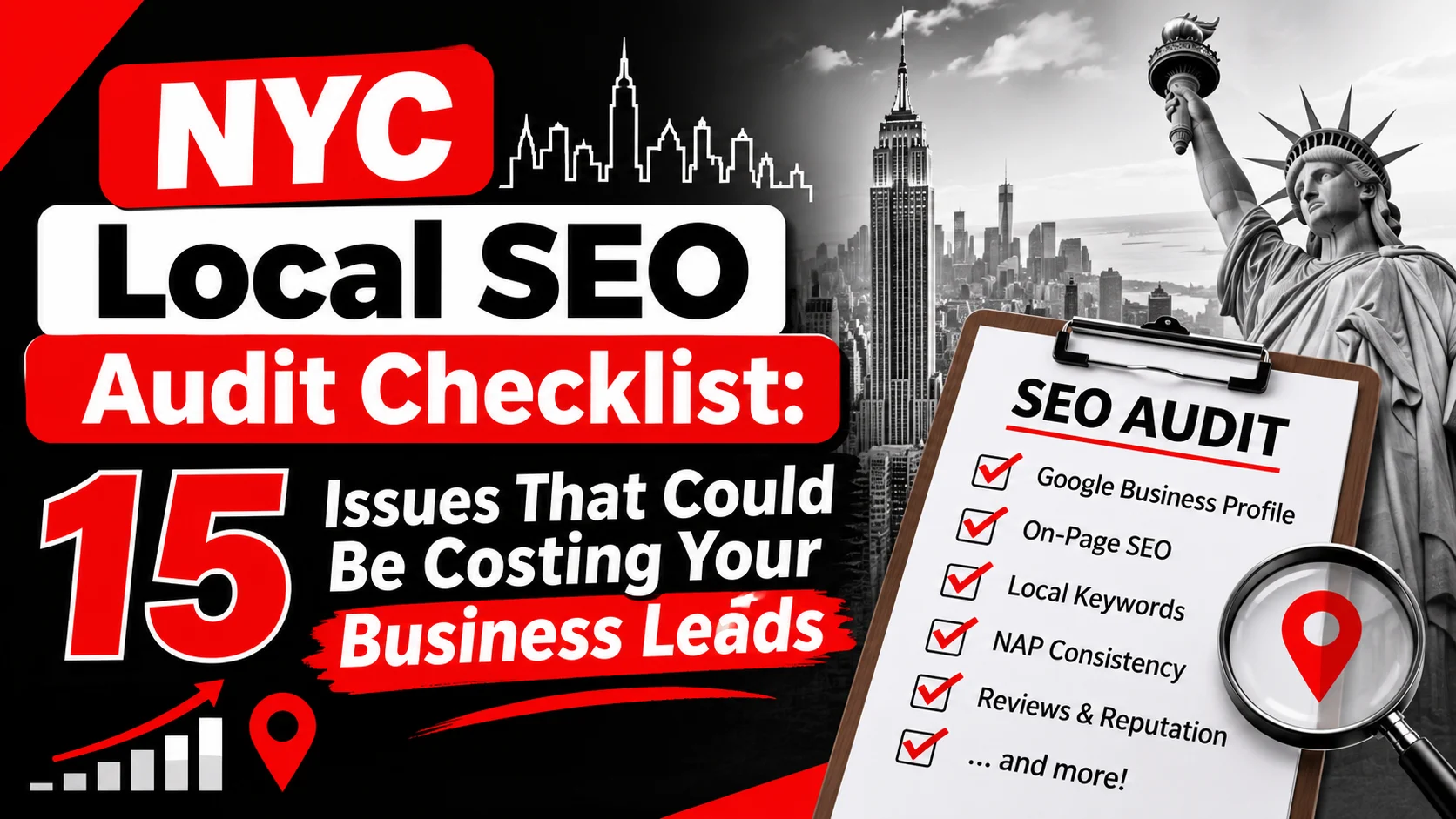
This NYC Local SEO Audit Checklist covers 15 common problems, how to verify each one, and what to fix. It is built to help you prioritise, not to promise rankings. No audit can guarantee a position, but a good one shows you where visitors and customers are slipping away.
What Should an NYC Local SEO Audit Cover?
Local search has two surfaces. Organic results are the standard web listings, shaped largely by your website's relevance and authority. Google Maps and the local pack show business profiles, which Google says are ranked mainly on relevance, distance, and prominence. Both can send customers, but they respond to different fixes.
A thorough local SEO audit reviews five areas: Google Business Profile, on-page SEO, technical SEO, local authority, and lead conversion. It should also judge business outcomes. A page that ranks but never produces a call is a finding, not a success.
Google Business Profile: Fix These 3 Local Visibility Issues
Issue 1: An Incomplete or Incorrect Google Business Profile
Open your profile and compare it with what your business really does today. Check the primary category (choose the most specific option), secondary categories, services, hours including holidays, phone number, website link, and description.
To correct it, list your actual services, match categories to them, remove anything you no longer offer, and write a plain description of who you serve. Mention a borough only where it is true. Our Google Business Profile checklist for NYC businesses walks through the full setup.
Issue 2: Incorrect Business Details or an Ineligible Location Setup
Confirm that your name, address, and phone number match your signage, website, and legal paperwork. Then verify your setup. Storefront businesses show an address. Service-area businesses that travel to customers can hide it and list the areas they serve; they do not need a public address.
The risk is eligibility. Google's guidelines say a rented mailing address or virtual office you do not operate from is not eligible, and a co-working office needs signage, customer visits, and staffed hours. Misleading addresses can lead to edits or suspension, which interrupts calls overnight.
Issue 3: Poor Review Management and Outdated Business Photos
Ask genuine customers for honest feedback soon after a job, using your direct review link. Ask everyone, not only people you expect to be happy. Google's review rules prohibit incentives, so no discounts, gifts, or purchased reviews.
Reply to every review in your own voice. For negative feedback, respond factually, offer to resolve it offline, and flag reviews that violate policy rather than arguing. Replace old photos with real images of your entrance, team, and work.
On-Page SEO: Identify 3 Website Problems That Weaken Local Relevance
Issue 4: Service Pages Target Broad Keywords Instead of Local Search Intent
A page titled "Our Services" tells Google little. Start by listing each service paired with where customers actually are: "emergency plumber Brooklyn," "tax accountant Midtown Manhattan," "HVAC repair Bronx." Use a keyword tool or Search Console queries to confirm demand rather than assuming it.
Then map each phrase to one page. One service, one primary page, one clear intent. If two pages chase the same phrase, merge or differentiate them.
Issue 5: Missing or Weak Title Tags, Meta Descriptions, and Headings
Crawl your site and export titles, meta descriptions, and H1s. Flag blanks, duplicates, and titles that ignore the service or location. Then search for your own pages and read them as a customer would. Does the result explain what you do and where?
A weak title: "Home | Acme Plumbing." An improved one: "Brooklyn Emergency Plumber | Same-Day Repairs | Acme." Keep it accurate. Meta descriptions do not directly raise rankings, but a clear one can earn more clicks.
Issue 6: Thin, Repetitive, or Unhelpful Location Content
A useful location page shows real service details, genuine local context (which neighbourhoods you reach, typical access issues, projects completed), and a clear next step. Photos, team details, and honest answers to common questions all help.
Do not mass-produce near-identical pages with only the borough swapped. They add little value for readers and risk looking manipulative. If you cannot say something true and specific about Staten Island, do not publish a Staten Island page yet.
Technical SEO: Find 3 Issues That Prevent Search Visibility
Issue 7: Important Local Service Pages Are Not Indexed
A page that is not indexed cannot appear in search. Paste each key URL into Google Search Console's URL Inspection tool and read the indexing status. If a page is excluded, check for noindex directives, robots.txt blocks, canonical tags pointing elsewhere, and whether it appears in your XML sitemap.
Submitting a sitemap helps Google discover pages, but it does not guarantee indexing. Fix the cause, then request indexing for priority pages. Being indexed also does not guarantee a ranking.
Issue 8: Slow Mobile Pages and Poor User Experience
Many NYC searches happen on phones, on the street or on the subway. Open your site on a real phone and test the menu, tap-to-call button, and inquiry form. Then run PageSpeed Insights and check the Core Web Vitals report in Search Console.
Common fixes are simple: compress oversized images, remove unused scripts, reserve space for banners and images so the layout does not jump, and shorten forms. Prioritise pages that carry calls and bookings first. Our technical SEO service covers deeper performance work.
Issue 9: Broken Internal Links, Redirects, or Missing Structured Data
Use a crawler to find broken links, redirect chains, and pages whose canonical tags point to the wrong URL. Update internal links to go directly to the final destination.
For structured data, use a relevant LocalBusiness type and make sure the details match your visible page and profile. Google's guidelines require markup to represent content users can see, and they do not guarantee rich results. Validate with the Rich Results Test.
Local Authority: Diagnose 3 Trust and Competition Problems
Issue 10: Inconsistent Business Information Across Relevant Directories
Compare your name, address, phone number, and hours across your website, Google profile, and the directories that matter in your industry, such as medical, legal, or trade listings. Fix wrong phone numbers, old addresses, and duplicate listings first.
Do not panic over every small variation like "Suite" versus "Ste." Minor formatting differences rarely explain ranking problems. Material errors confuse customers and are worth correcting.
Issue 11: Few Relevant Local Links or Community References
Prominence builds through real relationships. Look for NYC chambers of commerce, business improvement districts, professional associations, community sponsorships, partner businesses, and local publications that would naturally mention you. Useful local resources, such as a neighbourhood permit guide, can earn references too.
Skip paid link packages and bulk directory submissions. They carry risk and add little real authority.
Issue 12: No Meaningful Comparison With NYC Competitors
Pick three competitors who appear for your priority searches. Compare their service pages, profile categories, review volume and recency, content depth, and the types of sites that mention them.
Look for gaps: a service they explain and you do not, questions they answer better, trust signals they show. Use the gaps to build something original and more useful. Do not copy their wording, and do not assume what you see explains their performance.
Lead Conversion: Fix 3 Problems That Waste Local Website Traffic
Issue 13: No Clear Call to Action on High-Intent Pages
Visitors on a service page are close to deciding. Give them an obvious next step above the fold and again lower down. Match the action to the business: a dental office needs "Book an appointment," an electrician needs a tap-to-call button, a law firm needs "Request a consultation," and a contractor needs "Get a quote."
Keep forms short, confirm they actually deliver messages, and test them monthly.
Issue 14: No Reliable Tracking for Calls, Forms, and Qualified Leads
Impressions, clicks, inquiries, qualified leads, and customers are different things, and rankings or traffic are not revenue. Search Console shows how people find you. GA4 can record form submissions and call-button clicks as key events. Call tracking captures phone inquiries, and a CRM shows which leads became customers.
Tag your Google profile website link with UTM parameters so profile visits can be separated from other traffic.
Issue 15: No Borough-Level or Service-Level Performance Review
Review performance by service and by the areas you legitimately serve. In Search Console, filter queries and landing pages for each service. In GA4 and your call data, compare which pages produce inquiries.
Be careful with rank checks. Results change with the searcher's location, so a position from your Midtown office does not represent searchers in Flushing or Riverdale. Check from several relevant areas, and judge by inquiries rather than one rank.
How to Prioritise Your NYC Local SEO Audit Findings
The right order depends on business impact, severity, and what your audit actually finds.
As a starting framework:
- High priority: Incorrect business information, important pages that are not indexed, broken inquiry forms, and serious profile-policy issues.
- Medium priority: Weak service pages, internal-link problems, incomplete conversion tracking, and poor mobile usability.
- Ongoing improvement: Review management, relevant local links, competitor monitoring, and useful content development.
Fix anything that stops customers from reaching you first. Optimisation comes after.
When Should an NYC Business Hire a Local SEO Agency?
DIY work can be enough when you have a simple site, one location, and time to maintain it. Profile corrections, review replies, and basic title fixes are manageable in-house.
Professional support becomes valuable when pages stay unindexed after you have tried the basics, qualified inquiries are declining, service pages are not visible, or you cannot measure what SEO is producing. Multi-location businesses and teams without technical help often reach this point sooner.
Ingenious HiTech offers SEO services, including on-page and technical SEO, and can review your findings with you.
Frequently Asked Questions About Local SEO Audits in NYC
1. What is included in an NYC Local SEO Audit Checklist?
It covers your Google Business Profile, on-page SEO, technical SEO, local authority signals, competitor comparison, and lead tracking. The 15 issues above map to those areas.
2. How often should a New York City business conduct a local SEO audit?
A full audit once or twice a year suits most businesses. Check profile details, reviews, and form delivery monthly, and run a fresh audit after a redesign, a move, or a drop in inquiries.
3. How can I check whether my local business pages are indexed?
Use the URL Inspection tool in Google Search Console for individual pages, and the page indexing report for patterns across the site.
4. What affects Google Maps rankings in NYC?
Google names relevance, distance, and prominence. Complete profile information, accurate categories, reviews, and your web presence all contribute. Distance is partly outside your control.
5. How long does it take to see results after fixing local SEO issues?
There is no fixed timeline. Google must recrawl and reassess changes, and competition varies. Some fixes, like a broken form, help immediately. Ranking changes usually take longer.
Turn Your Local SEO Audit Findings Into More Qualified Leads
A local SEO audit matters because it shows where customers are lost before they ever contact you. Start with the problems most likely to affect visibility, usability, or inquiries, then build a steady routine for reviews, content, and measurement.
If you want help prioritising your findings, reach out to Ingenious HiTech about local SEO support.