
Status verified on November 4, 2026 against the Google Search Status Dashboard.
When your business depends on Google for enquiries, a ranking change can mean fewer calls, fewer form submissions and a quiet sales pipeline. That is why every rumour about a new core update spreads so quickly.
The phrase "Google Core Update November 2026" is already circulating in search communities. This article separates what Google has confirmed from what people only expect, then walks through a practical way to get your website ready. You will learn how to read the current status, how to assess your content and technical health, how to build a 7-day preparation plan, and how to respond sensibly if traffic drops.
One point first, because it matters: as of November 4, 2026, Google has not announced a November 2026 core update. Everything below about future changes is preparation, not prediction.
Current Status of Google Updates
Confirmed Algorithm Updates in 2026
Google's own record of ranking updates is the Search Status Dashboard. It is the reference to trust for update names, start dates and completion times.
As of the verification date above, it lists these ranking entries for the past year:
|
Update |
Type |
Started |
Duration |
|
December 2025 core update |
Core |
Dec 11, 2025 |
18 days, 2 hours |
|
February 2026 Discover update |
Discover |
Feb 5, 2026 |
21 days, 17 hours |
|
March 2026 spam update |
Spam |
Mar 24, 2026 |
19 hours, 30 minutes |
|
March 2026 core update |
Core |
Mar 27, 2026 |
12 days, 4 hours |
|
May 2026 core update |
Core |
May 21, 2026 |
11 days, 21 hours |
|
June 2026 spam update |
Spam |
Jun 24, 2026 |
2 days, 1 hour |
|
August 2026 spam update |
Spam |
Aug 18, 2026 |
2 days, 16 hours |
|
September 2026 spam update |
Spam |
Sep 24, 2026 |
13 days, 16 hours |
The distinction between these types matters for diagnosis. A core update is a broad change to Google's ranking systems. Google's core updates documentation describes these changes as broad in nature, not aimed at specific sites or pages. A spam update targets content and practices that break Google's spam policies, such as scaled content abuse. A Discover update affects the Discover feed rather than standard web results.
So a traffic change in late September points toward the spam update, while one in late May points toward the core update. The dashboard dates tell you where to start looking.
The most recent core update on the dashboard is the May 2026 update, which completed on June 2, 2026. No core update appears after it.
Why Many SEOs Expect Another Core Update
Core updates have not arrived on a fixed schedule. The dashboard shows December 2025, then March 2026, then May 2026, with a gap of roughly six weeks between the last two. Since the May update finished, several months have passed without another one. SEO professionals watch these gaps, along with ranking tools and community reports, and some conclude that another update is due.
That reasoning is understandable, but past frequency does not confirm the timing of a future update. Google can go months between core updates, or release two close together.
Industry reporting in late October also described unconfirmed ranking volatility, as summarised in Search Engine Roundtable's November 2026 webmaster report. Volatility chatter is not an announcement. Google also states in its documentation that it makes smaller core updates that are not announced because they are not widely noticeable. So movement can happen without a named update on the dashboard.
Treat the dashboard as the source of truth, and everything else as context.
What Could Matter in the Next Core Update?
The following are sensible preparation priorities. They are drawn from Google's published guidance, not from any confirmed detail of a future update. Google has not said what a future core update will change.
Scaled and Low-Quality AI Content
Using AI is not the problem. Google's guidance on generative AI content says AI can be useful for researching a topic and adding structure to original content. The risk comes from using these tools to generate many pages without adding value for users, which may violate the spam policy on scaled content abuse.
In practice, the warning signs are repetitive articles, claims with no source, shallow explanations, and near-duplicate landing pages that swap only a city or service name.
Google's guidance is direct on accuracy: generative models predict likely wording rather than retrieve facts, so AI output should be manually fact-checked and reviewed before publishing. That review also applies to titles, meta descriptions, structured data and image alt text.
The healthy alternative is simple. Let AI help with drafting or structure if you wish, then add human review, factual verification, original insight from your own work, and a clear reason for the page to exist.
Authorship and Expertise Signals
Readers want to know who is speaking and why they should be believed. Google's people-first content guidance encourages accurate bylines where readers would expect them, with links to author pages that explain the author's background and the areas they write about.
It equally warns against deceptive authorship. Fabricating creator profiles, such as AI-generated headshots, invented names or false credentials, makes a page untrustworthy.
Real experience is the most persuasive signal. Original examples, documented project findings and verifiable case studies help a reader judge credibility. Be careful with expectations, though. No author bio, schema markup or byline format guarantees better rankings. These elements help readers trust you, which is the purpose.
Helpful Content and Main Content Quality
Google describes main content as the part of a page that directly helps it achieve its purpose. Its guidance points to factors such as the human effort behind the content, how original it is, the skill shown, and its accuracy.
E-E-A-T stands for experience, expertise, authoritativeness and trustworthiness. Google states that it is not a specific ranking factor, and that trust is the most important of the four. In practical terms, it is a way of asking whether a reasonable reader would have good reason to rely on your page.
Real value looks different from padding. A worked example, a comparison of options, a step-by-step instruction or a source for a claim helps readers. 500 words of generic background does not, and Google notes it has no preferred word count.
Ask this question of every important page: what useful information, experience or analysis does this page provide that competing pages do not? If you cannot answer clearly, that page is your priority.
How to Prepare Your Website in 7 Days
This plan suits a small team or a single website owner. Adjust the pace to your site's size.
Day 1: Review Recent Traffic and Rankings
Start with a baseline. In Google Search Console, compare clicks, impressions, click-through rate and average position. In Google Analytics, review organic sessions and conversions. Identify your most important pages, queries, devices and countries.
Use comparable date ranges. Google's own advice is to wait at least a full week after a core update completes, then compare that week with the week before the rollout began. Comparing a normal weekday period with a holiday weekend, for example, produces false alarms.
To tell a temporary fluctuation from a sustained decline, look at duration and spread. A dip that recovers within days, or affects a handful of low-traffic queries, is usually noise. A decline that persists across weeks and hits your main pages and conversions deserves investigation.
Day 2: Audit AI-Generated Content
List the pages on your site that were created with AI assistance, then flag those that are repetitive, outdated, shallow or unhelpful. Check every factual claim, statistic, example and citation against a reliable source.
Where evidence supports it, improve a page or merge several weak pages into one stronger one. Do not delete a useful page just because AI helped write it. Google's core update documentation describes deletion as a last resort, to be considered only when content cannot be salvaged.
Prioritise by search performance and business value.
Day 3: Strengthen Authorship and Expertise Signals
Review your author profiles. Do they describe real, relevant experience? Make your editorial standards and business information accessible, and add original project insights, practical examples or documented findings wherever you genuinely have them.
Check every credential and experience claim for accuracy.
Day 4: Improve Main Content Quality
Check whether each top page fully answers the query it targets. Remove repetitive explanations and filler, and add useful instructions, examples, comparisons and evidence.
Update information only where there is a meaningful change or an inaccuracy. Google's guidance specifically warns against changing page dates to look fresh when the content has not substantially changed. Improve headings, readability and logical flow so a busy reader can find the answer quickly.
Day 5: Fix Technical SEO Issues
Check indexability, canonical tags, robots directives and your XML sitemap. Investigate crawl errors and broken internal links. Review mobile usability and Core Web Vitals, confirm that important redirects work, and validate relevant structured data.
A caution is worth stating plainly: technical problems should be investigated on their own merits. Do not automatically blame a ranking change on a technical issue, and do not assume a technical fix will reverse a quality-related decline. If you want expert eyes on this layer, a technical SEO review can separate real issues from distractions.
Day 6: Improve E-E-A-T and Trust Signals
Review your About, Contact, author and key service pages. Do they clearly show who you are, where you operate and how to reach you? Use trustworthy references for factual claims, and demonstrate experience through examples and case studies you can verify.
Keep business details and service claims accurate. Avoid fabricated testimonials, invented statistics and unsupported guarantees.
Day 7: Set Up Monitoring and a Recovery Plan
Create a routine, such as a weekly Search Console and analytics review. Keep a simple log of confirmed Google update dates and every important change you make to the site.
Define investigation triggers in advance. For example, you might decide that a sustained decline in organic clicks or conversions across several weeks starts a formal review, while a one-day dip does not. Decide how you will prioritise recovery work: by impact, by evidence and by business value.
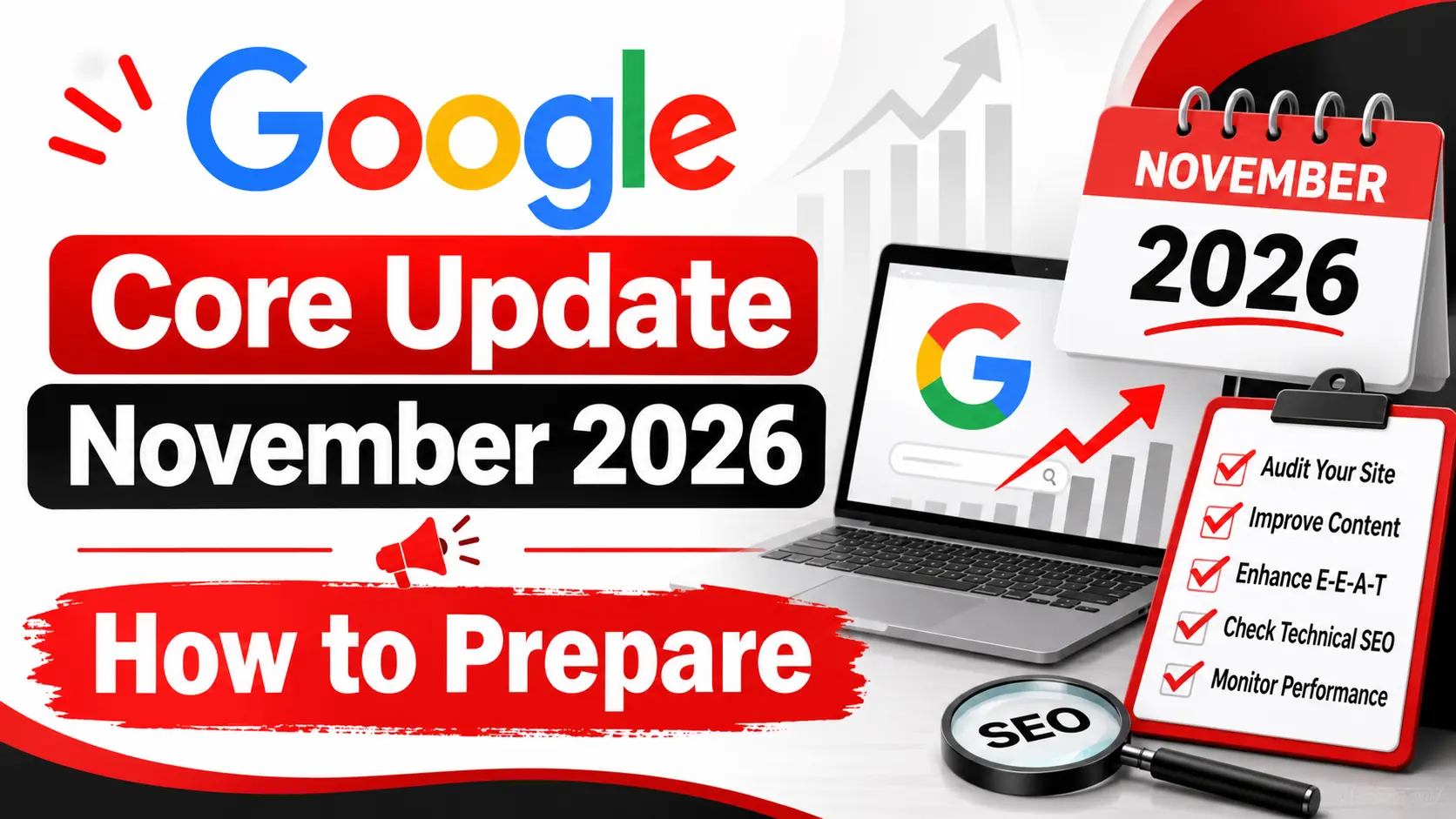
The 7-Day Checklist
- Baseline Search Console and Analytics data saved using comparable date ranges
- Priority pages and queries identified by business value
- AI-assisted pages reviewed, facts verified, weak pages improved or merged
- Author profiles and editorial information accurate and easy to find
- Top pages checked against search intent, with filler removed and evidence added
- Indexing, canonicals, sitemaps, redirects and Core Web Vitals reviewed
- About, Contact and service pages accurate, with no unsupported claims
- Reporting routine, update log and investigation triggers documented
What to Do If Rankings Drop After the Update
Immediate Recovery Steps
- First, check whether a confirmed update coincides with the decline. Open the dashboard, note the start and end dates, and compare equivalent time periods. A drop that started before an update began cannot be explained by that update.
- Second, locate the change. Is it sitewide, or concentrated in one section, one page type or one group of queries? Review search types separately, since a decline in Google Images is a different problem from a decline in web results.
- Third, rule out other causes: indexing and technical issues, seasonality, search demand and competitor activity.
- Fourth, assess your content honestly against the results that now outrank you. Do they answer the question better, show more experience, or present information more clearly? Google suggests asking people unaffiliated with your site to review it too, because owners are rarely objective.
Then prioritise improvements that the evidence supports, make meaningful changes rather than quick fixes, and monitor performance afterwards.
A ranking decline does not automatically mean a Google penalty. Core updates reassess content broadly, so pages can move down simply because other pages now serve the query better.
Recovery cannot be promised or scheduled. Google's guidance says improvements may take effect within days for some changes, but it can take several months for its systems to confirm that a site is consistently producing helpful, reliable content. If a few months pass without change, that could mean waiting for the next core update. There is no guarantee that any change will produce a noticeable result.
Frequently Asked Questions
Has Google confirmed a November 2026 core update?
No. As of November 4, 2026, the Search Status Dashboard lists no core update after May 2026. Check the dashboard for the latest status, since it is where Google posts when a rollout begins and ends.
When will the next core update happen?
Nobody outside Google knows. Past gaps between updates vary, so timing cannot be predicted from history alone.
How long does a core update take to roll out?
It varies. The dashboard shows the March 2026 update took about 12 days, the May 2026 update about 12 days, and the December 2025 update about 18 days. Google says a rollout can take up to two weeks, but treat the dashboard's completion note as the final word.
How do I know if a core update affected my site?
Confirm the rollout has finished, then wait at least a full week. Compare that week in Search Console with the week before the rollout began, and review your top pages and queries. Google advises against drastic action for a small drop in position.
Should I wait for a core update before improving my website?
No. Google's documentation says smaller, unannounced core updates also happen, and improvements can show an effect without waiting for a named update. Make changes that help users and are sustainable, and avoid quick fixes.
Will Google penalise my site for using AI-generated content?
Not simply because AI was used. Google's guidance focuses on whether content is accurate, original and useful. Publishing many pages without adding value for users may violate its scaled content abuse policy.
Do I need to tell readers when AI helped create a page?
Google's guidance says disclosures are useful where readers might reasonably wonder how the content was created. Sharing how automation was used can give readers helpful context.
Is E-E-A-T a ranking factor, and should I delete weak pages?
Google states that E-E-A-T is not a specific ranking factor, though its systems use a mix of factors that can identify content with good E-E-A-T, and trust is the most important element. On deletion, Google calls it a last resort for content that cannot be salvaged. Improving or consolidating pages is usually the better first step.
Conclusion: Key Takeaways to Stay Ready
Verify update news on the Search Status Dashboard, since no November 2026 core update has been announced as of November 4, 2026. Publish original, useful, human-reviewed content, keep technical SEO healthy, be honest about authorship and experience, and monitor performance consistently.
No checklist can guarantee rankings. A well-maintained website, however, is better positioned to serve users and to respond calmly when search results change. For further reading on how the wider search landscape is shifting, see Ingenious HiTech's November 2026 SEO and AI search guide.
If your website is experiencing ranking fluctuations or struggling to generate organic enquiries, Ingenious HiTech can help identify potential technical SEO issues, content gaps, and opportunities to improve organic search performance. Explore our SEO and digital marketing services or contact our team to discuss a practical SEO audit tailored to your business.