
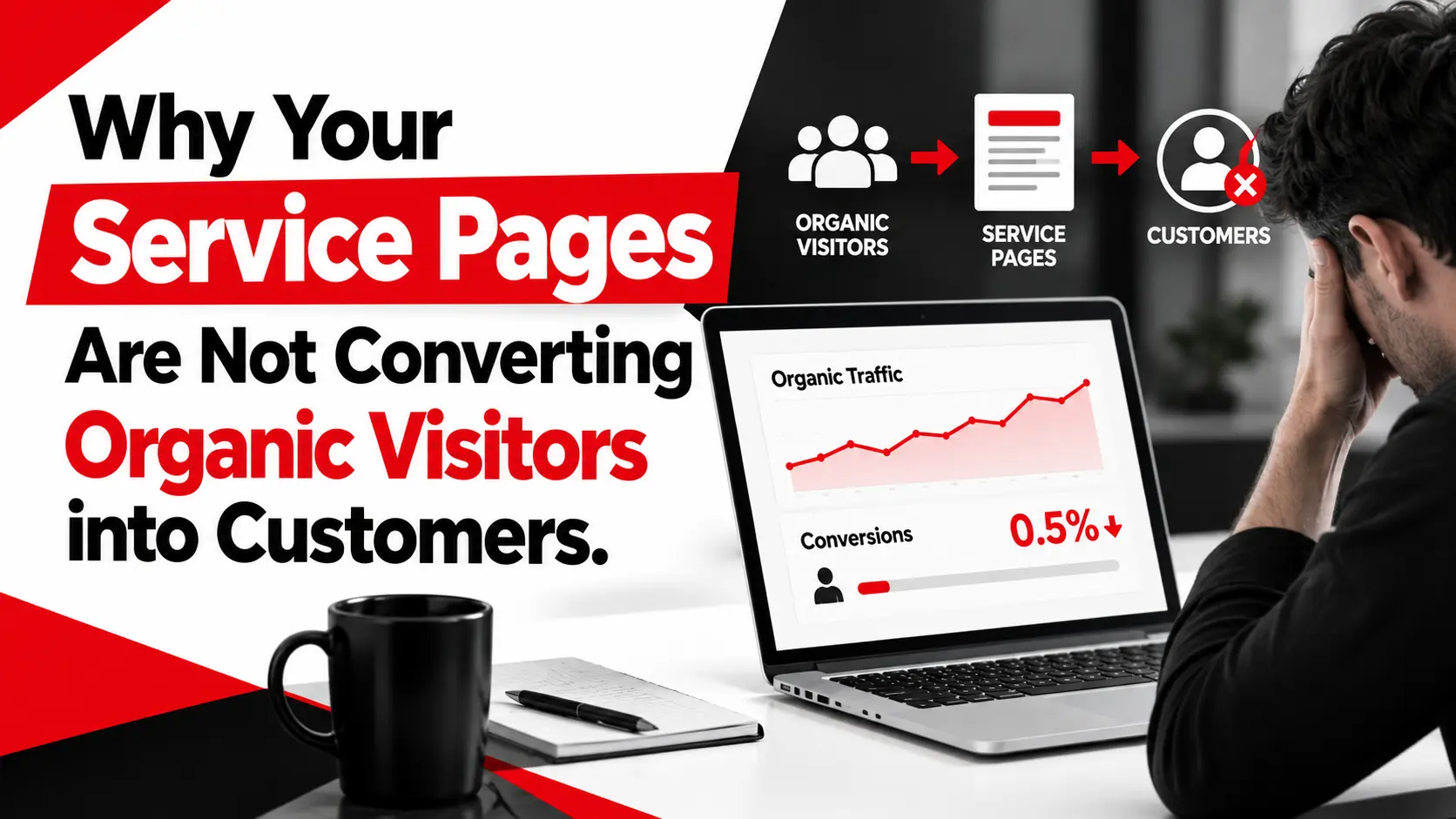
Your analytics show steady organic traffic, yet the phone stays quiet, and the enquiry inbox is nearly empty. This is a common frustration, and it usually has a clear explanation.
Ranking in Google earns a visit. It does not earn trust, interest, or a decision to get in touch. In most cases, service pages are not converting organic visitors into customers because of a handful of fixable problems. The page may match the wrong search intent. The message may be vague. The call to action may be weak, trust signals may be thin, the mobile experience may be frustrating, or tracking may be hiding what is really happening.
This guide explains how to work out which of these problems affects your site. You will find nine common causes, a practical website audit process, a step-by-step improvement framework, and answers to frequent questions. The aim is not more traffic. It is more qualified enquiries from the people who already find you.
Why Your Service Pages Are Not Converting Organic Visitors into Customers
Attracting visitors and converting them are two separate jobs. SEO earns the click. The page has to earn the enquiry.
A visitor arrives with a question, a level of urgency, and expectations about what the page will say. If the page answers the question, makes the offer clear, and shows an obvious next step, the visitor can move forward. If any of those pieces are missing, they leave and often search again.
Search intent sits at the centre of this. Someone searching "SEO services for dental clinics" is probably comparing providers. Someone searching "what is technical SEO" is probably learning. Both may land on the same page, but only the first is likely to enquire. A clear conversion journey respects that difference.
When you review service page conversion optimisation, five diagnostic areas explain most problems:
- Traffic quality: Are the right people arriving?
- Messaging: Does the page explain the offer clearly?
- Trust: Does the business look credible enough to contact?
- User experience: Is the page easy to read and act on across devices?
- Conversion tracking: Are enquiries measured accurately?
The nine reasons below map onto these areas.
9 Reasons Your Service Pages Fail to Generate Leads
1. Your Service Page Does Not Match Search Intent
A page can rank for queries from people who are researching, not buying. A web design agency, for example, may attract searches like "website design ideas" from people looking for inspiration rather than a provider. Those visits raise traffic but rarely produce enquiries.
Open Google Search Console, filter by the page, and review the queries behind its impressions and clicks. Ask what each searcher really wants. Then align the page with people who are ready to hire, and move purely informational topics to separate blog content.
2. Your Headline Does Not Communicate a Clear Value Proposition
Visitors decide quickly whether a page is relevant. A headline such as "Welcome to Our Digital Solutions" tells them nothing about what you offer or who it is for.
Compare it with: "SEO and Website Audits for Dental Clinics That Want More Booked Consultations." The second version names the service, the audience, and the outcome. State what you do, who you help, and the benefit, then add a short supporting line. Avoid claims you cannot back up.
3. Your Content Focuses on Features Instead of Customer Benefits
A list such as "keyword research, on-page optimisation, link building" describes tasks, not value. A business owner wants to know what problem you solve.
Describe the service, how the process works, what deliverables to expect, and what realistic outcomes look like. For instance, explain that a technical review can reveal pages Google struggles to crawl, and say what the client receives afterwards. Pair each feature with the customer problem it addresses.
4. Your Page Does Not Establish Enough Trust
Contacting a business is a risk for the visitor. They want proof that you are real, experienced, and reliable before they share their details.
Include genuine testimonials, case studies you can verify, relevant experience, a clear process, team information, and credible business details such as an address, registration information, or industry affiliations. Only publish true evidence and ensure you have permission to use it. Thin or generic proof can reduce confidence instead of building it.
5. Your Calls to Action Are Weak or Difficult to Find
"Submit" and "Learn more" leave visitors unsure what happens next. A hidden contact link at the bottom of a long page can lose people who were ready to act.
Use specific actions such as "Request a website audit," "Discuss your SEO goals," or "Book a consultation," depending on what you actually offer. Place a CTA near the top, after key explanations, and at the end. Add a line explaining what happens after the click.
6. Your Contact Form Creates Unnecessary Friction
Long forms, unnecessary fields, unclear instructions, and awkward mobile layouts all reduce completed enquiries. Visitors may also hesitate if the form asks for sensitive details without explaining why.
Ask only for what you need to start the conversation, usually name, email, and a short message. Add a brief privacy note, make labels clear, and show a confirmation message that states when to expect a reply. Test the form on a phone before assuming it works.
7. Your Website Loads Slowly or Performs Poorly on Mobile
Slow loading, cramped navigation, intrusive pop-ups, and layout shifts interrupt the journey just as the visitor is deciding whether to continue.
Test the page on real phones, not only in a desktop browser. Review the Core Web Vitals report in Google Search Console and use PageSpeed Insights to find specific causes, such as oversized images or heavy scripts. Fix the issues that affect your main service pages first.
8. Your SEO Strategy Attracts the Wrong Visitors
Broad keywords can bring large audiences with little commercial interest. A page targeting "digital marketing" may attract students, job seekers, and competitors alongside genuine buyers.
Connect your keyword targeting to commercial intent and the services you actually deliver. Terms that include a service, a location, an industry, or a clear problem tend to reflect stronger buying interest. Reassess which pages exist to educate and which exist to generate enquiries, and optimise each for its own purpose.
9. You Are Not Tracking the Complete Conversion Journey
If analytics is misconfigured, you may not know which pages produce enquiries. Missing events, broken forms, duplicated conversions, and untracked phone clicks can all distort the picture.
Also, separate a recorded conversion from a qualified business lead. A form submission from a job seeker is recorded but not valuable. Check that your conversion events fire correctly, then compare them with the enquiries your team actually receives and qualifies.
How to Diagnose Conversion Problems Through a Website Audit
A website audit is a structured review of how your site attracts, informs, and converts visitors. You can start one yourself with the steps below.
- Review Google Search Console: Look at queries, impressions, clicks, and landing-page performance for each service page. Check that the queries match the page's purpose.
- Check Google Analytics 4: Assess engagement on your service pages and confirm that conversion events, such as form submissions and phone clicks, are configured correctly.
- Test every action path: Submit your own forms, tap phone links, use contact buttons, and move through the mobile navigation. Confirm that notification emails actually arrive.
- Read the page as a buyer: Review the messaging, service relevance, trust signals, and CTA placement. Ask whether a stranger would understand the offer within a few seconds.
- Compare enquiries with outcomes: Match recorded conversions against qualified opportunities and actual sales. This shows whether the problem is volume or lead quality.
- Prioritise: Fix broken functionality and tracking errors first, then major usability problems, then unclear messaging.
A professional website audit can go deeper into technical SEO, content, usability, and conversion issues, and can save time when you are unsure where to start. An audit identifies and ranks the problems. Results still depend on how well the fixes are implemented and on other business factors.
Getting organic traffic but not enough enquiries? A focused website audit can help identify gaps in your service page content, SEO, user experience, and conversion journey. Contact Ingenious HiTech to discuss your website's performance and identify the improvements worth prioritising.
How to Turn an Underperforming Service Page into a Lead-Generating Asset
Once the audit highlights problems, work through them in a logical order.
- Align the page with one service and one intent: Each service page should serve a single, specific need. Avoid blending several services into one page.
- Improve the headline and above-the-fold area: Make the service, audience, and benefit clear without scrolling, and place a visible CTA nearby.
- Answer key questions before asking for contact: Cover who the service is for, what is included, how the process works, what it may cost or how pricing is determined, and what happens after an enquiry.
- Add genuine trust signals: Use real testimonials, verifiable examples, and clear business details. Place them close to the CTA.
- Simplify the contact process: Shorten the form, offer a phone or email option, and confirm clearly after submission.
- Test and measure: Change one significant element at a time where possible. Judge results by qualified leads and meaningful conversion data, not raw form counts alone.
Prioritise changes according to evidence from your own data rather than assumptions or generic best-practice lists. No change guarantees a particular conversion rate, so treat each one as a test.
How SEO and Digital Marketing Work Together to Generate Better Leads
SEO brings relevant visitors to the right pages. Service page optimisation helps those visitors decide to act. Other digital marketing channels can support the journey by reaching people who were not ready on their first visit.
For this to work, the pieces need to agree with each other. The search result promise should match the page. The page should match the ad or email that led to it. Helpful content, such as guides and comparisons, should lead naturally to the relevant service page. Analytics should show which sources produce qualified leads, not just clicks.
This is where an integrated lead generation strategy helps. Ingenious HiTech offers SEO optimisation, performance marketing, content writing, and web development, which can address visibility, messaging, and site performance together. The right mix depends on what your audit reveals.
Frequently Asked Questions
1. Why are my service pages getting traffic but no leads?
Common causes include mismatched search intent, unclear messaging, weak trust signals, poor mobile usability, and broken or incomplete tracking. Often several factors combine. Reviewing queries, testing forms, and checking conversion events will show which one is most likely.
2. How can I tell whether my service page needs SEO or conversion optimisation?
If few people find the page, you likely need better organic visibility. If many relevant visitors arrive but few enquire, the page needs conversion work. Search Console shows visibility, while analytics and enquiry records show what visitors do next.
3. What is a good conversion rate for a service page?
There is no universal benchmark. Results vary by industry, traffic quality, offer, location, and how you define a conversion. A better comparison is your own page over time, measured by qualified enquiries rather than a generic industry figure.
4. How long does it take to improve service page conversions?
Implementing changes and measuring their effect are different timelines. Edits may take days or weeks, while meaningful results depend on traffic volume and sales cycles. Any provider promising a specific timeline or outcome without reviewing your site should be treated with caution.
5. Can a website audit help an online business generate more leads?
It can reveal barriers to visibility, usability, trust, tracking, and enquiry completion. An audit does not generate leads by itself. Outcomes depend on how well the findings are implemented and on other factors such as market conditions and offer.
Conclusion: Turn Relevant Organic Traffic into Meaningful Enquiries
Organic traffic only becomes valuable when it leads to conversations with the right people. Align each service page with search intent, communicate your value clearly, build genuine trust, remove friction from the enquiry process, and measure qualified leads instead of raw visits.
If you suspect your pages are losing potential customers, start with an honest review of what visitors see and do. If you would like expert support, contact Ingenious HiTech to discuss a website audit, SEO improvements, or service page optimisation, and identify the changes most worth making first.