
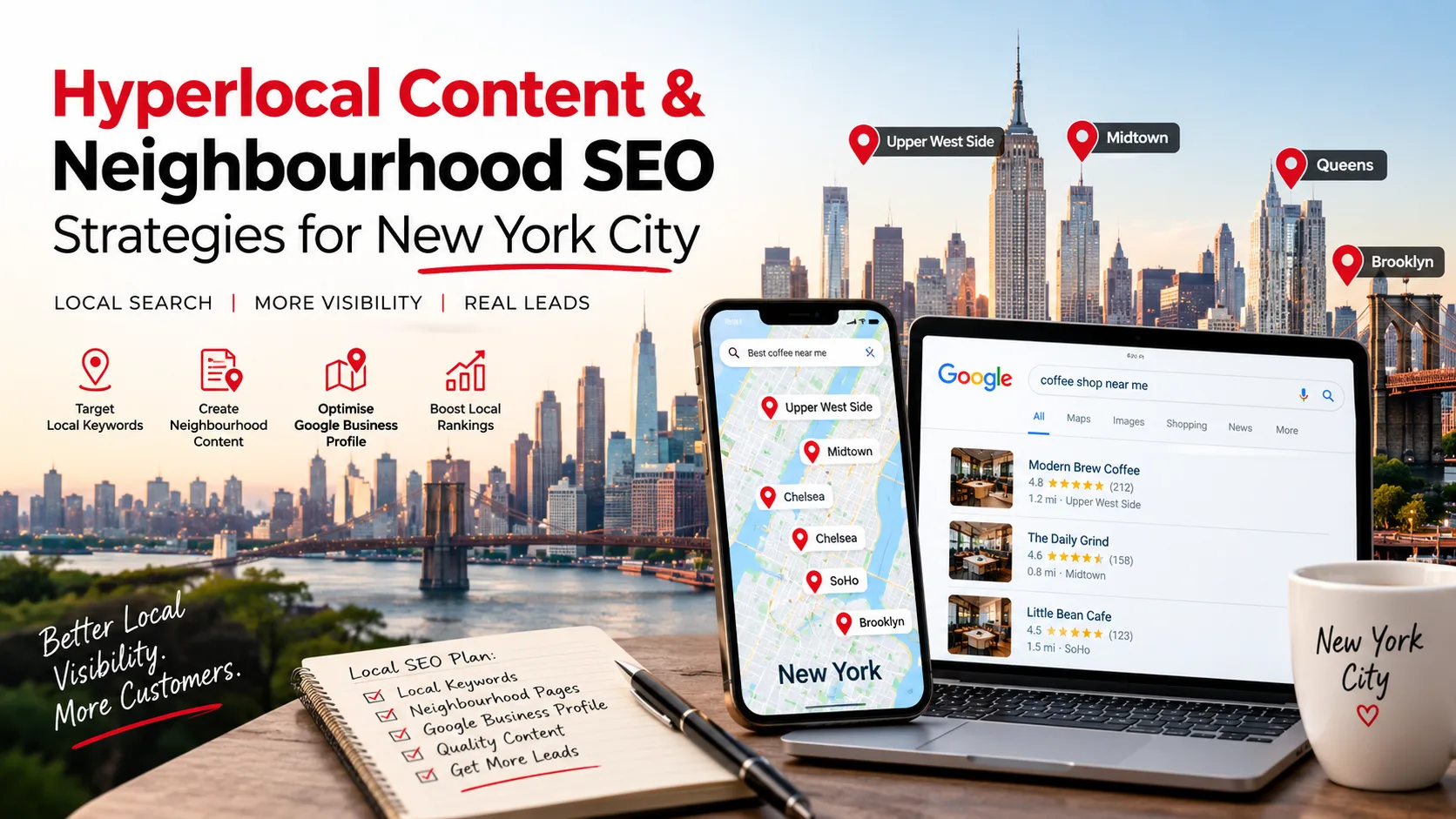
New York City may be the most crowded search market in the country. An accounting firm in Midtown, a plumber in Astoria, and a boutique in Williamsburg all compete for attention online, but they are not chasing the same customers. People searching from a specific block usually want a specific answer, and a page aimed at "New York" in general rarely provides one.
That gap is where hyperlocal content and neighbourhood SEO earn their place. Instead of targeting the whole city, you build pages, profiles, and supporting content around the areas you genuinely serve, using details that residents and workers there care about. Done well, this improves local relevance, helps the right people find you, and gives your website a better chance of producing qualified inquiries.
This guide walks through Hyperlocal Content & Neighbourhood SEO Strategies for New York City step by step: choosing neighbourhoods, writing useful content, strengthening your Google Business Profile, converting visitors, and measuring what matters. No tactic here guarantees rankings, but each one rests on sound, people-first principles.
What Is Hyperlocal SEO, and Why Does It Matter in New York City?
Hyperlocal SEO focuses on search intent tied to a small area, such as a neighbourhood, a business district, or a handful of blocks, rather than an entire city.
Hyperlocal SEO vs. Traditional Local SEO
Traditional local SEO targets a city or metro area, with searches like "accountant New York." Hyperlocal SEO targets the narrower intent behind searches like "bookkeeper near Chelsea" or "tax preparer in Astoria." These searchers are often closer to a decision, and they expect local knowledge: familiar landmarks, transit access, or typical building types.
Google says local results are based mainly on relevance, distance, and prominence. Writing for a specific area gives you a clearer way to show relevance to the people nearby.
Why NYC Businesses Need a More Specific Approach
NYC packs intense competition into small areas, and customer needs change from one part of the city to the next. A Midtown Manhattan office manager may need after-hours service and building-access coordination. A Brooklyn homeowner in a row house faces different maintenance concerns. A family-run restaurant in Queens may serve a multilingual community spread across several nearby streets.
None of this means every business should target every area. It means a focused message for the places you actually serve usually beats a generic one.
Identify the Right NYC Neighbourhoods Before Creating Content
Content works best when it follows evidence rather than guesswork. Start by deciding where you can serve customers well and profitably.
Research Local Search Demand and Customer Intent
Four sources can point you toward real opportunities:
- Google Search Console: Look for queries and pages that already earn impressions, including neighbourhood terms.
- Keyword research tools: Review related searches and questions, and treat volume estimates as directional rather than exact.
- Competitor research: See which neighbourhoods and topics nearby competitors cover, and where their pages are thin.
- Your own inquiries: Note the areas, questions, and objections customers mention in emails, calls, and forms.
Then read the search results themselves. Are people looking for a service, a comparison, or a price? That intent tells you which type of page to create.
Build a Priority Neighbourhood List
Midtown Manhattan, Chelsea, Williamsburg, Astoria, and Long Island City are useful examples for research. They are not automatic recommendations for every business. Score each candidate from 1 to 5 on four criteria: service coverage, customer demand, commercial value, and the gap left by competitors.
Here is a hypothetical example. A commercial cleaning company based in Long Island City notices that most past clients come from Long Island City, Astoria, and Midtown, and Search Console shows impressions for "office cleaning Long Island City." Those three areas score highest, so it starts there and waits on Williamsburg until it has the capacity and proof to serve that area well.
Begin with three to five areas. Publish, measure, and expand only when the results justify it.
Create SEO Friendly Content for Each Neighbourhood
SEO friendly content starts with people-first writing. Google's guidance asks creators to make content primarily to benefit people, not to manipulate search rankings.
Match Content to Local Customer Needs
List the questions a customer in that area asks before hiring you: building rules, parking and street access, landlord or permit requirements, seasonal issues, typical budgets, and timelines. Answer them with specifics your team actually knows. If you cannot speak credibly about a neighbourhood, do not write about it.
Develop Useful Local Content Ideas
- Neighbourhood service guides explaining how your service works in that area and what customers should prepare.
- Local customer FAQs built from real inquiries.
- Genuine project examples and case studies, shared with client permission and limited to real results.
- Comparisons and decision guides, such as repair versus replace, or in-house versus outsourced.
- Locally relevant educational articles on regulations, seasonal problems, or building types.
Optimise On-Page SEO Naturally
Write a descriptive title tag and one H1 that name the service and area once, in plain English. Add a meta description that tells searchers what they will find. Use subheadings that follow customer questions, link to related services and guides, write image alt text that describes what the image shows, and end with a call to action that fits the page, such as requesting a quote or booking a consultation.
A short before-and-after shows the difference (the copy below is illustrative; use only details that are true for your business):
- Before: "We offer fast, reliable commercial cleaning across New York. Contact us today for a free quote."
- After: "Our team cleans offices in Long Island City on evening schedules and coordinates with building management for loading dock access and security sign-in. Tell us your floor size and access rules, and we will send a written estimate."
The second version gives readers details they can act on.
Build a Neighborhood-Focused Content Strategy That Scales
A sound content strategy for neighbourhoods grows in layers, which keeps quality high as you add pages.
Create Content Clusters Around Services and Locations
Anchor each cluster with a main service page. Surround it with supporting articles that answer real questions, and add distinct neighbourhood pages only where you have something unique to say. Link them logically: the service page points to neighbourhood pages, and those pages link back to relevant guides. These links help visitors and search engines understand how your pages relate.
Use a Practical Content Calendar
List possible topics and rate each from 1 to 5 on search intent, business value, competition, and lead potential.
Publish the highest scorers first, then follow a simple workflow:
- Pull neighbourhood and service queries from Search Console and keyword tools.
- Validate them against real customer inquiries.
- Draft and publish one or two strong pages per month.
- Track clicks, qualified inquiries, and conversions.
- Review results after a few months before planning the next batch.
A modest, consistent calendar beats a burst of pages nobody maintains.
Avoid Duplicate and Thin Location Pages
Swapping "Chelsea" for "Astoria" on otherwise identical copy adds nothing for readers, and it looks like content made for search engines rather than people. Each location page should include distinct, accurate details: the services you offer there, local considerations, relevant projects, and clear contact options.
If you cannot add real value for an area, skip it or cover it on a single service-area page. Fewer, better pages almost always serve you better than many shallow ones.
Strengthen Google Business Profile and Local Trust Signals
If your business has an eligible local presence, your Google Business Profile is a core part of local visibility. Google advises keeping it accurate, complete, and engaging.
Keep Business Information Accurate
Select the most accurate primary category, add relevant secondary ones, and list correct contact details, hours, and service descriptions. Update holiday hours and changes promptly. Google notes that inaccurate information can keep a profile from showing up for relevant searches, so schedule a monthly review.
Build Trust Through Genuine Local Evidence
Ask real customers for reviews and respond thoughtfully. Never buy or fabricate them. Google lists review count and score among the factors in local ranking. Publish authentic project examples, use testimonials only with permission, and keep your listings consistent across reputable local directories and industry sources.
Understand Service-Area Limitations
Google's guidelines for representing your business say a service-area business should have one profile for its central location with a designated service area. It cannot list a virtual office unless that office is staffed during business hours. The service area also should not extend much beyond about two hours of driving time from where the business is based.
Do not use fake offices, mailboxes, or borrowed addresses to appear in more neighbourhoods. Describe the areas you serve through your website content instead of through extra profiles.
Turn Neighbourhood Traffic Into Qualified Leads
Traffic matters only when it leads to conversations with the right customers.
Create a Clear Conversion Path
Every page should answer four questions:
- What do you do here?
- Is it right for me?
- Can I trust you?
- What happens next?
Link from guides to the relevant service page, keep forms short, make phone numbers tappable on mobile, show credible proof such as real reviews or project photos, and give each section one clear call to action.
Our article on why NYC businesses lose website leads covers common friction points in more detail.
Track the Metrics That Matter
In Search Console and your analytics platform, watch organic clicks, impressions, relevant search queries, and landing-page performance. Then connect them to business outcomes: qualified inquiries, form submissions, phone calls, and conversion rates.
Rankings and traffic alone do not prove success. Five hundred visits with no inquiries are worth less than fifty visits that produce three good leads. Set up call and form tracking, and ask new customers how they found you.
Use Digital Marketing in New York City to Support SEO
SEO builds gradually, so it works best alongside other channels. Paid search can capture demand for terms where you do not yet rank organically, and it shows which neighbourhood keywords convert. Social media can distribute guides and project examples. Conversion optimisation improves what happens after the click. Use each channel only when it fits your goals and budget.
If you want professional support, Ingenious HiTech offers SEO services, broader digital marketing, and web development that can strengthen your landing pages and contact journey.
Common Hyperlocal SEO Mistakes NYC Businesses Should Avoid
- Publishing near-identical neighbourhood pages: Rewrite each page around genuine local details, or merge pages that cannot stand alone.
- Targeting areas you do not genuinely serve: Limit pages to places you can reach and serve well.
- Overusing geographic keywords: Read each page aloud. If the neighbourhood name sounds forced, edit it.
- Ignoring internal links and mobile usability: Link related pages and test every key page on a phone.
- Neglecting accurate business information: Audit your profile and listings on a regular schedule.
- Failing to track qualified leads and conversions: Set up tracking before you publish, not after.
Frequently Asked Questions About Neighbourhood SEO in NYC
What Is Hyperlocal SEO for New York City Businesses?
Hyperlocal SEO means optimising your website, content, and Google Business Profile for searches tied to a specific neighbourhood or small area. It helps you match nearby customers' needs more precisely than broad city-level targeting can.
How Do I Choose the Best Neighbourhood Keywords for My Business?
Start with areas you genuinely serve, then check Search Console, keyword tools, and customer inquiries for demand. Prioritise terms that show clear buying intent and where you can offer something more useful than competitors.
Should a Business Create a Separate Landing Page for Every NYC Neighbourhood?
No. Create a page only when you can provide distinct, accurate value for that area, such as specific services, local considerations, or relevant projects. Otherwise, a single service-area page is usually more useful.
How Long Does Neighbourhood SEO Take to Show Results?
It varies with competition, site strength, and content quality, and no one can promise a timeline. Many businesses review trends after a few months, but meaningful progress usually requires ongoing work and measurement.
Can an Online Business in NYC Benefit From Hyperlocal SEO?
Sometimes. An Online Business in NYC can benefit if it serves a meaningful local audience or has a legitimate local presence, such as events or pickups. If customers are purely national, neighbourhood pages usually add little.
Build a Smarter Local SEO Plan for Your NYC Business
Effective neighbourhood SEO comes down to a few disciplined steps. Research the neighbourhoods you genuinely serve, create content that answers real local questions, keep your Google Business Profile accurate, build trust with honest evidence, connect pages with relevant internal links, and measure qualified inquiries, not just traffic. Start small, learn from the data, and expand only where you can add value.
If you would like help turning this into a plan, Ingenious HiTech can review your current local search presence and discuss practical next steps. Contact the team to request an SEO assessment or discuss your local search strategy.