
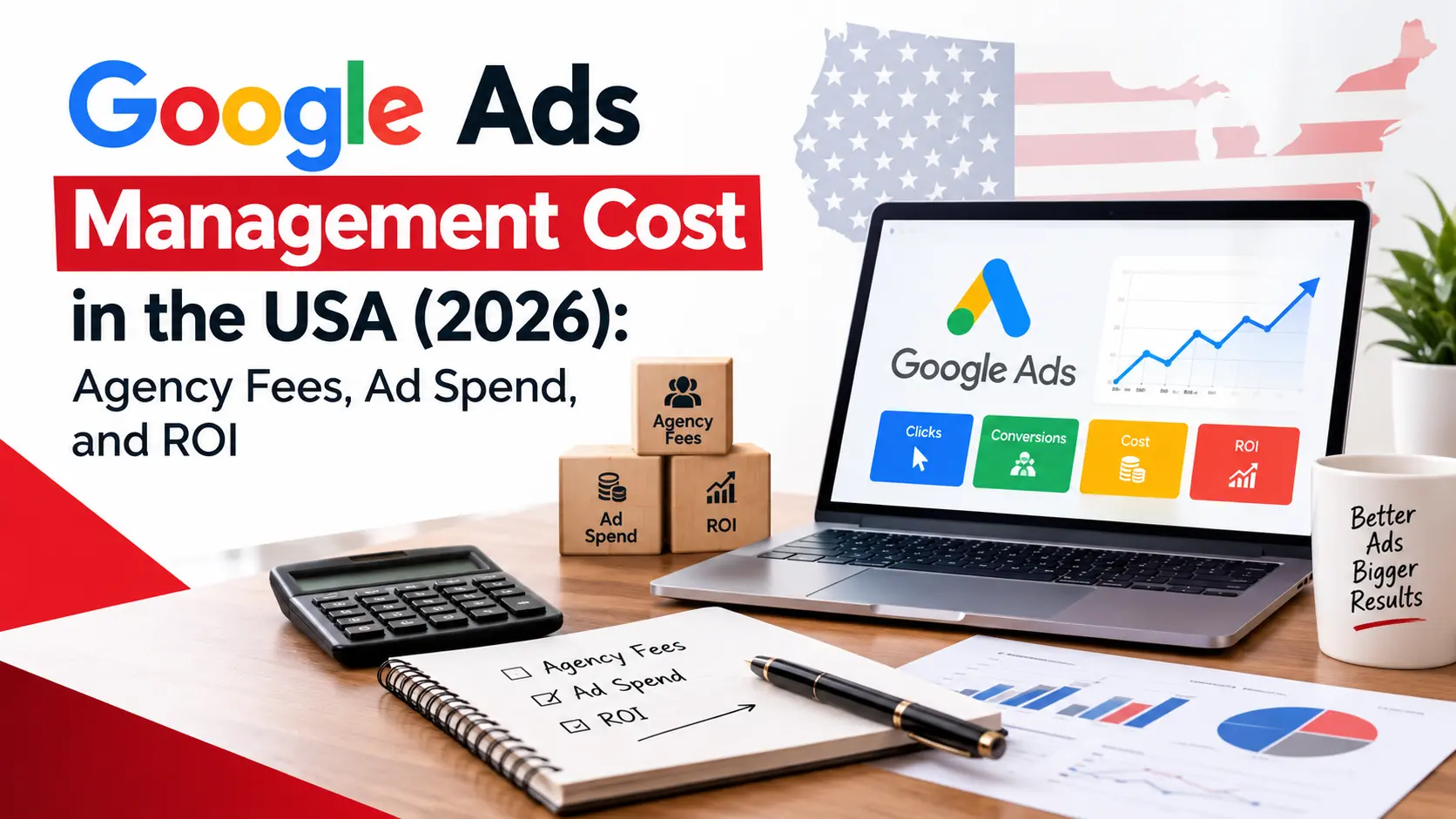
Budgeting for Google Ads is harder than it looks, because the bill is rarely one number. Understanding Google Ads management costs in the USA means separating the money you pay Google for clicks from the fees you pay a specialist to run your account. Add setup work, tracking, landing pages, and creative, and the real investment can look very different from the quote you first receive.
This guide breaks down what U.S. businesses typically pay for paid search management in 2026, how agencies structure their fees, how to estimate a sensible Google Ads budget, and how to measure whether your spend is actually paying off. All figures are illustrative ranges meant to help you plan, not verified industry averages.
How Much Does Google Ads Management Cost in the USA in 2026?
The short answer: most U.S. businesses pay a management fee of roughly $500 to $5,000 per month, on top of the advertising budget itself. Larger or more complex accounts can exceed that. Google Ads management cost in the USA depends on campaign complexity, your ad budget, how competitive your industry is, and the scope of work included.
The table below shows illustrative ranges. Your quotes may fall outside them, and any agency should explain exactly what its fee covers.
|
Business Type |
Typical Monthly Ad Spend |
Illustrative Management Fee |
Typical Setup Fee |
|
Small business (local services, single location) |
1,000–5,000 |
500–1,500 flat, or 15–20% of spend |
0–1,000 |
|
Mid-sized business (multiple services, regional or e-commerce) |
5,000–25,000 |
1,500–5,000 flat, or 10–15% of spend |
500–2,500 |
|
Complex or enterprise-level (national, multi-product, multi-market) |
$25,000+ |
5,000–15,000+, or 8–12% of spend |
2,000–5,000+ |
The percentage tends to fall as spend rises, because management effort does not grow in direct proportion to budget.
What Is the Difference Between Google Ads Management Fees and Ad Spend?
Many first-time advertisers assume the management fee is the cost of Google Ads. In reality, there are several separate cost layers:
- Advertising spend: The money you pay directly to Google each time someone clicks your ad. It goes to Google, not to your agency or freelancer.
- Management fees: What a freelancer or agency charges to build, monitor, and optimise campaigns. This is usually billed monthly.
- One-time setup fees: Charges for account structure, keyword research, conversion tracking, and initial ad creation.
- Optional costs: Landing page design, call tracking, CRM integration, ad creative, video production, and custom reporting dashboards.
A Practical Monthly Budget Example
Imagine a local home-services company with this monthly plan:
|
Cost Item |
Amount |
|
Ad spend (paid to Google) |
$2,000 |
|
Management fee (paid to agency) |
$750 |
|
One-time setup (first month only) |
$500 |
|
Optional landing page improvements (one-time) |
$300 |
In the first month, total marketing expenditure could be $3,550, but only $2,000 of that reaches Google. From month two, the ongoing cost drops to roughly $2,750. Always ask for this kind of breakdown before signing anything, so you know your true total marketing cost and not just the headline fee.
Google Ads Agency Pricing Models Explained
Agencies use several pricing structures. None is automatically best. The right one depends on your budget, your need for transparency, and how much support you want.
Percentage-of-Ad-Spend Pricing
The agency charges a share of your monthly ad spend, commonly 10% to 20%.
- Advantages: It scales with your account and is simple to understand. Fees naturally rise as the agency manages more spend.
- Limitations: It can create a conflict of interest, since the agency earns more when you spend more, whether or not results improve. Small budgets may also produce fees too low to cover real work, leading agencies to set minimums.
- Best for: Mid-sized and larger accounts with steady, growing budgets.
Flat Monthly Management Fees
You pay a fixed amount each month for a defined scope, such as a set number of campaigns, reporting, and optimisation hours.
- Advantages: Predictable costs and clear expectations. Your fee does not rise just because you increase your budget.
- Limitations: If the scope is vague, you may get less attention than you expected. Make sure deliverables are written down.
- Best for: Small and mid-sized businesses that want budget certainty.
Performance-Based or Hybrid Pricing
Part of the fee depends on results, such as leads generated, cost per acquisition, or revenue. Hybrid models combine a lower base fee with a performance bonus.
- Advantages: It aligns the agency's incentives with your goals.
- Limitations: It requires reliable conversion tracking and agreed definitions of success. Without them, disputes are likely. Some agencies may also chase easy, low-quality conversions to hit their targets.
- Best for: Businesses with solid tracking, clear margins, and enough conversion volume to measure fairly.
Hourly Consulting and One-Time Audits
You pay by the hour, often $100 to $250, or a fixed fee for a one-time account audit or strategy session.
- Advantages: Low commitment and useful if you already have an in-house marketer who needs expert guidance.
- Limitations: There is no ongoing optimisation, and Google Ads accounts usually need regular attention.
- Best for: Businesses reviewing underperforming campaigns or seeking a second opinion.
What Factors Affect Google Ads Management Cost in the USA?
Several variables push management pricing up or down:
- Industry competition: Legal, insurance, home services, and finance often face intense auction competition, which raises cost per click (CPC) and demands more careful optimisation.
- Cost per click: Higher CPCs mean tighter margins and more strategic work to protect profitability.
- Location targeting: Targeting a single city is simpler than managing dozens of states or markets with different bids and messaging.
- Campaign volume: More campaigns, ad groups, and keywords mean more monitoring and testing.
- Campaign types: Search campaigns are typically easier to manage than Shopping campaigns, which rely on product feed management, or Display and video campaigns, which require ongoing creative work.
- Conversion tracking: Setting up accurate tracking for forms, calls, and purchases takes expertise and time.
- Landing pages: Weak landing pages waste ad spend, so optimisation work often extends beyond the ads themselves.
- CRM integrations: Connecting Google Ads to your CRM lets you optimise for qualified leads and sales, but it adds technical effort.
- Reporting requirements: Weekly custom dashboards cost more than a simple monthly summary.
This is why a single local campaign with one service area generally costs less to manage than a national program with multiple product lines, seasonal promotions, and several conversion goals. The workload, not just the budget, drives the price.
How Much Should a Small Business Budget for Google Ads?
Instead of picking a number at random, work backwards from your goals:
- Decide how many customers you need per month.
- Estimate what share of leads become paying customers.
- Estimate your landing page conversion rate.
- Research likely cost per click in your industry.
- Check what you can afford to pay per customer based on profit margins.
A Hypothetical Calculation
The figures below are illustrative assumptions, not guaranteed results:
- Monthly advertising spend: $2,000
- Assumed average cost per click: $5
- Estimated clicks: $2,000 ÷ $5 = 400
- Assumed landing page conversion rate: 5%
- Estimated conversions: 400 × 5% = 20
Twenty conversions at $2,000 works out to about $100 per conversion. But a conversion is not automatically a qualified lead, and a qualified lead is not automatically a paying customer. Some form fills will be spam, wrong-fit inquiries, or people who never buy. If only half become qualified leads and a third of those close, you may end up with roughly three customers. Whether that is profitable depends on what each customer is worth.
This is why profit margins and lead quality matter as much as click costs when setting a Google Ads budget.
How to Calculate Google Ads ROI and ROAS
These two metrics are related but not the same.
ROAS (return on ad spend) measures how much revenue each advertising dollar generates. It ignores costs other than ad spend.
ROI (return on investment) measures profit after all marketing costs, including management fees, and gives a truer picture of financial performance.
- ROAS = Revenue attributed to advertising ÷ Advertising spend
- Marketing ROI = (Incremental profit − Total marketing cost) ÷ Total marketing cost × 100
Worked Example
Suppose a business spends $5,000 on ads and pays a $1,000 management fee, for a total marketing cost of $6,000. The campaigns drive $20,000 in attributed revenue at a 40% profit margin.
- ROAS: $20,000 ÷ $5,000 = 4.0x
- Profit: $20,000 × 40% = $8,000
- Marketing ROI: ($8,000 − $6,000) ÷ $6,000 × 100 = 33.3%
A 4.0x ROAS looks impressive, yet the ROI is a modest 33%. If margins were 25%, profit would be $5,000, and the campaign would lose money after fees. That is why ROAS alone can mislead.
Keep four things in mind. First, profit margins determine what ROAS you actually need to break even. Second, accurate conversion tracking is essential, since poor tracking produces unreliable numbers. Third, attribution affects which channel gets credit, so Google Ads may over- or under-claim sales. Fourth, lead quality counts, because cheap leads that never buy do not produce returns.
Google Ads vs. Meta Ads: Which Is Better for Your Budget?
Neither platform is universally cheaper or more effective. They serve different purposes.
- Google Ads reaches people who are actively searching for a solution. Someone typing "emergency plumber near me" has clear intent, which often makes search campaigns effective for capturing existing demand.
- Meta Ads (Facebook and Instagram) excel at audience targeting, visual storytelling, and demand generation. They can introduce your brand to people who were not yet searching, which suits products that benefit from images or video, such as fashion, home goods, or lifestyle services.
Many online business owners benefit from using both. Meta Ads can build awareness and feed audiences, while Google Ads captures people ready to buy. The best mix depends on your product, sales cycle, and margins, so test before committing heavily.
How to Choose the Right Digital Marketing Agency in the USA
Hiring a digital marketing agency is a significant decision. Use this checklist when comparing options:
- Transparent fees: Ask for a written breakdown of management fees, setup costs, and anything billed separately.
- Clear deliverables: Know how many campaigns, optimisation hours, and reports are included.
- Industry experience: Request examples relevant to your business type or market.
- Reporting: Look for plain-language reports focused on leads, sales, and ROI, not just clicks and impressions.
- Account ownership: Your Google Ads account should be in your name, with you retaining admin access.
- Conversion tracking: Confirm how calls, forms, and purchases will be measured.
- Contract terms: Check minimum commitments, cancellation notice, and what happens to your data if you leave.
- Communication: Ask who your contact is, how often you will speak, and how quickly questions get answered.
Where Ingenious Hi-Tech Fits
Ingenious Hi-Tech is a digital marketing agency that supports businesses with paid search, Meta Ads, and broader online growth strategy. Because paid and organic channels work best together, businesses often pair Google Ads with an SEO agency's expertise, so that paid campaigns capture immediate demand while organic rankings build long-term visibility.
If you are unsure whether your current spend is working, a good first step is an account audit. An experienced team can review your tracking, structure, and budget allocation, then recommend whether to fix, scale, or restructure. The right partner will explain costs plainly and focus on profitable growth, not just higher spend.
Frequently Asked Questions
How much do Google Ads cost per month for a small business?
Many small businesses spend $1,000 to $5,000 monthly on ads, plus a management fee of roughly $500 to $1,500. These are illustrative ranges, and your costs depend on your industry and goals.
Is a percentage-of-spend fee better than a flat fee?
Neither is always better. Percentage fees scale with growth but can reward higher spending. Flat fees offer predictability but require a clearly defined scope.
Can I manage Google Ads myself?
Yes, and some owners start this way. However, mistakes in keyword targeting, match types, or tracking can quickly waste budget. Many businesses begin in-house, then hire help as spending grows.
How long before Google Ads shows results?
Traffic can start within days, but meaningful optimisation usually takes two to three months of data. Expect an early learning period before performance stabilises.
Is a Google Ads setup fee normal?
Yes. Setup often covers research, account structure, tracking, and ad creation. Ask exactly what it includes and whether it is refundable or waived on longer contracts.
Final Thoughts
Understanding Google Ads management cost in the USA starts with seeing the full picture: ad spend, management fees, setup costs, and optional extras. From there, build your budget around your customer goals and profit margins, track ROI instead of ROAS alone, and choose a partner who is transparent about fees and results.
Ready to review your costs or find out whether your campaigns are working? Talk with the team at Ingenious Hi-Tech for an honest look at your Google Ads strategy.