
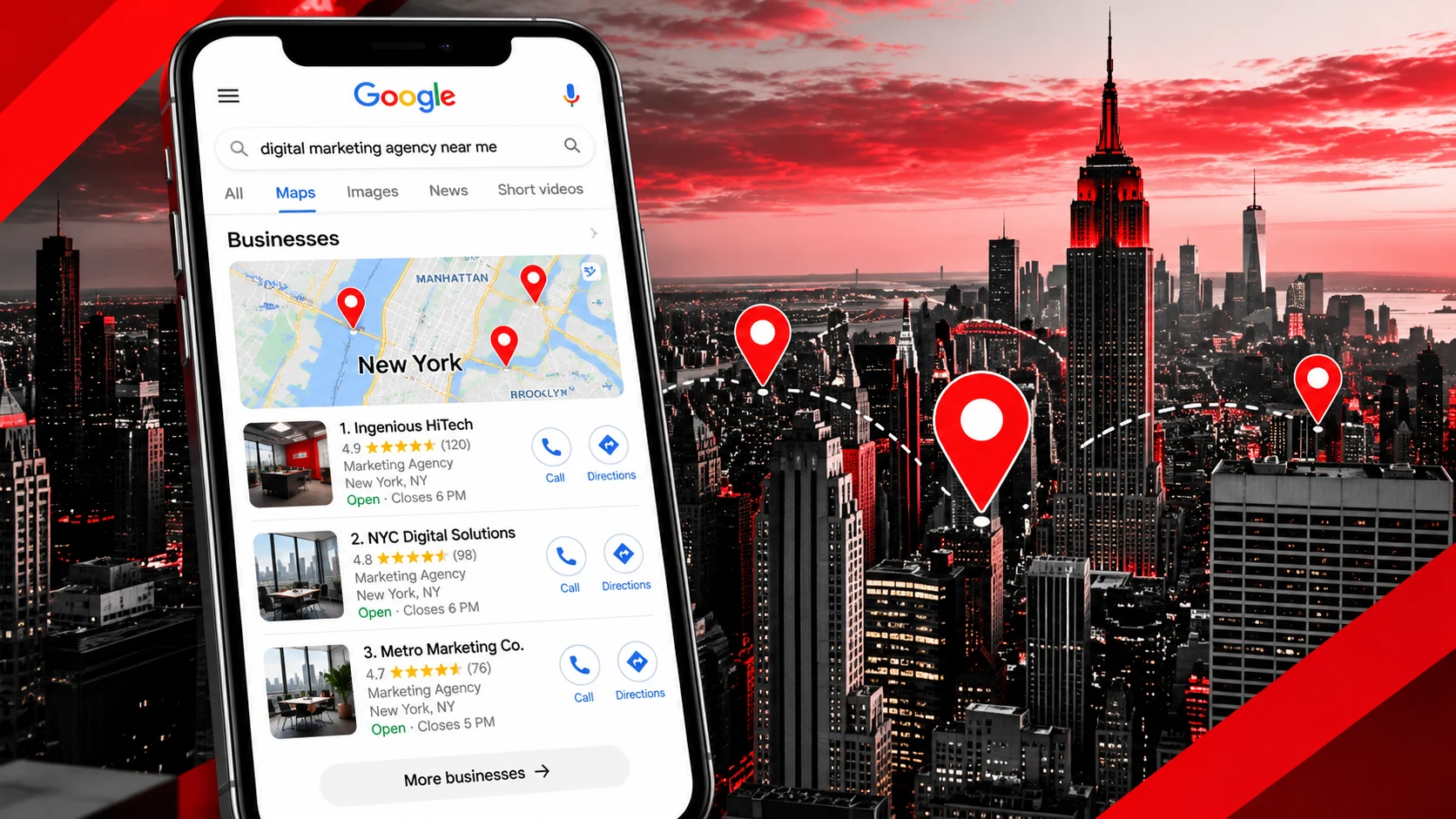
A competitor two blocks away appears in the map results for "accountant near me," while your firm, with better service and more experience, sits somewhere below the fold. Your Google Business Profile gets a few views, the phone stays quiet, and the contact form collects dust. If that sounds familiar, you are not alone. Learning how to rank on Google Maps in New York is one of the most direct ways to reach nearby customers who are ready to call, visit, or request a quote.
The map results at the top of a local search are often called the Google Maps 3-Pack: three businesses shown beside a map, above the standard listings.
This guide covers how Google picks winners, seven practical strategies, common reasons you may be missing the 3-Pack, and how to measure progress by leads instead of screenshots.
How Google Maps Rankings Work in New York
Google states that local results are based mainly on three factors: relevance, distance, and prominence.
- Relevance: how well your Business Profile matches what someone searched for. Complete, accurate categories, services, and descriptions help Google understand what you do.
- Distance: how far your business is from the location used in the search, whether that is the searcher's position or a neighbourhood named in the query.
- Prominence: how well known your business appears to be. Google says it draws on information from across the web, such as links, articles, and directories, and that review count and score also factor in.
These factors work together. A highly prominent business can still lose to a closer, equally relevant one. In New York, this plays out block by block. Someone searching "dentist" in Midtown Manhattan sees different results than someone in Bay Ridge, Flushing, Fordham, or St. George, so one business can rank well in one neighbourhood and barely appear a mile away.
Google also says there is no way to request or pay for a better local ranking, and no single tactic guarantees a top-three position for every searcher. The goal is to build an honest, strong foundation across all three factors.
7 Proven Strategies for Ranking on Google Maps
These proven strategies for ranking on Google Maps mix Google's guidance with common industry practice. Where an effect cannot be guaranteed, we say so.
1. Optimise Your Google Business Profile
Google Business Profile optimisation is the foundation, so start there.
Verify the business, then check that your name, address, phone number, and hours match what customers see in the real world. Google notes that complete, accurate profiles are more likely to appear in local results.
Your primary category deserves the most attention. It tells Google what your business is first and foremost, so pick the one that matches your core service, not the broadest option. Add secondary categories only if they truly apply, then complete your services and description.
Do not stuff keywords or neighbourhood names into your business name. Google's guidelines say it should reflect your real-world name. "Smith & Co. Best Plumber Brooklyn Cheap" invites suspension, which costs far more than a missed ranking.
2. Target the Right Local Keywords for New York City
Good local keywords come from what you sell, how customers describe it, and where you can realistically serve them.
Start with your services, then add location. "SEO agency in New York City" suits a firm serving the whole city. "Emergency plumber in Brooklyn" fits a trade with a clear territory. "Commercial cleaning services in Queens" works for a company with crews and clients there. Your inbox is useful research too, as is Google Search Console for queries already earning impressions.
Then map keywords to specific pages. Emergency repairs deserve their own page, maintenance plans another, commercial work another. Cramming every phrase onto the homepage dilutes relevance and confuses visitors.
3. Build Genuine Google Reviews and Respond to Customers
Reviews contribute to prominence, and they persuade the person comparing three businesses on a phone screen.
Ask real customers for honest feedback soon after a job goes well. A short text or email with your direct review link is enough. Do not offer discounts or gifts in exchange for reviews, review your own business, or buy reviews. Those practices violate Google's policies and can get reviews removed or profiles restricted.
Respond to every review. Thank happy customers specifically, and answer critical ones calmly, acknowledging the issue and offering to resolve it offline.
Review count and score matter, but they are one input among many. If review handling is a pain point, Ingenious Hi-Tech offers online reputation management support.
4. Create Useful Local Service Pages
For each area you truly serve, a helpful service page shows Google and customers that you understand that market.
A strong page includes details only you can provide: how the service works in that area, common customer needs, real project examples, clear contact information, and links to related services. A commercial cleaner might explain evening schedules and building sign-in rules for Long Island City offices. Swapping "Astoria" for "Chelsea" on an otherwise identical page adds nothing.
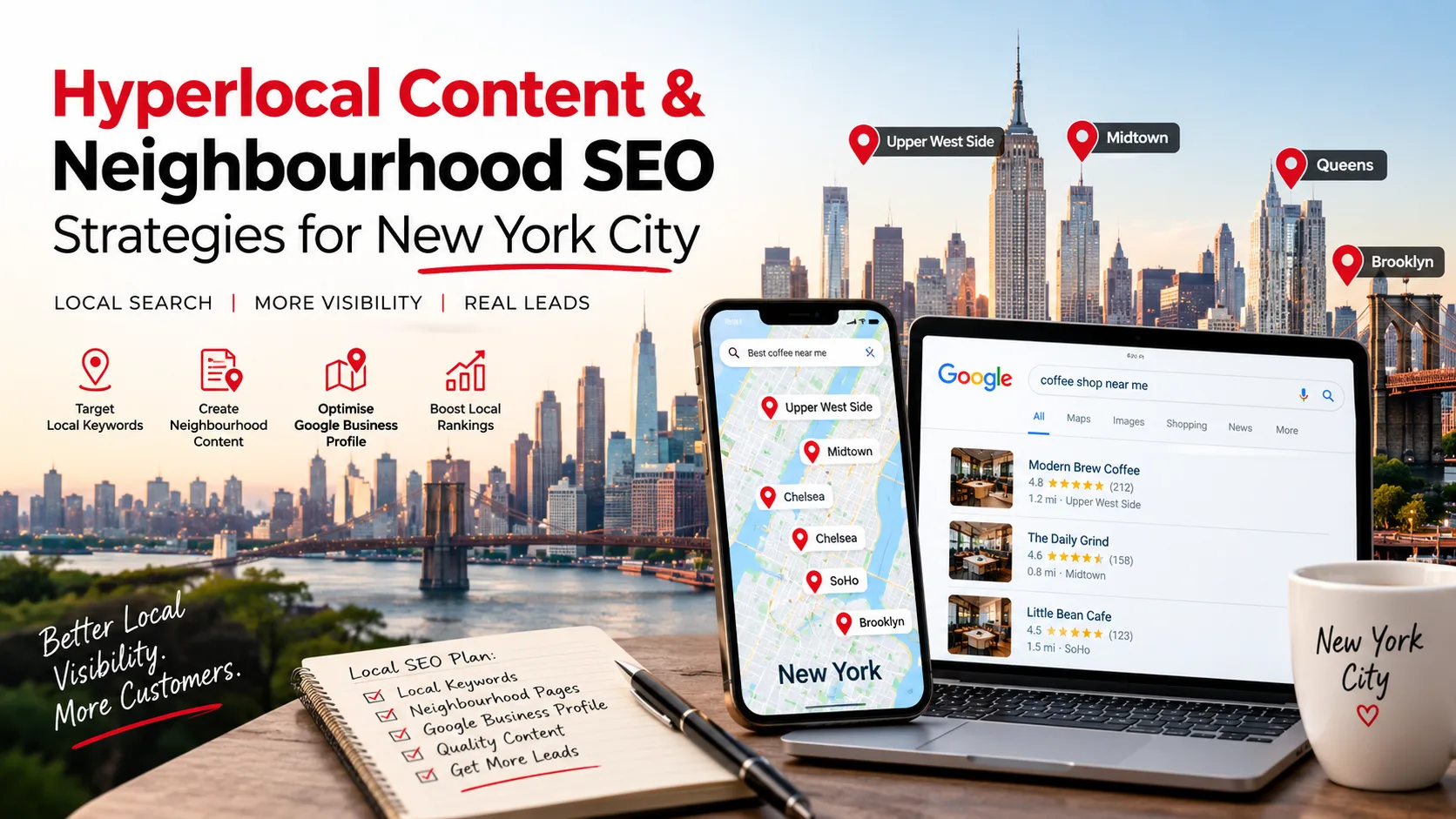
Avoid thin, near-duplicate pages for every neighbourhood. Our guide to hyperlocal content and neighbourhood SEO strategies for New York City covers choosing areas and writing pages that deserve to exist.
5. Build Relevant Local Citations and Backlinks
A citation is a mention of your business name, address, and phone number on another site, such as a directory. Consistency is the goal, so fix any listing where your suite number or phone format differs.
Focus on directories that fit your industry and region, not mass submissions. Earn links from real local sources such as professional associations, chambers of commerce, community sponsorships, partner businesses, and local press covering something you actually did. Skip paid link schemes, which rarely help and can create lasting problems.
6. Add Authentic Business Photos and Maintain an Accurate Profile
Real photos of your storefront, team, products, and completed projects help customers decide. Stock images reassure no one. Frequent uploads or posts have not been shown to improve Maps rankings automatically, so treat them as trust-building tools, not ranking switches.
Accuracy matters more than volume. Update holiday hours, closures, and service changes promptly. A customer who arrives at a closed shop will not leave a kind review.
7. Improve Website SEO and the Customer Journey
Many listings lose the lead after the click.
Check the basics:
- The site loads quickly and works well on a phone.
- Your name, address, and phone number match your profile exactly.
- Each service page has a clear purpose and internal links to related pages.
- Phone numbers are tappable, and forms ask only for what you need.
LocalBusiness structured data, a standard code format that describes your business details to search engines, can help Google read your site accurately. It does not guarantee higher Maps rankings, so treat it as housekeeping.
Put a clear call to action on every important page, such as "Call now" or "Request a quote." If visitors arrive but never contact you, our article on why NYC businesses are losing website leads outlines common friction points.
Local SEO for New York City: Competing Across Neighbourhoods
Local SEO for New York City works best when you stop trying to win the entire city. Pick the areas where you can genuinely deliver, then build outward.
List the neighbourhoods that produce your best customers and compare demand, competition, and your ability to serve them. Three to five areas is plenty to begin with. Then address real needs: a Midtown office manager may care about after-hours access, while a Brooklyn row house owner faces different maintenance issues. Use neighbourhood names only where they add practical value, and avoid repeating "New York" in every sentence.
Local authority grows from real connections, like sponsoring a neighbourhood event or partnering with nearby businesses.
One caution: publishing a page about Williamsburg does not make you eligible to rank there on Maps. Your profile location, physical proximity, and actual service arrangements still decide what you can show up for. Google's guidelines say a service-area business should have one profile for its central location with a defined service area, and they do not allow fake offices or borrowed addresses.
Why Your Business Is Not Ranking in the Google Maps 3-Pack
If you have done some of this work and still do not appear, one of these issues is usually involved:
- Incomplete or inaccurate profile details, such as missing services or outdated hours.
- The wrong primary category, one of the most common and most fixable problems.
- Weak relevance between your profile, website, and the search.
- Distance, when competitors sit closer to the searcher.
- Limited reputation and local authority, like few reviews and no local links.
- Duplicate profiles or policy violations, including keyword-stuffed names or ineligible addresses.
- Mismatches between profile and website in names, numbers, or services.
- Thin service pages that give Google little to work with.
For a starting point, search your main service from a few different New York locations and note who appears. Compare their categories, review volume, and website content with yours, then audit your own profile line by line. Fix the obvious gaps first. Not every business needs every service, and a few corrections often make the biggest difference.
If the picture is still unclear, Ingenious Hi-Tech can review your profile, website, and local competition and tell you plainly what is holding you back. You can request an assessment here.
How to Measure Google Maps Rankings and Generate More Leads
Rankings, traffic, and business outcomes are three different things. A first-place ranking for a search nobody makes is worthless, and a thousand visits with no calls does not pay rent.
Use these sources together:
- Google Business Profile performance data shows relevant search queries, calls, website clicks, and direction requests where applicable.
- Google Search Console reveals which queries and pages earn impressions and clicks.
- Website analytics shows how visitors behave and which pages lead to action.
- Call and form tracking ties enquiries to their source.
Then count qualified enquiries, meaning people who match your services and service area, and calculate your lead conversion rate. If 40 people contact you and 8 become customers, that 20 per cent rate tells you far more than an impression count. Rankings also vary by location, so check several points across your service area instead of relying on one screenshot.
How Ingenious Hi-Tech Can Help New York Businesses Improve Local Visibility
Ingenious Hi-Tech is a digital marketing agency that works on on-page SEO, technical SEO, Google Business Profile optimisation, website improvements, and lead-generation optimisation.
A useful starting point is an audit that looks at profile issues like categories and duplicates, website weaknesses affecting relevance and speed, local keyword opportunities tied to real services, and conversion barriers that stop visitors from calling or submitting a form.
We do not promise first-page rankings, guaranteed leads, or a fixed timeline, because no honest agency can. What we offer is a clear assessment, realistic priorities, and reporting based on qualified enquiries.
If you want to understand why competitors appear in the map results and you do not, contact Ingenious Hi-Tech to discuss your local SEO challenges or request an assessment.
Frequently Asked Questions
How long does it take to rank on Google Maps in New York?
There is no fixed timeline. It depends on competition, proximity, profile quality, reputation, eligibility, and the strength of your existing website and local SEO foundation.
Can a business rank on Google Maps without a physical storefront?
Sometimes. Service-area businesses that travel to customers can have a profile if they meet Google's eligibility rules, typically one profile for a central location with a defined service area. Virtual offices and borrowed addresses generally do not qualify unless the location is staffed during business hours.
Do Google reviews improve Google Maps rankings?
Google says review count and score factor into local ranking, and they support prominence and customer confidence. They are not the only factor. Relevance and distance still carry significant weight.
How much does local SEO cost in New York City?
It varies with competition, business type, how many locations you cover, and the scope of work. A tailored assessment is the most reliable way to get an accurate figure.
Can an SEO agency guarantee a top-three Google Maps ranking?
No. Google controls the results, and rankings vary by searcher, location, and time. Google also says there is no way to pay for a better local ranking. Be cautious of any agency that promises a specific position.
Final Thoughts
Knowing how to rank on Google Maps in New York comes down to steady habits: keep your profile accurate, match your pages to real services and neighbourhoods, earn honest reviews, build local credibility, and measure leads instead of vanity numbers. If you would like experienced help, Ingenious Hi-Tech can review your local presence and recommend practical next steps.