
Getting traffic to your website is only half the job. If people land on your site and leave without buying, signing up, or reaching out, that traffic isn't doing much for your business. This is exactly why Conversion Rate Optimisation has become one of the most important skills a business can invest in.
Think about two websites that both get 10,000 visitors a month. Website A converts 1% of visitors into customers, which means 100 sales. Website B converts 3%, which means 300 sales, from the same traffic. Website B isn't spending more on ads or SEO. It's simply doing a better job of turning visitors into paying customers. That difference is the entire idea behind CRO. Instead of chasing more traffic, you get more value out of the traffic you already have.
In this guide, you'll learn what CRO actually means, why it matters for small businesses, ecommerce stores, SaaS companies, and service providers, and exactly how the CRO process works. You'll also get 12 proven strategies, common mistakes to avoid, the metrics that actually matter, and a practical checklist you can start using today.
What Is Conversion Rate Optimisation (CRO)?
Conversion Rate Optimisation is the process of improving your website so that a higher percentage of visitors take a specific action you want them to take. That action is called a "conversion."
A conversion isn't always a sale. Depending on your business, a conversion could be:
- Ecommerce purchases: a visitor completing a checkout
- Lead forms: someone filling out a "Get a Quote" or "Contact Us" form
- Demo requests: a potential SaaS customer booking a product walkthrough
- Newsletter signups: a visitor subscribing to your email list
- Consultation bookings: someone scheduling a call with your sales team
CRO uses research, data, testing, and design improvements to remove the obstacles that stop visitors from completing these actions.
The Conversion Rate Formula
Conversion rate is calculated like this:
(Number of Conversions ÷ Number of Visitors) × 100
For example: if your landing page gets 2,000 visitors in a month and 40 of them fill out your contact form, your conversion rate is:
(40 ÷ 2,000) × 100 = 2%)
That single number tells you a lot about how well your website is performing, and tracking it over time shows whether your changes are actually working.
Why Conversion Rate Optimisation Is Important for Businesses
1. Get More Results From Existing Website Traffic
Most businesses spend money on SEO, ads, and social media to bring in visitors. CRO makes sure that traffic isn't wasted. A local plumbing company that improves its conversion rate from 1.5% to 3% effectively doubles its leads without spending an extra dollar on marketing.
2. Improve Marketing ROI
If your ad campaigns are already profitable, a better conversion rate makes them even more profitable. An ecommerce store paying $5 per click but converting more of those clicks into sales gets a much stronger return from the same ad budget.
3. Understand Customer behaviour
CRO isn't just about changing button colours. It forces you to study how real visitors interact with your site: where they click, where they scroll, and where they give up. This insight often reveals problems businesses didn't know existed, like a confusing pricing page or a broken mobile menu.
4. Improve User Experience
A site optimised for conversions is usually easier and more pleasant to use. Clear navigation, fast load times, and simple forms don't just help conversions; they make visitors trust your brand more.
5. Reduce Customer Acquisition Costs
When more visitors convert, your cost to acquire each customer drops. A SaaS company that improves free trial signups from 2% to 4% is effectively cutting its acquisition cost in half.
6. Gain Competitive Advantage
Two competitors can have identical products and similar traffic, but the one with a smoother, more persuasive website will consistently out-convert the other. Over time, this compounds into real market share.
How Does Conversion Rate Optimisation Work?
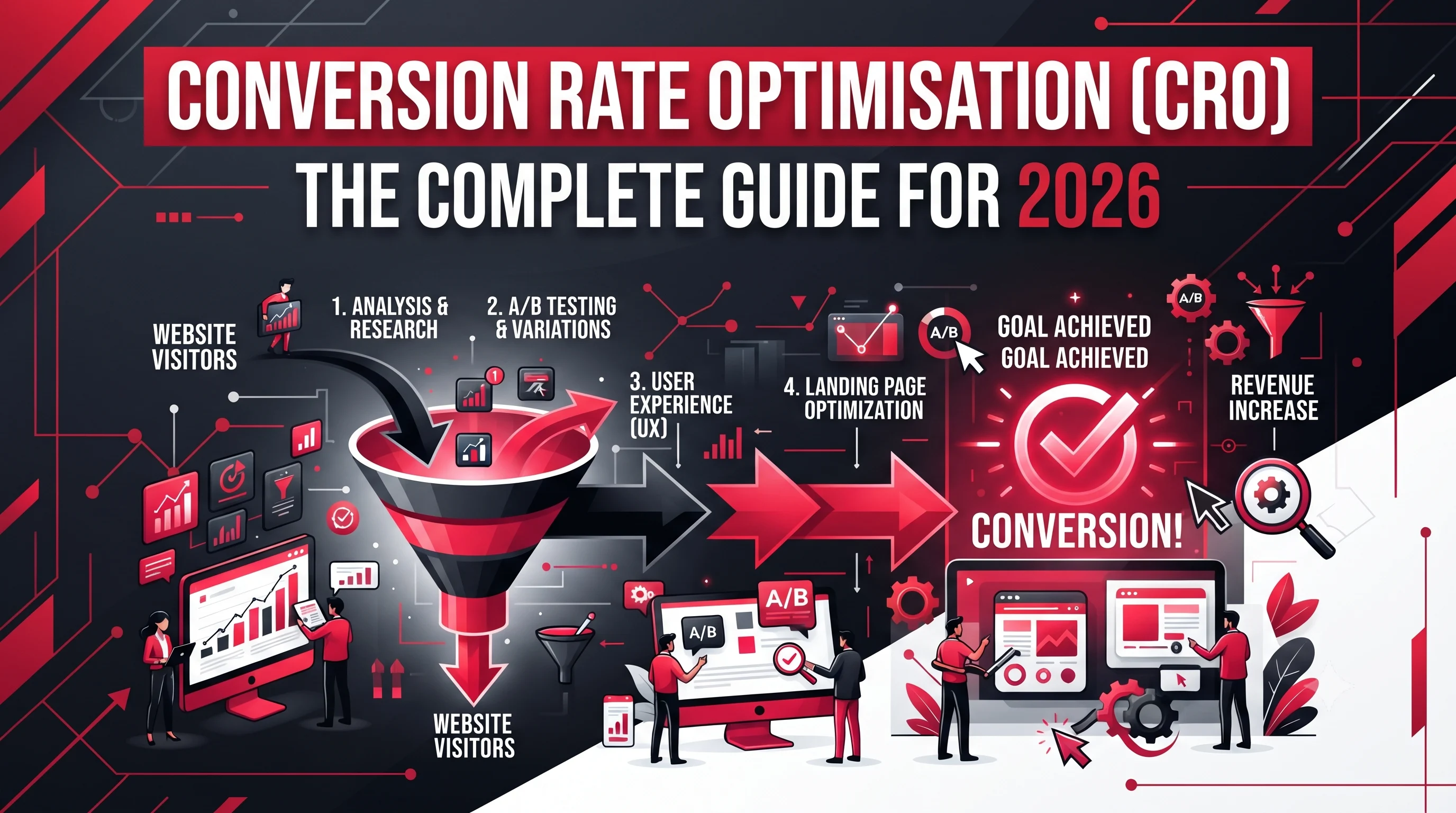
CRO follows a repeatable process. It isn't guesswork; it's a cycle of research, testing, and improvement.
Step 1: Research and Data Collection
Before changing anything, you need to understand what's actually happening on your site. This is done using:
- Google Analytics 4 (GA4): shows traffic sources, user paths, and where visitors drop off
- Heatmaps: visual maps showing where people click, tap, and scroll
- User recordings: session replays showing real visitor behaviour
- Surveys: on-site pop-ups asking visitors what's stopping them from taking action
- Customer feedback: reviews, support tickets, and sales call notes that reveal recurring objections
Step 2: Identify Conversion Problems
With data in hand, you look for patterns that point to friction, such as:
- High exit pages where visitors consistently leave
- Landing pages with confusing layouts or messaging
- Weak or unclear call-to-action (CTA) buttons
- Slow website speed that causes visitors to abandon the page
- Complex, multi-step forms that feel like too much effort
Step 3: Create CRO Hypotheses
A hypothesis connects a problem to a proposed fix. For example: "Visitors are leaving our pricing page because there are too many plan options, so simplifying to three clear tiers should increase signups." This turns assumptions into testable ideas.
Step 4: Test Website Improvements
Instead of guessing, you test changes with real visitors:
- A/B testing: showing two versions of a page to different visitors to see which performs better
- Multivariate testing: testing multiple elements at once to see which combination works best
- User testing: watching real people attempt tasks on your site to catch usability issues
Step 5: Analyse Results and Improve
After a test runs long enough to gather meaningful data, you review key CRO metrics such as conversion rate, bounce rate, and average time on page. Winning changes get rolled out permanently, and the cycle starts again with a new hypothesis.
12 Proven Conversion Rate Optimisation Strategies for 2026
- Improve Website Speed: A slow website drives visitors away before they even see your offer. Compressing images, using faster hosting, and minimising unnecessary scripts can meaningfully cut load times and reduce abandonment.
- Create Clear Headlines: Your headline should immediately tell visitors what you offer and why it matters to them. Vague or clever headlines that don't communicate value quickly lose people within seconds.
- Optimise Call-to-Action Buttons: CTAs should stand out visually and use action-driven language like "Get Your Free Quote" instead of a generic "Submit." Testing button colour, size, and placement often produces quick, measurable wins.
- Improve Landing Page Design: A strong landing page has one clear goal, minimal distractions, and a logical flow from headline to CTA. Removing unrelated links and navigation clutter keeps visitors focused on converting.
- Add Social Proof and Trust Signals: Reviews, testimonials, case studies, client logos, and security badges reassure visitors that your business is credible. This is especially powerful right before a purchase or form submission.
- Simplify Website Navigation: If visitors can't quickly find what they need, they leave. A clean, intuitive menu structure helps guide people toward the pages that matter most, like services or pricing.
- Improve Mobile User Experience: With most traffic now coming from phones, a site that isn't fully optimised for mobile loses conversions immediately. Larger tap targets, readable fonts, and simplified layouts make a big difference.
- Use A/B Testing: Testing isn't a one-time task; it should be an ongoing habit. Regularly testing headlines, images, and page layouts helps you continuously find small improvements that add up over time.
- Optimise Contact Forms: Every extra field on a form reduces completions. Asking only for essential information and breaking longer forms into simple steps increases the odds visitors will finish filling them out.
- Use Analytics Data for Decisions: Every design or copy change should be backed by data, not personal preference. Reviewing GA4 reports regularly keeps your CRO efforts grounded in how real visitors behave.
- Personalise User Experience: Showing tailored content based on location, referral source, or past behaviour makes visitors feel understood. Even simple personalisation, like location-based offers, can lift conversions.
- Optimise Checkout Process: For ecommerce sites, a long or confusing checkout is one of the biggest conversion killers. Reducing steps, offering guest checkout, and displaying shipping costs early all help reduce cart abandonment.
Conversion Rate Optimisation for Different Business Types
- Ecommerce CRO Focus areas include product pages with clear images and specifications, visible customer reviews, and a checkout process with minimal friction and multiple payment options.
- SaaS CRO: Key conversion points are free trial signups, demo request forms, and onboarding flows. Reducing signup fields and clearly communicating the value of a trial both improve completion rates.
- Local Business CRO: For local businesses, conversions often happen through contact forms, phone calls, and location pages. Making phone numbers clickable and directions easy to find matters more here than elsewhere.
- Service Business CRO: Service providers rely on lead generation, consultation requests, and content that builds trust, such as case studies and client results. A clear, low-pressure way to book a call is essential.
Best Conversion Rate Optimisation Tools
- Analytics Tools: Google Analytics 4 and Google Search Console help you understand traffic sources, user paths, and which pages perform best or worst in search.
- Heatmap Tools: Heatmap and session recording tools show exactly where visitors click, how far they scroll, and where they hesitate or get stuck.
- Testing Tools: A/B testing platforms let you run controlled experiments on headlines, layouts, and CTAs to see which version converts better.
- SEO Tools: Keyword and performance analysis tools help you understand search intent, so the traffic arriving at your site actually matches what your page offers.
Each of these tools plays a different role, but together they give you a complete picture of how visitors experience your website.
Common Conversion Rate Optimisation Mistakes to Avoid
- Focusing Only on Traffic: Driving more visitors to a site that doesn't convert well just wastes marketing spend. Fixing conversion issues first often delivers better returns than chasing more traffic.
- Making Changes Without Data: Redesigning a page based on personal taste, rather than user behaviour, frequently makes conversions worse instead of better.
- Ignoring Mobile Optimisation: A site that works well on desktop but poorly on mobile is turning away a large share of potential customers.
- Weak Messaging: If visitors can't quickly understand what you offer and why it matters, they won't stick around long enough to convert.
- Poor Website Trust Signals: Without reviews, credentials, or clear contact information, visitors hesitate to hand over their money or personal details.
- Not Tracking Conversions: Without proper tracking set up, you're optimising blind. You won't know which pages or campaigns are actually driving results.
How to Measure CRO Success
- Conversion rate: the core metric showing what percentage of visitors take your desired action
- Revenue per visitor: total revenue divided by total visitors, useful for ecommerce sites
- Lead quality: not just how many leads you get, but how many turn into real customers
- Average order value: how much customers typically spend per transaction
- Customer acquisition cost: how much it costs to acquire one paying customer
- Engagement rate: how visitors interact with your content, including time on page and scroll depth
Businesses should review these metrics regularly, compare them against past performance, and use them to decide what to test next rather than judging success from a single number in isolation.
Frequently Asked Questions About Conversion Rate Optimisation
1. What is Conversion Rate Optimisation?
Conversion Rate Optimisation is the process of improving a website so more visitors complete a desired action, like making a purchase or filling out a form.
2. Why is CRO important?
CRO helps businesses get more value from their existing traffic, improving marketing ROI without needing to spend more on ads.
3. How can I increase my website conversion rate?
Start by studying visitor behaviour with analytics and heatmaps, then test changes to headlines, CTAs, forms, and page design.
4. What is a good conversion rate?
Average conversion rates vary by industry, but most websites fall between 2% and 5%, with well-optimised sites often performing higher.
5. How long does CRO take?
CRO is an ongoing process rather than a one-time fix, though many businesses see measurable improvements within a few months of consistent testing.
6. Is CRO better than increasing traffic?
They work best together, but CRO is often more cost-effective since it improves results from traffic you're already getting.
7. What tools are used for CRO?
Common tools include Google Analytics 4, heatmap software, A/B testing platforms, and SEO analysis tools.
8. How does CRO improve SEO?
Many CRO improvements, like faster load times and better user experience, are also factors search engines consider when ranking pages.
9. What is A/B testing in CRO?
A/B testing involves showing two versions of a page to different visitors to measure which one produces more conversions.
10. Can small businesses benefit from CRO?
Yes. Small businesses often see significant gains from CRO since even small improvements can meaningfully increase leads or sales relative to their traffic.
Conclusion
Conversion Rate Optimisation isn't a one-time project; it's an ongoing habit that helps businesses turn the traffic they already have into real customers and revenue. Instead of constantly chasing more visitors, CRO focuses on understanding user behaviour and making data-driven improvements that compound over time.
Whether you're running an ecommerce store, a SaaS platform, or a local service business, the same principle applies: small, tested improvements to your website add up to meaningfully better results.
If you're ready to turn more of your website visitors into paying customers, Ingenious HiTech can help. Our team works across conversion Optimisation, website development, SEO, analytics, and digital marketing to build websites that don't just attract visitors, but convert them.