
1) Introduction: The Rising Cost of Acquiring Customers
Customer Acquisition costs are what a company spends to get a customer. This includes money spent on marketing, advertising, sales efforts, and other things used to get people to buy from the company. The formula to figure out Customer Acquisition costs is to divide the total sales and marketing costs by the number of new customers acquired during a specific period.
For companies, Customer Acquisition costs are important because they show how well the company is doing. If it costs a lot to get new customers, the company will not make as much money from those customers, and that can make it hard for the company to grow.
2) Scope of Customer Acquisition Cost Growth
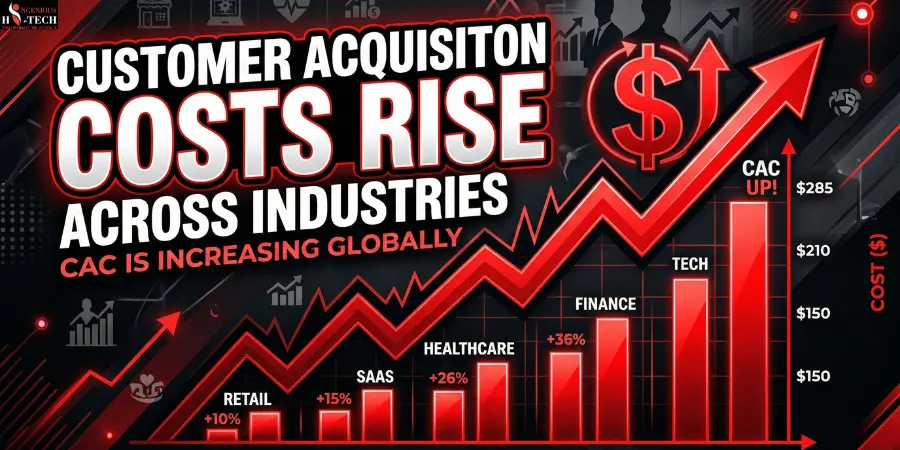
The cost of getting customers is going up for many businesses, and this is happening across a lot of different areas and types of advertising. Because the internet and online platforms are changing fast, companies are spending more money on things like online ads, working with famous people to sell their products, looking at lots of data to understand their customers, and using tools to keep their customers happy. This means that the cost of getting customers is not just about paying for ads anymore; it also includes spending money on technology, making content, and coming up with special plans to market their products.
Some types of businesses, like shopping companies, software companies, financial technology companies, and companies that sell products directly to customers, are seeing the biggest changes. These businesses rely a lot on marketing to reach their customers. Also, there is a lot of competition between businesses. People are buying things differently. There are new rules to protect people's private information, all of which are making the cost of getting new customers go up even more. So businesses need to focus on making their marketing, keeping their customers, and making sure their customers are happy, in the long term, to deal with the rising cost of getting new customers.
3) Key Factors Driving Rising CAC
Several things are happening that are making it more expensive to get customers. One big reason is that a lot of businesses are using ad platforms. Google, Facebook, Instagram, and TikTok are all places to advertise, and this means that the cost of showing an ad to someone and getting them to click on it is going up. When a lot of businesses are competing for the space, they have to pay more to get noticed, and that means they have to spend more money to get the same results.
Changes to how companies can use data are also affecting advertising on the internet.
For example, Apple's new iPhone software does not let apps track what people are doing much, and Google is getting rid of something called third-party cookies.
The way people buy things is also changing. Acquisition costs are going up because of all these things, including ad platform saturation and changes in consumer behavior and data privacy. Acquisition costs are. This is a problem for businesses because they have to pay more to get new customers, and this affects their acquisition costs.
4) Performance Analysis: CAC Trends Over Time

Looking at CAC trends over the past decade reveals a steady upward curve. In 2013, a typical e-commerce brand might have acquired a customer for $9. By 2018, that number had climbed to around $20. Today, the same brand might be spending $45 or more for a single acquisition. This isn't just inflation; it represents a structural shift in how digital competition works.
Industries that once enjoyed low-cost organic growth through social media are now finding that those channels are increasingly pay-to-play. What used to be "free" traffic now requires ad spend to sustain reach, fundamentally changing the unit economics for thousands of businesses.
5) Understanding the LTV: CAC Ratio
Customer Acquisition Cost only tells about the spend for a customer, and to know how much a customer is worth over their relationship with the brand, known as Lifetime Value or LTV. A good business aims for an LTV to CAC ratio of at least 3:1. This means that if you spend one dollar to get a customer, they should bring in three dollars over time.
When it costs more to get a customer, but their LTV stays the same, the ratio gets worse. The business suffers. Companies with customer retention, subscription models, or many repeat purchases can handle rising CAC better than those that only make one sale. That's why subscription businesses and loyalty programs have become so important lately.
6) How Rising CAC Impacts Business Performance
When a company spends a lot of money to get customers, it affects everything. The company makes money when it costs a lot to get a new customer before they even sell them anything. It becomes really hard to meet goals to grow the business when the company needs a lot of money to get more customers. For businesses or startups that do not have a lot of money, spending too much to get new customers can be a big problem.
People who invest in companies and analysts look really closely at how much money a company spends to get new customers. They think this is a way to know if a company will be okay in the long term. If a company is spending all its money to get customers and will run out of money soon, this is a bad sign, even if the company is making a lot of money from sales.
7) Strategies to Reduce Customer Acquisition Costs
The good news is that we do not have to accept rising customer acquisition costs. We can actually manage them. If we invest in things like search engine optimization, content marketing, and email nurture sequences, we can build a pipeline that does not depend on paid advertisements.
We can also start programs that reward our existing customers for bringing in new customers. This can really cut down on the costs of acquiring customers, and it can also improve the quality of the people who are converting.
If we target our audience in a way, even when we do not have a lot of data, we can make sure that the money we spend on advertisements reaches the people who are most likely to become our customers. It is also an idea to target people who have already shown an interest in what we have to offer. This is usually more cost-effective than trying to acquire customers who have never heard of us before.
8) Future Outlook: Will CAC Continue to Rise?
Most industry experts believe CAC will continue to climb, at least in the near term. Increasing regulatory pressure on data collection, the ongoing shift to privacy-first ecosystems, and growing competition across virtually every vertical point toward a sustained upward trend.
However, businesses that adapt early by building owned audiences, prioritizing retention over acquisition, and diversifying their channel mix will be better positioned to weather the change. First-party data strategies, community building, and product-led growth are increasingly seen as long-term buffers against rising acquisition costs.
Conclusion
Rising costs to get customers are a big problem for businesses today. As ad markets get tougher and it's harder to target people with data, companies need to change how they get and keep customers.
The companies that do well will be those that spend money wisely and have plans for growth. They will focus not only on how much it costs to get a customer but also on how much value that customer brings over time. Customer acquisition costs are going up. If you do it right, it won't hurt your business that much.
Frequently Asked Questions:
1. What is the customer acquisition cost (CAC)?
Customer acquisition cost (CAC) is the total amount a business spends to acquire a new customer. It includes marketing expenses, advertising costs, sales team salaries, software tools, and other related costs divided by the number of new customers gained during a specific period.
2. Why is customer acquisition cost increasing across industries?
Customer acquisition costs are rising due to increased digital advertising competition, stricter data privacy regulations, higher marketing expenses, and more complex customer buying journeys. As more businesses compete for online visibility, marketing channels like paid search and social media advertising have become more expensive.
3. How do you calculate customer acquisition cost?
Customer acquisition cost is calculated using the formula:
CAC = Total Marketing and Sales Expenses ÷ Number of New Customers Acquired
For example, if a company spends $50,000 on marketing and sales in a month and acquires 500 customers, the CAC is $100.
4. What is a good CAC for a business?
A good CAC depends on the industry and business model. Generally, businesses aim for a customer lifetime value (LTV) to CAC ratio of at least 3:1, meaning the revenue generated from a customer should be three times the cost of acquiring them.
5. What is the ideal LTV to CAC ratio?
The ideal LTV: CAC ratio is typically 3:1, which indicates a healthy balance between acquisition costs and customer value. A ratio lower than 1:1 suggests the business is losing money on each customer, while ratios above 4:1 may indicate underinvestment in growth.
6. Which industries have the highest customer acquisition costs?
Industries with the highest CAC often include SaaS, fintech, insurance, healthcare, and B2B services. These sectors usually require longer sales cycles, higher marketing investments, and more complex customer education.
7. How can businesses reduce customer acquisition costs?
Businesses can reduce CAC by investing in SEO, content marketing, referral programs, customer retention strategies, conversion rate optimization, and data-driven marketing campaigns. Improving brand trust and organic visibility also lowers dependency on paid advertising.
8. What is the difference between CAC and customer lifetime value (LTV)?
CAC represents the cost required to acquire a new customer, while LTV represents the total revenue a business expects to earn from that customer over their entire relationship with the company.
9. How does rising CAC affect business profitability?
Rising CAC can reduce profit margins, increase marketing budgets, and slow business growth. If acquisition costs grow faster than customer revenue, companies may struggle to maintain sustainable growth.
10. What marketing channels have the lowest customer acquisition cost?
Marketing channels with lower CAC typically include SEO, email marketing, referral programs, organic social media, and content marketing. These channels focus on long-term customer relationships rather than expensive paid advertising.
11. What is the CAC payback period?
The CAC payback period measures how long it takes for a company to recover the cost of acquiring a customer through the revenue generated from that customer.
12. How does customer retention impact CAC?
Higher customer retention reduces overall CAC because businesses generate more revenue from existing customers rather than constantly spending money to acquire new ones.