

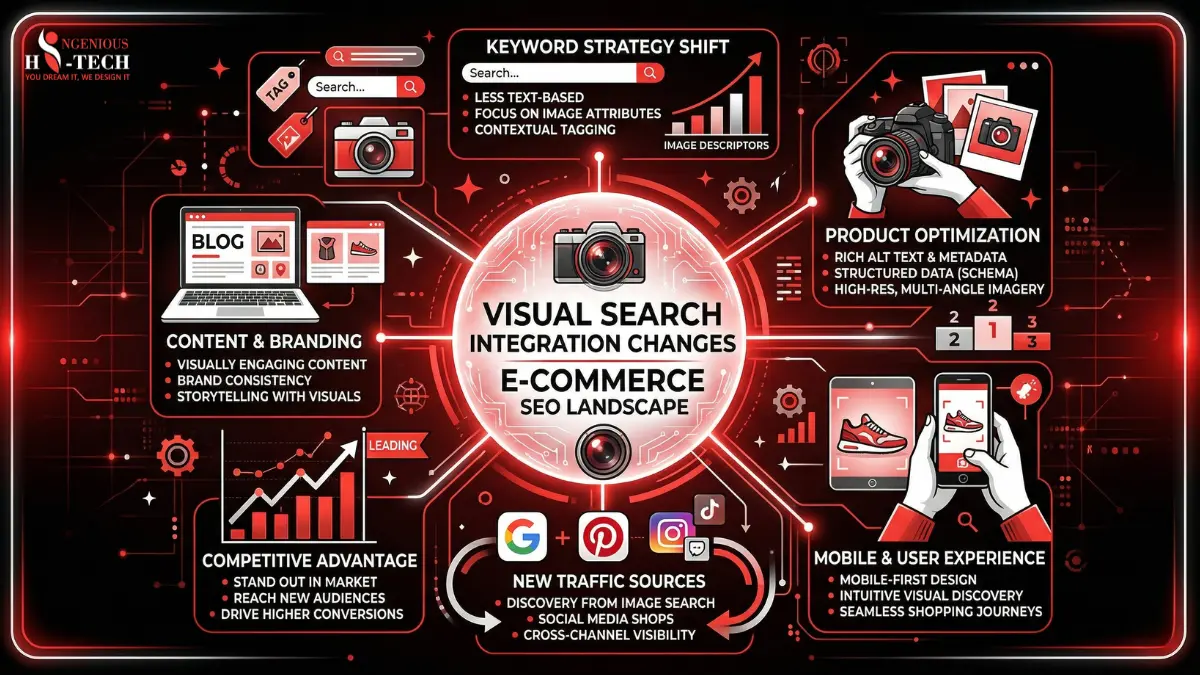
In 2026, the way of searching for online products has changed from the past few years. Customers no longer depend on typing keywords to search; instead, they simply take pictures or upload an image to search for the product or something similar in a faster way. This change came from advanced virtual technology such as Google Lens, Pinterest Lens, and Bing Visual Search, which use AI or artificial intelligence to analyse objects, colors, patterns, and product details from the image.
For e-commerce businesses, this technology is mainly changing the SEO traditional landscape. Earlier ranking on search engines was focused on keywords, backlinking, and written content, but now images, virtual data, and AI-powered recognition are becoming equally important for helping products appear in search results.
So, let’s understand how the transformation from keywords to images enhances e-commerce SEO most simply.
What Is Visual Search and Why Should E-commerce Brands Care?
People can now search the internet using pictures of words. For example, if someone sees a dress they like on the street, they can take a photo of the dress. Find the same or similar dresses online. This is possible because of tools like Google Lens, Pinterest Lens, and Amazon's visual search tool. These tools make it easy for people to find things online.
Earlier, people used to find products by typing words into a search engine. Now people are using pictures to search for things. So online stores need to make sure their product pictures are good and can be understood by computers. This is important because it will help people find their products when they use search.
The numbers show that this is a deal. More than 62 percent of younger people like using visual search. Over 36 percent of shoppers have already used visual search to buy something. The visual search market is going to be really big. It will help decide how people spend over 40 billion dollars online by 2026. These numbers show that people are changing how they shop online, and every online store needs to pay attention to this change. They need to think about search and how it will affect their business. It is going to be important for stores, so they need to make sure they are ready for it.
The Major Platforms Leading the Visual Search Revolution
Lots of big technology companies are putting a lot of money into search. This is having an impact on how people shop online.

-
Google Lens is one of the important ones. It is part of Google Search and Google Shopping. Google Lens can look at pictures. Find products that match. It can even do this from a screenshot. When you use Google Lens to shop, the products you see are not just random. They are from stores that have set up their information and pictures correctly on Google.
-
Pinterest is really good for things like clothes, home decor, and lifestyle products. Pinterest Lens lets you take a picture of something you like and find products from stores on Pinterest. If you have a brand that's all about how things look, you need to have a Pinterest account and make sure your product list is up to date. This is important for people to be able to find you when they search.
-
Amazon has a feature that connects pictures of products to the products you can buy. This means that how good your pictures look can affect how high your products show up in search results.
-
Microsoft Bing also has a visual search feature. This lets you search for things inside a picture and find stores that sell those things. This makes visual search more useful and not just limited to Google.
How Visual Search Is Rewriting the Rules of E-commerce SEO
The way we do search engine optimization, or SEO, has changed a lot. Before, it was about using the right words, making descriptions that grab people's attention, and organizing content in a way that helps it show up near the top of search results. Now, with visual search, things are different. The pictures we use are just as important as the words. This means that companies that sell things online need to think of their product pictures as a part of their SEO plan, not just something that looks nice.
When search engines look at pictures, they use tools to figure out what is in them. They look at the colors, the shapes of objects, what kind of products are in the picture, and even the style of the photo. If companies use high-quality pictures that are clear and well-organized, and they add text that describes what is in the picture, search engines can understand them better. This helps companies show up often in search results.
Image Optimization: The New Cornerstone of E-commerce SEO
For brands that want to use search, making their images better is just as important as finding the right words. This is not just about making the image files smaller so the page loads faster. Every part of how a product image is taken, labeled, and shown on a page helps people find it when they use visual search.
Images that are very clear and show the product from all sides do better in visual search than single photos. Search engines can recognize a product better when they have pictures to look at. Pictures that show the product being used in life are very helpful because they look like the pictures people take when they are searching for something.
What brands name their image files is something they often forget about. It really does matter for search engines. If you name a file such as red-canvas-backpack-lightweight.jpg, it gives search engines a lot more information than if you name it IMG_4821.jpg. If you use a file name and also write a good description of the image, it will be much easier for people to find. The description should say exactly what is in the picture, like the product name, what it looks like, the color, and anything else that is important. You should write it in a way that is not just stuff it with words that people might search for.
Structured Data and Schema Markup for Visual Search
One of the useful tools for searching things online with pictures is something called structured data markup. When companies use this tool with something called schema.org vocabulary and the Product schema, they can tell search engines like Google a lot of details about their products. They can tell them the name of the product, what it is, how much it costs if it is available, what brand it is, and what its product code is. This information helps Google show products in search results when people look for things with pictures.
When someone takes a picture of a pair of shoes with Google Lens and gets a list of places to buy them, the products at the top of the list are there because the companies that sell them did a good job of using the Product schema. They also have pictures of their products at the right prices and a good reputation online. The structured data markup is like a connection between the pictures of products and the information that search engines use to decide what to show people. If companies do not use it, even if they have pictures of their products, people might not be able to find them when they search online.
Page Speed and Mobile Experience Are Non-Negotiable
To do well with search SEO, you do not have to completely change your entire SEO approach. You just have to add some things that focus on images to what you're already doing. Companies that think of their product pictures as something that can help with SEO, not something to use for marketing, will do better than those who only use text.
You should start by looking at the pictures you have of your products to see if they are of good quality, if they are named in a way that makes sense, and if the words that describe them are accurate. Then you should check if these pictures are showing up in Google Image Search by searching for your product names and seeing if your pictures appear. You should also add some code to your products called Product schema markup and send a list of all your pages and a list of all your pictures to Google Search Console.
Making a profile on Pinterest. Getting your products listed in Google Merchant Center is a quick way to get your products to show up in visual search results. Both of these platforms have a connection to the places where people search for products using pictures, so if you set up your account correctly, your products can start showing up in search results pretty fast. You should use visual search SEO to your advantage. By using visual search SEO, you can make your products more visible to people who are searching for things online.
The Role of AI and Machine Learning in Visual Search Rankings
Visual search is different from search. It does not work by matching keywords. Instead, it uses learning models that have been trained on a huge number of images. These models try to understand the context of an image, how it looks, what kind of product it is, and the style of the product.
In search, the keywords are not actually words but the patterns and signals that are in your images. This means that things like a background, good lighting, the product being shown from the right angle, and the colors being realistic are important. All these things help the artificial intelligence model figure out what the product is and how it should be ranked when someone does a search.
As search engines that can understand images, text, and voice at the same time become more common, online stores will need to think about how all the different parts of their content work together. A product page that has an image and a good description, is set up with the right data, loads quickly, and has users interacting with it positively will do better than a page that is only good in one of these areas.
Conclusion
Visual search is not replacing text-based SEO. It is upgrading what SEO means and raising the standards for what it takes to be discoverable in an increasingly image-driven internet. The brands that create or invest in high-quality images, structured data, and fast mobile experiences today are creating a massive competitive advantage that will only grow more valuable in virtual search adoption.
In 2026, the virtual search landscape has changed; now is your turn to change your strategy and take a lead in this crowd.
Frequently Asked Questions:
1. What is visual search in e-commerce?
Visual search in e-commerce allows users to search for products using images instead of text. Customers can upload a photo or use their camera to find visually similar items on online stores. Popular platforms like Google Lens, Pinterest Lens, and Amazon StyleSnap use AI and computer vision to match images with products.
2. How does visual search impact e-commerce SEO?
Visual search is transforming SEO by shifting focus from traditional keywords to image optimization and visual content relevance.
Businesses now need:
- High-quality product images
- Descriptive image file names
- Optimized alt text
- Structured data markup
- Fast image loading speeds
These factors help search engines understand and rank images in visual search results.
3. Why is visual search important for online stores?
Visual search improves the shopping experience and conversion rates because users can quickly find products that match what they see in real life.
Benefits include:
- Faster product discovery
- Reduced search friction
- Higher engagement
- Improved mobile shopping experience
4. What technologies power visual search?
Visual search relies on several advanced technologies,
Including:
- Artificial intelligence (AI)
- Machine learning
- Computer vision
- Image recognition algorithms
- Deep learning models
These technologies analyze shapes, colors, patterns, and objects within images to identify similar products.
5. How can e-commerce websites optimize images for visual search?
To optimize images for visual search,
Businesses should:
- Use high-resolution product images
- Add descriptive alt text
- Include relevant keywords in image file names
- Implement image schema markup
- Use multiple angles and contextual images
- Compress images to improve page speed
6. Which platforms support visual search for shopping?
Several major platforms provide visual search features for product discovery,
Including:
- Google Lens
- Pinterest Lens
- Amazon StyleSnap
- eBay Image Search
These platforms allow users to upload photos and instantly find similar products online.
7. How does visual search improve customer experience?
Visual search improves customer experience by
Allowing shoppers to:
- Instantly find products from images
- Discover visually similar styles
- Avoid complex keyword searches
- Shop directly from real-world inspiration
This makes the buying journey faster, more intuitive, and highly personalized.
8. Is visual search the future of e-commerce?
Yes, visual search is becoming a major trend in digital commerce as mobile usage and AI capabilities grow. Retailers integrating visual search gain a competitive advantage by making product discovery faster and more engaging.
9. How does visual search affect product discovery?
Visual search expands product discovery by helping customers find products they did not know the name of. For example, a user can photograph a jacket and instantly find similar items across multiple online stores.
10. What industries benefit the most from visual search?
Visual search is especially valuable in industries where appearance matters most,
Such as:
- Fashion and apparel
- Home decor and furniture
- Beauty and cosmetics
- Art and design
- Consumer electronics
These industries rely heavily on visual inspiration and style matching.
11. What role does AI play in visual search for e-commerce?
AI enables visual search by analyzing product images, recognizing objects, and comparing them with large image databases to find matches. AI models continuously improve accuracy as they process more images and user interactions.
12. Can small e-commerce businesses benefit from visual search?
Yes. Even small businesses can benefit by optimizing product images for visual search engines and integrating visual search tools into their websites. This helps them increase visibility and compete with larger retailers.