
Last verified against Google's official documentation: November 20, 2026. Ad products change quickly, so check Google Ads Help before making budget decisions.
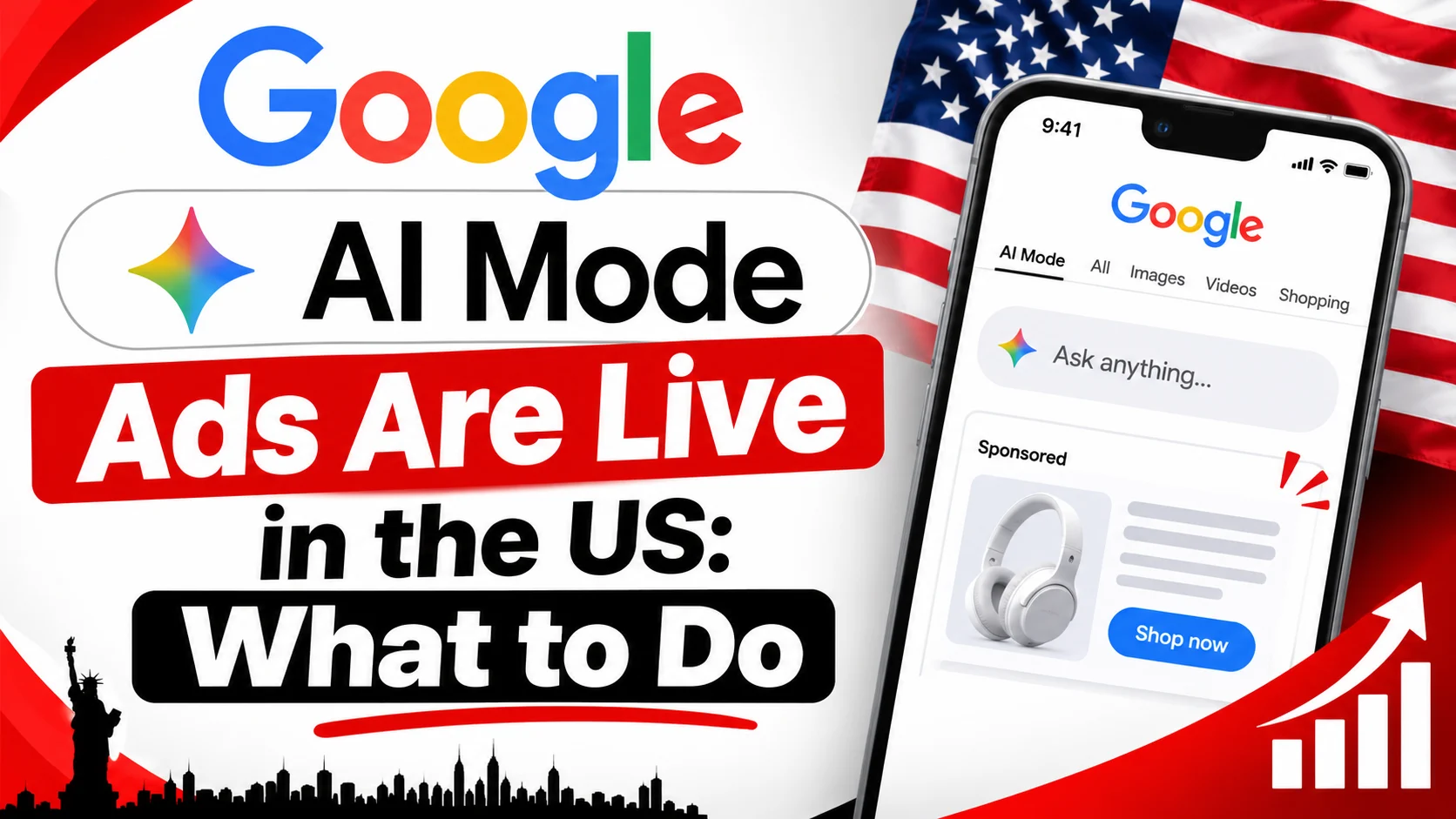
Google AI Mode Ads Are Live in the US, and the newest piece of the rollout matters most for advertisers. On October 28, 2026, Google announced multiturn ads in the US, which let sponsored results appear when someone asks follow-up questions inside an AI Mode conversation, not just on the first query.
That changes how people can find your business. A shopper no longer types one keyword and clicks. They ask a long question, read an AI-generated answer, then keep asking until they are ready to choose. Paid ads can now be part of that conversation.
In this guide, you will learn what Google AI Mode ads are, how they differ from traditional Search ads, what you can and cannot control, and the practical steps US businesses should take now.
What Are Google AI Mode Ads?
Google AI Mode ads are regular Google Ads that appear inside or alongside AI Mode, Google's conversational search experience. According to Google Ads Help, they sit in sections clearly labelled "Sponsored" and are visually separated from organic content.
- Traditional Search ads respond to a single typed query on the results page.
- Ads in AI Overviews appear within or near the short AI summary on some results pages.
- Ads in AI Mode appear in a back-and-forth conversation, and with multiturn ads, can appear across follow-up questions.
Three facts from Google's documentation are worth knowing:
- No new campaign type: Existing Search, Shopping, and Performance Max campaigns are automatically eligible, with no separate budget.
- Same auction: These ads use the standard Google Ads auction and your current bidding model, and Google says there is no extra charge to participate.
- Organic answers stay independent: Google states that paid advertising does not influence the organic responses its AI generates.
Ads in AI Mode currently serve in English. In some placements, Google may also show an "AI explainer," short Gemini-generated text describing how a group of ads relates to the question. Advertisers cannot write, edit, or opt out of these.
Why Google AI Mode Ads Are Live in the US Matters for Businesses
Conversational search tends to produce longer, more exploratory questions. Google's own example: someone asks why their pool turned green, and the AI answer creates commercial context for algae treatments or pool vacuums, even though the question was not a shopping query.
- The opportunity: you may reach people earlier, while they are still researching and comparing. A plumber, an accounting firm, or an online retailer can appear while the customer is still building a shortlist.
- The risk: early-stage questions do not always signal a ready buyer. As Search Engine Journal noted, a longer question or another follow-up does not, on its own, show someone is ready to buy. Loose targeting and generic landing pages can turn this reach into unqualified traffic.
That is why relevance, landing-page quality, and conversion measurement matter more than ever.
How Multiturn Ads Work in Google AI Mode
A Google spokesperson described multiturn ads, per Search Engine Roundtable, as ads that appear on responses to follow-up queries as users go back and forth with AI Mode.
Google matches ads in two ways. Direct matching connects an ad to a query that already shows clear intent. Contextual matching connects it to both the query and the AI response when intent emerges from the conversation.
Illustrative example (not an official Google scenario):
- A user asks, "How can a small accounting firm spend less time on bookkeeping?"
- The AI answer covers automation, outsourcing, and software.
- The user follows up: "What does outsourced bookkeeping cost for 15 employees?"
- Then: "Which providers near Dallas work with construction companies?"
By the fourth question, the user has described a service, a company size, and a location. A relevant, eligible ad could appear at that moment, but whether yours does depends on campaign type, targeting, bids, ad quality, and the auction. Eligibility is not a guarantee of impressions.
Google has not published how many ads can appear in one conversation or when multiturn ads will expand beyond the US. Treat claims that go further as unverified.
What US Businesses Should Do Immediately
Even though Google AI Mode Ads Are Live in the US, you cannot target AI Mode on its own or opt out of it separately from Search. The practical goal is a healthy overall account.
1. Audit Existing Google Ads Campaigns
Review campaign types, budgets, locations, targeting, and at least 90 days of conversion data. Ask which campaigns produce qualified leads or profitable sales, which spend heavily with little downstream value, and whether your conversion actions measure the right outcomes.
Also check for AI Max or campaign-level broad match. Industry reports indicate Google began automatically upgrading some Search campaigns to AI Max for Search in September 2026, so confirm the settings in your own account.
2. Review Keyword Targeting and AI-Powered Matching
Per Google's documentation, AI Max for Search, broad match, Shopping, and Performance Max are eligible for both direct and contextual matching. Exact and phrase match are eligible only when a query shows direct commercial intent.
That does not mean everyone should switch to broad match. Test AI-powered matching on campaigns with solid conversion tracking, enough budget, and a well-maintained negative keyword list. Review the search terms report weekly. Google notes AI Mode queries appear there in aggregate, and reported terms may approximate the user's intent. Negative keywords and brand exclusions still apply.
3. Improve Ad Copy for Conversational Search Intent
Conversational users describe problems, constraints, and outcomes. Name the problem you solve ("Same-day AC repair in Phoenix"), include details people ask about such as service area, pricing approach, and timelines, and avoid exaggerated promises.
Google recommends text customisation in AI Max for Search and Performance Max so assets can adapt to conversational queries. If you enable it, review generated assets regularly and use asset pinning where wording must stay exact.
4. Optimise Landing Pages for Qualified Leads
A visitor who arrives after a detailed AI conversation expects a detailed answer. A generic homepage creates a disconnect between what the ad promised and what the page delivers.
Build focused pages with:
- A headline matching the service or product in the ad
- Specific benefits, process steps, and pricing guidance where possible
- Verifiable trust signals such as reviews, licenses, and certifications
- A prominent call to action and a short form that asks only what you need
Check mobile usability and page speed, since many AI-assisted searches happen on phones. If you use final URL expansion, review your URL exclusions so ads do not land on pages never meant to convert.
5. Improve Conversion Tracking
Google advises pairing AI-powered targeting with Smart Bidding backed by accurate first-party conversion data, collected through the Google tag or offline conversion imports.
Review:
- Google tag implementation: confirm it fires on real conversions only.
- Forms and calls: track submissions, click-to-call, and call duration where relevant.
- Lead quality: separate raw enquiries from qualified leads and paying customers.
- CRM integration: import lead status back into Google Ads so bidding learns from revenue, not form fills.
If leads show in Google Ads but not in your CRM, fix that first. Our guide on why Google Ads leads are not showing up in your CRM covers the usual causes.
How Different US Businesses Can Prepare
- Local and service-based businesses: Sales cycles are short, and calls matter. Prioritise call tracking, location targeting, and service-specific pages. For example (illustrative), an HVAC company should separate emergency repair from new system installation, because urgency and budgets differ.
- B2B and professional services: Sales cycles are longer, and a form fill is rarely a sale. Track lead stages in your CRM, import qualified-lead or closed-deal data, and address decision-maker concerns such as compliance, process, and expertise.
- Ecommerce: Shopping and Performance Max are central. Google recommends complete Merchant Centre feeds with clear titles, descriptions, images, pricing, shipping, and return policies, consistent with your product pages.
How to Measure Google AI Mode Ad Performance
Google reports AI Mode and AI Overviews performance only in aggregate. Impressions, clicks, conversions, and cost are folded into standard campaign reports, so you cannot calculate a CPA or ROAS specific to AI Mode.
- Track core metrics at campaign level: impressions, clicks, conversions, cost per qualified lead, and return on ad spend.
- Judge efficiency by cost per qualified lead: not cost per click.
- Compare meaningful periods: Use several weeks of data and avoid conclusions from small samples.
- Change one thing at a time where possible: Enabling AI Max changes several variables at once.
- Use CRM data: see which campaigns produce valuable customers, not just cheap leads.
If results shift after this rollout, timing alone cannot prove AI Mode was the cause.
Common Google AI Mode Advertising Mistakes to Avoid
Because Google AI Mode Ads Are Live in the US, early missteps can get expensive.
- Increasing budgets without validating performance: More spend multiplies unproven results.
- Using broad targeting without monitoring relevance: Review search terms and add negatives regularly.
- Ignoring negative keywords and available controls: They remain your main protection against irrelevant traffic.
- Sending all visitors to a generic homepage: Match the page to the intent.
- Measuring success using clicks alone: Clicks do not pay invoices.
- Assuming paid ads guarantee organic AI recommendations or rankings: Google states ads do not influence organic AI answers.
Should Your Business Hire a Google Ads Agency?
Not every business needs one. If your account is simple, tracking is clean, and you can review search terms weekly, in-house management can work.
Consider outside help when tracking is unreliable, enquiries are plentiful but rarely qualified, spend rises without matching revenue, or nobody has time or expertise to manage AI-powered settings.
When evaluating an agency, ask about budget transparency, relevant industry experience, reporting that goes beyond clicks, and goals tied to business outcomes. Be wary of guaranteed rankings or lead volumes.
Ingenious HiTech is a Los Angeles-based digital marketing and technology company. Our PPC advertising services cover Google Ads management and campaign optimisation, and we also offer performance marketing, SEO, and web design so your ads, tracking, and landing pages work together.
Frequently Asked Questions
1. What does Google AI Mode Ads Are Live in the US mean?
It means ads can appear in Google's AI Mode for US users, and since October 28, 2026, that includes multi-turn ads on follow-up questions. All are labelled "Sponsored."
2. Do businesses need a separate campaign for Google AI Mode ads?
No. Google states that existing Search, Shopping, and Performance Max campaigns are automatically eligible, with no separate budget.
3. Can small businesses benefit from Google AI Mode ads?
Possibly. Small businesses can compete through relevant targeting, strong landing pages, and accurate conversion tracking. Results are not guaranteed, so grow budgets only after performance is validated.
4. How should advertisers optimise campaigns for conversational searches?
Use AI-powered targeting where it fits your goals, pair it with Smart Bidding and reliable conversion data, write copy that addresses real customer problems, and use focused landing pages. Keep monitoring search terms and negatives.
5. Can advertisers target only AI Mode placements?
No. Google states you cannot target AI Overviews or AI Mode exclusively, or opt out of them separately from Search.
6. How can businesses measure whether Google AI Mode ads generate leads?
Google reports results only in aggregate, so measure at campaign level, track qualified leads and customers through your CRM, import offline conversions, and compare meaningful time periods.
Final Takeaway: Prepare Your Google Ads Strategy for AI Search
Now that Google AI Mode Ads Are Live in the US, preparation matters more than speed. The priorities are familiar: keep targeting relevant, monitor search terms and negatives, write copy that answers real questions, send traffic to focused landing pages, and fix conversion tracking so you can see qualified leads and revenue.
If you are unsure where your campaigns stand, Ingenious HiTech can review your account and help plan next steps. Contact our team to discuss your advertising performance and lead-generation goals. It is a practical, no-pressure conversation about what is working and what is not.