
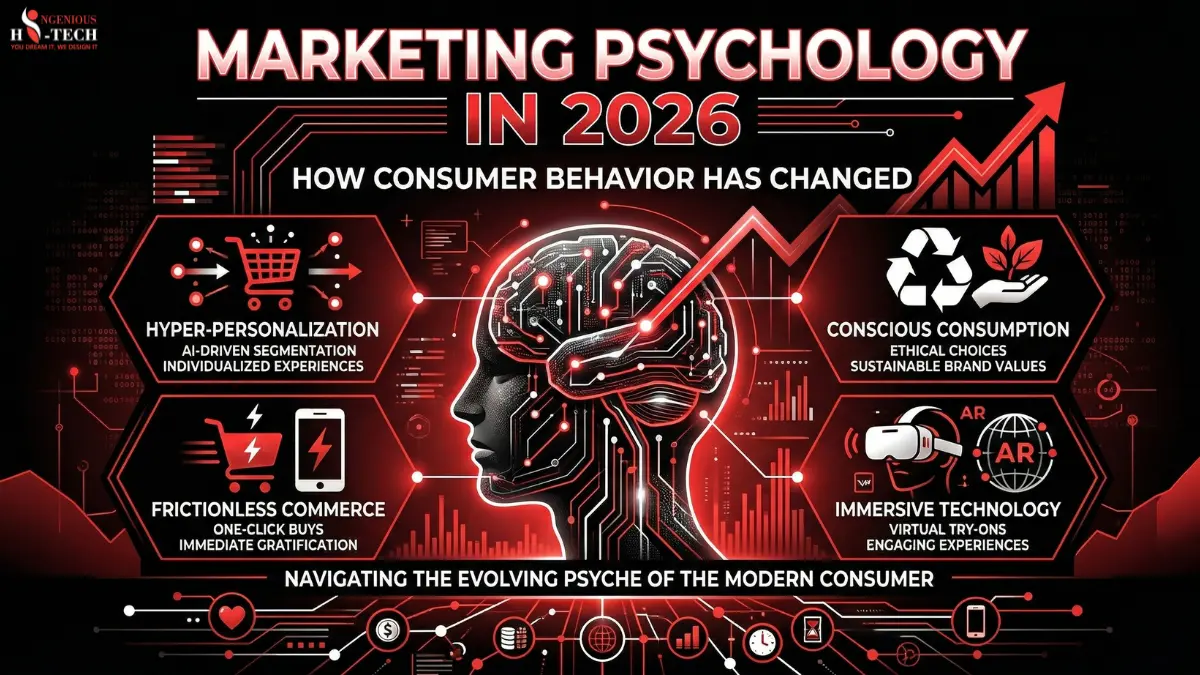
The world of marketing has never been more fascinating or more complex than it is now. As we continue to progress further and further into 2026, businesses and marketers alike are experiencing a fundamental shift in the way that consumers think, feel, decide, and buy. While being aware of consumer Behaviour trends 2026 is not a competitive advantage anymore, it is a requirement for any brand to remain relevant, credible, and successful in this highly fragmented digital world.
The New Consumer Mindset Has Arrived
In order to grasp the current state of consumer psychology, it is important to first recognize what has led us here. The accelerated pace of artificial intelligence, the acceptance of the hyper-personalized experience of the digital world, and the collective awareness of the world on the topics of authenticity and mental health have all led to the rewiring of the brain of the modern consumer. People in 2026 are the most informed, the most skeptical, and the most emotionally driven consumers the world has ever seen.
The classic marketing funnel of a smooth, linear journey from awareness to purchase has, in essence, imploded. The customer journey is no longer a line, but a loop, a zigzag, a spiral, as the customer discovers the brand on a short-form video platform, researches the brand via an artificial intelligence assistant, reviews the brand via community reviews, abandons the purchase, re-discovers the purchase via a curated newsletter, and finally converts the purchase via a voice-activated device weeks later. Every experience has profound psychological implications, and the marketer who doesn't grasp this non-linear, emotional journey is missing out on enormous value.
The AI Impact on Consumer Behaviour Is Deeper Than Most Brands Realize
Perhaps the most significant, transformative force currently being felt within the psychology of the consumer in the world of marketing today is the concept of artificial intelligence, not only as an element used within the world of marketing, but also as an experience the consumer has already internalized. The effect of AI on consumer psychology has, of course, gone well beyond the simple concept of the chatbot or recommendation engine. The fact of the matter is, AI has changed the very nature of how the consumer takes in information or makes decisions.
The consumer no longer scrolls through the ten links on the page of the search engine results. Instead, they ask the question, and the answer is given to them through the synthesizing power of the AI. The implications for consumer psychology are enormous, as the very idea of trust has, in essence, been outsourced to the algorithm. The consumer is psychologically locked into what the AI presents to them. If your brand is not part of the conversation, then, psychologically, your brand does not exist.
Outside of search, personalization powered by AI has created a consumer experience that has become unrealistic. In essence, people have subconsciously become conditioned to think that every single time they have a digital experience, it should be tailored to them. When it does not, there is a quantifiable loss of engagement that subconsciously says to the consumer, "This brand does not understand me." This has been created by years of having Netflix and Spotify curate music and TV shows based on our interests before we even consciously know them. In 2026, personalization is not a delight; it is a requirement.
Digital Consumer Behaviour Trends Reshaping the Entire Marketing Landscape
The digital consumer Behaviour trends for 2026 are also greatly influenced by attention economics. The average consumer is more aware than ever that their attention is being competed for, monetized, and even manipulated. However, this has created a new type of psychological state wherein consumers have never been more resistant to advertising and yet never more receptive to brand storytelling than they have been in recent history.
Video content continues to reign supreme as the primary way for emotional brand connections to happen, but the psychology behind this has shifted. Consumers in 2026 do not simply engage in short-form video content. After all, it is short-form. Consumers engage in short-form video content because they believe they’re experiencing a sense of authentic and unscripted human connection. Brands that successfully connect to this psychology are those that manage to produce video content that is not only discovered but also feels unscripted and not promoted. The psychological driver behind this is serendipity, or stumbling upon something authentic.
Social proof has also experienced a tremendous psychological shift. The influencer marketing era based solely on the number of followers is, in effect, over. Consumers have become incredibly sophisticated in terms of their internal radar for authentic sponsored content. They are much more responsive to micro-communities, peer recommendations, and user-generated content that has no discernible transactional agenda. The psychology of this can be summed up by the concept of tribalism. People trust people who are part of their tribe.
The Psychology of the "Slow Consumer" The Most Underestimated Trend of 2026

Amidst all the hubbub surrounding AI, hyper-personalization, and digital acceleration, one of the most potent and yet least talked-about shifts in consumer Behaviour is that of the "Slow Consumer," a term that Behavioural psychologists are now beginning to use to describe that consumer who, overwhelmed by too many choices and too many digital stimuli competing for their finite attention span, has now made a very deliberate and very psychological choice to slow down and buy less, research more, and emotionally invest only in brands that they now trust over time.
This is not minimalism for design reasons. This is a psychological defense mechanism. The human brain was never designed to process all the marketing messages, all the choices, and all the buying decisions that now bombard it on a constant basis. Decision fatigue is now an epidemic-level psychological phenomenon whereby the quality of decisions made decreases significantly after an extended period of making decisions. As such, a very significant and very deliberate segment of consumers has now redefined their very relationship with consumption and brands. They are not disconnected from brands. They are hyper-connected to very few brands.
For marketers, this is both a caution and an enormous opportunity. The caution is that competing for attention through volume, more advertising, more content, more touchpoints, is actually a deterrent to this consumer. The opportunity is that if your brand is able to secure a position within the Slow Consumer's inner circle, the loyalty that is returned is unprecedented in its stickiness to other brands’ offers and in its likelihood to create word-of-mouth advocacy for your brand. This is because this consumer does not simply purchase from you; they advocate for you in conversation, spontaneously promote you to others, and continue to purchase from you because to do otherwise is to experience personal loss.
The psychological key to reaching the Slow Consumer is patience and substance. They prefer depth over breadth; that is, one in-depth long-form content piece of genuinely useful information will always win out over twenty short pieces of promotional content. They will reward you as much for your candor about your product’s limitations as they will for your passion about your product’s strengths. And they will place an almost unimaginable value on post-purchase experience because they have already emotionally invested in making that purchasing decision. A brand that appears after the sale as enthusiastically as it did before it is a brand that will find a place in this consumer’s permanent inner circle, and in 2026, that is the most valuable marketing asset a company can hope to build.
Consumer Psychology in Marketing: Emotion, Identity, and the Ethics of Influence
However, at the deepest level, the psychology of the consumer in the field of marketing in 2026 is all about identity. The consumer is not buying a product; the consumer is buying an identity of who they are, what they believe in, and what kind of future they want to live in. Sustainability, social responsibility, and ethical transparency are not niche differentiators anymore; these are identity statements that the consumer uses to determine if the brand resonates with their self-identity.
The shift has given tremendous power to the psychology of the values of the brands. Study after study and consumer Behaviour have proven that if the values of the consumer are the same as the demonstrated values of the brand, the level of loyalty increases manifold. The word "demonstrated" is important in this context, as in 2026, the consumer can instantly look up the values of the brand and compare them with what the brand says on social media in seconds. Any discrepancy between what the brand says and what the brand does is psychologically perceived as betrayal.
One of the oldest psychological triggers in marketing history, scarcity and urgency, has also been rewritten. Consumers have become immune to tactics such as manufactured urgency through countdown timers and "only 3 left" notifications. Now, emotional scarcity has become the new norm, that is, that a brand experience, community, or moment of human connection is rare and worth engaging with now.
The Future of Consumer Behaviour: What Comes Next
As one looks to the future, it is possible to see that consumer Behaviour will be driven by three trends converging at once: the further embedding of AI decision-making into our lives, the growing psychological imperative for human connection in a world that is increasingly digitally saturated, and the growing imperative for consumers to support brands that contribute to our individual well-being, not exploit our psychological weaknesses.
Neuromarketing and Behavioural economics will continue to have more influence on how brands shape their digital environments, but only those brands that utilize this information for ethical purposes to help reduce friction and deliver actual value to consumers will be successful. Consumers of the coming years will not only reward ethical brands, but they will also punish unethical ones to the point of abandonment.
The marketers who thrive in this environment will be those who see consumer psychology not as a means of extraction but rather as a basis for relationship building. The ability to understand how and why people make decisions that are influenced by AI, shaped by digital culture, and rooted in identity and values is now, and will continue to be, the fundamental competence of marketers in 2026 and beyond.
Frequently Asked Questions:
1. What is marketing psychology in 2026?
Marketing psychology in 2026 refers to the use of Behavioural science, data, and artificial intelligence to understand how consumers think, feel, and make decisions. It goes beyond traditional persuasion by combining emotional triggers, real-time data, and predictive algorithms to influence buying Behaviour more precisely than ever before.
2. How has consumer Behaviour changed in 2026?
Consumer Behaviour in 2026 has become faster, more personalized, and heavily influenced by digital experiences. People rely more on AI recommendations, social proof, and instant content, while traditional brand loyalty has decreased. Consumers now expect quick, relevant, and seamless experiences across multiple platforms before making decisions.
3. How does AI influence consumer Behaviour?
AI influences consumer Behaviour by predicting preferences, recommending products, and reducing decision fatigue. It shapes what users see online, which directly impacts their choices. Over time, consumers begin to trust AI suggestions, making it a powerful factor in modern marketing psychology.
4. Why is personalization important in marketing psychology today?
Personalization is important because consumers expect content and offers tailored to their needs and interests. When marketing feels relevant, it increases engagement, trust, and conversions. In 2026, personalization is not a bonus but a standard expectation driven by data and AI.
5. What are the biggest consumer Behaviour trends in 2026?
The biggest trends include AI-driven decision-making, shorter attention spans, demand for personalized experiences, increased focus on trust and transparency, and the rise of multi-platform buying journeys. These trends show that consumers want convenience, speed, and relevance.
6. How has the customer journey changed in recent years?
The customer journey is no longer linear and predictable. Consumers now interact with brands across multiple channels such as social media, search engines, and video platforms before making a decision. This creates a complex journey where each touchpoint plays a role in influencing the final purchase.
7. What role do emotions play in consumer decisions today?
Emotions play a major role in modern consumer decisions, often more than logic. Factors like fear of missing out, trust, excitement, and social validation strongly influence buying Behaviour. Marketing strategies that connect emotionally tend to perform better than purely informational approaches.
8. How can businesses adapt to changing consumer Behaviour in 2026?
Businesses can adapt by focusing on personalized experiences, using AI tools strategically, creating high-quality and intent-driven content, and building trust through transparency. Understanding the customer’s mindset and delivering value at every stage of the journey is essential for success.
9. Why is trust more important than ever in marketing?
Trust has become critical because consumers are more aware of data privacy and marketing tactics. Brands that are honest, transparent, and consistent are more likely to gain long-term loyalty. Without trust, even the most advanced marketing strategies fail to convert.
10. What is the future of consumer Behaviour beyond 2026?
The future of consumer Behaviour will be shaped by deeper AI integration, hyper-personalization, and more immersive digital experiences. Consumers will expect even faster, smarter, and more intuitive interactions, making it essential for businesses to continuously evolve their strategies.