
Introduction: Why SEO Still Matters in 2026
In case you own a small business, chances are that you have heard the saying "you have to be on Google." By 2026, nothing much has changed, although the SEO game has definitely evolved. Search engines are more intelligent, AI-generated responses appear at the top of your search results, and user intentions rule the roost. And yet, amidst all this change, SEO continues to be one of the most rewarding investments that small businesses can make.
More than 68% of all online journeys start with a search engine. Even in the face of advancements like AI-generated overviews provided by Google, users continue to visit websites when they seek concrete and credible information. Whether it is a local service, product comparison, or business decision-making, organic search results remain relevant as ever before.
What has changed is the way you earn those rankings. Stuffing keywords and creating link farms won't take you anywhere anymore. Modern-day SEO is all about establishing your credibility and providing users with answers that others cannot. This guide tells you precisely how.
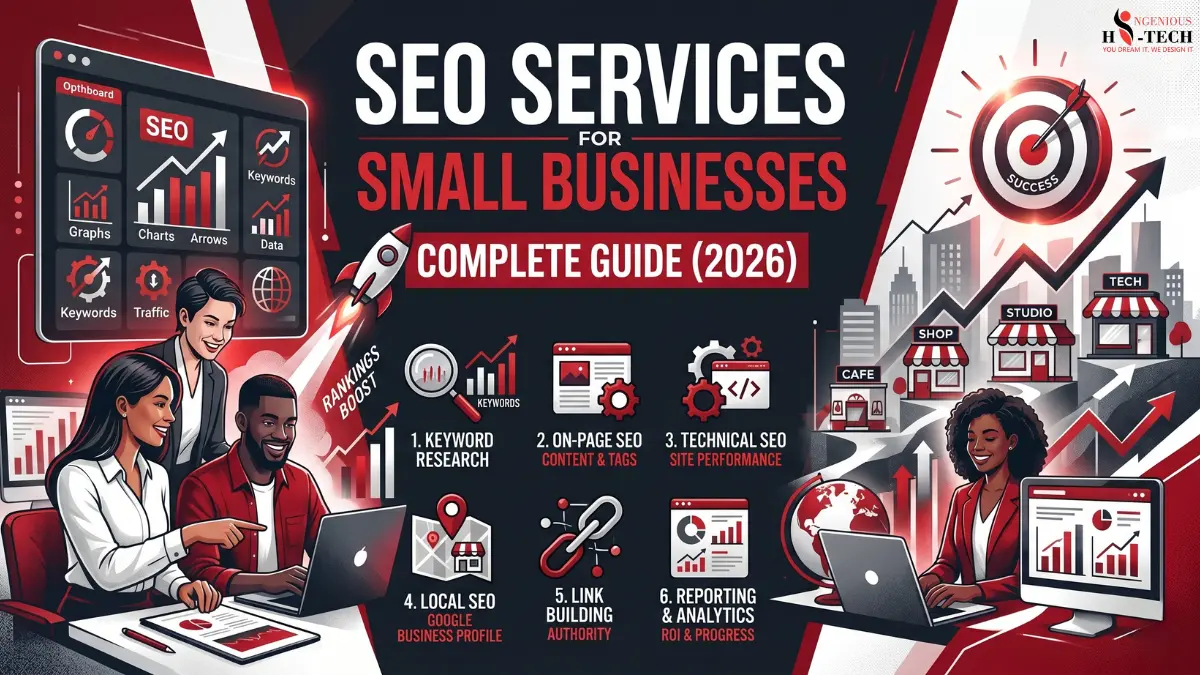
What Are SEO Services?
SEO is a series of strategies and techniques that aim at increasing the visibility of a particular website on search engines such as Google. This will ensure that more people are able to access your site and do business with you without having to pay any extra fees for advertisements.
SEO services are offered either by individuals, companies, or even through software. They include all aspects, ranging from the structuring of the website itself to the creation of content and the establishment of your credibility in cyberspace.
Types of SEO Services
On-Page SEO
SEO that is carried out on-page deals with anything inside the website, from the titles to headings, meta descriptions, internal linking, keyword placement, and even image optimisation. The idea behind on-page SEO is to make sure that it will be easy for search engines and people visiting your site to understand its content.
Technical SEO
Technical SEO is about making sure your website is healthy and works well. This means it should load fast, work well on phones, have a secure connection, be easy to navigate and have correct information. It also means fixing links. A good website is the foundation for everything.
Off-Page SEO
Off-page SEO is about making your website look good and trustworthy on the internet. You do this by getting trusted websites to link to yours. Each link is like a vote that says your website is good. Writing guest articles, getting mentioned in the press, and working with partners can help.
Local SEO
Local SEO is super important for businesses that serve an area. It helps you show up in Google and get customers. This means making sure your Google Business Profile is good, showing up in searches for things near people, getting reviews and listing your business in directories. Good local SEO can make a difference for your business.
Content SEO
Content SEO is about creating content that answers people's questions. This can be articles, pages on your website, FAQs and more. You want to help people and make them trust your business. This is how small businesses can compete with ones on search engines.
How SEO Works in 2026
Search engines use a lot of things to figure out which pages are good enough to be at the top. In 2026, there are some really important things.
E-E-A-T is a deal. It means Experience, Expertise, Authoritativeness and Trustworthiness. Google wants to know if the person who made the content really knows what they are talking about. For businesses, this means showing that you are good at what you do. You can do this by showing your credentials, what your customers say about you and real stories about how you helped people.
AI is also really important now. Google uses AI to get answers from websites that are easy to understand and have good information. If your website is used to answer questions, you will get a lot of visitors. This is because the same things that make your website good for SEO also make it good for AI.
What people do on your website is also important. How long they stay, if they go back away and what they do on your website all matter. Making a website that people like and that is good for SEO is basically the thing.
Finally, what people are looking for when they search is really important. Google is really good at knowing what people want. If you make content that matches what people are looking for, you will do well. You have to know if people are looking for information, trying to find a website, or wanting to buy something.
Benefits of SEO for Small Businesses
SEO provides steady and free traffic without spending money on advertisements. As compared to paid campaigns, which will cease to deliver any results once you exhaust your budget, SEO ranking will keep on providing traffic to you month by month. Moreover, SEO builds authority; users tend to trust organic results over paid results.
In particular, local SEO brings equality to the table and gives small companies an opportunity that they would have never gained otherwise. If your business listing and a few backlinks are done well, you can easily outrank the giant company located in the same geographical location. Since SEO is cumulative in nature, the results obtained in month twelve will be superior to those in month three.
The most crucial aspect of SEO is that it brings qualified leads. If someone is looking for emergency plumbing services in Leeds or the best accountants for freelance workers, then the chances of them buying something from you are very high indeed.
Common SEO Mistakes to Avoid
Many small business owners commit mistakes without even knowing it that affect their online visibility. Failing to pay attention to local SEO is the most costly mistake because not verifying or optimising your Google Business Profile means leaving potential visibility on the table that other companies are probably capitalising on.
Another mistake is producing thin or duplicated content, which will not only fail to rank well but will also drive away customers. In the same way, page speed, which is an important ranking factor, is often overlooked because about 50 per cent of people leave a website if it takes more than three seconds to load.
There are other mistakes, such as ignoring mobile optimisation, giving up after a few days, and purchasing low-quality backlinks, which could get you penalised by Google and cost you several months of recovery time.
What to Expect from a Good SEO Service Provider
An experienced company will first audit the current status of your website along with its competitors before coming up with any plans. After that, you can count on them for developing the strategy and providing you with regular and transparent reports and realistic timelines.
When choosing an SEO provider, be careful of those making unrealistic promises, such as promising to get you a "position 1 in 30 days", along with unclear deliverables and a lack of interest in your objectives. In order to perform their job well, the SEO specialists need to have good knowledge of your customers.
SEO Pricing for Small Businesses (2026 Overview)
The cost of services can be highly different based on the kind of vendor and the complexity of the task. The average DIY tool costs just $50-$150 per month and is appropriate for solopreneurs or extremely budget-conscious entrepreneurs. An independent SEO consultant will cost about $300-$1,000 per month and works excellently for small websites or particular projects. Small SEO agencies will charge an average of $750-$2,500 per month and would fit well into growing organisations that require consistency. On the other hand, full-service SEO agencies will cost more than $2,500 per month.
Cost shouldn't necessarily dictate your choice. The SEO consultant charging $500 per month and knowing the local market will probably perform better than a large SEO agency charging $2,000 per month, but considering you a lower priority. Always request examples of past successes in businesses similar to yours.
DIY SEO vs Hiring Experts
DIY SEO is completely feasible for small businesses with straightforward websites, a local clientele base, and a desire to learn. Free tools, Google Search Console, and even tools such as Ubersuggest will go a long way. The only drawback with DIY SEO is that it can be very time-consuming, and time is the most valuable commodity for a small business owner.
It may make more sense to hire professionals if your business operates in a highly competitive environment, if you require rapid results, or if there are technical aspects such as website migration and schema markup that need to be done.
How to Choose the Right SEO Service
Start by clarifying your objectives. Is it increased traffic, increased orders from websites, or increased inquiries? A clear objective will make the whole process of judging the value of an SEO service much simpler.
Look up some case studies and testimonials from similar companies within the same business verticals. Inquire about their measurements of success, what kind of reports they deliver, and whether or not they conduct an initial audit before recommending any course of action. Lastly, be wary of services that guarantee any results.
Local SEO Strategy: Actionable Steps
Local SEO is by far the quickest way to see a return on investment. Here is how to start the process.
First, upload pictures, add services provided, have accurate opening times, and include links to your website. This will decide what you show up for.
Then, work on gathering more reviews. Request reviews from happy customers and answer every single one of them, good and bad. Consistency in NAP (Name, Address, Phone) should be established for Yelp, Apple Maps, and local directories. Otherwise, there will be confusion among search engines and people.
In case you work in different towns or regions, create a separate page for every region along with locally optimised content. Finally, get some local backlinks by partnering with local organisations or writing for their media.
SEO Tools Worth Using
Free options include Google Search Console, Google Analytics 4, and Google Business Profile, which will give you an idea of your website performance, the sources of your visitors, and customer discovery.
To perform SEO keyword research, one can use tools such as Ubersuggest, AnswerThePublic, or the built-in tool by Google called Keyword Planner. If growth is your goal, then full-spectrum platforms such as Ahrefs, SEMrush, or Moz will provide competitive insights and backlinks analysis that are worth the price.
For an SEO audit, it would be best to use Screaming Frog (the free version works up to 500 URLs) and PageSpeed Insights, both of which will provide information on issues that might impact your rankings. For local-specific tasks, the two industry leaders are BrightLocal and Whitespark.
How Long Does SEO Take to Show Results?
Small businesses usually see their first measurable success within three to six months. More competitive markets and new websites might require six to twelve months. Search engine optimisation takes time, and by month twelve, your results will generally be better than those at month three.
The things that influence your SEO timeline include your initial level of domain authority and website health, competitiveness of your market, quality of content, and backlink power gained. Progress should be measured on a monthly basis rather than a weekly one, and try to avoid changing your SEO plan prematurely. Patience can actually be one of the best SEO strategies out there.
Future Trends in SEO (2026 and Beyond)
Overviews and Answer Engine Optimisation are the latest developments. Properly crafting content in a way that will make it useful in providing AI-based search answers is now crucial and will be rewarded with the good old basics of accuracy, clarity, and expert-level knowledge.
Voice searches keep rising with the increase in usage of smart speakers and assistants. Question-oriented and conversational content works best. There is also rapid growth in the field of video SEO, with videos both long and short form being indexed by Google.
The inclusion of local relevance in hyper-personalised search results, taking into account location, device and web history, makes local search SEO crucial. Google's core web vitals metrics for assessing page speed, user experience and visual stability have become an increasingly important factor in ranking pages.
Conclusion: Is SEO Worth It for Small Businesses?
Yes definitely. SEO services for SMEs have one of the best longevity values as well as the most effective ways of growing sustainably. As opposed to paying for advertisements that stop when you run out of funds, SEO services are built to work consistently around the clock.
This is achieved by setting your expectations right, looking at SEO as a way of bringing real value rather than using quick fixes, and either putting effort into doing it right yourself or finding a reliable company to help. For more information, you can go through Monthly SEO Services in 2026. Those who succeed in search engines are those who provide the most assistance to people.
Frequently Asked Questions
How much should a small business spend on SEO?
A reasonable starting budget is $300 to $1,000 per month for a freelance consultant, or $750 to $2,500 for a small agency. Even a modest, consistent investment in SEO will typically outperform sporadic large spends. Start with what you can sustain for at least six months.
Can I do SEO myself without any experience?
Absolutely. Start by claiming your Google Business Profile, installing Google Search Console, and publishing helpful answers to the questions your customers ask most. Free tools and beginner guides from Google itself can take you surprisingly far. As your business grows, consider bringing in a specialist for technical or competitive work.
Is local SEO different from regular SEO?
Yes. Local SEO focuses on appearing in geographically relevant searches, for example, "plumber in Manchester" or "coffee shop near me." It emphasises Google Business Profile optimisation, local citations, and location-specific content. For most brick-and-mortar or service-area businesses, local SEO should be the priority.
Will AI tools replace the need for SEO?
No, but they are changing it. AI-powered search answers still draw from websites that rank well. In fact, Google's AI Overviews often pull content from the top organic results. The rise of AI search makes quality content and authority more important, not less. SEO is evolving, not disappearing.
What is the single most important SEO action for a small business right now?
Fully optimise your Google Business Profile. It is free, takes less than an hour to set up properly, and has an immediate impact on local visibility. After that, focus on consistently collecting customer reviews and ensuring your website loads quickly on mobile. These three steps alone will put you ahead of most local competitors.