
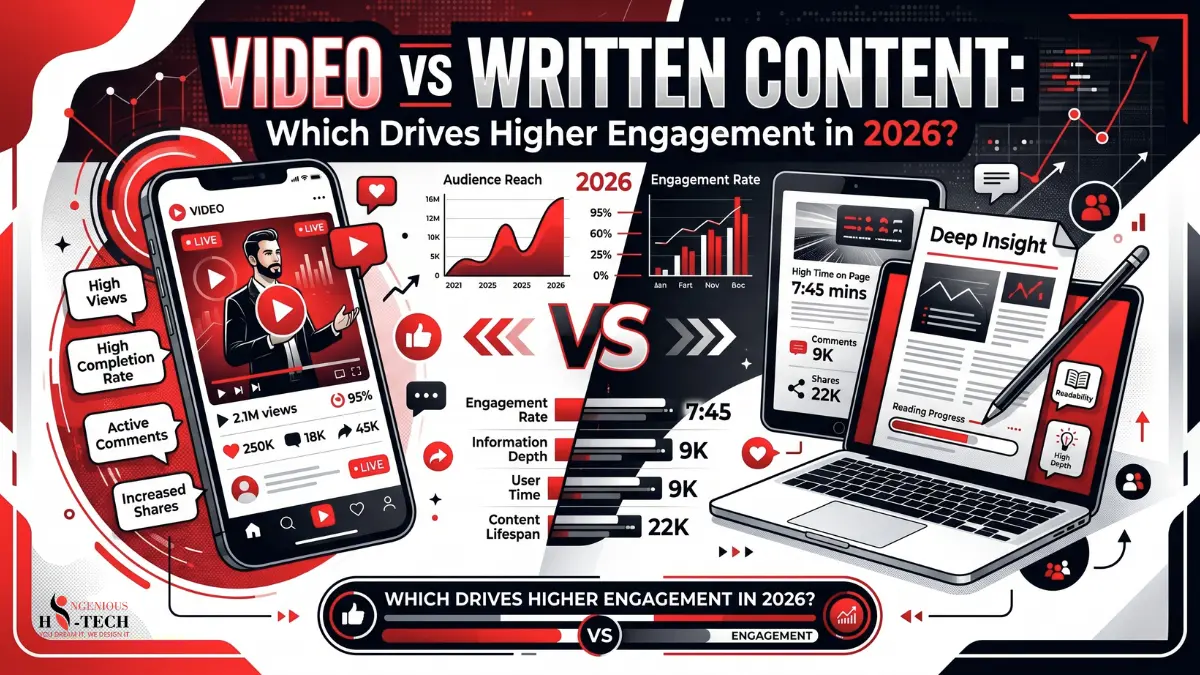
Introduction: The Content Battle Has Never Been More Complex
Content consumption in 2026 is worlds apart from what it was like five years back. AI-enabled search engines have reached the point of synthesis, providing an answer to a user query even before they hit a link. Short-form videos have made it from buzzword to baseline. Attention, ever a valuable commodity, is today the rarest form of currency in digital marketing.
What makes it harder for content creators, marketers, and business owners is figuring out the million-dollar question: which format is more engaging, video or written content? It's not an easy answer, but then again, there is no such thing as easy questions in digital marketing. With the right data in hand, however, you'll be able to choose a strategy.
What Is Video Content?
Video content is basically anything that uses moving images and sound to get a message across. By the year 2026, video content will come in different forms.
- Short video clips that are fifteen to ninety seconds long: things like Reels, TikToks, and YouTube Shorts
- Long video clips that are ten minutes or more: like YouTube tutorials, documentary-style videos, and webinars
- Live video: like when someone answers questions in time, launches a new product or shows what is happening behind the scenes
- Video made with artificial intelligence: like fake presenters and automated videos that explain things
In 2026, the big platforms for video content are YouTube, which is still the best for long video clips, TikTok, Instagram Reels and LinkedIn Video, which is really popular with businesses. Even Pinterest is a deal now for finding new video content.
So why is video content so good at getting people engaged? Video content uses sound, pictures and facial expressions and movement, all things that our brains can process quickly and remember for a time. Video content is better than text because our brains remember video content better. Studies have shown that people remember ninety five percent of what they see in a video but only about ten per cent of what they read. This is why video content like YouTube videos, TikTok videos and LinkedIn videos is so powerful for engagement.
What Is Written Content?
Some examples of written content include blog posts, articles, how-to pieces, newsletters, white papers, and case studies. It has been the lifeblood of digital marketing for 20 years, and in 2026, it is very much alive; it has just adapted.
Nowadays, the importance of written content in digital marketing lies in its ability to help with SEO and AI-based searches. With Google's SGE (Search Generative Experience) and AI Overviews relying on the indexed written content to generate answer snippets, having text-based content in place ensures your brand shows up in those answers.
Finally, written content shines when it comes to creating evergreen content that continues generating traffic and leads even years after being published. Today's well-written blog post can provide leads in 2028. Video is generally less effective in terms of compounding returns on investment.
Engagement Metrics Explained
Before declaring a winner, it's important to understand what "engagement" actually means across both formats. The key metrics differ significantly:
|
Metric |
Video |
Written Content |
|---|---|---|
|
Watch/Read Time |
Average view duration: longer = more authority |
Average time on page: 3–5 min is strong |
|
Click-Through Rate (CTR) |
Thumbnail + title drive clicks |
Meta title + description drive clicks |
|
Bounce Rate |
Session depth across videos |
Single-page exits |
|
Shares |
Viral sharing is native to video |
Social sharing, newsletter forwards |
|
Conversions |
Demo requests, product clicks post-video |
Form fills, email sign-ups, downloads |
Neither format wins across all metrics. Video leads in emotional engagement and shares. Written content leads in search-driven conversions and compounding traffic.
Video Content: Pros and Cons
Pros
- storytelling: Video helps create empathy and trust fast. A short 60-second brand video shows tone, personality and value better than thousands of words in print.
- Algorithm-friendly virality: media platforms like videos because they keep users engaged longer.
- Accessibility for consumption: People can watch videos while commuting, cooking or exercising. This makes it easy for them to consume content without reading.
- Conversion for complex products: Demo videos for software tools, physical products and online courses work better than text descriptions.
Cons
- High production cost and time: A good video needs planning, filming, editing and distribution. Even AI video tools need a lot of work to get right.
- Limited SEO depth: Search engines still have trouble understanding video content. A 10-minute video gets less search traffic than a 1,500-word article.
- Short shelf life: Short videos can go viral. Get old fast. If you don't reuse them, they stop working
- Accessibility barriers: Some users can't watch videos because of the internet, or prefer to browse silently.
Written Content: Pros and Cons
Pros
- SEO dominance: Search engines still understand text best. Optimised text gets the most search traffic.
- Evergreen compounding value: A good guide keeps generating traffic and leads with work.
- Thought leadership and authority: Long articles show expertise better than videos. They build credibility with readers and search engines.
- Low production barrier: A skilled writer can make content at a lower cost than video.
Cons
- emotional engagement: Text can't match the impact of a video with a human face and voice.
- Requires attention: Reading takes effort. Readers need to be in the mindset to finish a long article.
- Increased competition from AI content: With many AI articles online standing out with text that requires originality and depth, more than before.
SEO in 2026: The Multimodal Imperative
The SEO landscape in 2026 has fundamentally shifted in ways that affect both formats.
Integration of Google and YouTube
YouTube videos now appear not only in a separate tab called "Videos" but also as in-line results on ordinary search pages. Thus, being ranked on YouTube becomes ranking on Google itself. By posting an article and its corresponding video on the same subject, brands obtain two SERP rankings at once.
Role of AI Overviews and Its Relation to SGE
It should be noted that those AI-generated summaries will be generated based on text-based content, thus making written articles even more important. Articles that are well-organised using proper heading hierarchy, concise answers, and other content-rich structures are more likely to be cited in AI Overviews compared to raw texts or video transcriptions.
Actionable Tip: Organise your written content in a way that it would clearly answer certain questions. That is one of the key strategies to get your content cited in AI Overviews in 2026.
Multimodal Advantage of Ranking in 2026
The brands succeeding in SEO in 2026 won't be choosing between video and written content; they'll create both. Inserting a related YouTube video on the topic of the blog post boosts average time on page, reduces bounce rate, and gives a strong hint about content richness.
Audience Behaviour Trends in 2026
Understanding your audience's consumption habits is non-negotiable for any content strategy. For more information related to the audience behaviour, visit Marketing Psychology in 2026
- The mobile-first paradigm reigns supreme: In excess of 70% of all content viewing today takes place on mobile phones. While this is great news for video, which is inherently mobile, it requires that even textual content be mobile optimised with succinct paragraphs.
- Shortening attention span and higher quality bar: People can become impatient with poor quality content that fails to give them value upfront. If you offer them something of high value and utility, however, people are willing to spend their time reading your stuff thoroughly.
- Gen Z vs. millennials: The current trend in Generation Z is the preference for short-form videos for discovering new information, yet these generations turn to lengthy articles when trying to make an informed decision.
When to Use Video vs. Written Content
There is no universal answer, but here are clear directional guidelines:
Choose video when:
- You're launching or demonstrating a product (e-commerce, SaaS)
- You're targeting top-of-funnel awareness on social platforms
- Your topic is highly visual (cooking, fitness, design, travel)
- You want to build a personal brand and trust quickly
- You're targeting Gen Z audiences on TikTok or Instagram
Choose written content when:
- You're targeting mid-to-bottom funnel buyers who are actively researching
- Your goal is long-term organic search traffic
- You're in the B2B industry, where buyers read detailed case studies and guides
- You want to build domain authority over time
- Your topic requires nuance, data, and structured argumentation
The Hybrid Content Strategy: The Smartest Approach in 2026
The most successful content teams in 2026 don't debate video vs written content. They build integrated content ecosystems where each format amplifies the other.
The Repurposing Loop
A high-performing hybrid strategy typically flows like this:
- Start with a long-form blog post, research-backed, SEO-optimised, targeting specific search intent
- Convert key sections into a YouTube video using the blog as your script framework
- Clip the video into short-form content, Reels, Shorts, TikToks for social discovery
- Embed the video back into the original blog post, boosting both formats' performance
- Summarise insights into a newsletter, driving direct audience engagement
This approach means one core idea generates five to seven pieces of content, maximising ROI while creating a consistent presence across multiple platforms.
Embedding for SEO Boost
Embedding videos within articles isn't just a content strategy; it's an SEO tactic. Pages with embedded video see measurably higher dwell time and lower bounce rates, both of which are behavioural signals that correlate with better search rankings.
Future Trends: 2026 and Beyond
The content landscape will continue to evolve rapidly. Here are the forces shaping the next phase:
- Saturated content through AI production: There will be an overflow of content that is generated through artificial intelligence. It will become the major differentiator to have genuine opinions, experiences, and original research.
- Interactive content formats: Content that is shoppable, interactive quizzes inside articles, and AI personalised content will evolve into being expected rather than novel.
- AI content delivery: Artificial Intelligence will deliver the same content but in different formats to people depending on the behavioural pattern of that user.
- Audio search optimisation: Optimising for voice search is a future trend as AI evolves.
Final Verdict: Stop Choosing Sides
The winner between videos versus written material can only come down to one thing: the content that generates more engagement in 2026 will be the content that is suited to the intent of the user when they engage with it.
The true winning approach to generating greater engagement in today’s world will be a hybrid model of both types of media. By developing an integrated platform where writing brings people to you through SEO, videos connect emotionally, and short-form video makes waves on social media, you'll compound your efforts every year. For more information about content, visit Evergreen Content vs Trend-Based Content
If you can’t afford to invest in everything at once, it’s better to get started by writing for SEO optimisation first, and add video later as your budget allows.
Frequently Asked Questions (FAQ)
1. Is video better than blogs for SEO in 2026?
Not inherently. Written blog content still dominates organic search rankings because text is the primary language search engines index. However, YouTube videos do rank in Google search results, and pages that embed relevant videos often see improved engagement metrics. The most SEO-effective approach combines both: a well-optimised article with an embedded video targeting the same topic.
2. Which content type gets more engagement in 2026?
Video typically generates higher emotional engagement, more social shares, and stronger brand recall in top-of-funnel scenarios. Written content drives deeper engagement at the research and decision stage, particularly for B2B buyers and high-consideration purchases. The "winner" depends entirely on where your audience is in their journey and which platform they're using.
3. Can blogs still rank in Google in 2026?
Yes, and they remain one of the most cost-effective ways to generate consistent organic traffic. However, ranking requires higher quality standards than in previous years. Content must demonstrate genuine expertise, answer specific user intent clearly, and be structured to appear in AI Overviews and featured snippets. Generic or thin content will not rank regardless of keyword optimisation.
4. Should businesses focus on video or writing for their content strategy?
Most businesses benefit most from starting with a written content foundation, particularly blog posts, guides, and case studies, to establish search visibility and domain authority. Video should be layered in strategically for product demonstrations, brand storytelling, and social media reach. The ideal long-term approach is a hybrid strategy that repurposes core ideas across both formats.
5. How does AI-generated content affect this debate?
AI has flooded both the video and text content markets with volume. The response is not to produce more content but to produce more distinctly human content, original research, first-hand experience, strong opinions, and nuanced analysis that AI cannot authentically replicate. Whether video or written, originality and authority are the moat in 2026.
6. What is the best content format for e-commerce brands?
E-commerce brands benefit enormously from a combined approach: short-form video (Reels, TikTok) for product discovery and emotional appeal, product page copy and buying guides for search-driven purchase intent, and embedded demo videos for conversion optimisation. Neither format alone is sufficient for a complete e-commerce content strategy.