
Introduction
Picking a website platform feels like a small decision until you're six months in and realise you built on the wrong one. At that point, you're not just tweaking a few pages; you're rebuilding from scratch, losing SEO rankings, and paying twice for something you should have gotten right the first time.
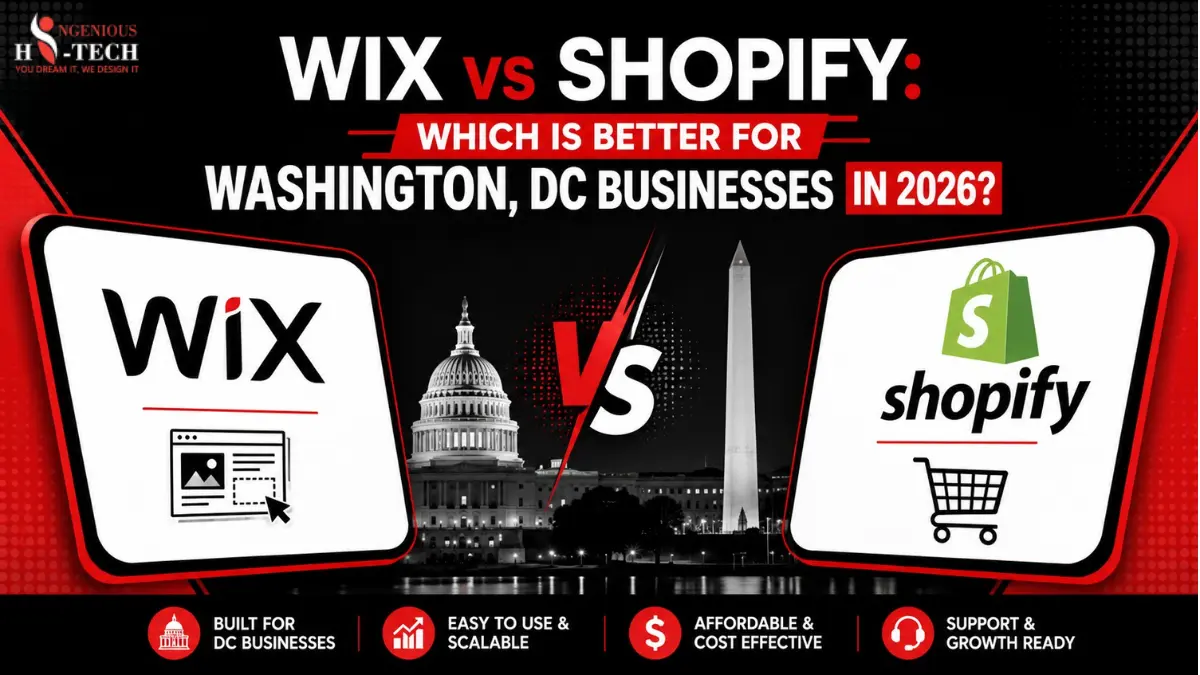
That's exactly why the Wix vs Shopify question comes up so often with Washington, DC business owners. DC has a unique mix of clients: law firms near Dupont Circle, retail shops in Georgetown, consultants working out of NoMa, restaurants along H Street, and a growing number of ecommerce brands competing nationally. Each of these businesses has different needs, and the platform that works beautifully for one can be the wrong fit for another.
We've built and managed websites on both platforms for clients across the DMV area, and we've seen firsthand where each one shines and where it falls short. In this guide, we'll walk through everything you actually need to know: pricing, SEO, ecommerce features, design flexibility, and real recommendations based on your type of business, so you can make this decision with confidence rather than guesswork.
Quick Answer
For most Washington, DC service businesses, restaurants, and professionals, Wix is the easier, faster, more affordable choice. For businesses that sell products online, especially ones planning to scale, Shopify is the stronger long-term investment. If you're still building your brand and don't sell physical products, start with Wix. If ecommerce is central to your business, Shopify will save you headaches later.
Understanding Wix and Shopify
What Is Wix?
Wix is a drag-and-drop website builder built for business owners who want control without needing a developer. You can design a homepage, add a booking system, publish a blog, and launch a basic online store all without touching code. It's especially popular with service-based businesses, local shops, and professionals who need a polished site without a big budget.
What Is Shopify?
Shopify is an e-commerce platform first and a website builder second. Everything about it the dashboard, the apps, the checkout process is built around selling products efficiently. It powers everything from single-product startups to national retail brands, and it's the platform most agencies recommend once a business is serious about online sales.
Who Should Use Each Platform?
Wix tends to fit businesses that need a strong online presence but aren't selling large product catalogues think consultants, clinics, law firms, and restaurants. Shopify fits businesses where the website's main job is processing transactions, managing inventory, and scaling order volume.
Neither platform is "better" in a vacuum. It depends on what your website needs to do for your business.
Wix vs Shopify: Quick Comparison Table
|
Feature |
Wix |
Shopify |
|
Ease of Use |
Very beginner-friendly |
Beginner-friendly, ecommerce-focused |
|
Pricing |
Lower starting cost |
Higher starting cost |
|
Templates |
900+ design templates |
100+ ecommerce-focused themes |
|
Customization |
Strong for general design |
Strong for store functionality |
|
SEO |
Solid, improved significantly |
Very strong, especially for products |
|
Blogging |
Built-in, easy to use |
Built-in, more limited |
|
AI Features |
AI site builder, AI text tools |
AI product descriptions, AI insights |
|
Ecommerce |
Good for small stores |
Built for serious ecommerce |
|
Payment Options |
Multiple gateways |
Extensive, including Shop Pay |
|
Marketing Tools |
Built-in email & social tools |
Strong native + app marketing tools |
|
Apps |
Large app market |
Massive, ecommerce-specific app market |
|
Customer Support |
24/7 chat and phone |
24/7 chat, phone, and community |
|
Security |
Standard SSL, hosting included |
PCI-compliant, ecommerce-grade security |
|
Scalability |
Limited for large catalogues |
Built to scale with order volume |
|
Best For |
Service businesses, local brands |
Ecommerce and retail brands |
Wix vs Shopify: Feature-by-Feature Comparison
Ease of Use
Wix wins here for non-technical users. The editor is genuinely drag-and-drop, and their AI site builder can generate a working homepage from a short questionnaire. Shopify's dashboard is intuitive too, but it's organised around products, orders, and inventory, which makes total sense if you're selling, but feels like extra structure if you're not.
Practical recommendation: If you want to log in and update your site yourself without a learning curve, Wix is more forgiving.
Website Design and Templates
Wix offers a much larger template library with more visual variety, great for restaurants, salons, and creative businesses that want a distinct look. Shopify's themes are polished but designed to highlight products, so a service business can end up with a homepage that feels a little "storefront" even when there's nothing to buy.
Best choice: Wix for brand-first design, Shopify for product-first design.
Customization
Wix gives you pixel-level control over layout, which is great for unique designs but can also let inexperienced users create cluttered pages. Shopify's customisation happens mostly within theme structures using Liquid code, which keeps things consistent but requires more technical know-how for big changes.
SEO Features
Both platforms have made major improvements here, and we'll cover this in detail later. Shopify has historically had the edge for product-based SEO (rich snippets, structured data for products), while Wix has closed the gap significantly with better URL control, faster indexing tools, and improved site speed.
Blogging
Wix's blogging tools are more mature, with better formatting options, categories, and content scheduling. Shopify's blog exists but feels secondary, since the platform's priority is product pages, not content marketing.
Advantage: Wix, if content marketing and blogging are part of your growth strategy.
Ecommerce Features and Product Management
This is where Shopify separates itself. Bulk product uploads, variant management (size, colour, material), automated inventory tracking across multiple locations, and abandoned cart recovery are all native to Shopify. Wix Ecommerce covers the basics well for a small catalogue but starts to feel limiting past a few hundred SKUs.
Inventory and Shipping
Shopify supports multi-location inventory, real-time carrier shipping rates, and print-at-home labels out of the box. Wix offers shipping rules and basic inventory tracking, which is enough for a boutique but not for a warehouse operation.
Payment Gateways
Shopify accepts more payment methods natively, including Shop Pay, which is known to boost checkout conversion. Wix supports major gateways too, but the ecosystem isn't as deep.
Mobile Responsiveness and Page Speed
Both platforms produce mobile-responsive sites by default. Shopify tends to load product pages slightly faster because of how its infrastructure is built for transaction volume. Wix has invested heavily in speed improvements over the past couple of years and now performs competitively for content-heavy sites.
App Marketplace
Shopify's app store is enormous and almost entirely focused on ecommerce upsells, subscriptions, loyalty programs, and accounting integrations. Wix's app market is broader but shallower for ecommerce-specific needs.
Marketing Features and Email Marketing
Both include built-in email marketing and social media tools. Shopify's marketing suite leans toward automated flows tied to purchase behaviour (abandoned cart emails, post-purchase upsells). Wix's marketing tools are more general, good for newsletters, event promotion, and audience building.
AI Tools
Wix's AI site builder can generate an entire site structure from a text prompt, which is genuinely useful for business owners starting from zero. Shopify's AI tools (Shopify Magic) focus on writing product descriptions and generating store insights more narrowly, but are well-suited to retail.
Customer Support
Both offer 24/7 support. Shopify's support ecosystem is larger due to its bigger user base of agencies and developers, so troubleshooting help is easier to find online. Wix support is responsive and generally sufficient for standard issues.
Security and Scalability
Shopify is built to PCI-DSS compliance standards automatically and can handle sudden traffic spikes (think a product going viral) far better than Wix. Wix is secure for standard business use but isn't designed for high-volume transaction spikes.
Wix vs Shopify Pricing
Pricing is where a lot of businesses make the wrong call, choosing based on the sticker price instead of total cost of ownership.
Wix Plans: Entry-level plans typically start lower per month, and once you're on a plan, most core features (templates, hosting, basic SEO tools) are included without extra charges.
Shopify Plans: Shopify's base plans cost more per month, and then transaction fees apply unless you use Shopify Payments. Add apps for reviews, upsells, or email marketing, and monthly costs climb quickly.
Hidden Costs to Watch:
- Wix: premium apps and advanced business features can add up
- Shopify: app subscriptions, transaction fees on non-Shopify Payments gateways, and premium themes
Overall Value: If you're not selling products, Wix delivers more value per dollar. If you are selling products, especially at volume, Shopify's higher cost is usually offset by better conversion tools and lower long-term friction.
Which Platform Is Better for Washington, DC Businesses?
- Restaurants: Wix. Menus, reservations, and local SEO matter more than ecommerce checkout.
- Law Firms: Wix. Professional templates, blogging for thought leadership, and simpler maintenance fit better.
- Healthcare Clinics: Wix. Appointment booking integrations and clean, trustworthy design are priorities, not product sales.
- Contractors: Wix. Portfolio galleries, service pages, and lead forms matter more than a shopping cart.
- Consultants and Professional Services: Wix. Content, credibility, and lead generation come first.
- Retail Stores (Physical + Online): Shopify. Inventory syncing between in-store and online sales is a major advantage.
- Ecommerce Stores: Shopify, without much debate. This is the platform's core strength.
- Nonprofits: Wix, generally donation tools and content-driven storytelling fit its strengths, unless the nonprofit sells significant merchandise.
SEO Comparison: Wix vs Shopify
- Technical SEO: Both platforms handle core technical SEO clean code, sitemaps, robots.txt control reasonably well today. Shopify has stricter URL structures for products (which can be a pro or con), while Wix gives more URL flexibility.
- On-Page SEO: Both allow custom title tags, meta descriptions, and header structures. Shopify's product pages support more built-in structured data for rich results like pricing and reviews.
- Local SEO: For Washington, DC businesses specifically, local SEO depends less on the platform and more on execution: location pages, consistent NAP (name, address, phone) data, and a connected Google Business Profile. Both platforms support this equally well.
- Schema and Meta Tags: Shopify auto-generates more product schema out of the box. Wix requires a bit more manual setup for advanced schema but supports it fully.
- Page Speed and Core Web Vitals: Both have improved substantially. Shopify tends to edge ahead on product-heavy sites; Wix performs strongly on content and service sites.
- Image Optimisation: Both compress images automatically, though manual optimisation before upload still improves results on either platform.
- Blogging for SEO: Wix's blogging tools give it an edge for businesses relying on content marketing to rank locally.
- Ranking Potential: Neither platform is inherently better at ranking; that comes down to content quality, backlinks, and technical execution. According to Google Search Central, helpful, well-structured content matters more than the platform it's built on.
- Our recommendation: Choose the platform that fits your business model first, then invest properly in SEO regardless of which one you pick. The platform won't save a weak SEO strategy, and a strong SEO strategy will work on either.
Pros and Cons
Wix Pros
- Easier learning curve
- Lower starting cost
- Larger, more varied template library
- Stronger blogging tools
- Great AI site builder for fast setup
Wix Cons
- Less powerful for large product catalogues
- Fewer advanced ecommerce automations
- Can be harder to migrate away from later
Shopify Pros
- Built specifically for ecommerce
- Scales well with order volume
- Massive app ecosystem for retail
- Strong checkout and payment options
Shopify Cons
- Higher monthly cost
- Transaction fees on non-Shopify Payments gateways
- Overkill for businesses that don't sell products
- Steeper learning curve for non-ecommerce features
Common Mistakes Businesses Make
- Choosing only by price: The cheapest plan today can cost more in migration fees later if it can't support your growth.
- Ignoring SEO from day one: Both platforms support strong SEO, but neither does it automatically. Businesses that treat SEO as an afterthought lose months of ranking potential.
- Ignoring scalability: A retail store that picks Wix because it's cheaper, then outgrows it within a year, ends up paying for a full rebuild on Shopify anyway.
- Poor planning before building: Jumping straight into a template without mapping out pages, goals, and customer journey leads to a site that looks fine but doesn't convert.
- Choosing the wrong template: A template built for a restaurant doesn't work for a law firm, and vice versa. Structure matters as much as style.
- Not considering future growth: If you plan to add ecommerce in a year, it's worth discussing that now, not after you've built an entire site on the wrong foundation.
Frequently Asked Questions
1. Is Wix or Shopify better for a small business in Washington, DC?
It depends on whether you sell products. Service-based DC businesses generally do better with Wix; product-based businesses do better with Shopify.
2. Can I switch from Wix to Shopify later?
Yes, but it requires rebuilding your site structure and migrating content, so it's better to choose the first time when possible.
3. Which platform is cheaper overall?
Wix is typically cheaper for non-ecommerce sites. Shopify costs more but delivers stronger ROI for product-based businesses.
4. Does Shopify rank better on Google than Wix?
Not inherently. Ranking depends on content, SEO strategy, and site structure, not just the platform.
5. Is Wix good enough for ecommerce?
For a small catalogue, yes. For a growing product line with complex inventory needs, Shopify handles it better.
6. Do I need a developer for Shopify?
Not for basic setup, but customisations beyond the theme often require Liquid coding knowledge, which is where working with a development team helps.
7. Which platform is better for local SEO in Washington, DC?
Both support local SEO equally well. Success comes down to executing location pages, Google Business Profile optimisation, and consistent local content.
8. What's the biggest mistake businesses make when choosing between them?
Picking based on price alone instead of matching the platform to their actual business model and growth plans.
Conclusion
There's no universal winner in the Wix vs Shopify debate; only the right fit for your specific business. If you're a Washington, DC service business, professional, or restaurant that needs a strong, credible online presence without ecommerce complexity, Wix will get you there faster and more affordably. If your business runs on product sales and you need room to scale inventory, orders, and checkout experience, Shopify is worth the higher investment.
The platform is only half the equation, though. Even the best-built Wix or Shopify site won't perform without proper SEO, thoughtful design, and a strategy behind it.
If you're a Washington, DC business trying to decide between Wix and Shopify, our team at Ingenious HiTech can walk you through your specific goals and build the right solution, whether that's a Shopify store built for growth, a Wix site optimised for leads, or an SEO strategy to help either one rank. Reach out to us to talk through what makes the most sense for your business.