
Introduction
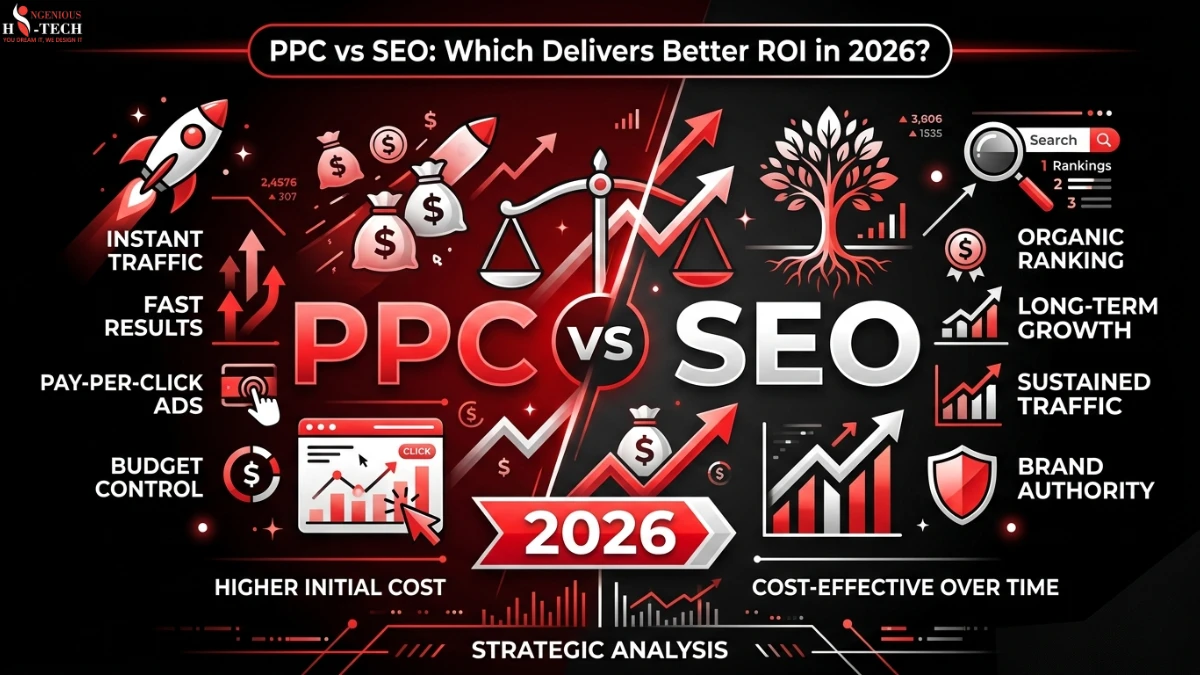
Ultimately, every entrepreneur who engages in digital marketing sooner or later has to ask themselves this simple yet vital question: Do I want to invest my money in PPC or SEO? On paper, it seems like an obvious choice; yet, a poor decision can cost you a lot of money since it would mean spending months on advertisements that disappear once you stop paying or wasting an entire year on creating organic rankings while your competitors are converting their leads using PPC ads.
The decision of whether to invest in PPC or SEO is one of the key questions in digital marketing that defines your pace of growth, sustainability, and effectiveness of each marketing dollar spent. Our guide will help you understand what the true ROI of PPC and SEO is and choose wisely in 2026.
PPC vs SEO: Quick Comparison
|
Factor |
PPC |
SEO |
|
Speed of Results |
Immediate (hours–days) |
Gradual (3–12+ months) |
|
Cost Model |
Pay per click |
Ongoing investment |
|
ROI Timeline |
Short-term |
Long-term, compounding |
|
Traffic Type |
Paid, intent-driven |
Organic, trust-based |
|
Sustainability |
Stops when the budget stops |
Persists and grows over time |
|
Avg. Click-Through Rate |
2–5% |
27–39% (top positions) |
What Is PPC and What Is SEO?
PPC or Pay-Per-Click is another paid marketing strategy where businesses pay for every click through the process of bidding on specific keywords. Google Adwords shows such ads right at the top position in the search results list almost instantly once an advertising campaign is launched. Everything depends on you and your budget; however, as soon as the budget runs out, your traffic goes to zero, too. Businesses that engage professionally managed PPC campaigns will definitely make the most out of this option, but no matter what, the basic requirement to spend money will remain relevant.
As opposed to the previous strategy, SEO marketing brings visibility through the quality of content, the website’s technical state, and authoritative backlinks. Rankings take a couple of months to build through constant optimisation efforts; however, once earned, they usually last and grow in importance. This means that having a high-ranking webpage can bring you organic traffic for many years with absolutely no extra cost involved. The main principle of differentiating between PPC and SEO is quite simple: you rent the traffic with PPC campaigns, but create it with SEO.
PPC vs SEO ROI Breakdown
Understanding SEO vs PPC ROI requires a time-based perspective, because each channel genuinely dominates at a different stage of your growth lifecycle.
Short-Term ROI (0–3 Months): PPC Wins
In the first ninety days, PPC wins hands down. A strategically run PPC campaign can attract highly targeted visitors to your website within one to two days of going live. For companies that need immediate results from their marketing campaign, like attracting customers for a new product or service offering, PPC will help you achieve your goals faster than SEO will during the first ninety days. Average conversion rates for Google Ads search campaigns have a baseline average of 3.75%. With an optimised landing page, the campaign becomes profitable quickly within weeks. In the same ninety-day period, SEO is in its investing stage. This involves writing content, acquiring links, and having Google index your pages. Results are still not showing up in terms of increased traffic, but the foundation is set for everything that is to follow.
Mid-Term ROI (3–12 Months): SEO Gains Traction
At this point, from months three to twelve, the comparison takes a new turn. Your SEO content begins getting ranked and bringing traffic organically, with no extra cost to pay since there is no click-through charge. Moreover, the authority of the domain will start to bear fruit. For instance, if one page brings you 200 organic visits in month four, the number can increase to 800 by month ten, all without paying extra money. At the same time, PPC expenses go up due to more competition for similar keywords, higher CPCs, and the need for more hands-on management in order to keep up the good work. Another benefit of incorporating both campaigns is their synergistic relationship.
Long-Term ROI (12+ Months): SEO Dominates
After one year and moving forward, SEO will always be more profitable than PPC when considering the ROI. This is due to the fact that organic search produces over 53% of total site visits, while paid search only contributes about 15%. The click-through rate for top-ranked organic searches is around 27-39%, which is far above that of paid campaigns due to the greater trust placed in organic results. The SEO work that got those results has been completed, and the cost per lead falls to an all-time low. Apart from this, SEO works to build brand authority, which leads to better conversion rates and lowers the costs of acquiring new customers.
PPC vs SEO Cost Comparison
The debate on PPC vs SEO costs goes deeper than many would expect. PPC campaigns work according to a cost-per-click bidding system, whereby the average cost per click ranges between two dollars in niche markets and up to fifty dollars or even more in sectors such as legal services, insurance, and enterprise software. Apart from media costs, one needs to consider the expenses involved in terms of management and creative work, which translates to twice or thrice the amount spent on buying leads through media costs alone.
Unlike PPC campaigns, SEO requires significant investment in terms of content creation, website technical optimisation, and link acquisition. Such an investment may cost anything between fifteen hundred and ten thousand dollars monthly, based on how competitive the market is. But the beauty of SEO is that once you make your investment, you have an asset worth keeping. Content that ranks now can give you traffic for as long as three to five years. When you factor in how valuable that traffic can be to your business compared to the costs involved in creating it, the dynamics are hugely in your favour.
PPC vs SEO for Lead Generation and Conversions
In terms of comparing PPC vs SEO for lead generation, while PPC attracts high-intent users, they do so only during the buying stage of the customer journey. The moment a user searches for something like "buy CRM software" or "emergency plumber near me," PPC ads come up front and centre, where they engage users who are looking to take action. If you present them with the right offer and an optimised landing page, you could generate leads from PPC almost immediately.
SEO, on the other hand, involves a more complex process that takes longer but yields higher-quality leads. When a user searches for something like "how to choose a CRM system," the user lands on your blog post, subscribes to your email newsletter, consumes more content over several weeks, and converts a month later. While your lead may not be as hot as one generated using PPC, by the time they convert, they are well-informed about what you have to offer and more inclined to believe your brand.
SEO or PPC: Which Is Better for Your Business?
When considering the question, which is better, SEO or PPC, the answer is completely contingent upon one’s phase, budget, and timeline. If you require quick results, have a budget to support ongoing spending, or must explore potential offers or keywords before investing in an SEO campaign, then PPC should be your primary expenditure. It is crucial for seasonal businesses, newly released products, and situations requiring urgent action.
Alternatively, if you are building for the future, wish to lessen your reliance on paid channels, or belong to a trust-centric industry, then SEO should be your primary investment. If you are unable to continue PPC spending, the cost structure associated with SEO is steep at the beginning, but eventually decreases, which makes sound financial sense.
Why Combining PPC and SEO Delivers Maximum ROI
Digital marketers who will enjoy success in the year 2026 are not opting for either PPC or SEO. Both are utilised by digital marketers as complementary methods. Data gathered through PPC will give insights into the keywords that convert, enabling you to create a smarter SEO content strategy based on facts. As organic ranks develop, PPC spending is moved towards areas where you no longer have ranking organically in order to bring down the costs of acquiring clients. Retargeted PPC campaigns, especially to those readers who have visited your blog pages organically, tend to have better conversion rates than PPC campaigns targeting unknown customers.
Conclusion
In 2026, PPC will be better for the short term, SEO will be better for the long term, and both working together will provide benefits that cannot be achieved separately. If immediate leads are required, PPC is where you should start. If sustainability and scalability are desired, SEO cannot be overlooked. And if maximum return on investment is to be achieved, using both channels to get quick returns as well as valuable data through PPC and create a compounding resource through SEO is vital.
In 2026, the important thing is not choosing between PPC and SEO but rather using both intelligently.
Ready to make ROI your reality? Whatever your needs might be, from expert SEO services to high-performance PPC management services, the right digital marketing partner can mean all the difference. Contact us today!
Frequently Asked Questions (FAQs)
1. What is the main difference between PPC and SEO?
PPC (Pay-Per-Click) is a paid advertising strategy where businesses pay for each click on their ads, while SEO (Search Engine Optimisation) focuses on improving organic rankings in search engines. PPC delivers immediate traffic, whereas SEO builds sustainable, long-term visibility.
2. Which is better for ROI in 2026: PPC or SEO?
The better ROI depends on your goals. PPC provides faster, short-term ROI with immediate results, while SEO delivers higher long-term ROI due to compounding organic traffic and lower ongoing costs. In 2026, businesses often achieve the best ROI by combining both strategies.
3. Is PPC more expensive than SEO?
PPC can be more expensive in the short term because you pay for every click, especially in competitive industries. SEO requires upfront investment in content and optimisation, but becomes more cost-effective over time as organic traffic grows without per-click costs.
4. How long does it take to see results from SEO vs PPC?
PPC campaigns can generate traffic and conversions within hours of launch. SEO, on the other hand, typically takes 3 to 6 months (or longer) to show significant results, depending on competition and strategy.
5. Which strategy is better for small businesses in 2026?
Small businesses often benefit from starting with PPC for immediate visibility while building an SEO foundation for long-term growth. Budget constraints usually make SEO more sustainable over time.
6. Can PPC and SEO work together?
Yes, combining PPC and SEO is one of the most effective digital marketing strategies. PPC can provide immediate data on high-converting keywords, which can then be used to optimise SEO content and improve organic rankings.
7. Does SEO still matter in 2026 with AI and paid ads growing?
Yes, SEO remains crucial in 2026. While AI-driven search and paid ads are expanding, organic search continues to be a major traffic source. High-quality, authoritative content is still essential for visibility and trust.
8. Which delivers better long-term value: PPC or SEO?
SEO delivers better long-term value because it generates ongoing organic traffic without continuous ad spend. PPC stops driving traffic as soon as you stop paying.
9. What industries benefit more from PPC vs SEO?
Highly competitive industries like finance, legal, and e-commerce often rely heavily on PPC for quick wins. Content-driven industries such as education, SaaS, and blogging benefit more from SEO over time.
10. How do conversion rates compare between PPC and SEO?
PPC often has higher conversion rates for high-intent keywords because ads target users ready to take action. SEO attracts a broader audience, which may include users at different stages of the buying journey.
11. Is PPC better for launching new products or services?
Yes, PPC is ideal for launching new products because it provides instant visibility, allows rapid testing, and helps generate immediate traffic and feedback.
12. What are the risks of relying only on PPC or SEO?
Relying only on PPC can become costly and unsustainable, while relying only on SEO can be slow and unpredictable due to algorithm changes. A balanced approach reduces risk and improves overall marketing performance.
13. How does AI impact PPC and SEO in 2026?
AI enhances both PPC and SEO by improving targeting, automation, and personalisation. In PPC, AI optimises bidding and audience targeting. In SEO, AI helps create content, analyse intent, and improve search rankings.
14. Which is easier to scale: PPC or SEO?
PPC is easier to scale quickly by increasing the budget and targeting more keywords. SEO scaling takes more time, as it requires content creation, link building, and authority growth.
15. What is the best strategy for maximising ROI in 2026?
The best strategy is a hybrid approach: use PPC for quick wins, testing, and conversions, while investing in SEO for sustainable traffic and long-term ROI growth.