
You open Google, search for your core service, and there they are: Amazon, Forbes, HubSpot, and the rest of the usual suspects claiming the top five spots. You're a small business owner with a real product, real expertise, and real customers. But your website is buried on page three.
Here's the uncomfortable truth: big brands don't rank because they're better than you. They rank because they've been playing the game longer, spending more, and building more links. But "longer," "more," and "more" aren't the only ways to win.
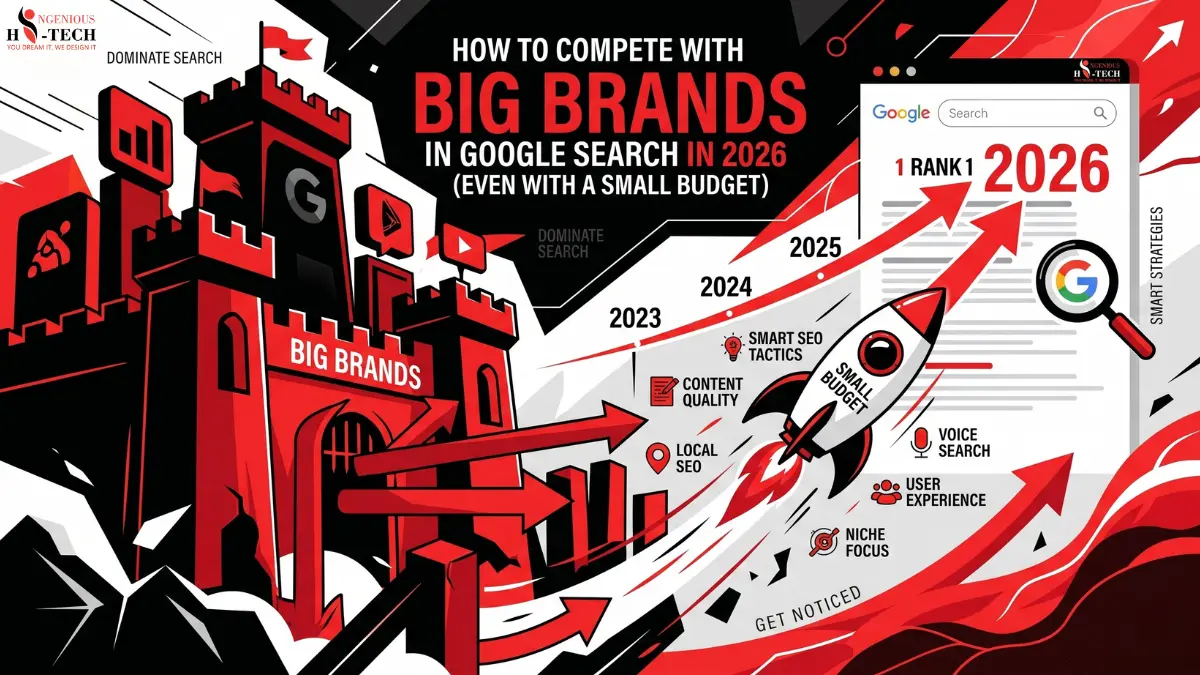
In 2026, the rules haven't changed, but smart small businesses are finally learning how to exploit the gaps the giants leave behind. This guide breaks down a practical, battle-tested small business SEO strategy for 2026 that lets you compete with big brands in Google without an enterprise budget or a 20-person marketing team.
Why Big Brands Dominate Google (And Why That's Not the Whole Story)
Google's algorithm rewards authority, trust, and relevance. Big brands have spent years accumulating all three. They have thousands of backlinks, high domain authority scores, brand search volume that signals credibility to Google, and entire teams dedicated to content production.
But here's what they also have: bureaucracy.
A Fortune 500 company can't publish a blog post without it going through legal, compliance, three rounds of editing, and a VP sign-off. They target broad, high-volume keywords because their KPIs demand massive reach. And they rarely go deep into niche topics because niche doesn't scale for their model.
That rigidity is your opening.
Small businesses can move faster, go deeper, and speak more directly to a specific audience. The SEO for small businesses in the USA market in 2026 belongs to those who know how to out-niche, not out-spend.
The Long-Tail Keyword Strategy: Win the Battles You Can Actually Win
If you're a local HVAC company, you're not going to outrank Angi or HomeAdvisor for "HVAC repair." But "emergency HVAC repair for older homes in Phoenix AZ"? That's a different conversation entirely.
Long-tail keyword phrases of four words or more have lower search volume but dramatically lower competition and far higher purchase intent. Someone typing a specific, detailed query is usually much closer to deciding than someone typing a generic two-word phrase.
Tools like Google's "People Also Ask" section, AnswerThePublic, and Semrush's Keyword Magic Tool make it easy to find these opportunities. Target 8–15 long-tail terms per content cluster and build from there. This is the foundation of every effective low-budget SEO strategy.
Building Topical Authority: Be the Expert Google Can't Ignore
One of the most significant shifts in how Google evaluates content over the past two years is the emphasis on topical authority, the idea that a website covering one subject comprehensively and deeply is more trustworthy than one with scattered posts on random topics.
Big brands often have wide but shallow content. You can build narrow but deep and win.
The framework looks like this:
Pillar Pages
Create one long-form, comprehensive page (2,000–4,000 words) on your core topic. This is your anchor. For example, a Digital Marketing Service firm might create: "The Complete Guide to Enhance Small Business in 2026."
Content Clusters
Build 8–15 supporting blog posts that go deep on specific subtopics: "how to secure your business Wi-Fi," "what is a phishing attack," "cybersecurity checklist for remote teams," etc. Each of these links goes back to the main page.
Internal Linking
Every supporting article links to the pillar, and the pillar links to each cluster post. This signals to Google that your site has genuine depth on the topic, not just a collection of loosely related articles.
When done consistently over 6–9 months, this approach builds the kind of topical authority that makes Google start treating your domain as a go-to resource and rank you accordingly.
Creating Better Content Than Big Brands: Depth Over Volume
Big brands publish frequently. What they rarely do is publish specifically.
A generic "10 Tips for Email Marketing" post written by a content agency for a software company can't compete with a post like "What I Learned Sending 47 Email Campaigns for a Regional Restaurant Chain" written by someone with actual firsthand experience.
Google's Helpful Content System rewards content that demonstrates experience, expertise, authoritativeness, and trustworthiness (E-E-A-T). Real case studies, first-person insight, original data, and specific examples score higher on that rubric than recycled advice padded out with filler.
To consistently out-content bigger players:
- Answer the exact question your customer is Googling, not a watered-down version of it
- Include screenshots, real numbers, and before/after comparisons wherever possible
- Structure every article with scannable H2/H3 headers and short paragraphs
- Update older content regularly. Freshness is a ranking signal
One exceptional article will outperform ten mediocre ones, every single time.
Smart Backlink Strategies on a Low Budget
Backlinks play the most important role in ranking signals for Google. But building them doesn't require a $5,000/month outreach agency.
Here are approaches that work for small businesses today:
- Guest Posting: Write one high-quality article per month for a reputable industry blog. A single link from a relevant, trusted domain is worth more than 20 links from random directories.
- Business Directories (the right ones) Focus on legitimate, niche-specific directories. For local businesses: Google Business Profile, Yelp, Bing Places, and industry-specific directories (Houzz for contractors, Avvo for lawyers, etc.) all pass real SEO value.
- Strategic Partnerships Partner with complementary businesses, a web design agency linking to a copywriting firm, for example, for mutual mentions on service pages or resource lists.
- Help a Reporter Out (HARO) / Connectively respond to journalist queries in your niche. A single mention in a Forbes or Inc. article delivers serious domain authority, and it's free.
- Linkable Asset Creation: Create one piece of original research, an industry survey, or a free tool relevant to your niche. When other sites in your space reference it, you earn backlinks organically. This is how small businesses earn the kind of links that usually require big brand budgets.
The goal isn't hundreds of links, it's a steady stream of quality ones that compound over time.
Local & Niche SEO: Your Unfair Advantage
This is where the playing field tips decisively in your favour.
If you serve a specific geography or industry, lean into it completely. A national brand can't credibly rank for "best family law attorney in Boise, Idaho", but you can, especially with:
- A fully optimised Google Business Profile with recent reviews, updated photos, and accurate service listings
- Location-specific landing pages for every city or region you serve
- Content that references local landmarks, events, or community specifics that a generic national brand would never think to include
- Schema markup for local businesses to make your NAP (Name, Address, Phone) data structured and readable by Google
The same logic applies to niche targeting. An SEO agency that specialises in dentists will outrank a general-purpose digital marketing firm for "SEO for dental practices" every time. Specialisation signals relevance, and relevance drives rankings.
Conversion Optimisation: Winning With Less Traffic
Here's something most SEO content won't tell you: you don't need to match a big brand's traffic to match their revenue.
If their website converts at 1.5% and yours converts at 4.5% through better copywriting, clearer calls-to-action, trust signals like testimonials and guarantees, and faster load times, you need a fraction of the traffic to generate the same leads.
Small businesses have an advantage here: personality. Your "About" page can feature the actual business owner. Your testimonials can come from people in your community. Your chat widget connects visitors to a real human. These things build trust faster than a faceless enterprise brand ever could.
Combine solid on-page SEO with an intentional conversion strategy, and ranking on page one, even for secondary keywords, becomes genuinely profitable. That's the intersection where small businesses win.
Common SEO Mistakes That Kill Small Business Rankings
Even with the right strategy, these errors will sabotage your progress:
- Thin content: Publishing 300-word articles to "stay active" on the blog. Google ignores it. Your audience ignores it. Save your time for content that's actually useful.
- Keyword stuffing: Forcing your primary keyword into every paragraph reads as unnatural and triggers spam filters. Write for humans first.
- Ignoring technical SEO: Slow page speeds, broken links, missing meta descriptions, and non-mobile-friendly pages cost rankings quietly but consistently. Run a free audit via Google Search Console or Screaming Frog regularly.
- Chasing volume over intent: A keyword with 500 monthly searches and high purchase intent beats a 10,000-search keyword with zero conversion potential.
- No internal linking structure: Treating each blog post as a standalone island. Every page should connect to something else on your site.
- Inconsistency: Starting strong and then publishing nothing for three months. Google rewards consistent sites. Build a realistic content calendar and stick to it.
Conclusion: Strategy Beats Budget Every Time
The era of dominating Google purely through spending is ending. In 2026, Google is increasingly rewarding specificity, depth, real expertise, and user trust, all things that small businesses can deliver better than bloated enterprise brands.
You don't need to compete with big brands on their terms. You need to find the lanes they've ignored, the long-tail keywords, the underserved niches, the local markets, the specific questions no one else is answering honestly and own them completely.
Build your topical authority methodically. Earn backlinks strategically. Optimise for conversions, not just clicks. And above all, create content that actually helps the human sitting on the other side of the search bar.
That's not a small business SEO strategy. That's just good SEO executed with the focus that only a smaller, hungrier operation can manage.
Ready to stop watching competitors take the top spots?
Our team specialises in helping small businesses and startups build SEO strategies that drive real, qualified traffic without wasting budget on tactics that don't move the needle. Get a free SEO audit today, and let's find the gaps your competitors don't know you're about to exploit.