

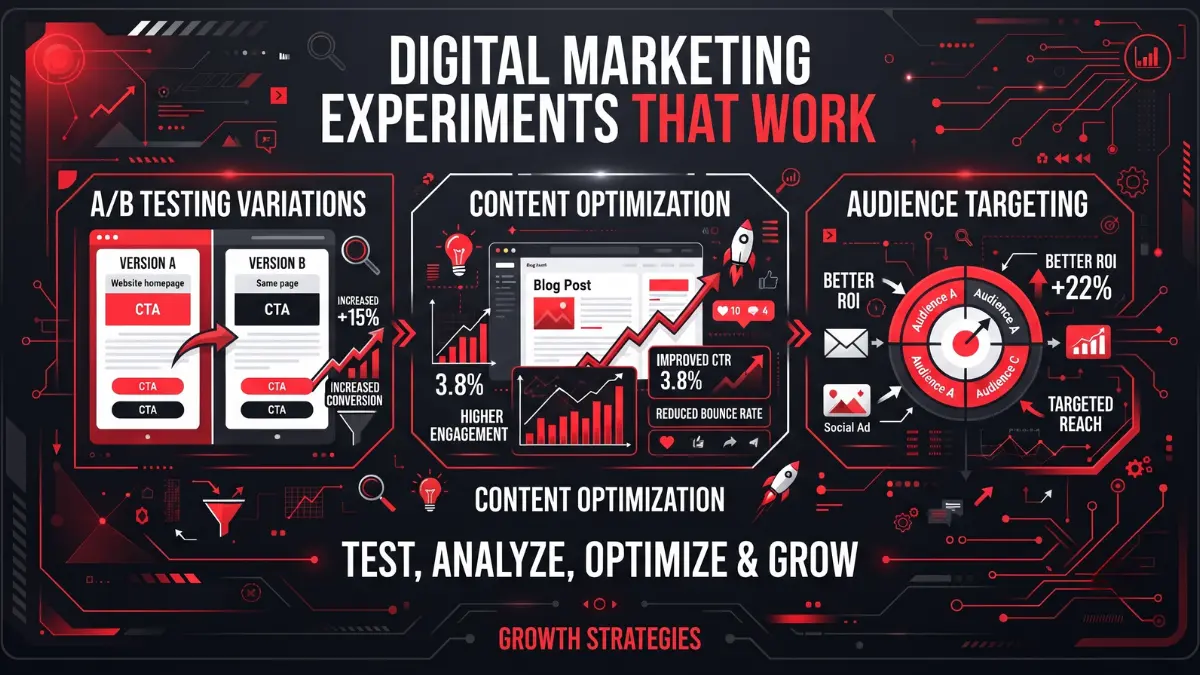
Most marketing budgets disappear on guesswork. A team picks a headline because it sounds good, or builds an email sequence based on a hunch about what customers want. Sometimes it works. Often it doesn't, and nobody can explain why.
Businesses that consistently grow their traffic and revenue share one habit: they test before they scale. Instead of assuming a strategy will succeed, they treat marketing as a series of small, measurable experiments that replace guesswork with evidence.
This matters because customer behaviour changes constantly. What worked last year may quietly stop working today, and without testing, a business can run the same underperforming campaign for months without ever questioning it.
In this article, you'll learn what digital marketing experiments are, why they matter for ROI and decision-making, how to structure a test correctly, and twelve specific experiments you can run across landing pages, email, content, and customer experience, plus the mistakes that ruin experiment accuracy and the tools that make testing easier.
Let's start with the fundamentals.
What Are Digital Marketing Experiments?
A digital marketing experiment is a controlled test where you change one specific element of a campaign, page, or message, and measure how that change affects performance. It's not a full campaign overhaul; it's a focused question: "If we change this one thing, what happens?"
That's the key difference from a regular campaign. A campaign achieves a business outcome by combining multiple tactics. An experiment is narrower: it isolates a single variable so you can understand its actual impact, separate from everything else happening around it.
Experiments matter because they replace opinion with evidence. Anyone can theorise about what will convert better; an experiment tells you which theory is actually true.
A failed experiment isn't wasted, either. If a new headline underperforms the original, you've learned something about your audience. The goal isn't a perfect win rate; it's a growing, evidence-based understanding of what customers respond to.
|
Marketing Campaign |
Digital Marketing Experiment |
|
Focuses on business goals |
Focuses on testing one idea |
|
Multiple marketing activities |
Single controlled variable |
|
Long-term execution |
Short-term learning process |
|
Measures overall success |
Measures individual changes |
|
Strategy implementation |
Strategy validation |
Why Digital Marketing Experiments Matter
- Better ROI: Knowing which landing page layout converts better before scaling ad spend keeps you from pouring budget into an underperforming page.
- Reduced marketing risk: A smaller experiment, first testing a format on part of your list before a full rollout, limits the downside of a bad idea.
- Higher conversion rates: A business that tests its CTA copy, checkout flow, and headlines separately often ends up with a meaningfully higher overall conversion rate.
- Improved customer understanding: Every experiment reveals something your audience values maybe specific pricing beats "starting at" pricing, or video builds more trust than static images.
- Smarter decision-making: Teams that experiment regularly stop debating opinions and start referencing results.
- Continuous optimisation: Algorithms and platforms shift constantly. Ongoing experimentation keeps your performance current instead of stale.
How to Run a Successful Digital Marketing Experiment
Define a Clear Objective
Before touching any element, decide exactly what you're trying to improve. "Increase conversions" is too vague. "Increase signups on the pricing page" is specific enough to design a real test around.
Develop a Testable Hypothesis
A hypothesis predicts what will happen and why. A weak one says, "Changing the button colour might help." A strong one says, "A high-contrast orange CTA will increase clicks because it stands out against the background." The "because" matters; it grounds your guess in customer behaviour rather than random preference.
Test One Variable
This is the single most important rule in experimentation, and the one most often broken. Change the headline, image, and CTA copy all at once, and even if conversions improve, you won't know which change caused it. Isolate one variable; it takes longer, but the results are trustworthy.
Measure the Right Metrics
Different experiments call for different metrics, and choosing the wrong one leads to false conclusions.
- Conversion Rate: percentage of visitors completing your target action
- CTR: how often people click a specific link, ad, or button
- Bounce Rate: how many visitors leave without further interaction
- CPA: cost to acquire one customer or lead
- ROAS: revenue generated relative to ad spend
- Revenue: the actual dollar impact of a change
- Engagement: time on page, scroll depth, interaction rate
Tie the metric directly to your objective, not whichever number looks best.
Analyse the Results
Once a test concludes, look past the headline number and ask why the result happened. If a shorter page converted better, was it faster load time, or a confusing section removed? Understanding the "why" lets you apply the lesson elsewhere. Document the hypothesis, sample size, duration, and outcome; this becomes a knowledge base your team can draw from later.
12 Digital Marketing Experiments That Work
1. Landing Page Headlines
Purpose: Find which headline best captures attention and communicates value.
Why It Matters: It's often the only thing a visitor reads before deciding to stay or leave.
How to Run the Experiment: Create two page versions identical except for the headline, then split traffic evenly until you reach a meaningful sample size.
Metrics to Measure: Bounce rate, time on page, conversion rate.
Key Takeaway: A stronger headline can lift conversions without changing anything else on the page.
2. CTA Button Testing
Purpose: Identify which CTA copy or placement drives more clicks.
Why It Matters: The CTA is the final nudge between interest and action.
How to Run the Experiment: Test one CTA variable at a time, say, "Get Started Free" versus "Start My Free Trial."
Metrics to Measure: CTR, conversion rate.
Key Takeaway: Specific, benefit-driven CTA copy usually outperforms generic phrasing like "Submit."
3. Short vs Long Landing Pages
Purpose: Determine whether visitors respond better to a concise or detailed page.
Why It Matters: The right length depends on price point and complexity, not personal preference.
How to Run the Experiment: Build a short version and a long version with testimonials and FAQs, then send equal traffic to both.
Metrics to Measure: Conversion rate, bounce rate, scroll depth.
Key Takeaway: Higher-priced or complex offers often need longer pages; simple offers convert better when kept brief.
4. Product Images vs Videos
Purpose: Compare how static images and video demos affect purchase decisions.
Why It Matters: Video can build trust faster than a photo, but can slow load time.
How to Run the Experiment: Replace a product image with a short demo video on one version, keeping everything else unchanged.
Metrics to Measure: Conversion rate, engagement, page load impact.
Key Takeaway: Video helps most with products that benefit from demonstration, like software or tools with moving parts.
5. Email Subject Lines
Purpose: Discover which subject line style increases open rates.
Why It Matters: Strong email content has no impact if the subject line fails to earn an open.
How to Run the Experiment: Send two versions of the same email to separate segments, changing only the subject line.
Metrics to Measure: Open rate, CTR within the email.
Key Takeaway: Curiosity and clarity often outperform urgency-based lines, since audiences grow fatigued by artificial urgency.
6. Personalised Email Campaigns
Purpose: Measure whether personalisation improves engagement.
Why It Matters: Generic, one-size-fits-all emails increasingly get ignored as inboxes grow more crowded.
How to Run the Experiment: Send a version referencing recent customer activity against a generic version with the same offer.
Metrics to Measure: Open rate, CTR, conversion rate.
Key Takeaway: Personalisation based on real behaviour outperforms personalisation based only on a first name.
7. Blog Content Formats
Purpose: Identify which content structure keeps readers engaged longer.
Why It Matters: The same topic performs differently as a list, a how-to guide, or a narrative case study.
How to Run the Experiment: Publish similar topics in two formats and compare engagement over a comparable period.
Metrics to Measure: Time on page, scroll depth, shares, conversion rate.
Key Takeaway: Step-by-step formats tend to win for how-to searches; narrative formats often build more trust.
8. Social Media Posting Frequency
Purpose: Determine the posting cadence that maximises engagement without fatigue.
Why It Matters: Posting too rarely limits visibility; too often dilutes engagement per post.
How to Run the Experiment: Test two posting frequencies over comparable periods, keeping quality and topics consistent.
Metrics to Measure: Engagement rate, follower growth, reach.
Key Takeaway: More posts isn't automatically better; consistent, well-timed posting usually beats sheer volume.
9. Internal Linking Strategy
Purpose: Test whether a revised internal linking structure improves SEO performance.
Why It Matters: Internal links help search engines understand page relationships and help visitors discover more content.
How to Run the Experiment: Add contextual internal links to a set of pages and compare against a similar, unchanged set.
Metrics to Measure: Organic traffic, average session duration, pages per session.
Key Takeaway: Thoughtful internal linking often improves crawlability and engagement without new content.
10. Organic vs Paid Landing Pages
Purpose: Compare how organic and paid visitors respond to the same offer.
Why It Matters: These visitors arrive with different intent and brand familiarity.
How to Run the Experiment: Create tailored page versions for each traffic source and compare against a shared, generic version.
Metrics to Measure: Conversion rate, CPA, bounce rate by source.
Key Takeaway: Matching messaging to the visitor's traffic source usually outperforms a one-size-fits-all page.
11. Customer Reviews Placement
Purpose: Test where reviews have the greatest impact on trust and conversion.
Why It Matters: Placement near the CTA versus mid-page changes how effectively social proof builds confidence.
How to Run the Experiment: Move testimonials to a different position, such as directly above the CTA, and compare against the original.
Metrics to Measure: Conversion rate, time on page.
Key Takeaway: Reviews often perform best when placed close to the decision point rather than buried at the bottom.
12. Live Chat vs Contact Forms
Purpose: Determine whether visitors prefer immediate chat or a traditional contact form.
Why It Matters: Response speed can influence whether a hesitant visitor converts or leaves.
How to Run the Experiment: Add a live chat widget to one page version and keep only a contact form on the other, then compare lead volume.
Metrics to Measure: Conversion rate, lead quality, response time impact on close rate.
Key Takeaway: Live chat often increases lead volume, but requires staffing or automation, or the benefit disappears.
Common Mistakes That Reduce Experiment Accuracy
- Testing multiple variables at once: making it impossible to know which change caused the result
- Ending tests too early: right after an early lead, before the data stabilises
- Using small sample sizes: producing results driven by chance rather than preference
- Measuring vanity metrics: like impressions instead of outcomes tied to revenue
- Poor documentation: so lessons get forgotten or repeated unnecessarily
- Ignoring customer behaviour: that contradicts what heatmaps already show
- Copying competitors blindly: assuming what works for them will work for you
Essential Tools for Digital Marketing Experiments
Website Analytics
Analytics platforms give you the baseline numbers: traffic, conversion rate, bounce rate, session behaviour to know whether an experiment moved the needle.
Heatmaps
Heatmap and session recording tools show where visitors click, scroll, and hesitate useful for understanding why a page underperforms before deciding what to test.
A/B Testing
Dedicated A/B testing platforms handle traffic splitting, statistical significance, and reporting automatically essential once you're running several tests at once.
SEO Performance
SEO tools track keyword rankings, organic traffic, and crawl issues, letting marketers validate SEO testing over the longer timeframes organic search requires.
Email Marketing
Email platforms with built-in testing features let marketers split subject lines and content across list segments a good entry point since results arrive fast.
Best Practices for Successful Marketing Experiments
- Test one change at a time: so results remain clear and actionable
- Collect enough meaningful data: a few dozen visitors rarely tell the full story
- Prioritise customer experience: a "win" that annoys customers isn't a win
- Record every experiment: including the ones that fail
- Repeat successful tests: on other pages where the logic might apply
- Keep optimising continuously: since preferences and algorithms never stay static
Frequently Asked Questions
1. What is a digital marketing experiment?
A controlled test where you change one element of a campaign or page to measure its effect.
2. How long should experiments run?
Long enough to reach a meaningful sample size and account for normal variation, typically one to several weeks.
3. What metrics matter most?
The metric tied directly to your objective. Testing a CTA? Click-through rate matters more than time on page.
4. What is A/B testing?
A comparison of two versions of the same page, email, or ad, identical except for one variable.
5. Which experiment should beginners start with?
Email subject line testing: low-risk, quick to set up, fast results.
6. Can small businesses benefit?
Yes. It doesn't require a large budget, just a clear hypothesis and the discipline to test one thing at a time.
7. How often should experiments be conducted?
Ideally as an ongoing habit, with new experiments planned as soon as previous ones conclude.
8. Why should only one variable be tested?
Because testing several at once makes it impossible to know which change caused the result.
Conclusion
Digital marketing experiments turn guesswork into evidence. Instead of assuming what customers want, you test it, measure it, and let real behaviour guide your next decision. This protects your budget and builds a deeper understanding of your audience than any assumption could.
You don't need to run all twelve experiments covered here at once. Pick one that fits your priorities a landing page headline, a CTA button, an email subject line and run it properly: one variable, a clear hypothesis, and enough data to trust the result.
From there, make experimentation a habit. Document what you learn, apply it elsewhere, and keep testing as customer behaviour and platforms evolve. Marketing performance isn't built through a single big win; it's built through the steady accumulation of small, well-tested improvements.