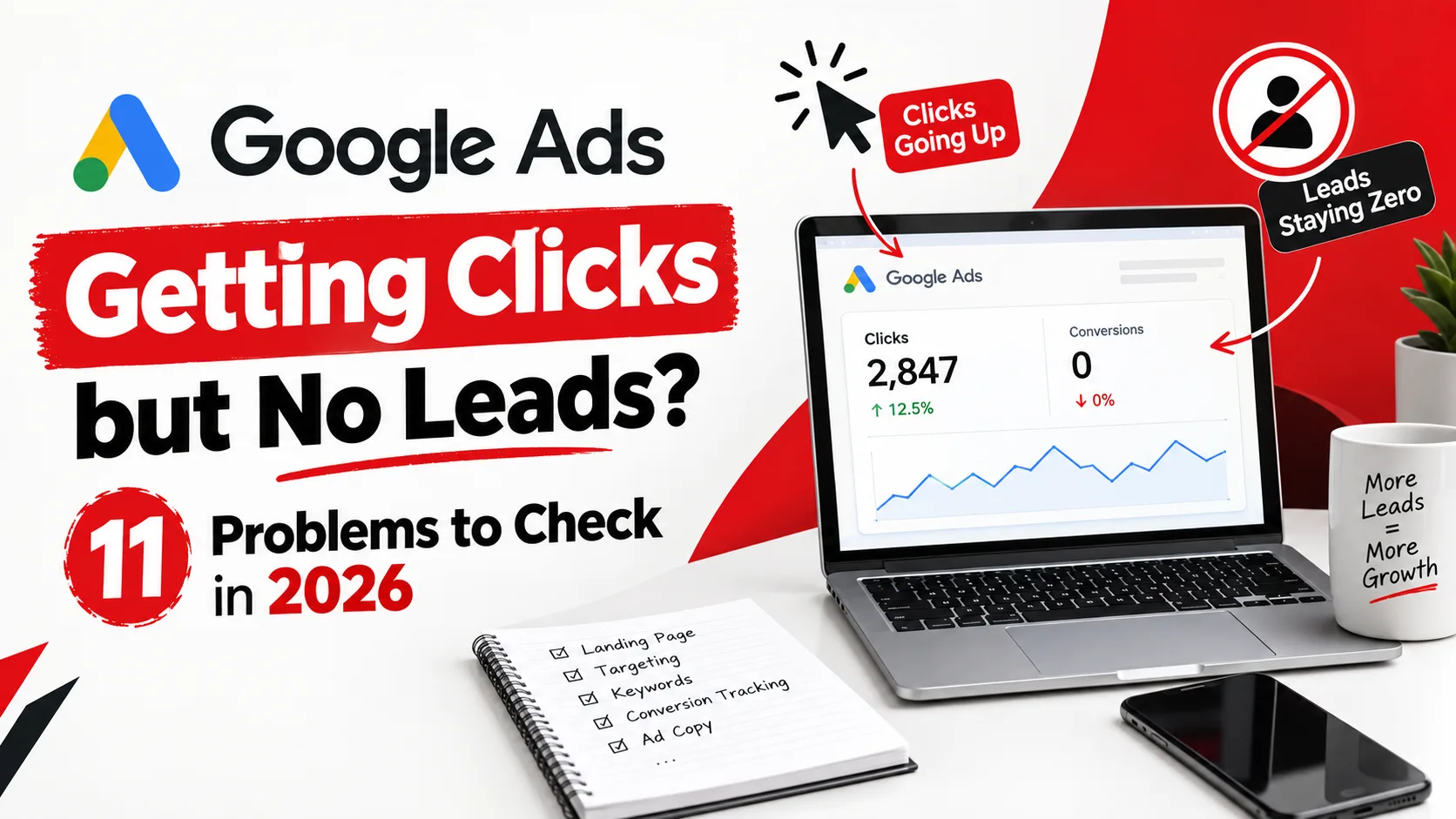

Getting website traffic but no leads is one of the most frustrating positions a business can be in. Your analytics show more organic visitors, more blog traffic, maybe some paid campaigns pulling people in, and yet the phone isn't ringing, the contact form sits empty, and quote requests aren't showing up in your inbox.
It's natural to assume the answer is "get more traffic." But if your current visitors aren't converting, more traffic usually just means more people looking without acting. The more useful question isn't "how do I get more website traffic?" It's "why isn't my existing traffic turning into leads?"
That second question is where the real fixes live. Below are 12 common reasons website traffic but no leads happens, along with practical steps to close the gap.
Traffic Alone Doesn't Guarantee Leads
Traffic, engagement, conversion, and leads are four different things, and treating them as one metric is where a lot of businesses go wrong.
- Traffic is simply how many people show up.
- Engagement measures whether they stick around, read, or click.
- Conversion is the moment someone takes a meaningful action: filling out a form, calling, requesting a quote.
- Leads are the people who convert.
- Qualified leads are the subset of those people who are actually a fit for what you sell.
Search intent explains a lot of this gap. Someone searching "what is SEO" is in research mode; they want an answer, not a sales pitch. Someone searching "SEO agency for small businesses in New York" is much closer to hiring someone. Both searches can land on your site, and both count as traffic, but only one represents a visitor ready to act.
This is why Digital Marketing strategy has to account for intent, not just volume. A site that ranks well for informational queries can rack up impressive traffic numbers while converting almost none of it, simply because most of those visitors weren't shopping in the first place.
12 Reasons Your Website Gets Traffic but No Leads
1. You're Attracting the Wrong Website Traffic
Not all traffic is created equal. If your top-performing keywords are broad or informational, you may be pulling in people who have no intention of buying students, researchers, or visitors outside your service area entirely.
Pull a report comparing your top landing pages against the search queries driving them, then check bounce rate, time on page, and geography. If a landing page gets strong traffic but almost zero engagement or conversions, and the queries feeding it are informational or geographically irrelevant, that's your answer.
Fix: Prioritise keywords with commercial or transactional intent, and add location qualifiers if you serve a specific area.
2. Your Website Doesn't Clearly Explain What You Offer
Visitors decide within seconds whether a site is relevant to them. If they can't immediately tell what you do, who you serve, and why it matters, they leave.
A weak headline like "Innovative Solutions for Tomorrow" tells a visitor nothing. A stronger version, "Commercial HVAC Repair for Chicago Businesses, Same-Day Service," tells them exactly what you do, who it's for, and what to expect.
Fix: Your homepage headline should answer what, who, and why in a single glance.
3. Your Call-to-Action Is Weak or Missing
Visitors need to know what to do next. A page full of information with no clear next step just leaves people to figure it out themselves, and most won't bother.
Effective CTAs are specific and low-pressure: "Request a Quote," "Schedule a Consultation," "Get a Free Strategy Call," "Talk to an Expert." These should appear near the top of the page, again after key content sections, and once more at the end without becoming pushy or repetitive.
Fix: Every important page needs at least one clear, specific CTA above the fold.
4. Your Landing Page Doesn't Match Search Intent
Imagine someone searches "emergency plumber Dallas" and lands on your generic homepage instead of a dedicated Dallas emergency plumbing page. The mismatch between what they searched and what they see creates hesitation, and hesitation kills conversions.
Fix: Build dedicated service and location pages that speak directly to specific searches, rather than funnelling every visitor to one generic page.
5. Your Website Doesn't Build Enough Trust
Unfamiliar businesses face a credibility gap. Visitors want evidence before they hand over their contact information: testimonials, reviews, case studies, portfolio samples, certifications, and clear information about your team and experience.
Simple things matter too: a visible phone number, a real address, and accurate business details all signal legitimacy. Agencies like Ingenious Hi-Tech often find that adding genuine proof points to key pages moves the needle more than almost any other single change, because it directly addresses the hesitation that keeps visitors from reaching out.
Fix: Audit your key pages for trust signals and add real, verifiable proof wherever it's missing.
6. Your Website Is Too Slow or Difficult to Use
A slow-loading page, a confusing menu, an intrusive pop-up, or a broken "Submit" button will cost you leads regardless of how good your content is. Frustration ends visits fast.
Fix: Test your most important pages on both mobile and desktop, checking load speed, navigation clarity, and whether every button and link actually works.
7. Your Contact Forms Create Too Much Friction
Long forms with unnecessary required fields discourage submissions. So do forms that break on mobile, throw errors, or don't confirm after submission; visitors are left wondering if it worked at all.
Fix: Ask only for what you genuinely need to follow up (usually name, contact info, and a brief message), and always show a clear confirmation message afterwards.
8. Your Offer Isn't Compelling Enough
"Contact Us" isn't much of a reason to act. Visitors respond better to something with clear value attached: a free consultation, a website audit, an SEO assessment, or a no-obligation discovery call.
Fix: Replace generic CTAs with a specific, low-risk offer that reduces uncertainty about what happens after they reach out. Avoid manufactured urgency or unrealistic promises; clarity works better than pressure.
9. Your Content Educates Visitors but Doesn't Move Them Forward
This is one of the most common and most fixable reasons behind website traffic but no leads. A lot of blog content is written to attract search traffic, but it doesn't guide the reader anywhere afterwards.
- Weak journey: Blog article → end of article → visitor exits.
- Better journey: Blog article → link to relevant service page → supporting example or case study → consultation CTA.
This is where Lead Generative Content matters. Rather than treating blog posts as isolated traffic magnets, Lead Generative Content connects educational search intent to a logical next step, so a reader who found you through research can naturally move toward considering your services.
Fix: Every blog post should link to a relevant service or resource, not just end abruptly.
10. Your Website Doesn't Answer the Buyer's Questions
Visitors often leave because basic questions go unanswered: What does this cost? Who is this for? How does the process work? How long does it take? What happens after I contact you?
Fix: Build FAQ content around the actual questions your sales team hears most often, and place it on the pages where those questions naturally arise.
11. You're Not Following Up After Visitors Show Interest
Not every visitor converts on their first visit. Someone who reads three service pages and downloads a resource has shown real intent, even without filling out a form, and that's different from someone who bounced after five seconds.
Fix: Use email follow-up, consultation reminders, and remarketing to re-engage visitors who've shown meaningful interest, and track this behaviour through a CRM so it doesn't get lost.
12. You're Not Measuring Where the Conversion Journey Breaks
Without tracking, you're guessing. You need visibility into landing-page performance, CTA clicks, form starts versus completions, phone and email clicks, and how these vary by traffic source, device, and location.
Here's the key distinction: a traffic problem is not always a conversion problem. Sometimes the issue isn't that you need more visitors; it's that the visitors you already have are hitting a specific, identifiable obstacle on their way to contacting you.
Fix: Set up conversion tracking on every meaningful action, then review it by source and page monthly, not just annually.
How to Turn Website Traffic Into More Leads
- Step 1: Identify high-intent traffic. Segment your analytics by query and page to see which visitors are closest to being ready to buy.
- Step 2: Audit your highest-traffic landing pages. These pages deserve the most attention since small improvements here have outsized impact.
- Step 3: Improve your value proposition. Make sure every key page answers what, who, and why within seconds.
- Step 4: Add relevant conversion paths. Link related content, services, and CTAs so visitors always have a logical next step.
- Step 5: Reduce form and navigation friction. Simplify forms and fix anything slowing visitors down.
- Step 6: Create Lead-Generative Content. Build blog and resource content that leads somewhere, not content that simply ends.
- Step 7: Track, test, and improve. Treat conversion optimisation as ongoing work, not a one-time fix.
Website Traffic vs. Leads: What Should You Measure?
|
Metric |
What It Tells You |
|
Organic Traffic |
How many visitors are finding you through search |
|
Engagement |
Whether visitors are actually reading or interacting with your content |
|
CTA Clicks |
Whether your calls-to-action are getting noticed |
|
Form Starts |
Whether visitors intend to contact you |
|
Form Completions |
Whether friction is stopping them partway through |
|
Leads |
How many visitors take a meaningful action |
|
Qualified Leads |
How many of those leads are a genuine fit for your business |
|
Conversion Rate |
How efficiently your traffic turns into leads overall |
Traffic volume alone tells an incomplete story. A smaller amount of well-targeted traffic that converts consistently is worth more than a large volume of visitors who never take action.
When to Fix Your Website vs. Your Digital Marketing Strategy
- Traffic is low: Look at SEO fundamentals, keyword targeting, content depth, technical SEO issues, and overall site authority.
- Traffic is high, but leads are low: Look at landing pages, CTA placement, trust signals, your offer, form friction, and whether pages match search intent.
- Leads exist but aren't qualified: Look at audience targeting, keyword selection, messaging clarity, and how well your offer is positioned for the right buyer.
Getting this diagnosis right matters, because the fix for weak traffic looks nothing like the fix for weak conversions, and a solid Digital Marketing strategy treats these as separate, sequential problems rather than lumping them together.
How Ingenious Hi-Tech Can Help Turn Traffic Into Leads
If your business is generating consistent traffic but not enough inquiries, the issue usually isn't visibility; it's what happens after someone arrives. Ingenious Hi-Tech works with businesses to look at the full picture: search-intent research, website analysis, conversion-focused landing pages, and lead-generating content that guides visitors toward a next step rather than leaving them to find one on their own.
That process typically includes reviewing where your current traffic is coming from, identifying where visitors drop off, improving the pages responsible for the most traffic, and setting up conversion tracking so future decisions are based on data rather than guesswork. The goal isn't just more visitors; it's a Digital Marketing strategy built around turning the visitors you already have into real inquiries.
If your website traffic isn't translating into leads, Contact Ingenious Hi-Tech to discuss a conversion-focused review of your site.
Frequently Asked Questions
Why am I getting website traffic but no leads?
Usually because your traffic doesn't match buyer intent, your pages don't clearly explain your offer, trust signals are missing, or friction (slow pages, complicated forms) is stopping visitors before they contact you. Reviewing intent, messaging, and user experience together usually reveals the cause.
How do I convert website traffic into leads?
Focus on matching landing pages to search intent, clarifying your value proposition, adding clear CTAs, reducing form friction, and building trust through genuine proof points. Tracking where visitors drop off helps you prioritise which fix matters most.
Is high website traffic always good?
Not necessarily. High traffic with low relevance to your services can inflate numbers without producing leads. Traffic quality whether visitors match your target customer and their intent matters more than raw volume.
Why are visitors leaving my website without contacting me?
Common reasons include unclear messaging, weak or missing CTAs, slow load times, complicated forms, and a lack of trust signals like reviews or case studies. Small friction points often add up to a much larger drop-off than expected.
What is Lead Generative Content?
Lead Generative Content is content designed to do more than attract traffic; it guides readers toward a logical next step, such as a related service page, case study, or consultation offer, rather than ending abruptly after delivering information.
Can Digital Marketing increase website leads?
Yes, when it addresses the full journey rather than just traffic volume. A strategy that combines SEO, conversion-focused landing pages, and lead-generative content typically produces more inquiries than simply driving additional visitors to an unchanged website.
Final Takeaway
Website traffic but no leads is rarely solved by chasing more visitors. It's usually a sign that something specific intent mismatch, unclear messaging, weak trust signals, friction, or a missing follow-up process is stopping people who already found you. Work through the diagnosis systematically: check your traffic quality, your messaging, your user experience, and your tracking. Once you know where the journey breaks down, the fix is usually more straightforward than expected. If you'd like a second set of eyes on it, Ingenious Hi-Tech is happy to help you find where.