
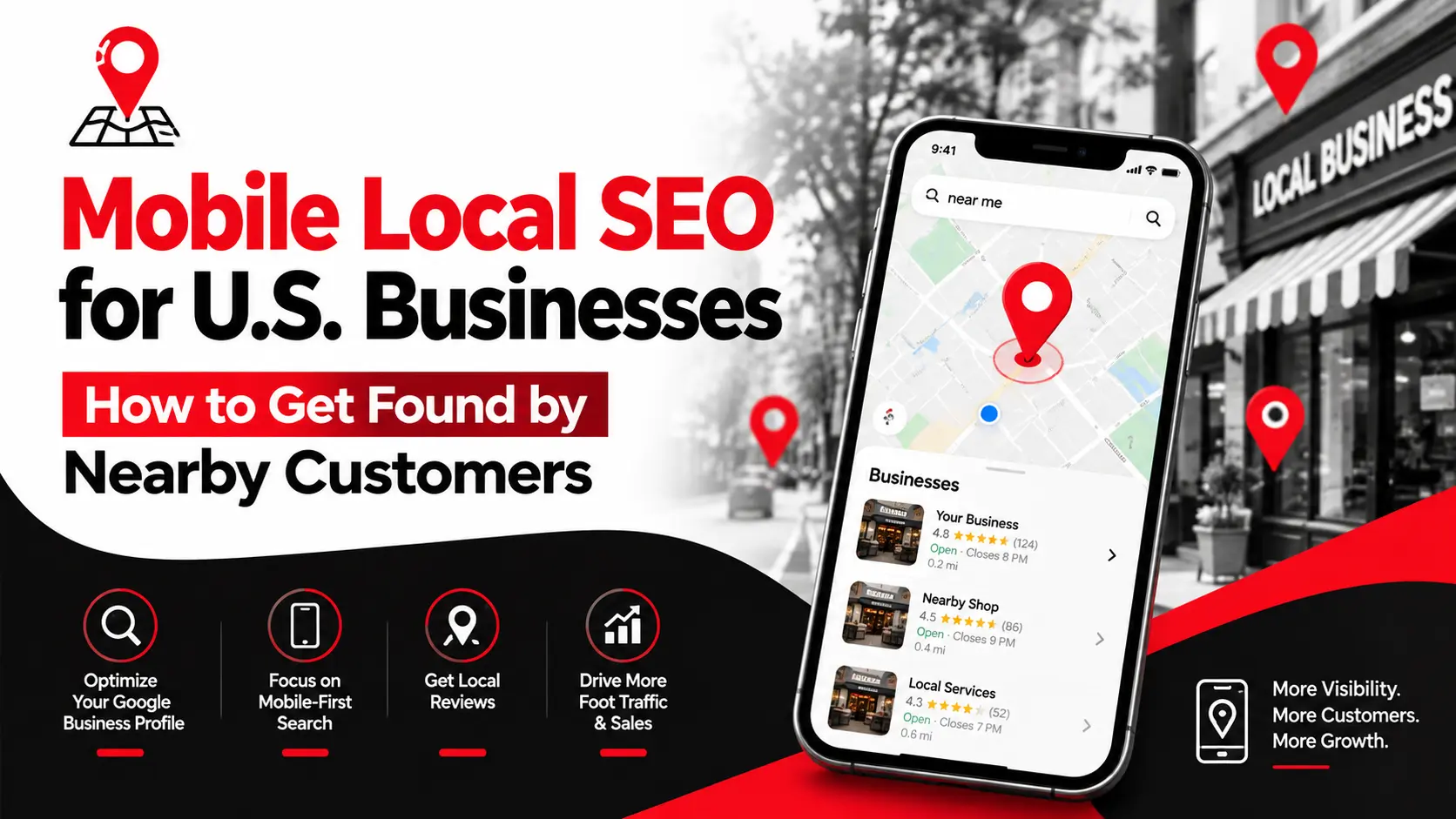
It's 6:40 on a Tuesday, and two blocks from a small plumbing shop, someone's kitchen sink starts backing up. They pull out their phone, type "plumber near me," and pick a business off the first screen before they've even stood back up. No comparison shopping just a quick search and a decision.
That moment, repeated thousands of times a day across the U.S., is what mobile local SEO for U.S. businesses is really about. It's not just having a mobile-friendly site or a city name in your footer; it's making sure your business is the one that shows up, with the right information, when a nearby customer is ready to act.
Ingenious HiTech works with U.S. businesses across industries to close that gap between "searchable" and "found." Here's what actually moves the needle.
What Is Mobile Local SEO for U.S. Businesses?
Mobile local SEO sits at the intersection of three things: how people search on phones, how Google understands location, and how local intent differs from general research. Mobile SEO covers speed and usability on smartphones; local SEO covers how a business shows up for geographically relevant searches in Google Search, the local map pack, and Google Maps. Combine them, and you get mobile local SEO: making sure a nearby customer can find, trust, and contact you quickly.
The intent difference is easy to see side by side. Someone searching "best accounting software" is comparing products, likely from a desktop, with no urgency to visit anywhere. Someone searching "accountant near me" wants a real office and a phone number, often for an appointment this week, and that search is almost always typed from a phone while the person is out and about.
Searchers don't need to type a city or neighbourhood for Google to show local results, either. Google can use device location to infer where someone is, which is part of what makes mobile local search feel almost instant.
Why Mobile Local SEO Matters for U.S. Businesses
Local mobile searches tend to convert into real-world action faster than most other searches. Someone typing "plumber near me," "dentist near me," or "HVAC company near me" usually isn't browsing; they're solving a problem right now. Same goes for "restaurant near me" before a dinner decision, or "real estate agent near me" when someone's ready to tour homes.
What happens after that search matters as much as the search itself. A well-optimised local presence gives that person an easy next step: call directly from the result, get directions, check hours before driving over, request a quote, or book an appointment.
For a U.S. business, the outcome isn't abstract visibility; it's the phone ringing or someone walking in the door. Businesses that treat this as a lead-generation channel, not a box to check, see it show up directly in call volume and bookings.
If your Google Business Profile or mobile site isn't set up to capture that moment, those calls are likely going to a competitor. [Request a Free Local SEO Audit] to see where.
How Google Determines Local Search Visibility
Relevance
How well a business matches what someone is searching for based on category, listed services, website content, and how completely you've filled out your Google Business Profile. A contractor who only lists "contractor," with no mention of kitchen remodels or roofing, is harder to match than one who's spelt it out.
Distance
How close a business is to the searcher, or to the location implied in the query. This one's real; no amount of on-page work changes where your building sits. SEO can help you compete within a realistic radius, but won't guarantee you beat every closer competitor.
Prominence
How established and trusted a business appears online and off: review quantity and quality, links from reputable sites, mentions across the web, and general online authority. A business with a strong review history tends to read as more prominent than a thinner, newer presence at the same distance.
How to Optimise Your Google Business Profile for Mobile Local SEO
Complete Your Business Information
Fill out the basics completely: business name matching your signage, the most accurate category, address, phone number, real website, accurate hours, and a clear list of services. Use the description field to explain what you do in plain language.
Add High-Quality Photos
Real photos outperform stock images. Your storefront, team, interior, and completed work give searchers a reason to trust you before they've visited. A roofing company showing finished jobs tells a more convincing story than any stock photo.
Keep Information Updated
Profiles go stale fast. Holiday hours, new services, a moved location, or a new phone number should be updated as soon as they change, or an outdated profile sends people to the wrong address or a disconnected line.
Manage Customer Reviews
Authentic reviews, collected consistently and responded to, support real prominence over time. Buying reviews or incentivising only positive ones violates platform policies; manipulated patterns are often noticeable, and trust evaporates the moment a customer spots it.
How to Optimise Your Website for Mobile Local Search
- Responsive design: A responsive site adjusts to whatever screen it's viewed on, using the same URL and content. Because mobile-first indexing means the mobile version gets crawled and evaluated most closely, an awkward mobile experience affects more than how the site looks.
- Important information above the friction point: Someone arriving from a local search shouldn't hunt for your phone number, address, hours, or booking link. Put it where it's immediately visible: a header or sticky bar, not buried three scrolls down.
- Mobile page speed: Compressing images, using modern formats like WebP, lazy-loading below the fold, trimming unnecessary JavaScript, caching, optimising fonts, solid hosting, and cutting third-party scripts that don't earn their keep all add up. These directly affect Core Web Vitals, Google's measurements of loading performance, interactivity, and visual stability.
- Local relevance: Location and service details should show up naturally in titles, headings, and location pages, written the way a customer would search. "Emergency Plumbing Services in Austin, TX" reads naturally. Repeating "Austin plumber Austin plumbing Austin pipes" reads like spam, because it is.
Getting the technical side right often decides whether you rank above or below competitors with weaker content but faster sites.
Mobile-Indexing and Local SEO: What Businesses Need to Know
Mobile-first indexing means Google primarily uses the mobile version of your website's content, not desktop, for crawling, indexing, and ranking decisions. That's been Google's standard approach for years now.
Here's the distinction worth remembering: mobile-first indexing is not the same thing as local ranking. It doesn't directly decide whether you show up in the local map pack. What it does is control which version of your site Google actually sees, so if mobile pages are missing content, links, or business details that exist on desktop, Google may never index that material, which indirectly weakens everything downstream, including local relevance.
In practice, that means checking that important content exists on mobile, internal links work the same way, key pages are crawlable, structured data matches between mobile and desktop, and mobile pages aren't accidentally blocked. None of this is exotic; it's mostly confirming nothing important got lost when the mobile version was built.
How to Get Found by Nearby Customers
A practical framework for how to get found by nearby customers on their phones:
- Optimise your Google Business Profile: often the first thing Google shows, before anyone reaches your site.
- Build useful local service pages around real searches: "water heater repair," "emergency roof leak repair," with specific content, not one generic services page.
- Improve the mobile website experience: Fast load times, easy navigation, and visible contact info turn a click into a lead instead of a bounce.
- Maintain consistent business information: Name, address, and phone number should match exactly across your site, profile, and every directory.
- Earn genuine customer reviews: Ask happy customers to leave one after a completed job, as a normal part of your process.
- Build local authority: through local publications, chambers of commerce, or community organisations, a prominence signal that's hard to fake.
Build Location Pages That Actually Help Customers
A good location page does real work: it explains what services are available in that area, addresses common local needs, lists an address or defined service area, and provides working contact options.
A weak location page just swaps the city name into an identical template, with the same paragraph reused across twenty pages, changed only by find-and-replace. Google recognises that pattern, and so do customers expecting something specific to their area.
A stronger version might mention that a company services a neighbourhood's older homes with outdated plumbing, include a photo from a nearby job, and define a specific service area rather than a vague regional claim.
Reviews, Citations, and Local Authority
- Reviews: What matters is authenticity, recency, volume, and how a business responds to praise and complaints alike. A handful of five-year-old reviews signals less activity than a steady, recent stream.
- Local citations: Mentions of your name, address, and phone number across directories and local platforms. Consistency across all of them builds trust with Google's systems.
- Local authority: Legitimate authority comes from real relationships, local publications, chamber membership, community partnerships, and backlinks earned through genuine involvement, not purchased link packages.
Common Mobile Local SEO Mistakes U.S. Businesses Should Avoid
- Incomplete Google Business Profile: missing hours or categories.
- Incorrect business information: a wrong number or address costs the lead instantly.
- Slow mobile website: every extra second raises bounce risk.
- Poor mobile navigation: hard-to-tap menus push visitors away.
- Difficult-to-use buttons: a call button too small to tap.
- Missing location information: unclear service areas hurt relevance.
- Duplicate location pages: near-identical city pages read as low value.
- Keyword stuffing: unnatural repetition reads as spam.
- Fake reviews: violates policy and erodes trust once noticed.
- Ignoring customer reviews: no responses suggest nobody's paying attention.
- Inconsistent citations: mismatched details dilute prominence.
- Content missing from mobile pages: if it's not there, Google may never index it.
- No clear mobile CTA: no next step means visitors leave without acting.
- Ignoring Google Maps visibility: often the biggest source of local mobile traffic.
- Treating local SEO as a one-time project: it needs ongoing attention.
Mobile Local SEO Checklist for U.S. Businesses
- Google Business Profile: verified · correct category · accurate info · updated hours · complete services · recent photos · active review management
- Website: responsive: fast · easy navigation · click-to-call · location and service pages · consistent business info · strong internal linking
- Authority: genuine reviews: · consistent citations · relevant backlinks · local mentions
- Technical SEO: mobile pages crawlable · content available on mobile · structured data implemented correctly · canonicals checked · Core Web Vitals monitored
How Ingenious HiTech Helps U.S. Businesses With Mobile Local SEO
Mobile local SEO touches technical work, content, and ongoing profile management, which is why most businesses find it more efficient to bring in a team that handles all three rather than piecing it together internally. Ingenious HiTech works with U.S. businesses on local SEO strategy, Google Business Profile optimisation, mobile-focused technical SEO, website performance, and local content development, with reporting that shows what's actually changing month to month.
The approach starts with understanding where a business currently stands: profile completeness, site speed, review activity, and where competitors are outperforming them before recommending changes. There's no promise of guaranteed rankings or a fixed timeline, since results vary by industry, competition, and location. What's realistic is a clear, prioritised plan based on what's actually holding a business back.
FAQs About Mobile Local SEO for U.S. Businesses
What is Mobile Local SEO for U.S. Businesses?
It combines mobile-friendly site performance with local search optimisation, Google Business Profile, local content, and mobile speed so nearby customers on their phones can find and contact you easily.
How does mobile-first indexing affect local SEO?
Google primarily indexes your mobile site. That doesn't directly set local rankings, but content missing from mobile may never get indexed, which can indirectly weaken local visibility.
How can I get my business found by nearby customers?
Complete your Google Business Profile, build service pages around real search terms, keep your site fast, match your details everywhere online, and earn reviews consistently.
Does Google Business Profile improve local SEO?
Yes. It's often the first thing Google shows for "near me" searches, so a complete, active, well-photographed profile plays a major role in whether customers find you.
Why isn't my business appearing in "near me" searches?
Common causes: an incomplete profile, inconsistent details online, a slow mobile site, weak review activity, or strong nearby competition. An audit usually pinpoints which.
Does website speed affect mobile local SEO?
Yes. Slow pages hurt Core Web Vitals and page-experience signals, and lose visitors directly; someone searching with local intent won't wait long before trying another result.
How important are Google reviews for local rankings?
Reviews are part of prominence, one of the three core local ranking factors, and they influence whether someone actually calls once they've found you.
How long does mobile local SEO take to produce results?
It varies by industry and competition, but many businesses see movement within a few months. It's ongoing, not a one-time fix.
Conclusion
Mobile local SEO for U.S. businesses isn't a single fix; it's smaller pieces working together: a complete Google Business Profile, a fast mobile website, useful local content, real reviews, and enough online authority to build trust before a customer picks up the phone.
For most businesses, this is ongoing work, not a one-time project, and results depend as much on industry, competition, and location as on strategy.
Want to know where your business is losing local mobile visibility? Go to the Ingenious HiTech for Local SEO Audit.