
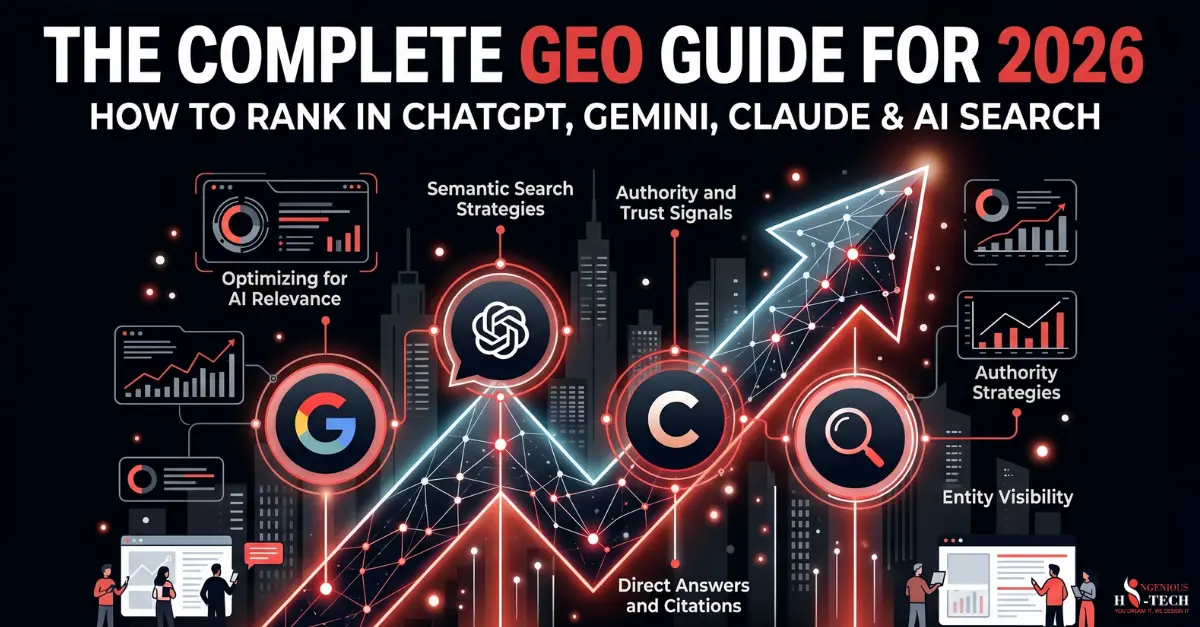
The search process seems to have changed. Consumers are increasingly turning to ChatGPT to find product recommendations, Gemini to compare service providers, and Claude to summarise the current situation in any particular industry. If your brand is not featured in any of those answers, then you do not exist to the majority of consumers who are searching for the information online.
Generative Engine Optimisation, also known as GEO, is the new way to ensure that your content can be found, comprehended, and recommended by AI models that are looking for answers on behalf of your consumers. GEO can be defined as the way to evolve from conventional SEO into the future when questions receive answers in the form of conversations rather than blue links.
Throughout this GEO guide, we will explain what Generative Engine Optimisation actually is, how the process of citation by AI search engines works, and what strategies one should apply in order to get their content featured in ChatGPT, Gemini, Claude, and Perplexity in 2026 and beyond.
What Is Generative Engine Optimisation (GEO)?
GEO, or Generative Engine Optimisation, is the practice of organising, writing, and distributing content in a way that enables AI-driven systems such as ChatGPT, Gemini, Claude, and Perplexity to correctly find, comprehend, and cite the content when producing their answers to the queries.
Traditional SEO was designed to make your page appear higher up on the results page. GEO was designed to make your brand and your information be included in the AI-generated answer, with citation or without it. The difference here is important since being visible in the AI search does not always mean being a link at the top of the list.
Why GEO Matters in 2026
The shift is that more people begin their research from within the AI chatbot rather than from a search engine. The research comes in the form of direct questions seeking direct, synthesised responses. When your business does not have an architecture in place for understanding the AI's needs and requirements, then the opportunity to engage is lost.
How GEO Differs From Traditional SEO
In contrast to SEO, which uses ranking positions as its main objective, GEO uses citation as its final result, though SEO concepts are used in GEO as well. The difference between them is in their objectives.
|
Factor |
Traditional SEO |
Generative Engine Optimisation (GEO) |
|
Primary goal |
Rank high on a search results page |
Get cited or referenced inside an AI-generated answer |
|
Content format |
Long-form pages optimised for keywords |
Clear, well-structured, directly quotable answers |
|
Success metric |
Rankings, clicks, organic traffic |
Mentions, citations, AI-driven referral traffic |
|
User behavior |
Click through to a website |
Receive an answer without always visiting a site |
|
Key ranking signals |
Backlinks, keywords, on-page SEO |
EEAT, structured data, topical depth, brand consistency |
|
Content lifespan |
Can rank for years with minor updates |
Needs regular freshness signals to stay "current" |
How AI Search Engines Find and Recommend Content
Although search engines powered by AI may not operate in the same way, the result is always similar: provide a reliable answer supported by relevant sources in the fastest way possible. Learning how each system typically handles content will help you create your GEO strategy.
ChatGPT
SEO for ChatGPT consists of optimisation for the model that uses its training information in combination with real-time browsing of the web if the search feature is on. Well-written, well-organised, and credible-sourced pages tend to be used in such searches more often than ambiguous or promotional content.
Google Gemini
Gemini SEO is highly integrated with Google’s entire search ecosystem, including AI Overviews. Since Google Gemini relies on Google’s index and Knowledge Graph, all existing SEO principles of topical authority, structured data, and good E-E-A-T signals play a crucial role in content recognition.
Claude
Claude AI search behaviour values clarity, accuracy, and well-sourced content. Information stated clearly without any exaggerations and logical organisation of ideas are easy for the model to understand and reference properly.
Common AI Search Ranking Factors
A few key signals affect visibility across the board:
- Content authority: the amount and consistency of information provided on the topic, not just a single piece
- EEAT for AI searches: Experience, Expertise, Authority, and Trustworthiness established
- Brand mentions: the frequency and consistency of mentions of your brand online
- Citation: being mentioned or linked from reputable sources
- Schema markup and structured data: for machines to understand what you are saying
- Updated content: recent updates show relevance and validity
- Relevant user intent: providing an answer directly related to the user’s query
These are some industry best practices as understood through how generative AI works, and are not actual specifics of any algorithm, as the companies do not publish this information.
10 Proven GEO Strategies to Rank in AI Search
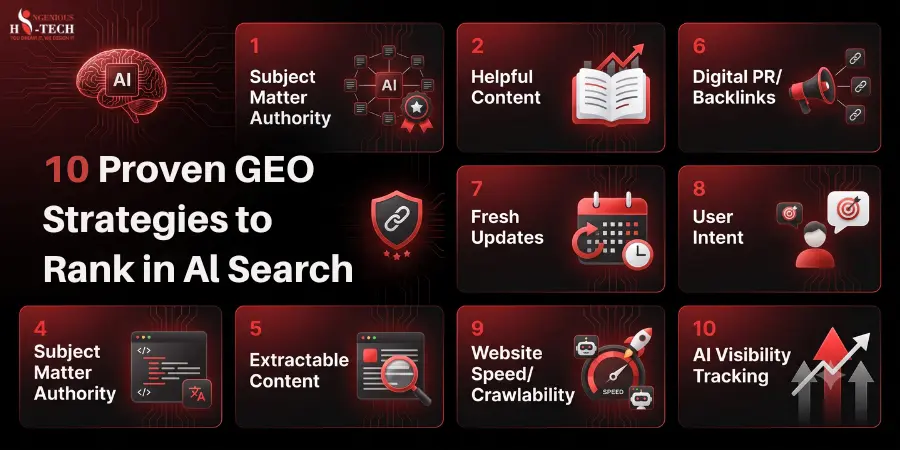
1. Focus on Subject Matter Authority, Not Page-Level Authority
- Why it’s important: The algorithms used by AI favour authorities on an entire subject, not a page-by-chance hit.
- Best practices: Develop topical clusters based on key subjects, linked together through internal links and common language.
- Mistakes made: Posting isolated blog articles without any thematic consistency.
- Implementation hint: Create 8-10 related sub-topics within each major service area.
2. Make Content That Actually Helps People
- Why it’s important: Google’s algorithms and AI favour content that answers a user’s need over content that just ranks well.
- Best practices: Answer the question within the first few sentences, then support your answer with relevant content.
- Mistakes made: Making people wade through a lot of introduction before getting an answer.
- Implementation hint: Answer the question first, as though you’re going to write only one paragraph.
3. Improve EEAT Signatures
- Relevance: EEAT in the context of AI searches is one of the most obvious criteria for how reliable a source is considered when referencing it.
- Best practices: Mentioning authors' credentials, including real-life examples, author bios, and clear sources.
- Common pitfalls: Creating anonymous or unattributed content without any expertise shown.
- How-to tips: Always add an author name and a short biography along with mentioning relevant experience in all blog posts.
4. Use Structured Data and Schema Markup
- Relevance: Structured data can help artificial intelligence and search engines figure out exactly what your content is about.
- Best practices: Article, FAQ, Organisation, and Product schema markup usage.
- Common pitfalls: Forgetting about schema markup or doing it the wrong way.
- How-to tips: Check the Rich Results Test for each type of schema you use on Google.
5. Organise Content for Extractability
- What it means: AI models extract clearly laid out information, list items, tables, and short definitions better than big paragraphs.
- Good practice: Use good headings, short paragraphs, bulleted text and definitions.
- Bad practice: Write long texts without any structure and visual hierarchy.
- Implementation tip: Once you write your text, read it from top to bottom and check: "Can I take this sentence separately and it would still make sense?"
6. Work on digital PR and Backlinking
- What it means: You build the brand mentions and link signals that help to establish the authoritativeness.
- Good practice: Do guest writing, roundups and get some PR coverage.
- Bad practice: Try to chase some random backlinks that don't really add value.
- Implementation tip: Aim for a few high-quality and relevant places rather than many useless ones.
7. Make sure your content is fresh and updated
- What it means: Outdated data reduces model confidence in citing your content.
- Good practice: Update main pages with new statistics and examples twice a year.
- Bad practice: Publish some evergreen content once and never come back to it again.
- Implementation tip: Add a visible "last updated" date to build trust and encourage recrawling.
8. Match Content to Intended User Intentions
- Why it matters: The AI system is created to answer the intention behind the query, not necessarily the keywords used.
- Good practice: Investigate the wording that people actually use in their queries to AI-powered tools.
- Mistakes: Writing for keywords rather than conversational questions for search engines.
- Tip: Create content using header phrases that represent conversational questions posed directly to ChatGPT or Gemini.
9. Website Speed and Crawlability
- Why it matters: The website cannot be indexed at all if it isn’t able to be accessed and crawled by AI systems and search bots.
- Good practice: Website optimisation for speed, mobile and clean architecture.
- Mistakes: Blocking AI crawlers via mistakes in robots.txt configuration.
- Tip: Perform robot.txt and server log audit once a quarter to make sure the major AI crawlers can access important pages.
10. Measure and Enhance AI Visibility Gradually
- Importance: Improvement is not possible without measurement, and measuring AI visibility has its own unique methodology.
- Best practices: Track brand mentions in AI applications, traffic coming from AI tools via referral, and citations.
- Mistakes: Using only traditional Search Console metrics provided by Google for evaluating AI performance.
- Tip: Ask relevant industry-specific questions in ChatGPT, Gemini, and Claude from time to time.
Common GEO Mistakes to Avoid
- Thinness: lacklustre, superficial content that does not address the query
- Keyword stuffing: excessive, forced use of keywords that negatively impacts both people and models
- Duplicate content: repeating content on multiple pages and confusing the topic
- Failure to demonstrate EEAT: failing to demonstrate expertise or experience
- Outdated content: outdated stats or references that make your content less trustworthy
- Poor internal linking: failure to leverage internal links to demonstrate topical depth
- Lack of schema: absence of structured data that makes your content difficult to understand
GEO Checklist for 2026
- Identify any topics that are lacking and thin out articles
- Include bios and credentials of the authors in important content
- Use Schema Markup for Article, FAQ, and Organisational content
- Convert bulky paragraphs into easily readable/extractable content
- Keep your cornerstone pages updated with current statistics and examples
- Create internal links between similar topics
- Look for digital PR for backlinks
- Check how your brand is featured in ChatGPT, Gemini, and Claude
- Ensure that your website loads quickly and is accessible by crawlers
- Set up a repeating schedule for cornerstone content updating
The Future of GEO and AI Search
AI searches are more likely to continue evolving in the direction of growth rather than become an alternative to conventional search. This is seen from such projects as AI overview, browsing capabilities of ChatGPT, and Claude's ever-increasing utilisation for research.
Companies that approach GEO and SEO as complementary fields rather than competitors will be able to succeed when AI search evolves into something greater. The underlying ideas behind it have been following the same old search principles for quite some time already: be useful, be clear, be trustworthy.
FAQs
1. What is Generative Engine Optimisation (GEO)?
GEO is the practice of optimising content so AI platforms like ChatGPT, Gemini, and Claude can understand, trust, and reference it in generated answers.
2. How is GEO different from SEO?
SEO focuses on ranking on search results pages, while GEO focuses on being cited or referenced inside AI-generated answers.
3. How do I rank in ChatGPT?
Focus on clear, well-organised, factually accurate content backed by credible sources, since ChatGPT's browsing features favour trustworthy, easy-to-parse pages.
4. Does schema markup help with AI search visibility?
Yes. Structured data and schema markup help AI systems accurately interpret your content, which supports better visibility across AI search platforms.
5. Is EEAT important for AI search optimisation?
Yes. EEAT for AI search is central to how models judge whether a source is credible enough to reference in an answer.
6. Do I need to abandon traditional SEO to focus on GEO?
No. GEO builds on SEO fundamentals, so strong technical SEO, quality content, and backlinks continue to support your AI visibility.
Conclusion
Generative Engine Optimisation is not a replacement for SEO; it's the next step companies have to take to maintain their visibility as the way search works changes. By enhancing topical authority, EEAT, structured data, and freshness of your content, you prepare your brand to be discovered and trusted by ChatGPT, Gemini, Claude, and any other future search engine that might appear.
This GEO guide provides an essential foundation, but implementing it into dozens of pages and types of schema and content clusters requires strategy. If you're ready to turn your website into one that will be found by AI searches, our team at Ingenious HiTech will assist you with creating your own GEO strategy.