
It takes a visitor only a few seconds to decide whether your website feels safe, credible, and worth their time. Before they read a single sentence, they're already scanning for clues: Does the design look current? Is the padlock icon there? Does anything feel "off"? That snap judgment happens long before logic kicks in, and it often decides whether someone stays, signs up, or clicks away for good.
This is why digital trust has quietly become one of the biggest factors separating businesses that grow online from those that stall. Search engines now favour sites that demonstrate real expertise and reliability. Customers are more cautious than ever about scams, data misuse, and AI-generated content flooding the web. In this environment, trust isn't a "nice to have"; it's the foundation on which everything else is built.
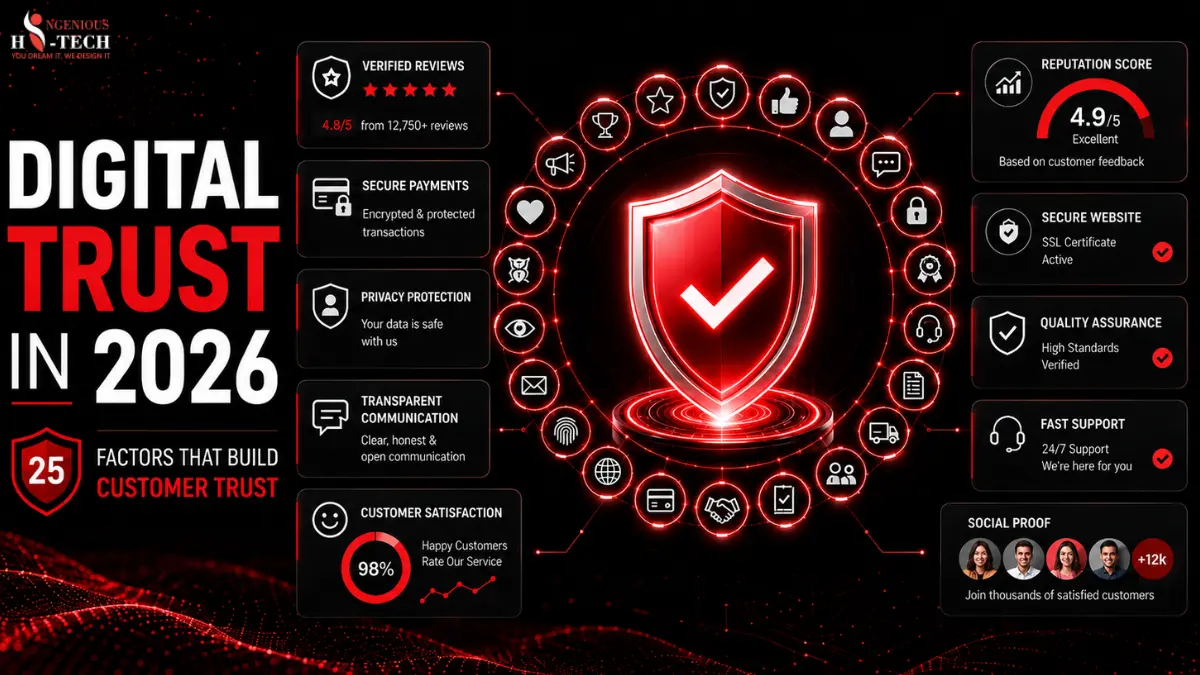
To help business owners make sense of this, Ingenious HiTech developed the Digital Trust Score™, an educational framework that breaks trust down into measurable, improvable factors. In this guide, you'll learn what digital trust actually means, why it matters more in 2026 than ever before, and the 25 specific factors that shape how customers perceive your brand online.
- (Quick Question: If a stranger landed on your website right now with zero background on your business, would they trust it enough to hand over their email or their credit card?)
What Is Digital Trust?
Digital trust is the confidence a visitor, customer, or search engine has in your website and brand as legitimate, secure, and capable of delivering on their promises. It's built through consistent signals: design quality, security, transparency, real reviews, and accurate information that reassure people they're dealing with a credible business rather than a risk.
Trust matters because it directly influences behaviour. A visitor who trusts your site is more likely to browse longer, fill out a form, make a purchase, and return later. A visitor who doesn't trust it leaves within seconds, often without you ever knowing why.
Digital Trust vs. Brand Awareness: Awareness is about recognition how many people know your name. Trust is about belief whether those people think you're reliable. A brand can be widely known and still be distrusted (think of companies that faced public data breaches). Awareness gets you noticed; trust gets you chosen.
Digital Trust vs. SEO: SEO is about visibility, helping the right people find you in search results. Trust is about what happens after they arrive. You can rank on page one and still lose the customer if your site looks outdated, lacks contact details, or feels insecure. Increasingly, though, the line between the two is blurring, since search engines reward the same signals expertise, authority, and trustworthiness that customers respond to.
- (Key Takeaway: Digital trust is the invisible currency of the internet. Brand awareness gets attention. SEO gets traffic. Trust converts both into customers.)
Why Digital Trust Matters in 2026
Several forces are converging right now to make trust more important than at any point in the internet's history.
- AI-powered search experiences: As AI tools summarise and recommend content, they lean heavily on signals of expertise and credibility rather than just keywords, making trust-building content more valuable for visibility.
- Rising customer expectations: People compare every website against the best ones they've used, and patience for clunky, confusing, or slow experiences keeps shrinking.
- Online scams and fake content: With AI making it easier to generate convincing but fake reviews, images, and content, consumers have become noticeably more sceptical of anything that seems too polished or too generic.
- Data privacy concerns: Customers want to know how their information is collected, stored, and used, and they're willing to act on those concerns.
- Brand credibility: A single visible red flag, such as a broken contact page or an expired security certificate, can undo months of marketing effort.
- Competitive advantage: When products and pricing are similar, trust is often the deciding factor in who wins the sale.
Introducing the Digital Trust Score™
Businesses are told constantly that they need to "build trust online," but are rarely given a way to measure it. That gap is exactly why Ingenious HiTech created the Digital Trust Score™, a practical, educational framework that turns an abstract idea into something you can actually assess and improve.
Important clarification: the Digital Trust Score™ is not an official Google ranking factor, and it isn't a metric used by any search engine or third-party authority. It's an internal assessment model developed by Ingenious HiTech to help business owners evaluate their website and brand across the areas that most influence customer confidence.
Here's how it works in practice. Businesses can use the framework to walk through their website with fresh eyes, category by category, scoring how well they perform on each of the 25 factors covered later in this guide. The result is a simple, 100-point view of where a brand currently stands and, more usefully, exactly where the biggest gaps are.
|
Score Range |
Trust Level |
|
0–20 |
Poor |
|
21–40 |
Fair |
|
41–60 |
Good |
|
61–80 |
Strong |
|
81–100 |
Excellent |
Most businesses that go through this exercise for the first time are surprised to find they're stronger in some categories (like design) and noticeably weaker in others (like social proof or security). That's normal, and it's exactly the kind of insight that turns vague marketing advice into a focused action plan.
The 25 Digital Trust Factors
To make digital trust practical rather than theoretical, we've grouped the 25 factors into five categories that reflect how customers actually experience a website.
Website Experience
The first few seconds on your site are almost entirely visual and functional.
- Professional design that looks current, not templated or dated
- Mobile responsiveness, since most visitors will land on a phone first
- Fast loading speed, because delays of even a couple of seconds increase abandonment
- HTTPS security, shown by the padlock icon in the browser bar
- Easy navigation that lets visitors find what they need in a click or two
Quick checklist:
- Site loads in under 3 seconds on mobile
- SSL certificate is active and up to date
- Menu structure is simple and predictable
- Design has been refreshed within the last 1–2 years
Content & SEO
Content is where you prove expertise, not just claim it.
- Helpful content that actually answers the questions your audience is asking
- Fresh updates that show the site is actively maintained
- Clear service pages that explain exactly what you offer and who it's for
- Internal linking that helps visitors (and search engines) navigate related information
- Structured data that helps search engines understand and accurately display your content
Optimisation tip: Review your top pages every quarter. Update outdated statistics, fix broken links, and expand thin sections. Search engines and readers both reward pages that are clearly maintained.
Brand Credibility
This is where visitors verify that a real, accountable business is behind the website.
- About page that tells a genuine story, not generic corporate copy
- Team profiles with real names and photos, not stock images
- Contact information that's easy to find and actually works
- Certifications or industry credentials, displayed clearly
- Case studies that show real results with real clients
Trust Tip: If a visitor can't find out who's behind your business within 10 seconds, they'll assume the worst. Make your "About" and "Contact" pages as easy to find as your homepage.
Social Proof
People trust other people more than they trust brands talking about themselves.
- Reviews on Google: industry platforms, or your own site
- Testimonials: with specific, believable detail rather than vague praise
- Social media: presence that shows the business is active and engaged
- Client logos: that lend credibility through association
- Awards or recognitions: when genuinely earned
Pro Tip: Detailed, specific testimonials consistently outperform vague ones. "They helped us cut support tickets by 30% in two months" builds far more confidence than "Great service, highly recommend."
Future-Ready Trust Signals
These factors matter more every year as technology and expectations evolve.
- AI-friendly content: that's clearly structured, factual, and easy for AI tools to summarise accurately
- Accessibility: features that make your site usable for people with disabilities
- Privacy policy: that's easy to find and written in plain language
- Brand consistency: across your website, social channels, and marketing materials
- Regular updates: that keep your site, security patches, and content current
As AI tools increasingly summarise and recommend businesses on a customer's behalf, sites that are transparent, accessible, and clearly organised will have a distinct advantage. over those that aren't. Investing in these signals now positions a business to stay trustworthy as customer expectations keep shifting.
How to Improve Your Digital Trust Score
Improving trust doesn't require a total rebuild. It requires a focused, sequential plan.
- Step 1: Audit your website. Go through each of the 25 factors above honestly. Note what's missing, outdated, or inconsistent.
- Step 2: Improve speed and security. Fix slow-loading pages, renew expired certificates, and eliminate broken links. These are often quick wins with outsized impact.
- Step 3: Build authority. Publish genuinely useful content, showcase real case studies, and highlight credentials or certifications prominently.
- Step 4: Collect customer reviews. Make it easy for satisfied customers to leave feedback, and respond to reviews, good and bad, professionally.
- Step 5: Update content consistently. Set a recurring schedule to refresh service pages, blog posts, and statistics so nothing on your site looks abandoned.
Treat this as an ongoing cycle rather than a one-time project. Businesses that revisit their trust factors quarterly tend to catch small issues before they become the reason a customer leaves.
Common Mistakes That Reduce Digital Trust
|
Mistake |
Why It Hurts Trust |
Practical Solution |
|
Slow websites |
Visitors assume the business is careless or outdated |
Compress images, use caching, choose reliable hosting |
|
Poor design |
Signals lack of investment or professionalism |
Refresh templates and layout every 1–2 years |
|
Fake testimonials |
Once spotted, they damage credibility permanently |
Use only verified, specific customer feedback |
|
Missing contact information |
Feels evasive or untrustworthy |
Display phone, email, and address clearly |
|
Weak security |
Raises fear of data theft or fraud |
Maintain active SSL and regular security updates |
|
Thin content |
Suggests low expertise or effort |
Expand pages with genuinely useful detail |
|
Outdated blogs |
Implies the business is inactive |
Refresh or remove stale posts regularly |
|
Broken links |
Creates a frustrating, unreliable experience |
Run periodic link audits and fix promptly |
Digital Trust vs SEO vs Brand Authority
These three concepts often get used interchangeably, but each plays a distinct role.
|
Digital Trust |
SEO |
Brand Authority |
|
|
Purpose |
Reassure visitors the business is credible and safe |
Help the right audience find the business in search |
Establish the business as a recognised leader in its space |
|
Benefits |
Higher conversions, lower bounce rates, customer loyalty |
Increased visibility and organic traffic |
Premium positioning, referrals, industry recognition |
|
Business Impact |
Directly affects whether visitors convert |
Directly affects how many visitors arrive |
Indirectly affects both, over time |
|
Relationship |
Trust turns SEO traffic into paying customers |
SEO brings people to the door |
Authority is trust and SEO sustained at scale |
None of these works well in isolation. SEO without trust brings visitors who quickly leave. Trust without SEO means a great site nobody finds. Authority is what happens when both are done consistently over time.
Frequently Asked Questions
1. What is Digital Trust?
Digital trust is the confidence customers and search engines place in a website's legitimacy, security, and reliability, built through consistent signals like design quality, transparency, and real social proof.
2. Why is Digital Trust important?
It directly influences whether visitors stay, engage, and convert. Without it, even well-designed marketing campaigns struggle to produce results, since traffic alone doesn't guarantee sales.
3. How can businesses improve Digital Trust?
By auditing their website against key trust factors, fixing security and speed issues, collecting genuine reviews, and keeping content current and accurate.
4. Does Digital Trust affect SEO?
Yes, indirectly. Search engines increasingly reward sites that demonstrate expertise, authority, and trustworthiness, which overlaps significantly with the factors that build customer trust.
5. What are website trust signals?
Trust signals are visible cues such as HTTPS security, clear contact information, real testimonials, and professional design that reassure visitors a business is legitimate.
6. Can small businesses build Digital Trust?
Absolutely. Many trust factors, like adding real contact details, collecting reviews, and writing an honest About page, cost little to nothing and can be implemented quickly.
7. Is the Digital Trust Score™ an official Google ranking factor?
No. The Digital Trust Score™ is an educational framework created by Ingenious HiTech to help businesses assess their own trustworthiness. It is not an official metric used by Google or any other search engine.
Conclusion
Digital trust isn't a passing trend; it's becoming one of the clearest dividing lines between businesses that grow online and those that quietly lose customers without knowing why. The good news is that trust is built through specific, identifiable factors, which means it's also something you can measure, improve, and track over time.
Start small if you need to. Fix what's broken, add what's missing, and keep showing up consistently. Trust compounds the same way a good reputation does: slowly at first, then all at once.
If you're ready to see exactly where your business stands, Ingenious HiTech invites you to request a Digital Trust Audit. We'll walk through your website against the 25 factors covered in this guide and show you precisely where your biggest opportunities are. Contact Ingenious HiTech today to get started.