
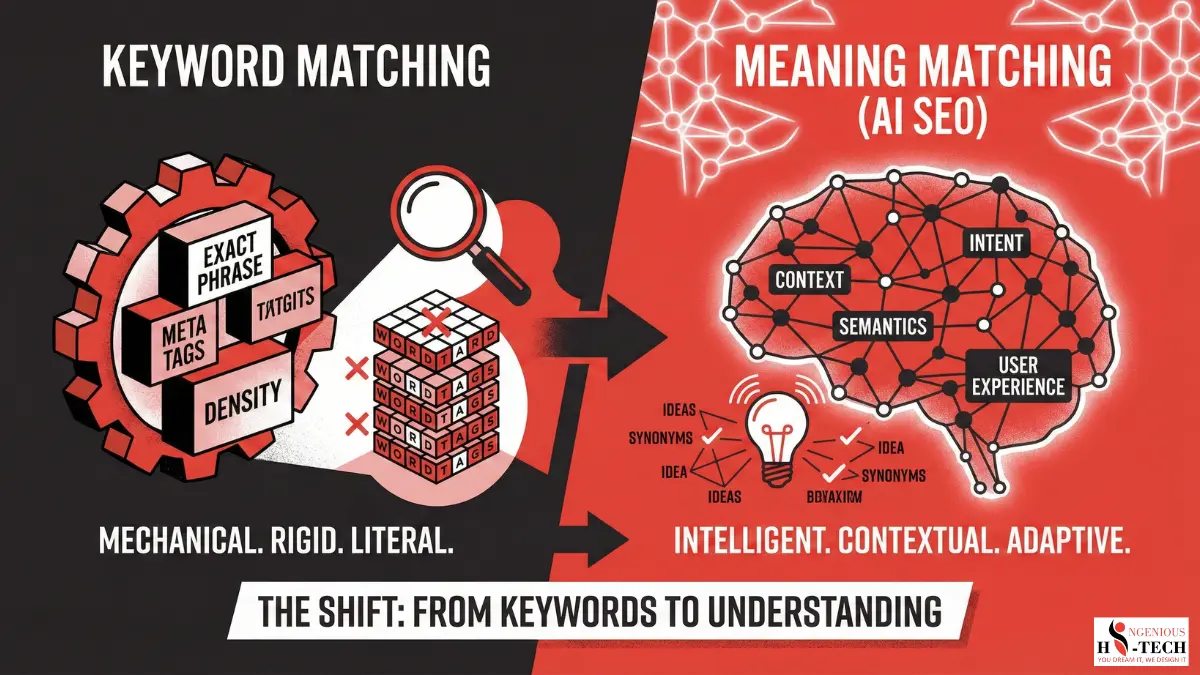
SEO is undergoing a major transformation. The era of ranking through excessive keyword repetition is rapidly declining. Now, search engines, powered by smart AI, are all about understanding what people mean, what their intent is, and the context behind their searches. This whole thing is what we call the switch from basic keyword matching to "Meaning Matching" in AI SEO.
For anyone running a business or doing marketing, you absolutely have to get this change. Websites that stick to those old, keyword-stuffed tactics are starting to lose ground, even if their technical SEO is spot-on. To stay competitive, your SEO strategy must align with how AI systems interpret meaning, not just how it counts a few keywords.
Understanding Keyword Matching in Traditional SEO
Earlier, SEO was all about keyword matching. You would optimize pages around a specific keyword phrase, placing it in titles, headings, meta descriptions, and throughout the content., sticking it in the title, headings, meta description, and all over the content. Search engines largely evaluated how frequently a keyword appeared on a page. This meant sites that just repeated phrases a ton often won, even if the content wasn't super clear or helpful. Quality took a backseat to stuffing in those keywords. That worked back in the day, but it couldn't handle more complicated searches.
Those limitations are exactly why AI came along and changed the game. Today, ranking depends on understanding context and intent rather than repetition.
Why Search Engines Transitioned to Meaning Matching
Searching is totally different now. People don't just type in single keywords anymore. They're asking full questions, using everyday language, and expecting quick, spot-on answers. This change really sped up with everyone using mobile, voice search, and longer, more complex queries.
To keep up, search engines brought in AI that can actually understand language. This tech looks at how words, phrases, and ideas connect. Basically, AI search now gives you results based on what you mean, not just if the exact words are there. This shift improves result accuracy and reduces manipulation, and it makes it harder to game the system with keyword stuffing.
For Example, updates like Google’s BERT and MUM models got way better at figuring out the context and relationships between words, instead of just matching exact keywords.
What Meaning Matching in AI SEO Actually Means
AI SEO's "Meaning Matching" is basically the search engine trying to figure out if your content actually answers the real question a user has. Forget just hunting for exact words; the AI now digs into the core meaning, the overall vibe, and how deeply you cover the subject.
Here's the deal: Your page can totally rank even if you skip the exact search phrase, as long as you absolutely nail the topic. The AI is smart enough to spot related stuff, synonyms, and truly helpful explanations. That's how search engines ensure people find genuinely useful content.
Bottom line? This AI ranking method cares way more about being truly relevant, clear, and complete than just following a bunch of technical rules.
How AI Interprets Search Intent and Context
These days, search intent is key for modern AI ranking systems. AI figures out if someone's query is looking for info, trying to navigate somewhere, looking to buy something, or trying to complete a transaction. Then, it checks how well the content delivers on that goal.
Contextual stuff like how the phrase is worded, where the user is, what device they're using, and their past searches really helps AI nail the meaning. A simple keyword can mean different things depending on the context. This focus on meaning makes sure the search results actually match what people are trying to find. That's why ranking well is less about keyword stuffing and more about lining up with what the user wants.
Why Exact-Match Keywords Are No Longer the Priority
Exact keywords are still relevant, but they're not the be-all and end-all anymore. If you stuff your writing with one phrase, it usually sounds weird, which makes people tune out and hurts your credibility.
AI ranking systems prefer content that sounds natural and flows well. If you really nail an explanation, that content will often rank for tons of related searches without you having to specifically target each one. This shift is all about rewarding real expertise, not just shallow pages built around keywords.
The Importance of Semantic Coverage in Meaning Matching
Semantic coverage is super important for Meaning Matching in AI SEO. Instead of targeting a single keyword per page, the winning approach is to cover the whole topic. That means including all the related questions, extra explanations, and real-world examples.
When your content is this thorough, AI can easily figure out what it's about and where it belongs. This deep semantic coverage shows you're an authority and relevant, which are huge for meaning-based rankings. These ranking systems really like content that shows understanding, not just content that's been keyword-stuffed.
How Content Strategy Must Change for AI SEO
Businesses must move beyond keyword targeting and start thinking about what people really want to know. Your pages should be set up to clearly and completely answer actual user questions. When you focus on giving users value, the right keywords will naturally follow.
AI search engines love it when your writing is well-organized, flows logically, and makes sense in context. Try to think ahead: what's the next question a user will have? Answer it right there in the same piece of content. This kind of strategy not only helps your rankings but also builds user trust and keeps them engaged.
The Relationship Between User Experience and Meaning Matching
The way people experience your site actually backs up Meaning Matching in AI SEO. When folks really like your content, they stick around longer, get more into it, and aren't rushing back to Google.
These good engagement signs help AI figure out that your content hits the mark for the user's intent. Pages that are hard to read, confusing, or just plain wrong won't do well, even if they have all the right keywords.
Keeping things neat with clear formatting, simple language, and a logical flow helps both your readers and the AI understand what you're saying.
Measuring SEO Performance in a Meaning-Based System
Traditional keyword ranking reports provide limited insight in a meaning-driven environment. Success in a meaning-driven SEO system is reflected through broader visibility, sustained traffic, and higher engagement across related queries.
Pages that rank for multiple variations, attract qualified visitors, and support conversions demonstrate strong intent alignment. These outcomes indicate that content is being evaluated by meaning rather than keyword repetition. Long-term SEO success depends on relevance consistency.
Why Meaning Matching Is the Future of SEO
AI search is changing things up, moving us toward a more user-friendly experience. As AI gets smarter, search engines will care way less about exact keywords and much more about the actual meaning behind your search.
If your website has great content that really explains things well, you're going to stay visible for the long haul. Just stuffing in keywords? That's a strategy with a shelf life. SEO isn't about gaming the machine anymore; it's about clearly telling people what value you offer.
Final Perspective: Write for Meaning, Not Metrics
The change from matching keywords to understanding what words mean in an AI search engine optimization is a deal. It shows that being clear and helpful is what gets you results. When you write something that teaches people things, answer their questions. Shows them the way the AI system sees that it is useful and relevant.
If businesses focus on what people are looking for, go deep into the subject, and understand the meaning of words, they can make sure their search engine optimization plan works well for a long time. This way, they can get more people to visit their website without paying for ads and keep growing in a way that's good for the business.
Frequently Asked Questions: (FAQ’s)
1. What is the meaning of matching in AI SEO?
Meaning matching in AI SEO is how search engines use artificial intelligence to understand the intent and context behind a search query and match it with content that best answers the user’s question, even if the exact keywords are not used.
2. How is meaning matching different from keyword matching?
Keyword matching focuses on exact or similar words appearing on a page, while meaning matching evaluates the overall topic, intent, and relevance of the content. Meaning matching prioritizes understanding over repetition.
3. Do keywords still matter in AI SEO?
Yes, keywords still matter, but they are no longer the primary ranking factor. In meaning matching in AI SEO, keywords help signal relevance, while content quality and intent alignment drive rankings.
4. Can a page rank without exact-match keywords?
Yes. With meaning matching in AI SEO, a page can rank for a search query even if it does not include the exact keyword, as long as it clearly explains the topic and satisfies user intent.
5. How does search intent affect meaning matching?
Search intent is central to meaning matching in AI SEO. Search engines analyze whether users want information, comparisons, or solutions and rank content that best fulfills that intent.
6. What type of content works best for meaning matching?
In-depth, informative, and well-structured content performs best. Meaning matching in AI SEO favors content that explains topics clearly, answers common questions, and covers related concepts naturally.
7. Does keyword density still impact SEO rankings?
Keyword density is far less important than before. Meaning matching in AI SEO prioritizes natural language and clarity, making forced keyword repetition ineffective and sometimes harmful.
8. How can I optimize content for meaning matching in AI SEO?
Focus on understanding user questions, writing comprehensive explanations, using natural language, and covering related topics. This approach aligns content with meaning matching in AI SEO.
9. Is meaning matching related to semantic SEO?
Yes. Semantic SEO supports meaning matching in AI SEO by helping search engines understand relationships between concepts, topics, and terms rather than relying on individual keywords.
10. Why is meaning matching important for long-term SEO success?
Meaning matching in AI SEO helps content remain relevant over time. Because it focuses on intent and understanding, well-written content continues to rank even as search trends and keywords change.