

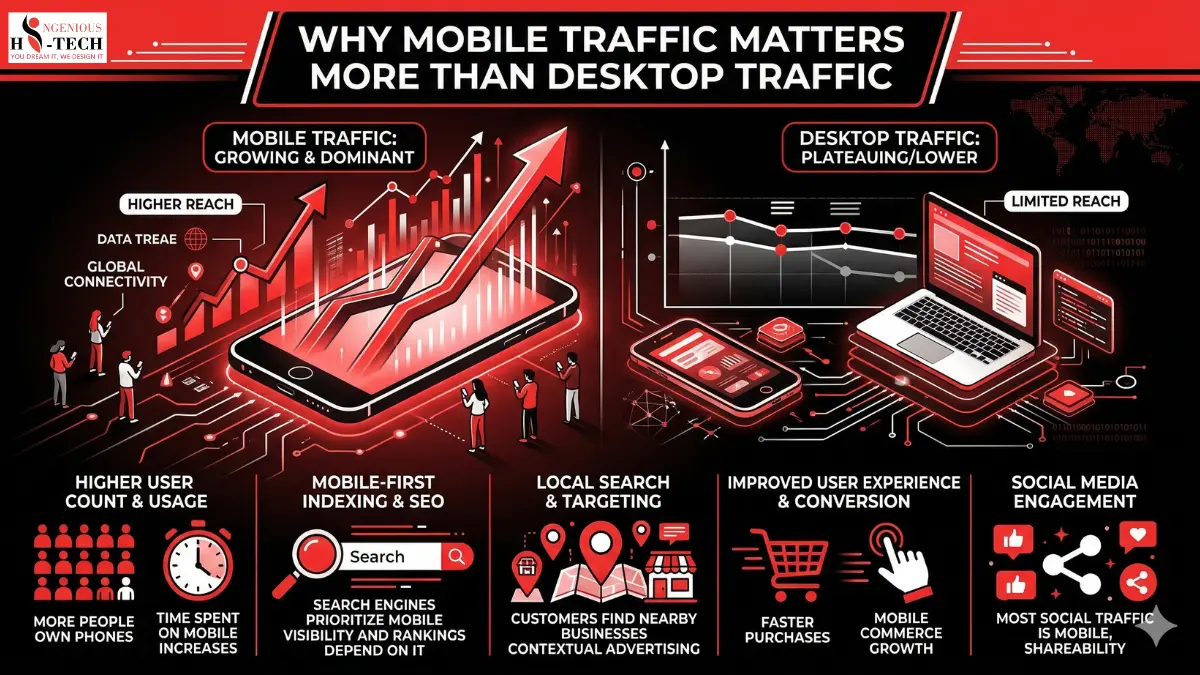
For a time, people thought that the traffic from computers was the most important thing for a website. Companies were about making things look good on big screens and work well with a mouse. Things have changed a lot. Now people mostly use their Mobile devices to get on the internet. They use these devices to search for things, look around, compare stuff, and buy things online. This change means that how a website works on devices is now more important than how it works on computers for getting good search results and helping businesses grow.
Mobile traffic is also important for search results and for businesses as well. Websites that still prioritize desktop traffic without analyzing mobile traffic often struggle with declining engagement, lower conversions, and weaker search visibility. Understanding why mobile traffic now matters more, and how it impacts rankings, trust, and revenue, is essential for sustainable digital growth.
The Reality of Mobile-First Internet Usage

More Than 60% of All Global Web Search Activity is Now Conducted on Mobile Devices, and Google Began Testing its Methodology All the Way Back in 2016, but in 2023, made it Universal for All Websites Without Exception. As Google's primary objective has always been to connect users with content that is most relevant and best performing. The majority of users are mobile users, and Google needs to analyze websites through a mobile-first approach in order to serve them correctly.
Every website on the internet, regardless of size or age, is now subject to the mobile-first indexing approach. If you have poor mobile traffic, you will see poor rankings for it, and there is no way out.
Mobile traffic reflects how users actually interact with the internet today.
Why Search Engines Prioritize Mobile Traffic
People use search engines all the time. Search engines pay attention to what people do. When more people started using their phones, search engines had to make some changes. They changed how they decide which websites are the best. Now search engines look at the version of a website first. This is called first indexing. Search engines use the version of a website to figure out where it should rank. Search engines do this because they want to make sure people can find what they are looking for on their phones. Mobile-first indexing is important for search engines. Search engines follow user behavior, so they have to think about phones.
This change directly connects mobile traffic with SEO performance. If a website looks good on desktop but performs poorly on mobile, search engines analyse that as a negative user experience. As a result, rankings can fall even if desktop traffic appears stable. Mobile traffic is no longer a design preference; it is a ranking factor.
How Mobile Traffic Influences User Trust
Trust is built fast when you are using your mobile phone, and it can be lost in no time. When you are on your mobile, you usually have something that you want to do, and you do not have a lot of time to waste. If the page takes forever to load, the words are hard to read, or it is difficult to find your way, people will start to doubt that the business is legitimate. Mobile users, like you and me, will quickly think that the business is not trustworthy if things do not work properly on our phones.
When you use a phone to analyse a website, it should be easy to use and look good. This shows that the people who made the website are professional and can be trusted. People are more likely to trust a brand that does not waste their time and works well on their phone. If you are using a computer you might not mind if a website is a little complicated. People who use mobile phones want things to be simple. Good mobile traffic is important for brands like these because mobile users expect simplicity from an experience.
This trust directly impacts conversions, lead generation, and brand perception.
Why Mobile Traffic Converts Differently Than Desktop Traffic
Desktop traffic usually comes from people who are looking around or doing some research on the Desktop. Mobile traffic is different. It often comes from people who need something away on their Mobile. They might be searching for directions or prices. Reading reviews on their Mobile. They could be looking for an answer on their Mobile.
Because mobile users are often closer to decision-making, poor mobile traffic results in lost opportunities. A difficult checkout process, unresponsive buttons, or cluttered layouts can stop conversions instantly.
Optimizing mobile traffic aligns your website with high-intent traffic, making it more valuable than desktop visits alone.
The Relationship Between Mobile Traffic and SEO Engagement Signals
When you look at search engines, they check how people interact with the content to see if it is really relevant. The experience people have on their Mobile devices has a big impact on this. If people go to a website and then leave, or if they have a hard time scrolling through it, or if they do not do anything on the website, it means they are not happy with the search engine's results. Search engines use these signals from the experience to understand what people like and what they do not like.
If people leave your pages quickly and do not interact with them, this can hurt your mobile pages' performance on search engines. Even if the content of your pages is really good, high bounce rates and low engagement can still be a problem. On the other hand, when your mobile pages are easy to use, people will stay on them longer, scroll down more, and interact with them more, which are all good signs that your mobile pages are relevant to what people are looking for.
Mobile traffic supports SEO not through technical tricks, but through better user behavior.
Why Responsive Design Alone Is Not Enough
Many businesses assume that having a responsive website automatically solves mobile issues. While responsiveness is important, it does not guarantee good mobile traffic.
True mobile optimization considers font size, spacing, touch-friendly elements, page speed, and content prioritization. A page that simply shrinks desktop content to fit a small screen often feels overwhelming on mobile.
mobile traffic requires intentional design choices that reflect how users read, tap, and navigate on phones.
How Page Speed Impacts Mobile Traffic More Than Desktop
.webp)
Page speed is critical on mobile devices. Mobile users often rely on cellular networks, which can be slower or less stable than desktop connections. A slow-loading mobile page creates immediate frustration.
Search engines factor mobile page speed into rankings because it directly affects user satisfaction. Even small delays can significantly reduce engagement and conversions on mobile.
Optimizing images, reducing unnecessary scripts, and streamlining content are essential for improving mobile traffic and maintaining visibility.
Why Mobile Traffic Drives Local and Service-Based Searches
Local and service-based searches are heavily mobile-driven. Users search for nearby businesses, directions, operating hours, and contact details while on the move. Poor mobile traffic makes it difficult for users to take action when intent is highest.
Clear calls to action, easy navigation, and accessible contact information are critical for mobile success. Desktop traffic may explore options, but mobile traffic often wants immediate answers.
Mobile traffic directly supports revenue for local and service-oriented businesses.
How Content Should Be Adapted for Mobile Users
Mobile users consume content differently from desktop users. They scan more, read in shorter sessions, and expect clarity. Content must be structured to deliver value quickly without overwhelming the screen.
Clear headings, concise explanations, and logical flow improve mobile readability. This does not mean content should be shorter; it means it should be more focused.
Search engines recognize content that works well on mobile and reward it with better visibility.
Why Desktop Traffic Alone Is a Misleading Metric
When you look at the numbers, desktop traffic seems good. The truth is, it does not always mean your business is actually growing. You can have a lot of people visiting your website on their desktop computers. If they are not doing anything or buying anything, then it is not really helping your business. Desktop traffic is that desktop traffic, and it is not always a good measure of how well your business is doing.
Mobile traffic is really important. It helps us see how people who use their mobile devices are affected by what they find. When people use their devices, and they do what we want them to do, like buy something or come back to our site, it means that what we are showing them is what they are looking for. The mobile traffic directly connects the people who visit our site to the results we want.
Focusing on mobile traffic provides a more accurate picture of performance than desktop traffic alone.
The Long-Term Impact of Ignoring Mobile Traffic
If a website does not work well on phones, it will have big problems in the long run. Search engines like Google are always making their systems better for phones first, so if a website is not good on mobile phones, people will notice the difference. Websites that are not good on phones will struggle because search engines are making sure that mobile phones can use them easily. This means that websites need to make sure they are good on phones, or they will have trouble. Mobile optimization is very important for websites.
Competitors with better mobile usability gain rankings, trust, and conversions over time. Recovering from poor mobile traffic often requires more effort than maintaining it from the start.
Investing in mobile traffic is not a trend; it is a necessity.
Final Thoughts: Mobile Traffic Is the New Standard
Mobile traffic is really important. It is more important than how many people look at a website on their desktop computer. This is because the mobile traffic shows how people actually use the internet. The mobile traffic affects how high a website appears in search results, how much people trust a website, how much people interact with a website, and how many people buy something from a website. Mobile traffic affects these things more than anything that happens on a desktop computer. Mobile traffic matters when it comes to things like search rankings, user trust, conversions, and to know more, you can go through Mobile-First Indexing: What You Need to Know.
Companies that make sure their websites work well on phones are more likely to do well in the long run. If a company only thinks about people using desktop computers to visit their website, they will probably have problems keeping up with everyone who uses their mobile phones to get online. Businesses need to think about usability to stay ahead.
In modern SEO and online business, mobile traffic is not an enhancement. It is the foundation.
FAQ’s: Frequently Asked Questions
1. Why is mobile traffic more important than desktop traffic?
Mobile traffic matters more because most users now browse, search, and buy on smartphones. Search engines also prioritize mobile usability when ranking websites.
2. How does mobile traffic affect SEO rankings?
Search engines use mobile-first indexing, meaning they evaluate the mobile version of a site to determine rankings. Poor mobile traffic can negatively impact SEO performance.
3. Does mobile traffic convert better than desktop traffic?
Mobile traffic often has higher intent, especially for local searches and quick decisions. Strong mobile traffic increases conversions and engagement.
4. What is mobile-first indexing and why does it matter?
Mobile-first indexing means search engines primarily use the mobile version of a website for ranking and indexing. If the mobile site is weak, rankings can drop.
5. How does page speed impact mobile users?
Slow page speed frustrates mobile users and increases bounce rates. Faster mobile pages improve user experience, engagement, and search rankings.
6. Is responsive design enough for good mobile traffic?
Responsive design helps, but it is not enough on its own. Mobile traffic also depends on readability, navigation, page speed, and touch-friendly elements.
7. Why do mobile users leave websites faster?
Mobile users leave quickly when pages load slowly, text is hard to read, or navigation is confusing. Mobile users expect fast and simple experiences.
8. How does mobile traffic affect local search results?
Most local searches happen on mobile devices. Poor mobile traffic reduces visibility and conversions for location-based and service businesses.
9. Can a website rank well with good desktop design but poor mobile traffic?
No. Even if a desktop site performs well, poor mobile usability can hurt rankings due to mobile-first indexing and lower engagement signals.
10. How can businesses improve mobile traffic for SEO?
Businesses should focus on fast loading times, clear content structure, easy navigation, and mobile-friendly design to improve SEO and user satisfaction.