


Introduction: When a Machine Knows More About You Than You Know About Yourself
Imagine Google were a psychologist. What kind of analysis would it run on your content? You enter three words into a search box. With no punctuation, no context, and no further explanation, Google serves up precisely what you were looking for in some cases, even before you finish the search term.
This is not sorcery. It is practical psychology in a computerised world.
Google's search intent algorithm does not simply correlate keywords to the content of web pages; it decodes why a user is searching based on the emotional state, intended goal, decision-making point, and probable next step. The knowledge of how this system works is more than interesting psychology trivia; it is the fundamental framework of modern marketing and SEO.
What Is Search Intent? The Foundation of Google's Thinking
Search Intent (User Intent or Query Intent) refers to the true purpose behind a search query. Since its 2013 update, called Hummingbird, followed by the massive leaps made by BERT in 2019 and MUM in 2021, Google's whole approach to ranking pages has revolved around moving from keyword-matching to intent analysis.
Google divides search intent into four broad categories:
- Informational Search: User seeking knowledge. ("How does photosynthesis take place?")
- Navigational Search: User looking for a website or page. ("Login Facebook")
- Transactional Search: User wanting to perform some function or buy something. ("Buy running shoes online")
- Commercial Research Search: User comparing various products before making up their mind. ("Best running shoes 2024")
However, there is something the books seldom reveal about these four types of search intents: Google's algorithm for search intent goes much deeper psychologically than just that.
The Neuroscience of Searching: How Human Brains Form Queries
To comprehend Google’s algorithm, one must first understand human search behaviour, which is more complicated than most think. Cognitive psychologists refer to it as the vocabulary problem; individuals are not aware of the exact words to describe what they need. Individuals tend to ask questions using their confusion language rather than their solution language. A person who feels heartburn will type in "Why am I feeling pain in my chest after having spicy foods?" rather than “Gastroesophageal reflux disease.”Google’s algorithm works on the basis of this problem. Three key psychological principles drive how the Google search intent algorithm processes this:
1. Explicit vs. Implicit Intent
The explicit intent is what the query implies. The implicit intent is what the user actually meant. "Chocolate cake" might be a search for a recipe, delivery service, or even pictures of a cake to add to a blog post. Google collects data about clicks, bounce rate, time on page, and search refinement queries to determine which one satisfies the largest number of users in the greatest variety of situations.
2. The Decision Journey
Barry Schwartz, a psychologist, found that when we make decisions, our brains follow a certain progression of cognitive processes that include awareness, consideration, preference, and decision. It seems that the Google algorithm of search intent correlates queries with these mental states quite accurately: "Is intermittent fasting healthy?" reflects awareness. "Intermittent fasting vs. keto diet for weight loss" reflects consideration. "Intermittent fasting meal plan PDF" is a clear sign of a decision. Even excellent content can fail if it is aimed at the wrong cognitive process of the decision journey.
3. Contextual Memory and Search Sessions
Google does not look at each search query separately. They analyse your searches and sequences of connected search queries during your browsing session to establish what you're trying to find out. That is the reason why, when you do another search, such as "side effects," immediately after looking up some medicine, Google will show you results only on the side effects of that particular medicine.
How Google's Algorithm Actually Models Human Intent
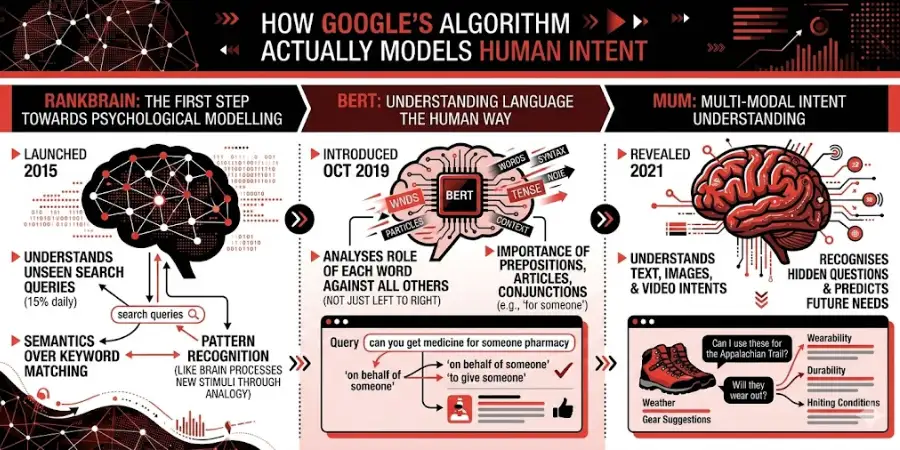
RankBrain: The First Step Towards Psychological Modelling
RankBrain, launched in 2015, was Google’s first big move towards implementing machine learning in understanding search intent. Its design was aimed at dealing with new and previously unseen search queries, which, surprisingly, comprise up to 15% of the total number of search queries done daily.
RankBrain recognised new search queries based on similar search queries that it had encountered before. This is made possible using semantics instead of keyword matching. Simply put, it works by pattern recognition, which is exactly how the brain processes new stimuli through analogy.
BERT: Understanding Language the Human Way
Google search received its biggest update in over five years with the introduction of BERT in October 2019. BERT helped Google analyse the role of each word in a sentence against all other words, unlike previous updates that did this from left to right.
The practical effect: Prepositions, articles, and conjunctions became immensely important. A query such as "can you get medicine for someone pharmacy" took into account the differences between the phrase "for someone," "on behalf of someone," or "to give someone." For example, BERT knew which meaning was intended and served the user appropriate results. Again, like humans' brain does when understanding language.
MUM: Multi-modal Intent Understanding
Multi-Task Unified Model (MUM), an algorithm revealed by Google in 2021, has brought intent modelling a notch higher. MUM can understand intents across text, images, and even video eventually. For example, MUM would be able to recognise that an image of a pair of hiking boots is accompanied by a question, "Can I use these for the Appalachian Trail?", referring to wearability, durability, and weather conditions, all in one shot. The other aspect where MUM outperforms previous algorithms is that MUM recognises hidden questions underlying the intent and what the user needs next. This shows the psychological sophistication of MUM in predicting future needs.
The Role of E-E-A-T in Intent Satisfaction
The guidelines for Google's quality raters include E-E-A-T: Experience, Expertise, Authority, and Trustworthiness. This concept exists because intent satisfaction not only implies that the search query is answered, but also the mental satisfaction of getting credible information.
It is important to realise that users not only seek answers to their queries. Rather, what they look for is a trustworthy source of answers. The algorithm has understood that certain features, such as authorship, credibility, facts, and citations, correlate with users' satisfaction with searches. The pages that have been found worthy of E-E-A-T not only get indexed but also earn users' trust.
Behavioural Feedback Loops: How Users Train the Algorithm
This is where it really becomes amazing. The algorithm used by Google to detect search intent is not fixed in nature. It constantly improves itself based on user behaviour.
If many people:
- Click and quickly go back ("pogo sticking"), they are clearly dissatisfied
- Click and do not go back, they are clearly satisfied
- Refine their searches by using additional keywords, since it suggests the results are too general
- Click and purchase, suggesting that high commercial intent was successfully detected
Google's systems analyse all of these behaviours millions of times daily, and constantly improve upon its understanding of what constitutes "the best match for this intent."To sum it up, every search you make helps to train Google.
What This Means for SEO Content Strategy
Having understood the workings of Google’s intent algorithm has drastically changed your perspective on content creation. The following principles should apply to your strategy:
- Content form should depend on the kind of intent. Informational intents should be satisfied by thorough guides and how-to articles. Transactional intents will require a well-crafted product page. Commercial intents will be addressed using comparison articles and reviews.
- Do not write for the bot; write for the reader. Today’s advanced algorithms have reached a level where they can easily differentiate between content written for the reader and content written for bots. Keyword stuffing, unnatural phrases, and a lack of depth in the article are just some of the reasons why content will receive quality penalties.
- Prepare for the following question. As MUM searches predict need, the best content for answering is the one that fully covers all possible questions regarding the topic, rather than only addressing the actual question. Your content should be built the way an expert would describe the topic.
- Focus on semantics, not just keywords. Today’s search engines value topical authority more and favour deep and connected articles about a topic over articles using a particular keyword several times.
Conclusion: The Algorithm Is a Mirror
The most profound realisation about the Google search intent algorithm is simple: it is, at its heart, a reflection of human psychology. With each update, from Hummingbird to BERT to MUM, Google has edged closer to the point where its algorithms don’t just understand what you type – they can understand what you’re feeling, what you need, and what you expect when you conduct your search.
From a user perspective, this results in ever-smoother access to data. From the perspective of SEO professionals and content producers, it means that the game of outracing the algorithm has become moot – the secret to success lies in catering to the human being sitting behind the computer screen. The machine understands you better than you do. You should be working to think as it does.
Frequently Asked Questions:
1. How does Google’s algorithm understand user intent?
Google’s algorithm uses machine learning, search history, and natural language processing to analyse what users really mean behind their queries, not just the keywords they type.
2. What is search intent in SEO?
Search intent refers to the purpose behind a user’s query, such as finding information, making a purchase, or navigating to a specific website.
3. How does Google predict what users want?
Google predicts user behaviour by analysing past searches, click patterns, location, and engagement signals to deliver the most relevant results instantly.
4. Can Google’s algorithm understand human psychology?
Yes, Google uses behavioural data and AI models to interpret user preferences, emotions, and intent patterns, making search results more personalised.
5. What role does AI play in Google’s search algorithm?
AI technologies like RankBrain and BERT help Google understand context, language nuances, and user intent more accurately than traditional keyword-based systems.
6. Why is user intent important for SEO ranking?
Content that matches user intent ranks higher because Google prioritises pages that solve user problems effectively and provide relevant answers.
7. How can I optimise content for search intent?
You can optimise by understanding your audience, using relevant keywords, answering common questions, and creating valuable, user-focused content.
8. What are the different types of search intent?
The main types are informational, navigational, transactional, and commercial investigation.
9. How does Google know what users will click?
Google analyses click-through rates, dwell time, bounce rates, and historical behaviour to predict which results users are most likely to engage with.
10. Is Google smarter than humans in predicting intent?
In many cases, yes. Google processes massive amounts of data in real-time, allowing it to identify patterns and predict intent faster and more accurately than humans.
11. How does machine learning improve search results?
Machine learning helps Google continuously learn from user interactions and refine search results to become more accurate over time.
12. What is RankBrain, and how does it work?
RankBrain is an AI system that helps Google interpret unfamiliar queries and match them with relevant results based on context and intent.
13. How does user behaviour affect Google rankings?
User actions like clicks, time spent on a page, and engagement signals influence how Google evaluates and ranks content.
14. Can Google personalise search results for each user?
Yes, Google personalises results based on location, search history, device, and preferences to deliver a more relevant experience.
15. What is the future of search algorithms and user intent?
The future will focus more on AI, voice search, predictive search, and hyper-personalisation to better understand and anticipate user needs.