

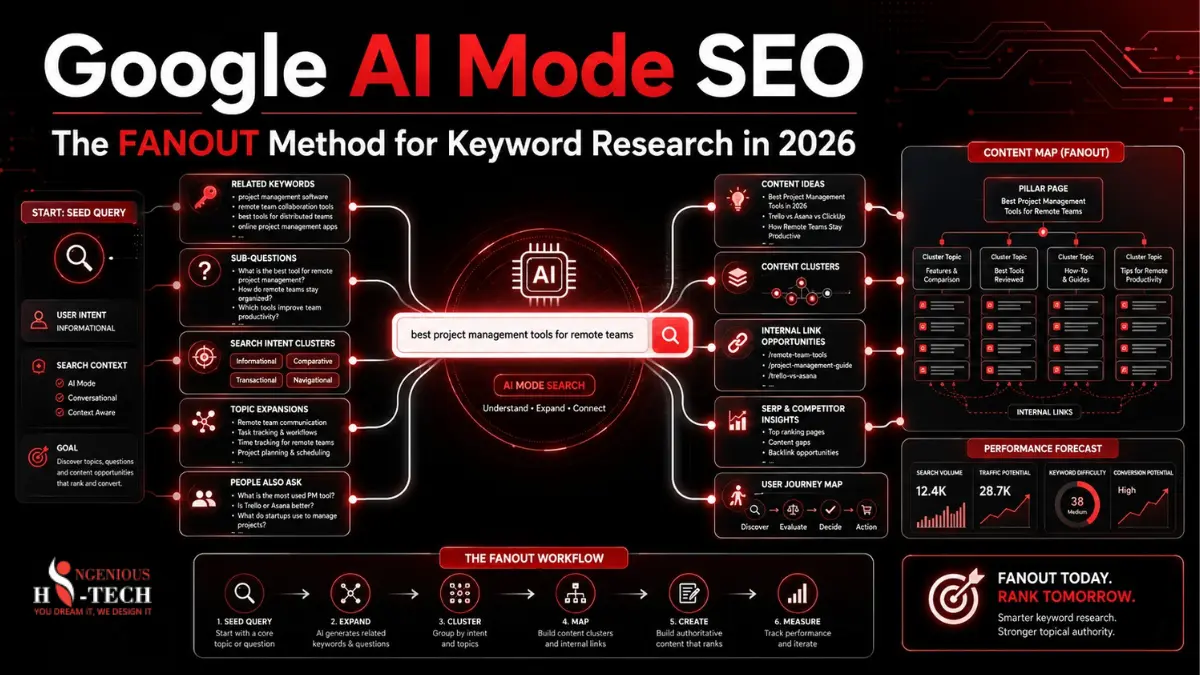
Introduction: The Keyword You See Is Only the Starting Point
One question is typed by the customer into Google AI Mode. But what lies behind this single sentence? It could be about price, comparative analysis, applicability, risk, timing, evidence, or action plan. And here is how Google AI Mode SEO looks in 2026; this is just a part of the process that you actually see. To see the process in full is to understand why keyword lists are inadequate for the job. The FANOUT Method is a six-step approach that helps to develop keyword strategy from one customer question.
Google AI Mode Does Not Search Once; It Builds a Research Path
AI Mode in Google Search is a conversational experience for complex or exploratory queries that would have otherwise required multiple searches. Instead of serving links, Google AI Mode serves synthesised responses with links to back up the answer from the web. Per official documentation from Google's Search Central, AI Mode could split a question into subtopics and run each separately, a query fan-out technique, according to Google's terminology. It is the basis of optimising AI Mode and keyword research for AI Mode. The query entered by the customer is not always the full information requirement.
It does not mean you need to abandon SEO practices. First of all, it means that a page should be crawlable, indexed and eligible to appear in Google Search with a snippet. Google officially stated that there are no specific technical considerations, and no separate index or AI schema is required. Check out our comprehensive guide to generative engines optimisation that includes such factors. This article focuses on optimising AI Mode in Google Search through keyword research and content architecture only.
Query Fan-Out: The Invisible Searches Behind One Visible Question
The phenomenon of query fan-out means that Google AI-based search capabilities might decompose one query into several related searches and combine the obtained findings in order to create an answer with links to sources for further study. This is how Google query fan-out works, and it is the principle behind successful query fan-out SEO.
Consider this question about the business: "Is SEO or Google Ads better for a new dental clinic with a limited budget?"
The information needs that might be associated with this question may include:
- Cost of local SEO for dental clinic
- Cost of Google Ads for dentists
- Time to see SEO effects
- Option for a brand new clinic
- Division of a limited budget between channels
- Measurement of leads via each channel
- Compatibility of SEO and Google Ads
The listed query fan-out examples should not be considered as a list of the actual queries that Google might generate for a particular search. The truth is that the website owner does not know what exactly Google is doing internally for the particular query; all that is known publicly is the mechanism of query fan-out.
One customer question → multiple information needs → relevant sources → AI-generated answer.
Why a Spreadsheet Full of Keywords Can Still Produce Weak Content
A list of keywords gives a sense of accomplishment, but quantity doesn’t mean quality. Keywords in an Excel sheet can hardly explain the choice customers have to make, the problems they’re having, the comparisons they’re making, the proofs they require, or even the next logical question to ask.
Consider three keywords: SEO cost, SEO pricing, monthly SEO price. These three keywords seem alike, giving you the impression that answering the price question will help you answer all three questions. However, the comparison of "SEO cost" has everything to do with whether or not the price is worthwhile based on the factors listed above.
Keyword research should include more than just listing the keywords in a database.
The FANOUT Method: A Six-Step Keyword Research System for 2026
The FANOUT Method makes such an approach a process that can be applied to keyword research through query fan-out. The approach does not attempt to duplicate what goes on inside the Google engine because only people at Google have access to the queries used to generate the fan-out queries for any particular search.
F Create a Framework for the Customer Decision
Begin with a customer scenario, rather than a brief seed keyword.
Poor framework: "SEO services"
Good framework: "What approach should a small business take in selecting an SEO service, considering that they have a budgetary constraint and require leads to be tangible?"
The ideal framework will mention the target market, the challenge, the constraint, the desired outcome, and the option to achieve this objective. Sources for helpful information include sales calls, form submissions, emails from customers, Search Console questions, on-site search analytics, onboarding challenges, and objections from sales.
A. Predict the Branching Questions
Develop questions related to the decision statement in six dimensions: Understanding, Cost, Suitability, Comparison, Risk and Action.
Applying to SEO vs. Google Ads dilemma: Understanding (How does local SEO work?), Cost (What is the cost of both channels?), Suitability (Is it good for the start-up?), Comparison (How SEO compares to Google Ads?), Risk (Where could I waste the budget?), and Action (What is the first step?). The set of branching questions will serve as the base of the fan-out map.
N Name the Evidence the Reader Needs
There is a distinction between information gaps (an unanswered question) and evidence gaps (questions that have been answered without evidence). Helpful pieces of evidence include the following: original computations, screenshots, personal experience, expert opinions, mini case studies, comparison of before and after, industry-specific examples, templates, decision trees, and properly sourced facts.
Even though a competitor ranks for your target keyword, there is still an opportunity for your article, if it offers better evidence or a better format. This is the way how AI suggests some brands, because well-evidenced articles are more reusable than generic ones.
O Organise Queries by Intent and Content Role
Different branching questions often need different types of pages. Grouping them by intent stage, a form of topic cluster keyword research, makes it clear what to build and where.
|
Intent stage |
Reader need |
Best content format |
|
Learn |
Understand the subject |
Educational guide |
|
Evaluate |
Compare options |
Comparison article |
|
Validate |
Find evidence |
Case study, review or proof page |
|
Act |
Request help or purchase |
Service or landing page |
For example: "What is local SEO?" suits an educational guide, "local SEO versus Google Ads" suits a comparison article, "local SEO agency for dentists" fits a service page, and "local SEO results for dental clinics" calls for proof. Forcing all four onto one page weakens each of them.
U Uncover Coverage Gaps and Unnecessary Overlaps
Compare the fan-out map to current site content and tag questions as either fully covered, partially covered, outdated, covered in the wrong place, not covered at all, or duplicated.
Not every new keyword requires a new URL. Depending on your tag, you may need to add a new section, refresh an old article, add a table with a comparison, create a supplementary article, update a service page, add a calculator, or download a checklist. This keyword clustering stage in the AI search process prevents the same intent from being addressed on three pages.
T Tie the Journey Together and Track the Result
Internal links must point in the direction of what the user will ask next rather than just to something that is related for the sake of being related. Here’s a sample journey:
Marketing budget guide → SEO vs. Google Ads comparison → SEO pricing guide → SEO forecast calculator → SEO services page → Request for consultation
Always use descriptive text that makes the reader aware of what the page is all about. The final step in developing the AI Mode content strategy is to identify quantifiable objectives like visibility, organic visitors, link clicks, calculator usage, requests for consultation, and leads. It becomes hard to determine whether the AI Mode content strategy is working without objectives.
Worked Example: Turning One Budget Question Into a Complete Search Journey
Take the query: "Should a small business invest in SEO or Google Ads in 2026?" Running it through the FANOUT Method surfaces a set of hidden decisions:
|
Hidden decision |
Supporting question |
Recommended content asset |
|
Budget |
How much should each channel cost? |
Cost comparison |
|
Speed |
Which generates leads sooner? |
Timeline section |
|
Sustainability |
Which creates long-term value? |
SEO-versus-PPC guide |
|
Suitability |
Which is better for a new business? |
Decision tree |
|
Risk |
Where can the budget be wasted? |
Checklist |
|
Measurement |
How should ROI be compared? |
ROI calculator |
|
Industry |
Does the answer change by industry? |
Industry examples |
|
Combined strategy |
Can SEO and PPC work together? |
Supporting article |
Not every row needs its own page. Budget, speed and risk can usually live as clearly headed sections on one comparison page, since they share the same evaluating intent. Suitability and combined strategy often deserve their own supporting articles, since they serve readers at a different stage of the decision. A calculator or decision tree earns its own tool page because the "answer" changes based on what the reader inputs. If budget planning is the sticking point, our guide to calculating a realistic marketing budget is a useful companion piece.
The guiding principle: build the smallest collection of pages that fully supports the customer's decision, without repeating yourself.
One Page, a Content Cluster or a Tool? Make the Right Publishing Decision
Keep the answer on the existing page when:
- It shares the same intent as the surrounding content
- It can be answered in a few paragraphs
- It directly supports the main decision
- A separate page would be repetitive
Create a separate article when:
- The intent is meaningfully different
- The subject requires detailed explanation
- It serves another stage of the buyer journey
- It provides independent value beyond the main page
Create a tool or downloadable asset when:
- The answer changes based on user inputs
- A calculation is required
- Readers need to compare scenarios
- A reusable worksheet would help more than extra text
Common examples include an ROI calculator, a budget worksheet, or a keyword mapping template. Getting this choice right separates a genuinely useful AI search content strategy from a site with dozens of thin, near-duplicate pages.
From Fan-Out Map to a Human-Written Content Brief
Once the fan-out map and publishing decisions are in place, translate them into a brief a writer can actually use a simple form of search journey mapping that turns research into useful content instead of a folder of notes. A reusable template should cover:
- Customer situation
- Direct answer
- Supporting questions
- Required evidence
- Best content format
- Internal-linking journey
- Relevant business action
Filling in each field forces clarity before a word gets written, and keeps writers working from the same understanding of the decision rather than interpreting the keyword list differently.
The finished article should read as advice from an experienced professional talking a customer through a real decision, not a list of keyword variations turned into headings. If handing this stage to a team that writes this way by default is appealing, our content marketing services build every brief around this decision-first approach.
How to Measure Whether the Fan-Out Strategy Is Working
Visibility
- Impressions and clicks in Search Console's Performance report
- Which pages appear as supporting links in AI features
Engagement
- Organic visits and engaged sessions
- Internal-link clicks and calculator or template usage
Business outcomes
- Consultation requests and qualified leads
- Cost per organic lead
- Revenue influenced by organic search
Search Console doesn't currently offer every property a separate, dedicated AI Mode dashboard; Google reports this activity within the standard Performance report's "Web" search type. Tracking Google AI search optimisation means watching trends within tools you already use, alongside platforms like Ahrefs to track AI mentions and leads. Visibility is not, on its own, the business goal; content still has to attract the right customer and move them toward action.
Six Mistakes That Turn Query Fan-Out Research Into Content Clutter
1. Creating a separate page for every question
Thin, near-duplicate pages compete with each other instead of strengthening one clear answer.
2. Treating every related phrase as a different intent
Many supporting questions share the same intent and belong together on one page.
3. Copying People Also Ask questions without analysing the decision
Lifting suggested questions without asking what decision they support misses the point behind them.
4. Forcing every subtopic into one oversized article
A page trying to serve every stage of the journey at once usually serves none of them well.
5. Publishing generic answers without evidence
A fan-out map shows what to cover, not how convincingly. Evidence still earns the citation or the click.
6. Measuring traffic without tracking leads
Visibility is a means, not the goal, without conversion tracking to prove the strategy is working.
Frequently Asked Questions About Google AI Mode SEO
1. What is Google AI Mode SEO?
Google AI Mode SEO means structuring keyword research and content around the way Google AI Mode may explore several related searches behind one question, so pages address the full customer decision rather than a single isolated phrase.
2. What does query fan-out mean?
Query fan-out is the technique Google's AI features may use to break one search into several related searches across subtopics, then combine the results into a single response with supporting links.
3. Does AI Mode make traditional keyword research obsolete?
No. Traditional SEO fundamentals crawlability, indexing, useful content and clear site structure remain necessary for any page to be eligible to appear in AI Mode or classic search results.
4. Should every fan-out query have its own page?
No. Many related questions share the same intent and belong on one well-organised page; separate pages are best reserved for genuinely different intents or buyer-journey stages.
5. Is special schema required for Google AI Mode?
No. Google has confirmed there is no special schema, AI file or separate index required to appear in AI Mode; standard structured data and existing SEO best practices still apply.
6. How can a business track visibility in Google AI Mode?
Search Console reports AI Mode and AI Overviews activity within its standard Performance report rather than a separate dashboard, so filtering existing impression, click and query data is currently the most reliable approach.
Conclusion: Research the Decision, Not Just the Keyword
A more effective strategy for SEO using Google AI Mode would require an understanding of the decision surrounding the use of the keyword. These include: framing the decision, anticipating branching questions, naming the evidence, organising queries based on intent, identifying gaps in coverage, and connecting the entire process.
The professional SEO services from Ingenious HiTech can analyse the customer’s search journey and potential gaps in your keyword strategies. Contact us now for a free SEO consultation.