
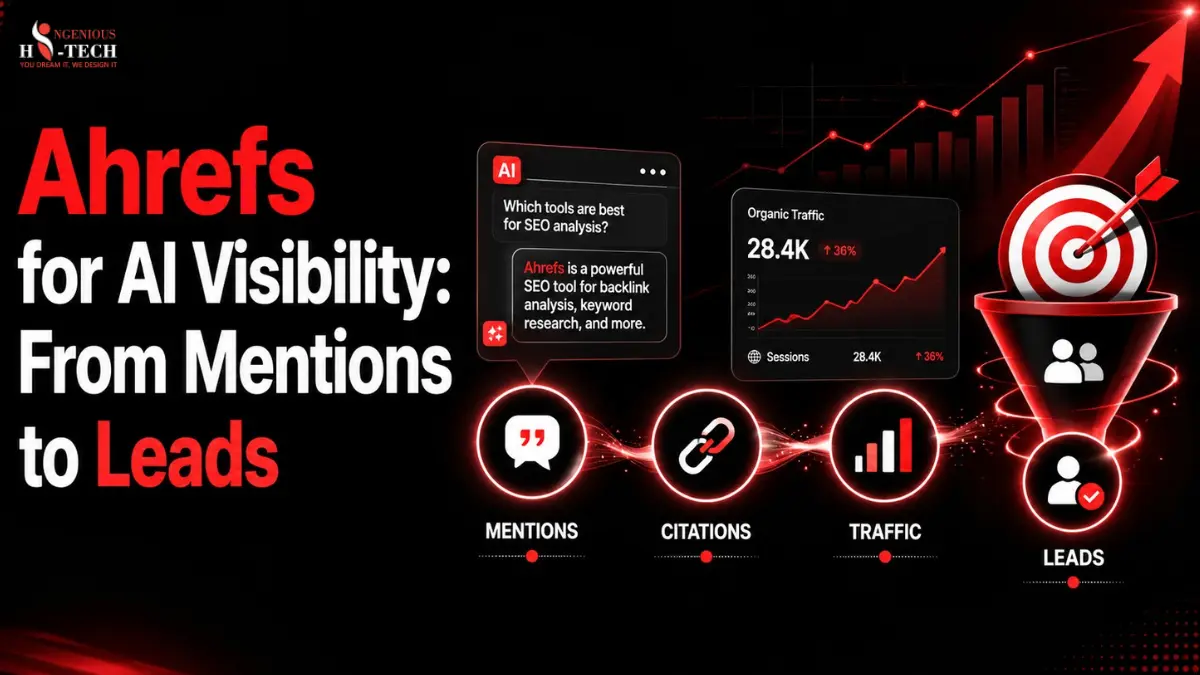
Introduction: An AI Mention Is Not Yet a Lead
The marketing manager enters the name of her organisation into ChatGPT out of curiosity, only to see it referenced in the answer that mentions the company as one of the industry service providers. It looks like a win. However, several questions still need answering. First, is the brand mentioned in relation to a prompt of some value to the audience or just an informational question with little value? Second, is it recommended by the responder or just included among the list of five companies? Finally, does the response include a link to the company’s website, and do people actually click on it? Here, Ahrefs for AI visibility helps convert an unstructured feeling of “they must have mentioned us somewhere” into a structured, traceable customer journey.
What Does AI Visibility Mean in Ahrefs?
It is essential to define “visibility” prior to performing any action with the data. The methodology of tracking AI visibility from Ahrefs considers the frequency and manner in which a particular brand appears within AI responses and classifies these appearances into several key signals.
Brand mentions
The term mention refers to instances where the brand name shows up in some AI-generated text. This is quite a broad concept since there could be many different situations in which a brand is being mentioned by the AI, for instance, when the brand is suggested as a recommendation, just one brand from a long list of suggestions, an example, a non-recommending statement about the brand, or even old and potentially negative information about the brand.
Citations
Citations are not mentions; citations are references to a certain website that served as a source for AI systems. There are two points to keep in mind when dealing with this issue. First, a brand may be mentioned in its full name while there is no citation of any website connected to it. At the same time, a website may serve as an excellent source, but it does not mean that the company running it is a recommended one.
AI Share of Voice
The AI Share of Voice measures the relative visibility of a brand when compared to a selection of its competitors on the same set of prompts. The AI visibility of a brand is a relative figure rather than an absolute figure, which can be used to detect a pattern rather than a clear winner. Measuring AI visibility using Ahrefs via its Brand Radar tool reveals patterns of mentions, citations, impressions, and share of voice but must be interpreted with care.
Using Ahrefs for AI Visibility: Track the Prompts and Competitors That Matter
It’s easy to follow any prompt with even a tangential relation to an industry, yet this leads to a lot of noise and no direction whatsoever. One might find it more helpful to organise prompts according to the stage of the customer's journey and focus on tracking fewer prompts.
Informational prompts
These are starting questions like “What is AI search optimization?” or “How does ChatGPT select brands?” Such prompts create general topical presence but do not drive any commercial value alone.
Problem-aware prompts
Now the user has discovered a problem: “Why isn’t my company listed in ChatGPT?” or “Why does AI recommend my competition?” Such prompts are important in that they show us where our visibility is deficient.
Solution-aware prompts
Now we have a person who is actively searching for a solution: “How can a business become visible in AI?” or “What tools will monitor ChatGPT brand mentions?” This is when the business needs to position itself as an answer to the question.
Commercial prompts
Such prompts carry a clear intent to buy: “Best AI SEO agencies for SMBs,” “Best GEO service providers for SaaS companies,” or “What is the price for AI search optimization?”
That is what makes this process for Ahrefs visibility for AI practical and not overwhelming. Then, the prompt could be assigned a business value rating ranging from high commercial value to low business relevance, informational value or reputation value. It would always be better for a brand to show a lot of presence in twenty well-chosen high-intent prompts rather than hundreds of general and informational queries. The competitors should always be chosen on the basis of the same rationale as in any other competitive analysis.
Evaluate Mention Quality and Competitor Citation Gaps
This may not be the case with all mentions of the AI. Using them equally usually results in inaccurate findings. An innovative approach to ranking such mentions is through the use of the AI Recommendation Quality Score, which is a score designed to differentiate between actual victories and those that make the brand look good on the screen but do nothing else.
The scale could be structured in the following manner: three points when the brand is the primary recommendation, two points when the brand is mentioned positively in a list, one point for neutral mentions, zero points when there is no mention, and minus one point when the mention is either wrong, outdated or negative.
From there, the next thing to look into would be gaps in competitor visibility – a competitor showing up where the brand does not, a competitor being recommended when the website of the company itself is mentioned, third-party content promoting the competitor while completely disregarding the business itself, or a brand showing up for informational triggers, but remaining silent on commercial triggers. The reasons why competitors get mentioned more often tend to lie in identifiable elements such as better service pages, more recognised brands, original research, greater third-party content mentions, reviews, proven expertise, comparison content positioning, or just better supported claims.
Map Every Important Citation to a Conversion Opportunity
A citation is only relevant when it sends a potential visitor to a resource that will help them move on to the next step. Classification of sources based on their type will make it easier to analyse this factor.
Sources owned
Blog entries, service pages, product pages, case studies, research papers, free tools under the control of the company.
Sources earned
Industry publications, news media, review sites, roundup articles from industry experts and partner websites.
Sources community
Discussion on Reddit, forums, customer conversations and Q&A sites.
Citation Sources
There are YouTube tutorials, interviews, webinars, and product demonstrations that are referenced much more than many companies anticipate.
An easy-to-use tool in managing this information is the Citation Path Audit. For each of the prompts valuable from the commercial point of view, make sure to write down the prompt itself, the funnel level it corresponds to, whether the brand is mentioned or not, the level of recommendation, the URL being cited, the citation owner, the landing page type, the CTA of the page, the natural following conversion step, and actual conversions if there were any. This would help you turn raw data of brand visibility into actionable insights one page at a time.
Also, you need to check the page itself in terms of whether it answers the question raised in the prompt, whether it flows naturally into some kind of service instead of leaving the visitor confused, whether it demonstrates credibility of expertise in the matter, whether the call to action matches the readiness of the visitor to convert and whether the next step is obvious.
Track AI Referral Traffic and Qualified Leads
Two aspects should be differentiated here: first, the activities of AI crawlers, which are automated and have nothing to do with any real people; second, the referral traffic from humans who use AI to find information on your website. It is only the latter that can provide you with leads.
Tracking the latter accurately would require you to integrate different metrics, including GA4, Ahrefs Web Analytics, CRM data, forms, calls, booking systems, eCommerce tracking, among others, depending on your business model. Specifically, there are several metrics worth being tracked: AI referral sessions, traffic by AI platform, top landing pages where that traffic goes, sessions that demonstrate engagement, CTA clicks, form start and submission rates, consultations, trial subscriptions, purchases, sales qualified leads, and, if possible, revenue.
Making this connection to CRM data completes the loop. By tracking the source of the AI, the first landing page viewed, the type of service that was sought, an evaluation of the quality of the lead, what sales stage it has reached, and whether revenue has been generated from this process, one can determine, over time, which prompts and citations have led to pipeline. There is, of course, one caveat to this process – some of the AI platforms do not always transfer referral data, resulting in some of this traffic being categorised as direct traffic or non-referral traffic in analytics.
Turn Ahrefs Data Into a Lead-Generation Action Plan
Once the data is in front of you, the next step depends on which specific problem it reveals.
Competitors are recommended, but your brand is not mentioned
Content creation for the missing use case, creation of service pages, comparative content creation, creation of case studies and proof points, earning mentions from a reputable source and defining the audience you are serving will help in this regard.
Your brand is mentioned but is not cited.
Improving the most relevant owned page, answering the target question, publishing original insight or research, improving the internal links, earning authoritative external citations and keeping brand descriptions consistent on the web will solve the problem at hand.
The website is cited, but competitors are recommended
Differentiation of the business, earning proof, identifying industries served, bridging the gap between information and commercial pages, improving trust signals, and author and expertise information will make the difference here.
AI visitors reach the site but do not convert.t
The landing page must match the initial prompt; contextually correct CTAs are added, forms are simplified, mobile usability is improved, testimonials and case studies are added, and a low-commitment first step is offered to the visitor.
AI presents outdated information
Correct the source: update website content, company profiles, directories, product information, old press releases and, where feasible, third-party content still circulating outdated details.
A Practical 30-Day Ahrefs Visibility-to-Lead Plan
- Week 1: Define the baseline. Select twenty to thirty commercially relevant prompts, include three to five competing sites, track the number of mentions, citations, and AI Share of Voice, determine which pages are cited the most, and set up AI referral and conversion tracking.
- Week 2: Repair the conversion funnel. Analyse the pages that are being cited, introduce relevant internal links, enhance CTAs, update service pages, and insert examples or trust signals where necessary.
- Week 3: Address the most important visibility issue. Pick one of the commercially valuable issues detected previously, generate or update content for it, produce a corresponding case study, update conflicting information on your brand online, and seek out one commercial external mention.
- Week 4: Evaluate initial signals. Evaluate visibility of high-value prompts, quality of recommendations, number of citations, AI referral traffic, CTA clicks, leads, engagement, and conversion rate compared to the Week 1 baseline. Thirty days can reveal preliminary trends, but not conclusive ones.
Common Mistakes and Important Limitations
There are some common errors in utilizing Ahrefs to increase the company's visibility through AI: monitoring prompts that have nothing to do with the business, interpreting all the mentions as positive recommendations, paying attention solely to the AI Share of Voice, neglecting the third-party citation sources, redirecting visitors to general landing pages, mentioning mentions without analyzing their impact, expecting results instantly following one single content update, considering all the visits made without attributing as the AI-driven ones, duplicating the competitor's material without any additional proof and taking the Ahrefs estimate for the guaranteed income.
Ahrefs can help identify visibility trends, but not provide the proof that a certain mention was the reason for the purchase. The AI-based answers are also changeable depending on the wording, the location, the medium, and the timing.
Practical Example: Turning a Blog Citation Into a Lead
The following example is hypothetical and used only to illustrate the process:
A B2B digital agency has received a citation request for the topic "How can a SaaS company improve its visibility in ChatGPT?" After digging through Ahrefs data regarding AI visibility, there were quite a few things to be found: their blog post was used as a source, yet the mention itself was just neutral; there were two competitors that got a higher recommendation for the same prompt; the post had no SaaS-specific CTAs; and only a small percentage of people reached a service page after reading it.
The agency decided to implement several changes to the post: adding a SaaS-related section to it, linking to the AI visibility service page, providing a brief case study, having a clear CTA related to the AI visibility audit, creating a dedicated SaaS page, and keeping track of the form submissions there separately from other pages. What we learned was not about the need for a thousand more mentions. It was about finding the right way to convert them.
Frequently Asked Questions
1. What is Ahrefs AI visibility?
It refers to how a brand appears inside AI-generated answers, covering mentions, citations, estimated impressions and Share of Voice relative to competitors.
2. Can Ahrefs track brand mentions in ChatGPT?
Yes. Using Ahrefs for AI visibility monitoring, Brand Radar tracks brand mentions across AI platforms, and custom prompt tracking allows businesses to follow specific, commercially relevant questions over time.
3. What is the difference between an AI mention and a citation?
A mention means the brand's name appears in the answer. A citation is a link to a specific webpage used as a source; the two don't always occur together.
4. Can Ahrefs show how many leads came from AI search?
Ahrefs supports AI visibility tracking and traffic analysis, but confirming actual leads requires connecting that data with website analytics and CRM records.
5. Why is my website cited while a competitor is recommended?
It usually means the site is seen as a useful information source, while the competitor is currently viewed as the stronger provider choice two different things worth solving separately.
6. How can a business turn AI citations into leads?
By aligning landing pages with the original prompt, strengthening internal links, adding credible proof, using contextual CTAs, and setting up proper conversion tracking to see what actually happens after the click.
Conclusion: Measure the Entire Journey
The mentions mean that the brand is noticed. The recommendations indicate some preference for it. The citations mean that there is an opportunity for creating a potential link to the website, but it is only the proper landing page that can transform this visit into communication, and only the analytics and CRM metrics can tell if this actually happened. Utilising Ahrefs for measuring AI visibility provides more insights into how the brand ranks among AI-generated answers, but the benefit lies in tracking this visibility till the conversion, not the mention numbers.
Discover where your business ranks in AI-generated answers, which competitors get more recommendations, and which citation opportunities you miss out on. Get a free AI Visibility and Citation Audit by Ingenious HiTech.