

The $1,000, $5,000, or 10% Question!!
Should a small business spend $1,000 a month on marketing? $5,000? Or a fixed percentage of revenue?
The honest answer: all three can be correct, depending on the business.
A one-location bakery with loyal regulars has very different needs than a multi-city HVAC company chasing new service calls. A realistic small business marketing budget isn't copied from a competitor or pulled from an old rule of thumb; it's connected to your customer value, your growth goals, and the revenue you expect this year.
This guide shows you how to calculate that number for your own business.
The Direct Answer: What Should a Small Business Spend on Marketing?
In case you require a figure to base your calculations on, below are the usual figures used by most businesses:
- 5%-7% of your income to keep up your current visibility and keep your standing
- 7%-10% for gradual and sustainable growth
- 10%-15% for fast-paced growth or expansion into new territories
- Over 15% for rapid expansion or in very competitive markets
As you can see, these are only guidelines, not set-in-stone figures that you must follow.
Here’s an illustration: a company making $600,000 annually that spends 8% of their income on marketing will end up spending $48,000 per year, or roughly $4,000 every month.
Your income figure is not the entire story, however. A company with poor margins can’t really spend as high a percentage of their income on marketing as one with excellent margins, even though they may have the exact same income level. It isn’t just your income that dictates what you should be doing; competition and average customer value do as well, and there are wide differences in typical digital marketing budgets across various industries in the USA.
The Five-Number Small Business Marketing Budget Test
Instead of guessing at a percentage, run your business through this five-number test. It won't hand you one "correct" answer, but it will show a realistic range that actually fits your situation.
Yearly Revenue
Your current yearly revenue forms the outer limits of realism. It’s the point from which every percentage range is based.
Gross Margin
The firm operating at a 60% margin will be able to afford a larger percentage of its revenue spent on marketing compared to the company running on a 15% margin because it has more to work with from every sale.
Average Value of a Customer
What is the amount of revenue, even better, profit earned from one average customer? That’s what you can invest to get that customer.
Lifetime Value of a Customer
If your customers have a habit of coming back, recommending others or buying again, you will be justified in investing more in order to get them.
Growth Objective
What additional income or how many additional clients are you hoping for in the current year? Here comes the time when your budget gets real. Suppose a fictitious service business is aiming at getting 50 clients this year, with each client generating around $2,000 in gross profit. It amounts to a $100,000 worth of growth objective, a figure that makes the whole acquisition process much simpler to budget.
Identify Your Marketing Budget Personality
Not every business needs the same approach, even at a similar revenue level. Before settling on a number, see which of these four profiles sounds most like your business right now.
Maintainer
A steady firm whose concern lies in preserving existing visibility and encouraging customers to return. Such firms usually give priority to local SEO, email marketing, reputation management, and frequent website updates.
Builder
A firm with a successful offering and only requires a reliable and consistent stream of leads. Such a firm usually focuses its efforts on SEO, Google Ads, landing pages, and fast and organised follow-up of leads.
Challenger
A business which faces competition from other bigger and established companies for the same customers. Such a business usually puts emphasis on paid media, quality content, digital PR, and conversion rate optimisation.
Expander
An enterprise which intends to enter new locations or launch new services, and target new geographic markets. Such an enterprise usually gives priority to market research, creating new landing pages, location-focused campaigns, production of new creative material and testing. Most small businesses will find themselves more familiar with one category than others. Admitting which category a business belongs to helps one avoid spending as a Challenger, while the business should be considered a Builder or being conservative as a Maintainer while the market calls for expansion.
Build the Budget Backwards from Customer Goals
Another practical way to calculate a marketing budget is to work backwards from how many customers you actually want.
Here's the framework:
- Set a monthly customer target: How many new customers do you realistically want each month?
- Estimate your lead-to-customer conversion rate: Based on past performance, what percentage of leads typically become paying customers?
- Calculate how many leads you'll need: Divide your customer target by your conversion rate.
- Estimate an acceptable cost per lead: What can you reasonably afford to pay for each qualified lead, based on your customer value?
- Calculate your working lead-generation budget: Multiply the number of required leads by your acceptable cost per lead.
Here's what that looks like in a hypothetical example:
- Target: 20 new customers per month
- Lead-to-customer rate: 20%
- Required leads: 100
- Acceptable cost per lead: $20
- Estimated direct lead-generation budget: $2,000 per month
That $2,000 figure only covers direct lead generation. Your complete monthly marketing budget for a small business will typically be higher, since it also needs to cover campaign management, software subscriptions, content creation, creative production, and the website improvements that support those campaigns.
Where Should the Money Go? Allocate by Business Goal
Instead of splitting your budget by channel first, it helps to organise spending around what you're actually trying to achieve.
Goal: Generate Leads Quickly
If you need results in weeks rather than months, prioritise Google Ads and other PPC campaigns, paid social media marketing, dedicated landing pages, call tracking, and retargeting to recapture visitors who didn't convert the first time. These channels tend to produce the fastest measurable results.
Goal: Reduce Dependence on Paid Advertising
If rising ad costs are squeezing your margins, shift more budget toward technical SEO, service-page optimisation, local SEO, and ongoing content marketing that builds authority over time. This route usually takes longer to show results, but it gradually lowers your cost per lead.
Goal: Increase Repeat Sales
If most of your budget goes toward winning new customers while existing ones are neglected, redirect some spending toward email marketing, customer retention campaigns, remarketing, loyalty programs, and upselling or cross-selling. A repeat customer is usually far cheaper to sell to than a brand-new one.
Goal: Enter a New City or Market
Expanding into new territory calls for competitor research, dedicated local landing pages, location-targeted advertising, local citations, and strategic partnerships that help you build credibility from a standing start.
Goal: Build Trust
If visitors are landing on your site but hesitating to buy or call, prioritise case studies, testimonials, expert content, active review generation, digital PR, and a professionally built website that gives people confidence at first glance.
As a flexible starting model, many small businesses allocate 60%–70% of their budget to proven activities, 20%–30% to promising growth opportunities, and around 10% to testing new ideas. This distribution should shift based on what your performance data actually shows.
Three Realistic Small-Business Budget Stories
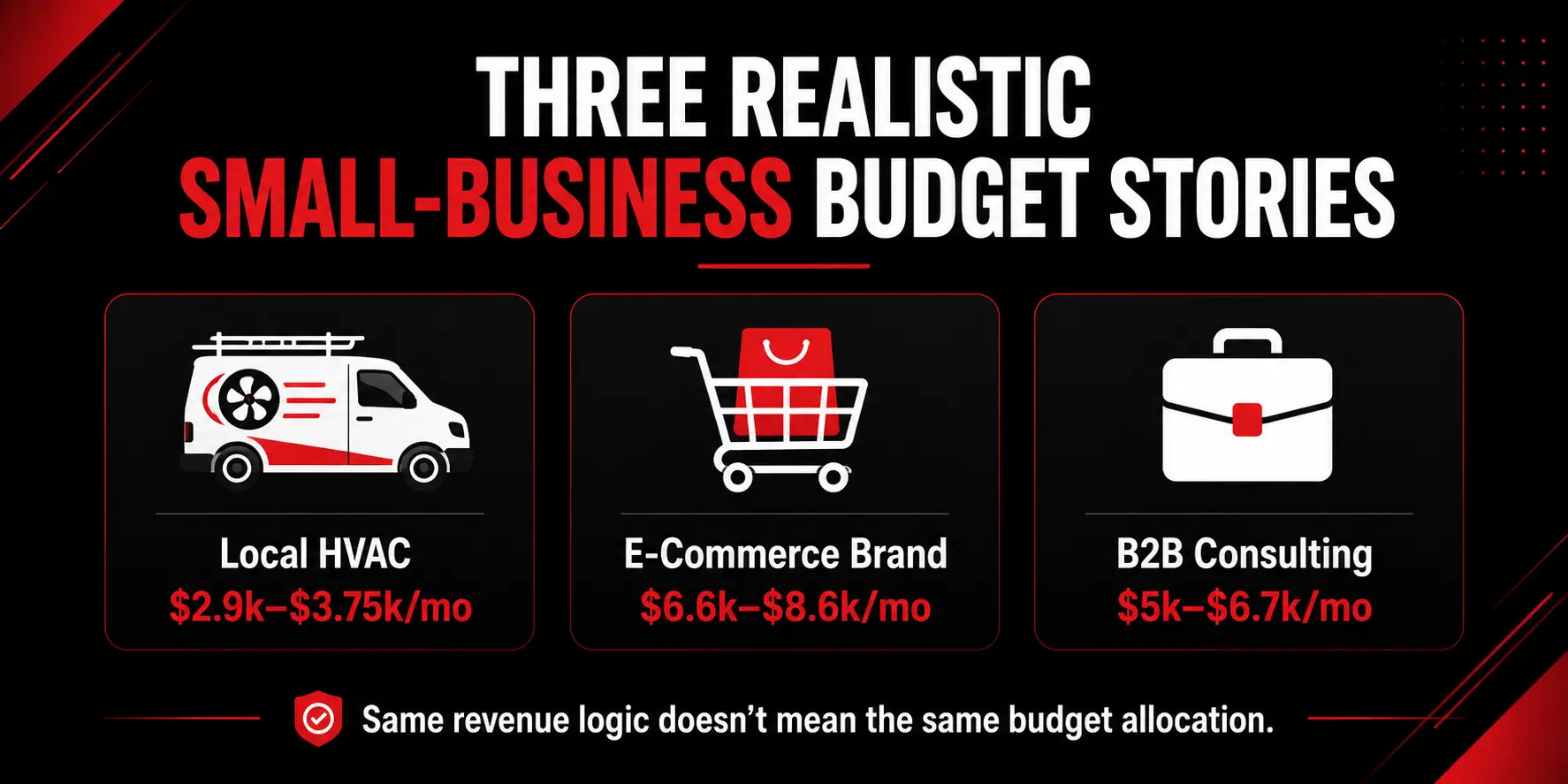
These examples are hypothetical, but they reflect realistic budget patterns for businesses in these industries:
Example 1: Local HVAC Company
Picture a hypothetical residential HVAC company with $500,000 in annual revenue, mainly trying to generate more seasonal service calls. At a planning range of 7%–9%, its marketing budget would land between roughly $2,900 and $3,750 per month.
Suggested priorities: Google Ads, local SEO, an optimised Google Business Profile, active customer review generation, and seasonal landing pages built around emergency repairs and tune-ups.
For a business like this, high-intent local search deserves more budget than general social media activity. Someone searching "AC repair near me" on a 95-degree afternoon is far closer to booking a service call than someone scrolling a social feed.
Example 2: Growing E-Commerce Brand
Take a hypothetical online retail brand doing $800,000 in annual revenue, focused on increasing online sales and repeat purchases. At a planning range of 10%–13%, its monthly marketing budget would fall between roughly $6,600 and $8,600.
Suggested priorities: shopping ads, paid social, email automation, product-page optimisation, ongoing creative testing, and abandoned-cart recovery sequences that win back shoppers who almost bought.
Example 3: B2B Consulting Company
Imagine a hypothetical consulting firm generating $1 million in annual revenue, focused on qualified leads from decision-makers rather than high volumes of general traffic. At a planning range of 6%–8%, its monthly marketing budget would land between roughly $5,000 and $6,700.
Suggested priorities: SEO, thought-leadership content, LinkedIn campaigns, detailed case studies, webinars, and lead-nurturing email sequences that keep the business top-of-mind during a longer sales cycle.
Notice that all three hypothetical businesses generate meaningful revenue, yet none use the same budget allocation. Purchase behaviour, sales cycle length, and how customers search all shape where the money should go, not just how much revenue is coming in.
The Costs Business Owners Commonly Forget
When business owners think about a marketing budget, they often picture advertising spend alone the money paid directly to Google or Meta for ad placement. A complete budget covers far more than that.
Commonly overlooked costs include landing-page creation, website hosting and maintenance, CRM software, analytics tools, call tracking, graphic design, photography, video production, copywriting, email platforms, campaign management, marketing automation, conversion testing, and the value of employee time spent managing it all.
This is the real difference between a $3,000 advertising budget and a $3,000 total marketing budget. The first number might only cover ad spend, leaving nothing for the tools, content, and people needed to turn that spend into results. The second accounts for everything required to run campaigns properly from start to finish.
Are You Spending Too Little, or Simply Spending Badly?
Before increasing your budget, it's worth figuring out which problem you actually have:
Signs the Budget May Be Too Low
- Campaigns can't collect enough data to know what's working
- Ads get paused too quickly to build any momentum
- SEO work happens inconsistently, in bursts
- Too many channels are splitting one small budget
- Competitors consistently dominate the searches that matter most to you
Signs the Budget Is Poorly Allocated
- Website traffic rises, but inquiries don't follow
- Leads come in, but quality is poor
- Sales can't be clearly connected back to a channel
- Ads send visitors to pages that don't convert
- Most spending goes toward awareness despite an urgent need for sales
- Campaigns keep running without any measurable goal attached
Increasing the budget will not fix poor targeting, a weak offer, or a low-converting website. In those cases, more money just buys more expensive mistakes.
A 90-Day Marketing Budget Launch Plan
Once you've settled on a starting budget, treat the first 90 days as a structured learning period rather than a finished strategy.
Days 1–30: Establish the Baseline
- Review current revenue and profit margins
- Calculate your average customer value
- Audit any campaigns already running
- Install proper conversion tracking
- Identify your strongest product or service
- Select one main growth objective to focus on
Days 31–60: Launch Priority Activities
- Improve key landing pages
- Launch one main lead-generation campaign
- Strengthen local or technical SEO
- Build out email follow-up sequences
- Publish content around your customers' highest-intent questions
Days 61–90: Optimise and Reallocate
- Compare lead quality across channels
- Review your cost per lead
- Review your customer acquisition cost
- Pause campaigns that clearly aren't working
- Increase spending on the channels that are proven
- Improve underperforming pages
- Prepare your next quarterly plan
By day 90, you should have real performance data instead of assumptions, and that data should directly shape next quarter's budget, not just repeat this one.
The Small-Business ROI Dashboard
You don't need complicated software to track whether your marketing budget is working. A handful of simple formulas cover most of what you need to know:
- Cost Per Lead = Marketing spend ÷ number of leads
- Customer Acquisition Cost = Total sales and marketing cost ÷ new customers
- Lead-to-Customer Conversion Rate = New customers ÷ qualified leads × 100
- Return on Ad Spend = Revenue from advertising ÷ advertising spend
- Marketing ROI = (Revenue attributed to marketing − marketing cost) ÷ marketing cost × 100
For example: a business that spends $4,000 and generates $12,000 in attributable revenue has a basic marketing ROI of 200%.
Raw ROI doesn't tell the whole story. Profit margin, repeat purchases, and customer lifetime value all affect how much that 200% is actually worth. A high ROI on a low-margin product means something different than the same ROI on a high-margin service.
Check these numbers monthly, and set aside time for a deeper review each quarter.
Questions to Ask Before Approving Next Month's Budget
Before signing off on another month of spending, run through this checklist:
- Which channel generated the most qualified leads?
- Which channel actually produced paying customers?
- What was the customer acquisition cost?
- Which campaign attracted the highest-value customers?
- Are landing pages converting effectively?
- Are leads being followed up with quickly enough?
- Which activities support long-term growth, not just short-term traffic?
- Which expenses can't be connected to a clear goal?
- Which channel deserves more budget next month?
- Which activity should be reduced, paused, or changed?
Working through these questions regularly helps prevent emotional or guess-based spending decisions the kind that quietly drain a budget without anyone noticing until months later.
Frequently Asked Questions
1. How much should a small business spend on marketing?
Most small businesses plan for 5%–15% of annual revenue, depending on growth goals, competition, and profit margin. Aggressive growth typically sits toward the higher end.
2. Is $1,000 a month enough for marketing?
It can work for a very small, single-channel business. For most growing companies, though, $1,000 monthly is closer to a test budget than a full strategy.
3. Should a new business spend more on marketing?
Often yes. Startups typically need heavier upfront spending to build visibility and gather performance data, since they lack existing customers or brand recognition.
4. Is SEO included in a marketing budget?
Yes. SEO is part of the overall marketing budget, covering technical improvements, content creation, and ongoing optimisation rather than direct advertising spend.
5. Should small businesses choose SEO or PPC first?
It depends on urgency. PPC delivers faster results for immediate leads, while SEO builds longer-term, lower-cost visibility. Most established businesses eventually use both.
6. How often should a marketing budget be reviewed?
Review performance monthly, and schedule a deeper review each quarter to reallocate spending based on results rather than assumptions.
Conclusion: Spend With a Target, Not a Guess
The best marketing budget isn't automatically the highest one. It's affordable, consistent, connected to a real growth goal, measurable, and flexible enough to adjust once results start coming in.
Not sure how much your business should invest in digital marketing? Ingenious HiTech can evaluate your goals, competition and current performance to create a practical strategy focused on measurable growth.