
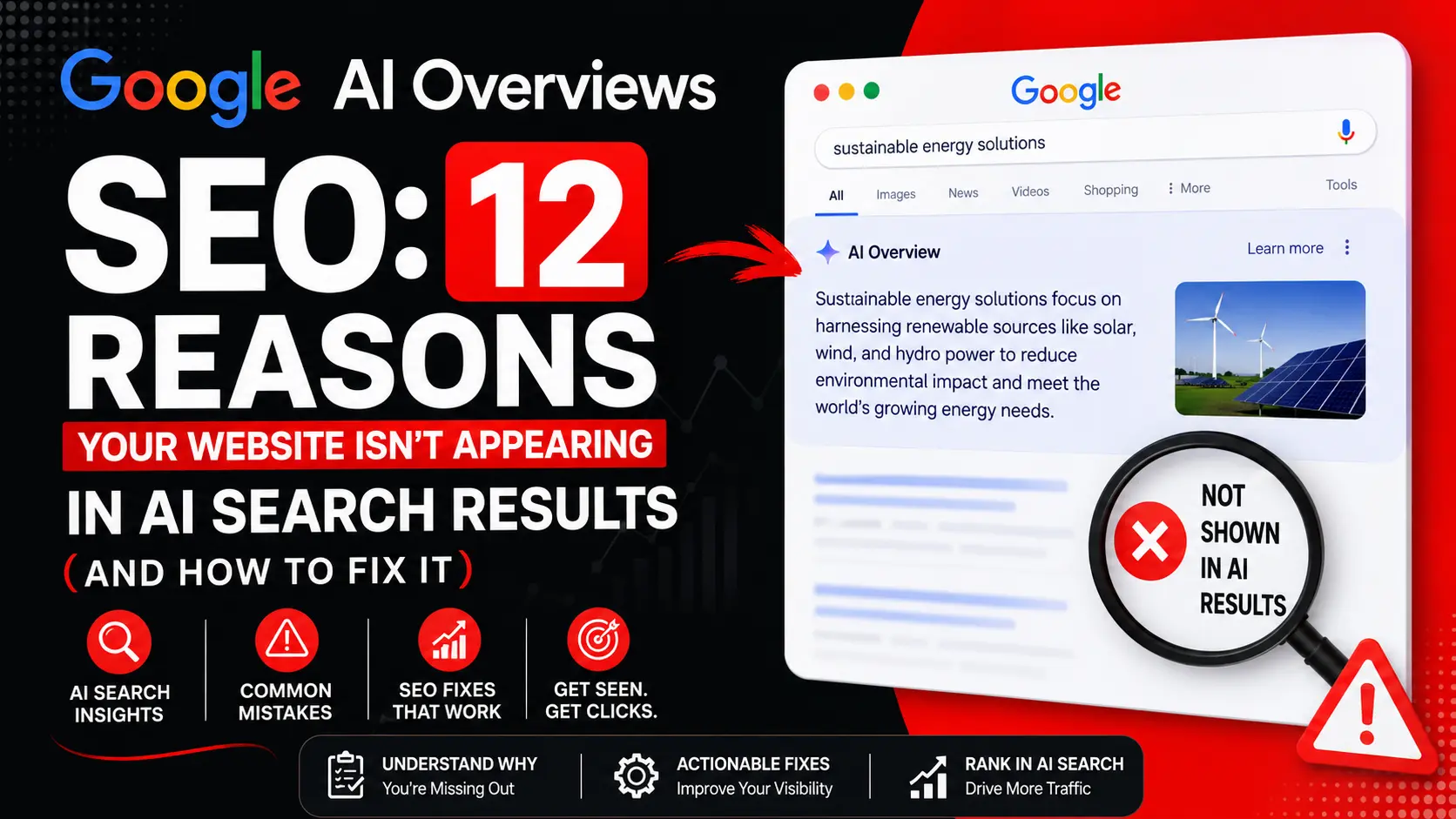
A client came to us a few months ago with a strange complaint. Their website ranked on page one for their main keywords, traffic looked healthy in Search Console, and yet they kept losing quote requests to a smaller competitor. When we looked closer, the answer was sitting right at the top of the search results page: Google's AI Overview was recommending the competitor, not them.
This is happening across almost every industry right now. Google search has moved beyond a simple list of blue links. For a growing number of queries, Google now generates an AI summary that answers the question directly, often drawing on a handful of trusted sources. If your website isn't one of those sources, you can rank well and still lose visibility where it counts.
This article breaks down why that happens, in plain language, and what you can realistically do about it. There are no guarantees in AI search or in traditional SEO, but there are clear patterns in what tends to get referenced and what gets skipped over.
What Are Google AI Overviews?
Google AI Overviews are AI-generated summaries that appear above traditional search results for certain queries. Instead of showing ten links and letting the user click around to find an answer, Google synthesises information from multiple sources and presents a direct response, with links to where that information came from.
The underlying system pulls from a wide range of web content, evaluates how well it answers the query, and stitches together a summary that's meant to save the user time. A website doesn't need to be the number one organic result to be referenced. It needs to be a source Google's system judges as clear, relevant, and trustworthy for that specific question.
This is a meaningful shift in how visibility works. Here's a simple way to think about the difference.
|
Traditional SEO |
Google AI Overviews |
|
Focuses on webpage rankings |
Focuses on useful information sources |
|
Keyword-based optimization |
Context and understanding |
|
Click-focused |
Answer-focused |
|
One page competes for one spot |
Multiple sources can be referenced together |
This is also where the term Generative Engine Optimisation, or GEO, has started showing up. It's not a replacement for SEO, but it describes the extra layer of thinking needed to get content considered by generative, AI-driven search experiences.
12 Reasons Your Website Isn't Appearing in Google AI Overviews
Reason #1: Your Content Does Not Answer Real User Questions
- Why It Happens: A lot of business content is written around what a company wants to say about itself, not what a potential customer is actually typing into Google. If someone searches "how much does a CRM implementation cost," and your page only talks about "our comprehensive CRM solutions," there's a mismatch.
- Why It Matters: AI Overviews are built to answer specific questions. If your content doesn't directly address the question behind a search, there's nothing for the system to pull from, no matter how well-written the page is.
- What You Should Do: Start with search intent. Look at the actual questions your customers ask in emails, on sales calls, and in support tickets, and build content around them. A simple FAQ section, written honestly and specifically, often performs better here than a polished brand page.
Reason #2: Your Website Lacks Topical Authority
- Why It Happens: One great article about a topic isn't the same as being known for that topic. If your site has a single blog post about "cybersecurity for small businesses" and nothing else related to it, there's no depth behind it.
- Why It Matters: Google's systems look at how thoroughly a site covers a subject area, not just one page in isolation. A single article competing against a site with twenty connected, well-organised pages on the same topic is at a real disadvantage.
- What You Should Do: Build content clusters. Pick a core topic, then create supporting articles that cover related questions, tools, comparisons, and use cases, all linked together. Over time, this builds the kind of subject-matter depth that AI systems and human readers both recognise.
Reason #3: Your Content Is Too Generic
- Why It Happens: It's tempting to write broad, safe content that could apply to almost any business in your industry. The problem is that thousands of other websites are writing the same broad, safe content.
- Why It Matters: AI systems are trained to prioritise sources that add something specific and useful over ones that repeat common knowledge. Generic content blends into the background.
- What You Should Do: Add your own data, real examples, and specific case studies. If you've solved a particular customer problem three times this year, write about how you actually did it. That kind of specificity is very hard for competitors to copy and very easy for search systems to recognise as original.
Reason #4: Your Website Has Weak E-E-A-T Signals
- Why It Happens: E-E-A-T stands for Experience, Expertise, Authority, and Trust. Many websites skip author bios, credentials, and clear "about us" information, which makes it hard for anyone, human or algorithm, to judge who's behind the content.
- Why It Matters: Google has been public about how much E-E-A-T factors into how content is evaluated, especially for topics that affect people's money, health, or major decisions.
- What You Should Do: Add real author bios with relevant credentials. Show your team, your history, and your experience in the field you're writing about. Link to case studies or client results where you can. Small, honest signals of credibility add up.
Reason #5: Your Content Does Not Match Search Intent
- Why It Happens: Different searches behind the same keyword often need completely different answers. Someone searching "AI chatbot benefits" could be comparing options, researching cost, or just starting to explore the idea.
- Why It Matters: If your page only covers one angle, like a sales pitch on features, it may miss the actual intent behind a large share of the searches for that term.
- What You Should Do: For a keyword like "AI chatbot benefits," a well-rounded page should cover the core benefits, realistic use cases, cost considerations, and what implementation actually looks like. Covering the full picture, rather than one narrow slice, gives AI systems more reasons to reference your content.
Reason #6: Your Website Has Technical SEO Problems
- Why It Happens: Slow load times, poor mobile experience, broken indexing, and confusing site structure are still common, even on otherwise good websites.
- Why It Matters: If Google's crawlers can't properly access, read, or index your pages, none of your content quality matters. It simply isn't part of the pool of sources being evaluated.
- What You Should Do: Run a technical SEO audit. Check Google Search Console for indexing errors, test your site speed and mobile experience, and fix crawl issues like broken links or blocked pages. This is unglamorous work, but it's foundational.
Reason #7: Your Content Structure Is Difficult to Understand
- Why It Happens: Long, unbroken blocks of text without headings, bullet points, or clear organisation are hard for readers to scan, and they're just as hard for AI systems to parse into a clean summary.
- Why It Matters: AI Overviews need to extract clear, specific answers quickly. A well-organised page makes that extraction easier. A wall of text makes it harder, even if the information inside is accurate.
- What You Should Do: Use clear headings that match real questions, keep paragraphs short, and use bullet points, numbered steps, and tables where they genuinely help. Structure isn't just about design. It's about making your answer easy to find.
Reason #8: Your Internal Linking Strategy Is Weak
- Why It Happens: Many websites publish content without ever linking it back to related pages on the same site, leaving each article isolated.
- Why It Matters: Internal links help Google understand which pages matter most, how topics connect, and where your real expertise lives. Without them, your site can look like a scattered collection of unrelated pages instead of a coherent source.
- What You Should Do: Link related articles to each other using descriptive, natural anchor text. Point toward your most important pages from multiple places on the site. This also helps human readers explore more of your content, which is a bonus.
Reason #9: Your Website Lacks Original Experience
- Why It Happens: A lot of online content is a reworded version of other content, without any first-hand experience behind it.
- Why It Matters: AI systems, much like careful human readers, can tell the difference between someone describing a process they've actually done and someone summarising what they read elsewhere. First-hand experience carries more weight.
- What You Should Do: Share what you've actually learned. If you've run a project, tested a tool, or solved a specific client problem, describe what happened, including what didn't work. That kind of detail is very difficult to fake and very valuable to both readers and search systems.
Reason #10: Your Brand Authority Is Limited
- Why It Happens: Some websites treat SEO as something that only happens on their own site, ignoring how they're mentioned or referenced elsewhere.
- Why It Matters: Quality backlinks, mentions from respected industry sources, and general brand reputation all feed into how much trust Google places in your website as a source.
- What You Should Do: Focus on earning mentions and links from credible, relevant sources rather than chasing volume. Guest contributions, partnerships, and genuine industry visibility tend to matter more than a long list of low-quality backlinks.
Reason #11: Your Website Does Not Use Structured Data Properly
- Why It Happens: Structured data, also known as schema markup, is often skipped or implemented incorrectly, especially on smaller business websites.
- Why It Matters: Schema helps search engines understand exactly what a page represents, whether it's an organisation, a service, an article, or a set of FAQs. It removes ambiguity.
- What You Should Do: Add schema markup for your organisation, services, articles, and FAQ sections. It's worth being clear here: structured data improves understanding, but it does not guarantee placement in an AI Overview. It's one supporting piece, not a shortcut.
Reason #12: You Are Only Following Traditional SEO Practices
- Why It Happens: Many businesses are still optimising purely for keyword rankings the way SEO worked five or ten years ago, without adjusting for how search has evolved.
- Why It Matters: Modern search visibility depends on a combination of factors working together: solid SEO fundamentals, genuinely helpful content, real brand authority, and a strong user experience. Leaning on just one of these rarely works anymore.
- What You Should Do: Treat AI search optimisation as an extension of good SEO, not a separate system. If you're already doing the fundamentals well, adding AI search awareness on top is a natural next step rather than a complete overhaul.
How to Improve Your Chances of Appearing in Google AI Overviews
No formula guarantees placement, but certain practices consistently improve your chances:
- Create helpful, original content built around real questions
- Answer customer questions directly and specifically
- Build topical authority through connected content clusters
- Improve technical SEO, including speed and indexing
- Strengthen E-E-A-T with real credentials and experience
- Optimise website structure for easy scanning
- Update outdated content instead of letting it sit
- Build online authority through genuine mentions and links
Google AI Overviews SEO vs Traditional SEO
It's worth being direct about this: traditional SEO is not going away. Technical SEO, keyword research, site structure, and backlinks are still the foundation everything else is built on. AI search doesn't replace SEO. It adds a new layer on top of it. A site with weak technical SEO or thin content isn't going to suddenly perform well in AI Overviews just because it adds a few FAQ sections. Strong SEO fundamentals are what make AI visibility possible in the first place. Think of it less as "SEO versus AI search" and more as SEO forming the base, with AI search optimisation as the next floor built on top.
Common Mistakes Businesses Make With AI Search Optimisation
A few patterns show up again and again when businesses try to chase AI search visibility:
- Publishing generic, AI-written content without adding original insight or editing
- Ignoring technical SEO while focusing only on content
- Writing purely for keywords instead of for the person asking the question
- Expecting fast results from something that takes sustained effort over months
- Neglecting brand authority and assuming good content alone is enough
Avoiding these mistakes matters more than chasing any single trick or shortcut.
How Ingenious HiTech Helps Improve AI Search Visibility
At Ingenious HiTech, this is the kind of work we do with clients every week: reviewing where a website stands today and identifying what's actually holding back its visibility, in both traditional and AI-driven search.
That usually starts with a full SEO audit covering technical health, content quality, and site structure, followed by a clear look at where content gaps exist compared to what real users are searching for. From there, we work on technical SEO fixes, content strategy built around genuine search intent, and the kind of structural and authority-building work that supports long-term visibility, including AI search optimisation.
We don't promise specific rankings or guaranteed placement in AI Overviews. No one honestly can. What we focus on is building a site that's technically sound, genuinely useful to the people reading it, and structured in a way that gives it a real chance to be recognised as a trustworthy source, by search engines and by the humans they're built to serve.
Frequently Asked Questions
What are Google AI Overviews?
They're AI-generated summaries that appear at the top of some Google search results, pulling together information from multiple sources to answer a query directly instead of just listing links.
How do I get my website to appear in Google AI Overviews?
There's no guaranteed method, but sites that consistently show up tend to have clear, question-focused content, strong technical SEO, real E-E-A-T signals, and genuine authority in their subject area. Focus on those fundamentals rather than any single trick.
Is Google AI Overviews SEO different from regular SEO?
Not entirely. It builds on traditional SEO rather than replacing it. Technical SEO, quality content, and backlinks still matter; AI search optimisation just adds an extra layer of focus on directly answering questions and demonstrating real expertise.
Does structured data guarantee a spot in an AI Overview?
No. Schema markup helps Google understand what a page is about, which supports visibility, but it doesn't guarantee placement in an AI-generated answer on its own.
How long does it take to see results from AI search optimisation?
It varies by industry and starting point, but this is a longer-term effort, typically months rather than weeks. Sites that already have strong SEO foundations tend to see improvements faster than sites starting from scratch.
Can small businesses compete with larger sites in AI Overviews?
Yes, particularly on specific, niche questions where a smaller site has genuine first-hand experience. AI systems tend to value clear, specific expertise over sheer site size.
Where This Leaves You
Google AI Overviews are changing how people find information, and that shift isn't slowing down. Websites that want to stay visible need more than old keyword tricks. They need genuinely helpful content, real authority, and a technically sound foundation working together.
None of this happens overnight, and no one can promise a specific spot in an AI-generated answer. But businesses that focus on answering real questions well, building depth around their expertise, and keeping their technical SEO solid are putting themselves in the best possible position as search keeps evolving.
If you're not sure where your website currently stands, an SEO and AI search audit is a reasonable place to start. It's a lot easier to fix specific gaps once you know exactly where they are.