
Picture a commercial HVAC contractor in Ohio (an illustrative scenario). Organic traffic is climbing, the ad budget is spent every month, and the contact form keeps filling up. Yet the sales team says most enquiries are homeowners wanting a $90 repair, students doing research, or vendors pitching services. The owner is paying for attention and getting little revenue.
That is the gap between attracting visitors and attracting the right visitors. Traffic is easy to measure. Qualified conversations are harder to measure, and they pay the bills.
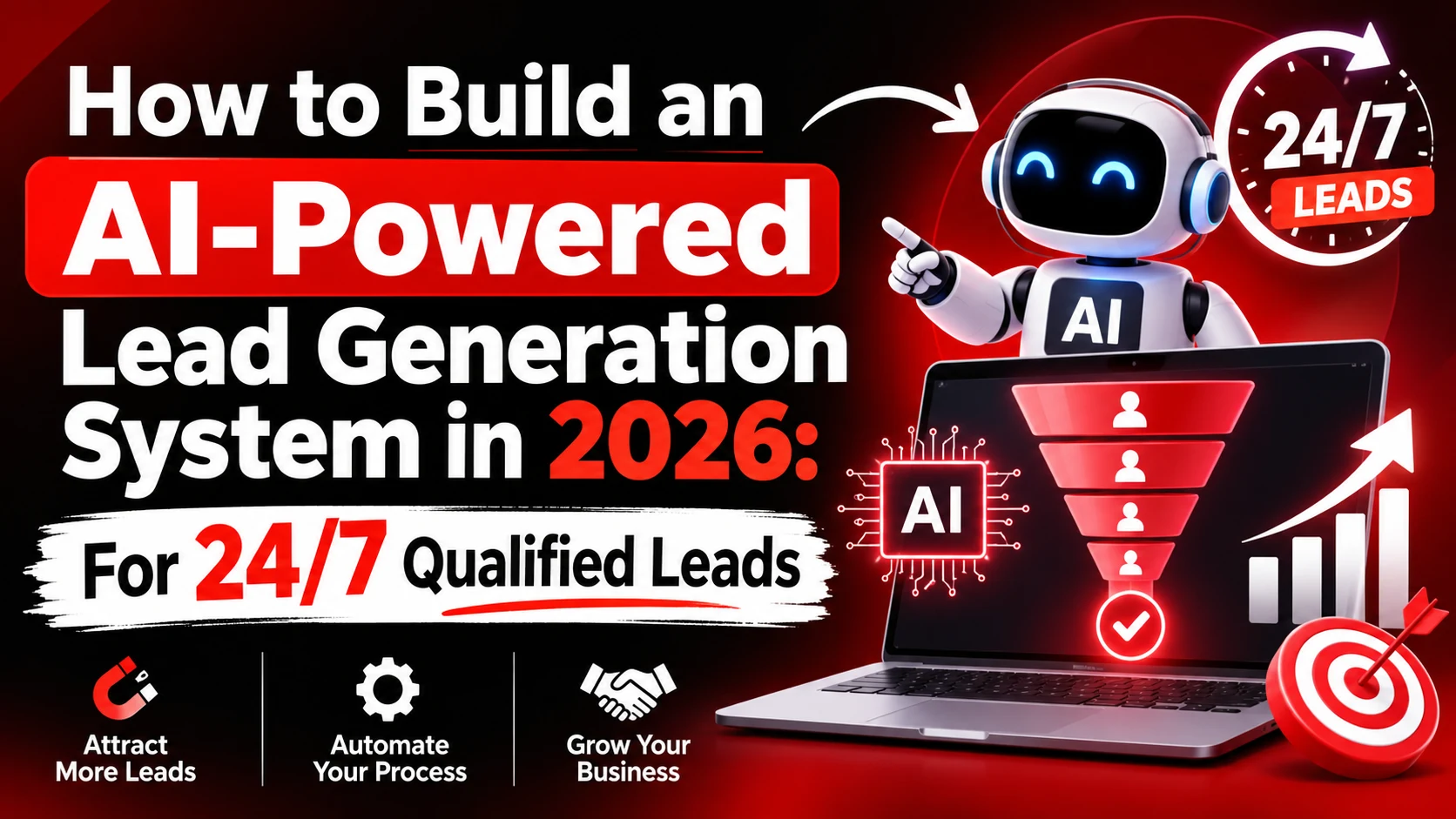
This guide explains how to build an AI-powered lead generation system in 2026 that closes the gap. An AI-powered lead generation system is a connected process where four tools share information. SEO brings in people already searching for what you sell. Google Ads adds speed and control. AI chatbots answer questions and screen enquiries at any hour. Email automation follows up with the right message at the right time.
The central idea is simple: AI is most valuable when it improves a connected marketing and sales process. A chatbot bolted onto a weak website, or an automated email sent to the wrong person, only makes mistakes faster.
The Problem with Traditional Lead Generation Today
More Website Traffic Does Not Always Mean More Qualified Leads
These terms get mixed up, and the confusion hides the problem. Traffic is anyone who visits. Raw enquiries are form fills, calls, and chats, fit or not. Qualified leads match your criteria for service, location, budget, and authority to buy. Sales-ready opportunities are qualified leads who want a conversation now.
Slow Responses Cause Businesses to Lose Opportunities
People who submit an enquiry are often contacting several providers, and the first helpful reply tends to shape the conversation. A form sent at 7 p.m. and answered at 10 a.m. gives competitors a long head start while the prospect's interest cools.
Disconnected Marketing Channels Create Data Gaps
SEO reports sit in one tool, ad data in another, form entries in a third, and chat transcripts somewhere else. The CRM (customer relationship management software) holds only part of the story. Nobody can say which channel produced the customers who actually paid.
Manual Follow-Ups and Weak Tracking Waste Resources
Manual follow-up depends on someone remembering. Leads get missed, messages sound generic, and attribution disappears when a prospect clicks an ad, leaves, and returns through organic search a week later. Teams end up judging campaigns by clicks and form fills, which say little about revenue.
An illustrative example: A B2B accounting software consultancy runs search ads and publishes blog posts. Leads arrive through a form that emails a shared inbox, and replies take a day. The CRM labels every lead "website." Ads get credit for leads that content started, and nobody knows which enquiries became clients. The company has activity but no feedback loop.
The 4-Pillar AI-Powered Lead Generation System
The four pillars should operate as one system because each covers a weakness in another. SEO is durable but slow. Google Ads is fast but stops when the budget stops. Chatbots capture demand at any hour. Email keeps prospects warm until they are ready. Shared tracking and a CRM connect them, so every pillar learns from real sales outcomes.
1 Pillar 1: SEO for High-Intent, Qualified Traffic
SEO lead generation works best when it targets people evaluating providers, not just browsing.
- Find high-intent queries: "Commercial HVAC maintenance contract near me" signals a buying decision. "How does a furnace work" does not.
- Optimise the right pages: Service and commercial landing pages carry buying intent. Supporting articles answer earlier questions and link to them.
- Guide visitors: Internal links and clear calls to action give each page a logical next step.
- Build trust: Show real expertise and transparent service information.
- Measure qualified organic leads: not only rankings and traffic.
An illustrative example: A commercial cleaning company publishes a page on janitorial services for medical offices, an article on infection-control checklists, and a pricing explainer. A facilities manager comparing vendors reads all three and submits a detailed request.
SEO is a long-term channel. Rankings and leads cannot be guaranteed, and results usually build over months.
2 Pillar 2: Google Ads for Instant Scale and Control
Google Ads lead generation puts you in front of active searchers quickly. The fundamentals matter more than any AI feature:
- Search campaigns aimed at commercial-intent queries.
- Keyword selection and negative keywords that filter out job seekers and DIY researchers.
- Landing-page relevance, so the page matches the ad's promise.
- Budget caps until performance is proven.
- Conversion tracking for forms, calls, and booked consultations.
CRM feedback. Google Ads can import offline results, and Google recommends enhanced conversions for leads for this. Its documentation suggests using a qualified or converted lead as the goal, so bidding optimises toward real prospects. Google has been moving these uploads to its Data Manager API, so check current setup steps.
Paid search covers the gap while organic visibility develops, and its data informs your SEO plan.
An illustrative example: An IT services firm runs separate campaigns and landing pages for managed IT support, cybersecurity audits, and cloud migration. Budget shifts toward whichever service produces qualified meetings, not the cheapest clicks.
Google Ads reaches searchers fast, but it does not guarantee profitable leads.
3 Pillar 3: AI Chatbots for 24/7 Qualification and Booking
An AI chatbot for lead generation is conversational software that talks with website visitors. A well-configured one can answer common questions after hours, collect details about the prospect's needs, score leads against your criteria (automated lead qualification), route enquiries or book appointments, pass records to your CRM where integrations exist, and hand complex questions to a human.
An illustrative conversation:
- Visitor: Do you handle HVAC maintenance for office buildings?
- Bot: Yes. Roughly how large is the building, and which city is it in?
- Visitor: About 40,000 square feet, in Columbus.
- Bot: We serve Columbus. Is this a one-time inspection or an ongoing contract?
- Visitor: Ongoing. Our current contract ends in March.
- Bot: That timeline works. Would Tuesday or Thursday suit you for a site assessment?
In six messages, the bot captured size, location, service type, and timing, and moved toward a booking. The limits are real. Chatbots can give inaccurate answers, so restrict them to approved information. Automation is wrong for complaints and sensitive issues. They also handle personal data, so disclose that the visitor is talking to an AI, collect only what you need, and follow your privacy policy. Human oversight is essential.
4 Pillar 4: Email Automation That Nurtures and Converts
Email automation for lead nurturing keeps prospects engaged until they are ready. It covers instant acknowledgement of new enquiries, educational sequences for people not ready to buy, relevant case studies and consultation invitations (use only real ones you can document), segmentation by behaviour, and CRM-triggered workflows with clear stopping conditions.
An illustrative sequence for a prospect who asked about website redesign pricing but has not booked:
- Immediately: Confirm receipt, say when a person will reply, and link to a pricing-factors guide.
- Day 2: Share a short article on what affects project timelines.
- Day 5: Show a relevant example of past work, with permission.
- Day 8: Invite them to a 20-minute consultation.
- Stop: when they book, reply, or opt out.
Different leads need different sequences, and no sequence guarantees conversions. Compliance matters too. The FTC says the CAN-SPAM Act covers commercial email, including business-to-business messages. Marketing emails need a clear opt-out, and opt-outs must be honoured within 10 business days. If you email people in other regions, check local consent rules as well.
How the Four Pillars Work Together as One System
Here is the journey from first click to sales opportunity:
- A prospect discovers the business through organic search or Google Ads.
- They visit a relevant landing page.
- A form or chatbot captures the enquiry and qualification details.
- The CRM records the source, contact information, requirements, and next action.
- Email automation sends relevant follow-ups when appropriate.
- Qualified prospects are routed to sales.
- Sales outcomes and revenue data feed back into SEO, advertising, and automation.
Step 7 is where most businesses stop short. It turns a pile of tools into a learning system.
The Role of CRM, Analytics, and Integrations
CRM integration for lead generation depends on unglamorous details: accurate tracking so every lead carries its source and landing page, integrations tested regularly, agreed attribution rules, duplicate management so one person is not counted as three leads, and a named owner for every lead's next step.
What a 24/7 Lead Generation System Actually Means
A 24/7 lead generation system captures and responds to enquiries around the clock. It does not run your sales process around the clock. Complex discussions, pricing judgment, and customised proposals still need people.
An illustrative example: At 9:40 p.m., a facilities manager finds a service page through organic search and opens the chat. The bot learns the building size, location, and contract timing. The CRM logs the lead as "organic, commercial maintenance," and an email confirms the request and offers two consultation times. The next morning, a sales rep sees a qualified lead with context, not a bare form entry.
Step-by-Step Implementation Roadmap
The right sequence and timeline depend on your existing infrastructure, team, and budget. Treat this as a framework, not a fixed schedule.
Step 1: Define Your Ideal Customer and Lead Qualification Criteria
Document industry, company size, service needed, location, budget range, decision-making role, and purchase timeline. These criteria drive every chatbot question, ad filter, and email segment.
Step 2: Audit Your Existing Lead Generation Process
Review search visibility, ad structure, landing pages, forms, chat tools, CRM records, and follow-up speed. Look for untracked calls, missing sources, and dead-end pages. A digital marketing review from an outside team can speed this up.
Step 3: Set Up Reliable Conversion Tracking
Track enquiries, calls, booked meetings, qualified leads, and closed sales. Test every form, call tag, and integration before increasing spend. Broken tracking quietly corrupts every later decision.
Step 4: Strengthen SEO and Launch Focused Google Ads Campaigns
Start with the pages and queries closest to a purchase. Give each service its own landing page with a clear offer and one conversion goal. Ingenious HiTech's SEO and Google Ads (PPC) services cover this stage. Launch with a capped budget and watch lead quality before scaling.
Step 5: Implement an AI Chatbot and Connect Your CRM
Begin with a short list of common questions, a few qualification questions, defined routing rules, and a clear path to a human. Connect it to your CRM so each conversation creates or updates a record. If your site needs structural changes first, website development may come before the chatbot, and AI chatbot integration can follow.
Step 6: Build Targeted Email Automation Workflows
Create separate flows for new enquiries, qualified leads, prospects needing more information, and booked consultations. Add stopping conditions and an unsubscribe link to every message.
Step 7: Measure, Test, and Improve Performance
Review lead quality, booked meetings, sales acceptance rate, cost per qualified lead, conversion rates, and customer acquisition cost. Change one variable at a time.
Common Mistakes That Kill Lead Generation Systems
- Automating a broken process: If sales follow-up is inconsistent, fix that first. Automation amplifies what already exists.
- Prioritising quantity over quality: Judge campaigns by cost per qualified lead, not cost per click.
- Sending irrelevant responses or generic emails: Segment by need and behaviour, and read chatbot transcripts regularly.
- Running ads without accurate conversion tracking: Bidding systems learn from the data you provide, so bad data means bad optimisation.
- Ignoring CRM data quality: Duplicates, missing sources, and broken integrations undermine every report.
- Expecting AI to replace sales expertise: AI screens and schedules. People build trust and negotiate.
- Collecting unnecessary personal data: Ask only what you need, and honour privacy and email rules.
- Scaling spend too early: Confirm that leads become customers at an acceptable cost before raising budgets.
DIY vs. Hiring Experts: What Makes Sense in 2026
When a DIY Lead Generation System Makes Sense
A simple setup can work in-house: one or two channels, a straightforward sales process, a modest budget, and someone comfortable with analytics and automation tools.
When Professional Implementation Is Worth Considering
Consider outside help when you run several channels at once, need complex CRM integrations, cannot trust your tracking, want custom AI workflows, or spend significant money on advertising. At that point, one tracking error can cost more than the help would.
What to Look for in an AI Lead Generation Partner
Evaluate any partner on:
- Real SEO and paid advertising expertise.
- CRM and automation integration capability.
- Transparent reporting and measurable deliverables.
- Data privacy and security practices.
- Clear communication and ongoing optimisation.
- A focus on qualified opportunities and business outcomes, not vanity metrics.
Ingenious HiTech offers SEO, Google Ads, email marketing, AI chatbot integration, and web development- the pieces this kind of system needs. If you want an outside view of your current setup, you can request a consultation to discuss what is not working.
Frequently Asked Questions
What is an AI-powered lead generation system?
It is a connected process using SEO, paid ads, chatbots, and email automation, tied together by a CRM, to attract, screen, and follow up with prospects. AI supports qualification and speed, while people handle complex sales conversations.
How do SEO and Google Ads work together for lead generation?
Google Ads delivers visibility immediately, while SEO builds lasting visibility. Ad data shows which search terms convert, which helps prioritise SEO content.
Can AI generate qualified leads 24/7?
AI can capture, screen, and respond to enquiries at any hour. It cannot guarantee leads or replace the human work of building relationships and closing deals.
How do AI chatbots qualify leads?
They ask questions based on criteria you define, such as service, location, budget range, and timeline. They then score or route the lead, book a meeting, or escalate to a person.
What role does email automation play in lead generation?
It acknowledges enquiries quickly and nurtures prospects who are not ready yet. Workflows should be segmented, stop when a prospect books or opts out, and comply with rules such as CAN-SPAM.
How do you measure the success of an AI lead generation system?
Track qualified leads, booked meetings, sales acceptance rate, cost per qualified lead, conversion rate, and customer acquisition cost, with each lead tied to its source.
How long does it take to build an AI-powered lead generation system?
It depends on your tracking, website, CRM, and resources. A basic version can come together in weeks, while SEO results and refinement take months.
Should small businesses invest in AI lead generation?
Often yes, if they have a clear customer profile and a working sales process. Start with your biggest bottleneck and expand only after you see qualified results.
Conclusion: Build Your 24/7 Lead Engine Now
Building an AI-powered lead generation system in 2026 comes down to one principle: connect SEO, Google Ads, AI chatbots, and email automation into a single measurable process. Attract the right audience, qualify enquiries accurately, follow up appropriately, and feed sales results back into your marketing.
Find your biggest bottleneck, whether poor tracking, slow follow-up, or weak landing pages, and fix it first. Then add the next piece.
To talk through a lead generation strategy that fits your goals, contact Ingenious HiTech.