
People no longer start every purchase decision with ten blue links. Many now ask an AI tool to compare options, summarise reviews, check specifications, and narrow a shortlist before they ever visit a website. A buyer comparing software, a laptop, or a marketing agency may see your brand mentioned, skipped, or described inaccurately without clicking through to your site.
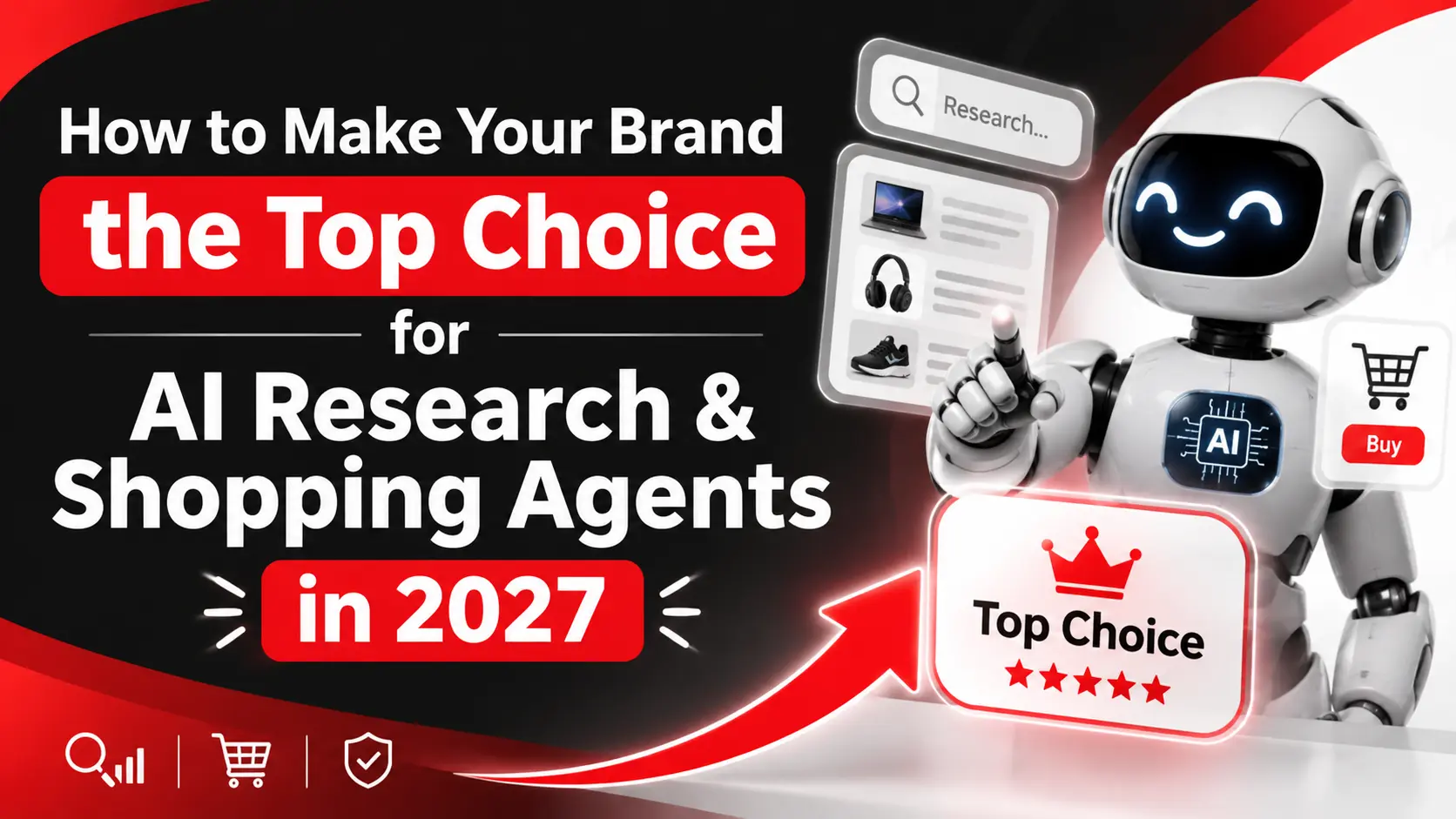
December 2026 is a practical time to prepare because these tools are already in use, and the fixes are mostly foundational: accurate information, accessible pages, and credible proof. This differs from ordinary keyword work, though traditional SEO still matters and remains the base layer. Learning how to make your brand the top choice for AI research and shopping agents in 2027 means making your business easy to find, easy to compare, and easy to trust.
This guide covers brand information, technical accessibility, trust signals, content usefulness, and performance measurement, with a seven-step plan you can start this month.
What Are AI Research & Shopping Agents, and How Are They Different From AI Overviews?
Traditional search returns a ranked list of links, and the person does the comparing. AI-generated answers, such as Google's AI Overviews and AI Mode, write a summary from retrieved pages. Google describes using query fan-out, where the system runs several related searches to cover the subtopics of a question (Google Search Central).
AI research tools stretch this idea across a multi-step task: gather sources, compare them, and report back. AI shopping agents add product details such as price, availability, and features, and in some cases help complete a purchase. The core difference is generating an answer versus performing a task. An answer summarises. An agent plans steps, visits pages, and may act. Not every AI answer comes from an autonomous agent, and capabilities vary by tool and change often.
Picture two people. One asks an assistant to compare CRM platforms for a ten-person sales team, and the tool pulls pricing pages, integration lists, and reviews. The other is buying a laptop and cares about weight, battery life, and warranty. OpenAI says ChatGPT ranks merchants on factors such as availability, price, quality, and whether they are the maker or primary seller (OpenAI Help Centre).
Google says SEO fundamentals still apply to its AI features (Google Search Central), so brands need to support both traditional and AI-assisted discovery.
How AI Agents Decide Which Brands to Recommend
No universal ranking formula exists. Each platform uses its own systems and data, and most do not publish details. Some points below are documented. The rest are reasonable strategies, not confirmed rules.
Documented: for Google's AI features, a page must be indexed and eligible to appear with a snippet, with no additional technical requirements.
Strategic, not universal requirements: agents are more likely to represent a brand well when they find:
- A clear identity with consistent business details everywhere.
- Structured, comparable product or service details.
- Content that answers real customer questions.
- Trust signals: reviews, expertise, and credible third-party references.
- Fresh, accurate pricing, specifications, availability, and business details.
- First-party proof, including case studies, original research, and documented results.
Brands get overlooked when copy is vague, details conflict across websites, product data is incomplete, or claims lack evidence. Systems can only use what they can verify, and vague claims are easiest to skip.
December 2026 Action Plan: 7 Practical Steps to Prepare Your Brand for AI Agents
1. Strengthen Your Brand Entity
An entity is a business or person that systems can identify and describe consistently. Start with About, Services, Contact, Team, and location pages where relevant, each using the same legal name, address, phone number, and service area. Add expert biographies with real credentials. Align listings such as Google Business Profile and respected industry directories. Add Organisation, Person, or LocalBusiness structured data (code that labels page facts for machines) only where it matches visible content.
Example: a regional digital marketing agency should describe its name, services, service area, and leadership identically on its site, Google Business Profile, LinkedIn, and directories. Conflicts, such as an old suite number, force any system to guess.
2. Restructure Key Pages for Agent Readability
Service pages, product pages, comparison pages, and buying guides should be easy to scan for people and parsers. Use descriptive headings, open each section with a concise answer, then add depth. State deliverables, specifications, compatibility, and genuine customer questions. Link related pages with meaningful anchor text.
Google's web.dev guidance explains that browser agents read pages through screenshots, HTML, and the accessibility tree, so real buttons, links, and labelled form fields help (web.dev). Keep the writing persuasive, because a page built only for machines loses the human making the final decision. An on-page SEO review covers these basics.
3. Add Clear, Comparable Data Points
Ecommerce stores should publish accurate prices, product attributes, availability, shipping terms, returns, warranties, and compatibility. Product structured data and Merchant Centre feeds keep those facts consistent between pages and feeds. Google notes that Merchant Centre feeds and Business Profiles can help products and services appear in AI responses. OpenAI accepts direct product feeds by application.
Google's Universal Commerce Protocol, an open standard for agent-based shopping, is currently limited to select U.S. merchants (Google Merchant Centre Help), so watch it while you clean up your data.
Service businesses should publish scope, deliverables, pricing models, realistic timelines, target industries, service locations, and documented outcomes. "Projects start at [real figure] for [defined scope]" beats "contact us for pricing." Never publish misleading prices, unsupported guarantees, or invented metrics.
4. Build Strong Trust and Proof Signals
Collect authentic reviews and ask for specifics. Publish detailed case studies covering the problem, approach, timeline, and measured result. Share original research when you have it. Show expert biographies, verifiable credentials, transparent policies, and third-party mentions you earned. Google says chasing inauthentic mentions is less helpful than it seems (Google Search Central).
Before: "We deliver outstanding SEO results for ecommerce brands."
After: "For a [category] retailer, we fixed [specific issue] and tracked [metric] in Search Console from [month] to [month]. The report summary and method are on this page."
The second version can be checked. Fill the brackets only with real data, and never fabricate testimonials, statistics, customer names, certifications, or results.
5. Improve the Technical Foundations AI Systems Rely On
Confirm that important pages are crawlable and indexable. Review robots.txt, XML sitemaps, canonical tags, and HTTP status codes (live pages return 200, permanent moves use 301). Strengthen internal linking, mobile usability, page speed, and Core Web Vitals. Keep structured data accurate, product feeds correct, and business details synchronised. A web development team can fix most of these.
Platforms differ. Google advises allowing crawling in robots.txt and in any CDN or hosting infrastructure. OpenAI documents separate crawlers: OAI-SearchBot for ChatGPT search, GPTBot for model training, and ChatGPT-User for user-initiated visits, where robots.txt rules may not apply (OpenAI). Sites that opt out of OAI-SearchBot will not be shown in ChatGPT search answers.
No file, schema type, or technical change guarantees recommendations. Google also says you do not need llms.txt or special markup to appear in its AI features.
6. Create Decision-Focused Content AI Systems Can Reference
"Agent-friendly content" simply means content that helps someone choose between alternatives and is clear to both people and machines. No format guarantees inclusion or recommendations. Useful formats include comparison guides, buying guides, industry solution pages, original surveys and benchmark reports, troubleshooting guides, expert-led explanations, practical FAQs, and transparent comparisons that admit limitations and trade-offs.
Example: a CRM comparison guide for small businesses could compare pricing models (per seat, tiered, add-on fees), integrations with tools small teams already use, setup effort, limitations, and ideal use cases, such as "best for teams under ten who work mostly in email." Date the pricing check, and say where a competitor fits better.
Original insight beats volume. Google warns that creating pages mainly to capture query variations can violate its scaled content abuse policy. Publish fewer pages that contain something only you know, such as your test data, customer questions, or field experience. Our content strategy service can help.
7. Set Up Simple Tracking for Early Wins in Q1 2027
December baseline. Write 20 to 30 repeatable prompts a buyer might ask, such as category comparisons and brand-name checks. Run them in the AI tools your customers use. Record brand mentions, whether the description is accurate, and visible citations or links to your site. Responses vary, so treat results as directional.
January to March. Fix foundations in January and log every change. Update priority pages in February and re-run the same prompts. Compare against your baseline in March.
Track these alongside the manual tests:
- Google Search Console, including the Generative AI performance reports, which show impressions in AI features by page, country, device, and date (Google Search Central).
- Identifiable AI referral traffic in your analytics.
- Qualified leads, enquiries, and sales in your CRM, plus a "How did you hear about us?" field.
- Conversion rates and lead quality.
- Organic search performance and Merchant Centre feed diagnostics.
Keep observed data (analytics, Search Console, CRM) separate from estimates (manual prompt tests). AI referral traffic may not always be identifiable, and a brand mention does not necessarily produce a visit. Skip universal benchmarks and compare against your own baseline. Our guide to qualified leads in 2027 shows how to connect visibility to sales.
Common Mistakes That Cause AI Systems to Overlook Your Brand
- Relying only on keyword targeting: Pages that match words but add no evidence blend in. Answer real buyer questions.
- Publishing generic, repetitive AI-generated content: It adds nothing new and risks spam-policy trouble. Add original data and expert review.
- Keeping inconsistent business or product information: Conflicts lower confidence. Audit listings and feeds quarterly.
- Ignoring product feed and structured data quality: Errors cause rejected or outdated listings. Check diagnostics monthly.
- Accidentally blocking important pages: A stray noindex tag or firewall rule can hide your best pages. Test access regularly.
- Using irrelevant or misleading structured data: Markup must match visible content. Remove anything that does not.
- Fabricating reviews, testimonials, or endorsements: It destroys trust and can trigger penalties. Earn real proof.
- Expecting immediate results or guaranteed rankings: No one can promise either. Measure steadily.
What Success Looks Like in 2027
Realistic wins include more frequent relevant brand mentions in the AI experiences you test, more accurate descriptions of your offerings, and stronger presence in comparison and research tasks. You may also see more qualified traffic from identifiable AI referrals and better conversion among high-intent visitors. Technical SEO, content, product data, and lead generation start working as one system.
Outcomes depend on your industry, competition, platform, baseline, and implementation quality. A mention alone is not proof of commercial success, so tie visibility to qualified enquiries, sales, and measurable outcomes.
Frequently Asked Questions
What Is AI Agent Optimisation?
It is the practice of making your brand information, pages, and data easy for AI tools to find, verify, and compare. It builds on conventional SEO and overlaps with GEO, with extra focus on product data and task-based discovery.
How Can My Brand Get Recommended by AI Tools in 2027?
Keep business details consistent, publish comparable product or service data, allow appropriate crawling, earn genuine reviews and proof, and create decision-focused content. Then test repeatable prompts monthly and track results against your baseline.
Is Traditional SEO Still Important for AI Shopping Agents?
Yes. Google says its AI features rely on indexed, snippet-eligible pages and that SEO fundamentals still apply. Accessible pages, relevant content, technical quality, and reliable information remain the foundation for visibility.
Does Structured Data Guarantee AI Recommendations?
No. Google says structured data is not required for its generative AI features. It remains useful for clarity and rich result eligibility, but no markup guarantees recommendations from any AI platform.
How Long Does AI Search Optimisation Take to Show Results?
It varies by platform, competition, technical condition, and implementation. Fixing crawl problems may help sooner than building trust and content depth. Track monthly against your baseline, and distrust fixed timelines.
Can Small Businesses Compete With Established Brands in AI Search?
Possibly. Specialisation, verifiable evidence, and useful niche information can create openings that large brands overlook. Success is never guaranteed, but focused expertise and accurate data give smaller companies a fair chance.
Conclusion: Prepare Your Brand for AI-Driven Discovery in 2027
Learning how to make your brand the top choice for AI research and shopping agents in 2027 comes down to fundamentals. Keep business information accurate and consistent, publish comparable product and service data, stay technically accessible, back claims with evidence, and create content that helps people decide.
Just as important, measure real outcomes. Throughout Q1 2027, compare your December baseline with qualified leads, enquiries, sales, and lead quality, not only brand mentions, so each improvement connects to business results.
If you would like a clear view of where your site stands today, Ingenious HiTech can review your SEO, technical foundations, content quality, and AI-search readiness, then help you prioritise practical, realistic next steps. Request a free audit when you are ready.