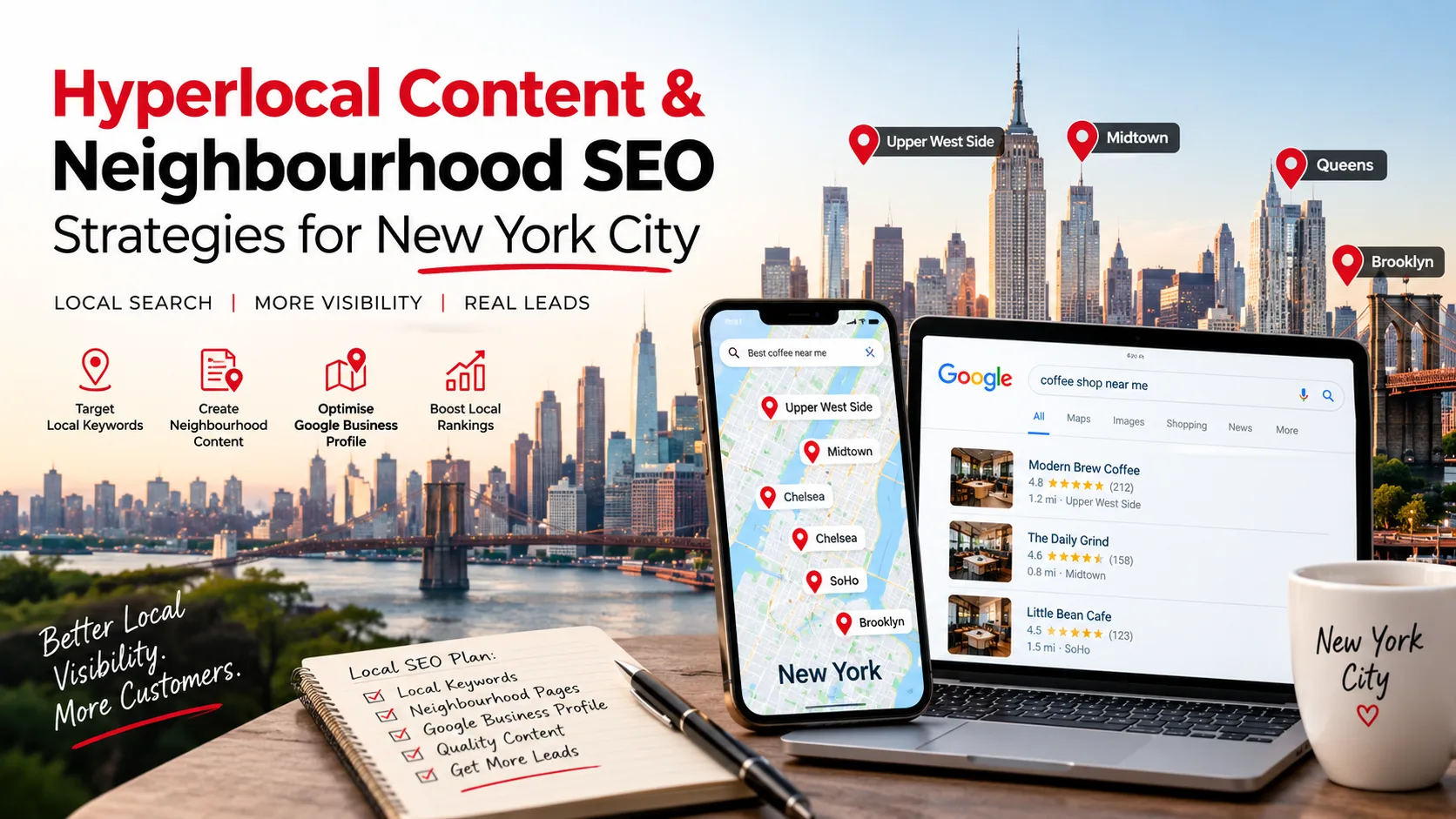


A San Diego dentist can have a beautifully designed website, five-star clinical care, and a genuinely helpful staff and still watch new patients book with a competitor three blocks away simply because that competitor shows up first on Google Maps. This happens constantly across the city, from Pacific Beach surf shops to Mission Valley law firms. It's rarely about who does better work. It's about who's easier to find.
That's what local SEO for San Diego businesses actually solves. It isn't about sprinkling "San Diego" across a homepage and hoping rankings improve. It's a combination of Google Business Profile management, local keyword targeting, on-site optimisation, reviews, citations, local content, technical performance, and, increasingly in 2026, visibility inside AI-assisted search results. This guide walks through what actually matters, in the order it matters.
Why Local SEO Matters for San Diego Businesses in 2026
Customers Search Locally Before They Buy
Most local purchase decisions start with a search that already assumes proximity. Someone doesn't search "law firm"; they search "personal injury lawyer near me" or "SEO agency San Diego." A homeowner with a leak doesn't browse plumbing company websites for fun; they search "plumber in San Diego" while water is actively pooling on the floor. These searches carry urgency and intent, and the businesses that show up in the Local Pack and Maps results are the ones that get the call.
The same pattern shows up for "digital marketing agency San Diego," "dentist near me," and dozens of other service categories. Local SEO for San Diego businesses is really about being present at the exact moment someone is ready to choose.
San Diego Is Not One Single Search Market
San Diego covers roughly 325 square miles and a genuinely diverse set of neighbourhoods, each with different demographics, competition levels, and search behaviour. A boutique fitness studio in La Jolla is competing against a different set of businesses and different customer expectations than a similar studio in Chula Vista or El Cajon. A home services company that covers Santee and Escondido is dealing with commute times and service radius questions that a downtown business never has to think about.
This matters because "San Diego SEO" isn't a single strategy. It's a set of decisions about which neighbourhoods and search terms actually reflect where a business operates and who it can realistically serve.
How Local SEO Works for San Diego Businesses
Google's local ranking factors generally come down to three things, and understanding them helps explain why some strategies work and others waste time.
Relevance
Does the business genuinely match what the searcher is looking for? A business categorised incorrectly on Google Business Profile, or a website that never mentions the specific services a customer is searching for, struggles here regardless of how established the business is.
Proximity
How close is the business to the searcher, or to the location implied in the search? This one is largely outside a business's control, but it's part of why service-area businesses need to think carefully about which neighbourhoods they claim to serve.
Prominence
How well-known and trusted is the business, based on signals like reviews, citations, backlinks, and overall online presence? This is the factor most within a business's control, and it's built over time through consistent, genuine effort rather than shortcuts.
These three factors work together with a business's website, Google Business Profile, reviews, citations, and content. None of them operates in isolation.
10 Local SEO Strategies for San Diego Businesses
1. Optimise Your Google Business Profile
Google Business Profile is often the first thing a potential customer sees, and it deserves more attention than most businesses give it. Choose the primary category that most precisely matches the core business, not the broadest one available. Add relevant secondary categories, but only ones that genuinely apply. Write a business description that explains what the business does and who it serves, without keyword stuffing. List actual services with clear names. Keep business hours accurate, especially around holidays. Upload real photos of the location, team, and work, not stock imagery. Define service areas honestly, based on where the business truly operates. And monitor the Q&A section, since customers often post questions there before ever visiting the website.
2. Target San Diego and Neighborhood-Specific Keywords
Not every keyword needs a neighbourhood attached to it, and not every neighbourhood deserves its own keyword strategy. The goal is matching keywords to actual customer intent. Broad terms like "SEO in San Diego" attract a wide audience researching options. More specific phrases like "SEO services La Jolla" or "local SEO for small businesses in San Diego" tend to convert better because the searcher already has a narrower, more defined need. Building keyword targets around real services and real service areas rather than every neighbourhood on a map keeps content useful instead of repetitive.
3. Build High-Quality Local Landing Pages
If a business genuinely serves multiple distinct areas, dedicated location pages can help, but only when each page offers something unique. A useful location page includes specifics: the services offered in that area, relevant local context, any location-specific proof like project photos or testimonials from that neighbourhood, a short FAQ addressing common questions from that area, and a clear next step for the visitor. What doesn't work is duplicating the same page eight times and swapping out the neighbourhood name. Google recognises this pattern, and so do customers.
4. Strengthen On-Page SEO
On-page SEO is the foundation everything else builds on. That means a clear, keyword-relevant SEO title and meta description, a single well-structured H1, a logical H2/H3 hierarchy, a clean URL, natural keyword placement rather than forced repetition, descriptive image alt text, and internal links that guide visitors toward related services. None of this is glamorous work, but it's what allows Google to understand exactly what a page is about and who it should be shown to.
5. Build Consistent Local Citations
NAP Name, Address, Phone number needs to match exactly across every directory, platform, and listing a business appears on. Inconsistencies, even small ones like "St." versus "Street," can create confusion for both search engines and customers. The goal isn't submitting a business to hundreds of low-quality directories. A handful of accurate, relevant citations on reputable platforms does far more for trust and consistency than volume ever will.
6. Earn Genuine Customer Reviews
Reviews remain one of the strongest trust signals in local search, and there's no substitute for real ones. The best approach is asking satisfied customers at the right moment, right after a positive interaction, when the experience is still fresh, and making the process as simple as possible, ideally with a direct link. Responding to reviews professionally, including negative ones, shows prospective customers how a business handles real feedback. Buying reviews or writing fake ones isn't just against Google's policies; it erodes the very trust local SEO is meant to build.
7. Create Content Around San Diego Search Intent
Generic SEO content that could apply to any city rarely performs well and rarely helps readers. Content built around real questions San Diego customers are asking is a different story. Pieces like "How Much Does SEO Cost in San Diego?" "Local SEO vs. Google Ads for San Diego Businesses," or "How to Rank a San Diego Service Business on Google" address genuine decision points. This kind of content also tends to earn more organic backlinks, because it's actually useful to share.
8. Improve Technical SEO and Mobile Experience
Most local searches happen on a phone, often while someone is already moving, walking, driving, or standing in a parking lot deciding where to go next. If a website loads slowly or doesn't display properly on mobile, that visitor bounces to the next result. Beyond mobile usability and page speed, technical fundamentals matter: solid Core Web Vitals, HTTPS, clean crawlability and indexation, no broken links, correct canonical URLs, structured data (schema markup) that helps search engines understand the business, and an accurate XML sitemap. These aren't flashy improvements, but they quietly support everything else.
9. Build Local Authority and Relevant Backlinks
Earning mentions and links from relevant San Diego sources local publications, business associations, chambers of commerce, industry-specific sites, community organisations, and event sponsorships builds authority in a way that's hard to fake. A single relevant link from a well-known local organisation typically carries more weight than dozens of generic, unrelated ones. Digital PR and genuine community involvement tend to produce these links naturally, as a byproduct of real relationships rather than link-building campaigns.
10. Optimise for AI Search and Local Discovery
This is where 2026 genuinely changes the picture. AI-powered search experiences and AI Overviews increasingly shape how people discover local businesses, often summarising information before a searcher ever clicks through to a website. Businesses improve their chances of being understood and surfaced in these experiences the same way they improve traditional visibility: by maintaining clear, accurate service information, demonstrating real topical expertise, answering common questions directly, keeping business details consistent everywhere they appear, building a genuine reputation through reviews, and using structured data that makes information easy for machines to parse. No legitimate SEO provider can guarantee a business will appear in a specific AI-generated answer; anyone claiming otherwise isn't being straight with you. What businesses can do is build the same fundamentals that have always mattered, applied to a search landscape that now includes both traditional results and AI-assisted ones.
Local SEO Mistakes San Diego Businesses Should Avoid
Keyword stuffing makes content harder to read and signals low quality to search engines, not relevance. Duplicate location pages with swapped city names get flagged as thin or doorway content and can hurt an entire site's credibility. Fake reviews risk removal, platform penalties, and real damage to customer trust once discovered. Inconsistent business information across listings confuses both search engines and customers about which details are accurate.
Ignoring Google Business Profile means missing out on the single most visible local search asset a business has. Targeting only broad San Diego keywords wastes effort competing for terms with intense competition while ignoring more attainable, higher-intent searches. Publishing generic AI-generated content without real expertise or local specificity tends to underperform and can dilute a site's overall quality signals.
Buying low-quality backlinks can trigger penalties that take far longer to recover from than the shortcut ever saved. Ignoring mobile performance loses the majority of local searchers before they even see the content. And expecting instant results sets businesses up for frustration; local SEO is a compounding effort, not a switch that flips.
How to Measure Local SEO Performance in San Diego
Rankings alone don't pay the bills, so measurement needs to go further. Useful signals include Google Business Profile interactions, calls, website clicks, and direction requests, along with organic traffic, local keyword visibility, lead volume, and conversion rate. Search Console data on impressions and clicks shows how visibility is trending over time, while review growth and referring domains reflect long-term authority building.
It's worth remembering that a keyword ranking in position six that consistently sends qualified leads can be more valuable to a business than a position-one ranking for a term that generates plenty of clicks but few actual customers. Tracking outcomes, not just positions, is what turns SEO data into business decisions.
When Should You Hire a Local SEO or Digital Marketing Agency?
Not every business needs outside help, but there are clear signals when it makes sense. If there's no internal SEO expertise, if local competition is intense, if the website has unresolved technical problems, if the Google Business Profile has been neglected, if rankings have stalled despite effort, or if there simply isn't time to manage all of this consistently, working with an agency offering digital marketing services in San Diego can close that gap faster than trying to learn everything in-house.
The most effective approach usually combines several disciplines at once: local SEO, technical SEO, content strategy, website optimisation, and often paid advertising and conversion optimisation, working together rather than as disconnected efforts.
Why Choose Ingenious HiTech for Local SEO?
Ingenious HiTech works with San Diego businesses on the full range of what local visibility actually requires: SEO strategy, local SEO execution, technical SEO fixes, content strategy, website optimisation, and broader digital marketing support, including positioning for AI-era search visibility. Rather than treating SEO as a checklist item, the approach centres on understanding a business's actual services, service area, and customers before building a strategy around them.
That means realistic reporting focused on the metrics that reflect real business impact, not vanity numbers. Want to improve your local visibility and attract more qualified customers? Contact Ingenious HiTech to discuss a strategy tailored to your business.
Frequently Asked Questions About Local SEO in San Diego
1. What is local SEO for San Diego businesses?
It's the practice of optimising a business's online presence Google Business Profile, website, reviews, citations, and content to appear in local search results and Google Maps when nearby customers search for relevant products or services.
2. How long does local SEO take to show results in San Diego?
Timelines vary by industry, competition, and starting point, but most businesses begin seeing measurable movement within three to six months, with stronger results building over six to twelve months of consistent work.
3. How much does local SEO cost in San Diego?
Costs depend on competition level, scope of work, and business goals. Highly competitive industries and service areas typically require more investment than niche or low-competition markets.
4. Is Google Business Profile important for local SEO?
Yes, it's often the first thing potential customers see and a major factor in Google Maps and Local Pack rankings, making it one of the highest-priority elements to optimise.
5. Does SEO still work for local businesses in 2026?
Yes. Search behaviour has expanded to include AI-assisted experiences, but the fundamentals relevance, proximity, prominence, and trustworthy content still drive visibility across both traditional and AI-powered search.
6. Should a business create separate pages for San Diego neighbourhoods?
Only when the business genuinely serves that neighbourhood and can offer unique, useful information for it. Creating pages purely to target keywords tends to backfire.
7. Can local SEO help a business appear in AI search results?
It can improve the odds by building the same clarity, expertise, and consistency AI systems draw on, but no agency can guarantee placement in a specific AI-generated answer.
Conclusion
Local SEO for San Diego businesses isn't about putting the city's name everywhere on a website. It's about making it unmistakably clear to both search engines and real customers who you serve, what you offer, where you operate, and why you're worth trusting. That clarity gets built through a Google Business Profile that's genuinely optimised, a website that supports it, reviews that reflect real experiences, local content that answers real questions, citations that stay consistent, authority earned over time, and visibility that extends into AI-assisted search. Ready to build that foundation? Contact Ingenious HiTech to talk through a strategy built around your business.