
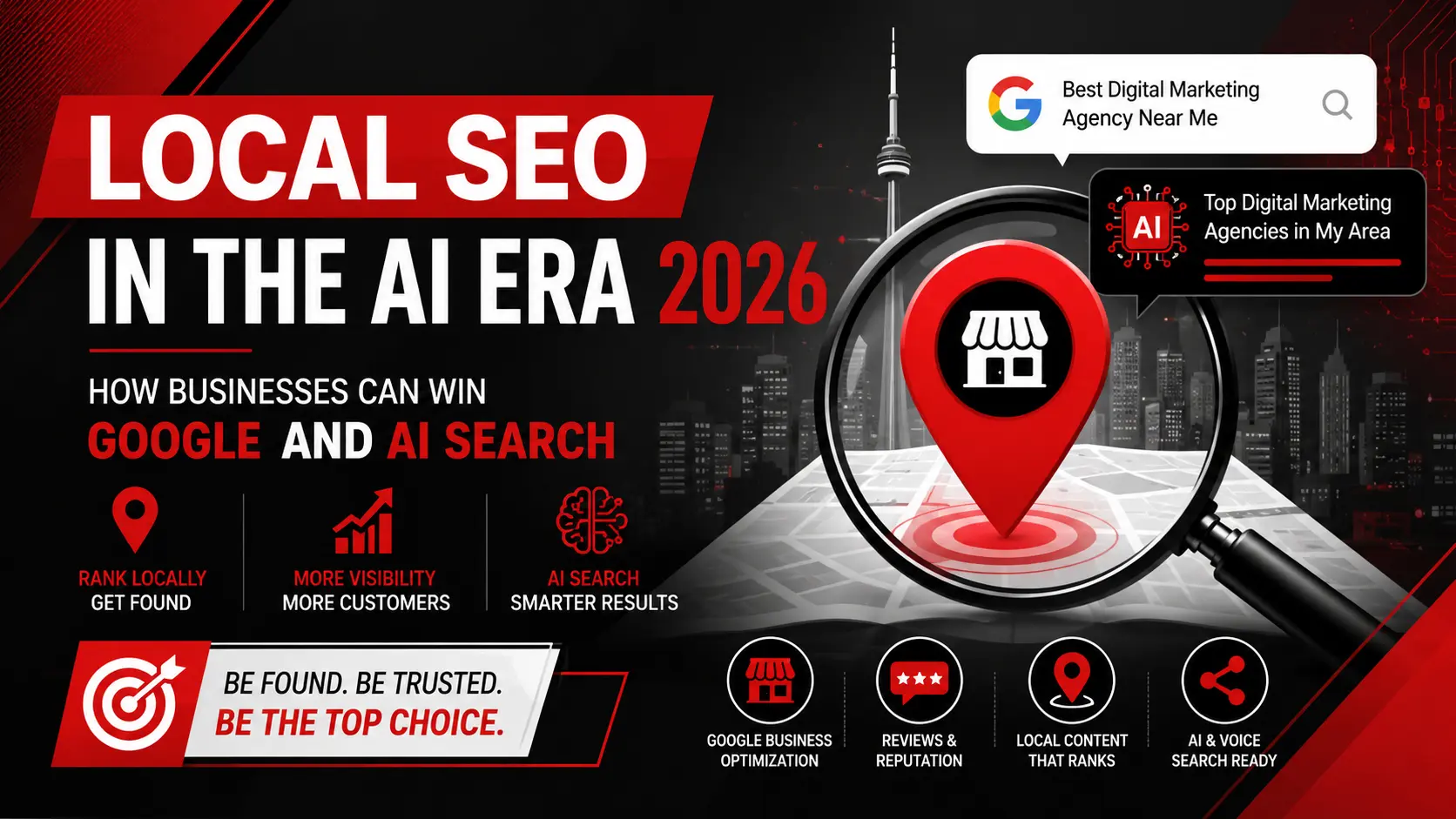
Someone looking for “best digital marketing agency near me” in 2026 often sees more than a simple list of blue links. They may get a map pack, traditional organic results, an AI Overview summary, and sometimes a conversational recommendation pulled from Google Business Profile data, reviews and trusted sources.
The same person might later ask ChatGPT, Gemini or Perplexity a longer question about agencies that understand local search. Local SEO in the AI Era 2026 is no longer only about ranking in the map pack. It is about making your business understandable, trustworthy and recommendable across both classic Google results and AI-driven experiences.
Local SEO isn’t disappearing because of AI. It’s expanding. The businesses that keep winning are the ones treating Google Business Profile, accurate information, reviews and useful local content as the foundation, then layering on clearer entity signals and answer-ready content so they remain visible when search becomes conversational.
If you want a practical audit of where your local presence stands today, request a Local SEO consultation.
What Is Local SEO in the AI Era 2026?
Local SEO is the work of helping search systems and customers understand that your business is relevant for a specific place and a specific need. In traditional Local SEO, the focus was on rankings in the local pack, Google Maps visibility, Google Business Profile completeness, citations, reviews and on-page location signals.
In the AI era, the same foundation still matters, but the environment has grown. AI systems now generate summaries and recommendations. They draw on Google’s index, structured business data, review language, third-party mentions and the overall strength of a business as an entity.
Local SEO in 2026 therefore combines the classic ranking work with clearer entity understanding, conversational content and broader authority so your business can appear in both traditional results and AI-generated answers.
Think of it this way: traditional Local SEO gets you into the conversation. Generative Engine Optimisation and stronger entity signals help the systems decide whether to recommend you when someone asks a longer, more specific question.
How AI Is Changing Local Search in 2026
Google Search and AI Overviews
Google’s AI Overviews and AI Mode sit on top of the same ranking and quality systems that power regular Search. They use retrieval-augmented generation to pull relevant pages and business information, then synthesise an answer with supporting links. For many local queries, the traditional map pack and organic results still appear. AI Overviews are more common on informational or hybrid queries, such as “how much does a local SEO audit cost” or “what should I look for in a digital marketing agency near me.”
Google’s own guidance is clear: the best practices that help a page rank and earn a snippet also help it become eligible for generative AI features. There is no separate ranking algorithm just for AI Overviews, and special “AI-only” tactics such as llms.txt files or forced content chunking are not required.
Google Maps and Local Search
Google Business Profile remains the primary structured data source for local businesses. Accurate hours, categories, services, photos and reviews still feed Maps results and increasingly inform AI summaries. When someone asks a conversational question inside Maps or Search, the systems reach for the entities they already trust- those with consistent NAP, complete profiles and verifiable review signals.
Conversational AI Search
People now ask fuller questions. Instead of “plumber near me”, they type or speak “reliable plumber in [neighbourhood] who can fix a leaking water heater this week and has good recent reviews.” Platforms such as ChatGPT, Gemini and Perplexity answer these queries by synthesising information from websites, directories, reviews and other sources. Visibility depends on relevance, clarity, authority and consistency rather than any single ranking position.
A realistic example: a homeowner asks an AI assistant for a local roofing company that specialises in flat roofs and has responded to recent reviews. The systems look for businesses whose profiles, websites and third-party mentions match that combination of service, location and reputation signals.
Local SEO vs. Generative Engine Optimisation: What’s the Difference?
|
Aspect |
Local SEO |
Generative Engine Optimisation |
|
Primary purpose |
Rank in Google Search, Maps and the local pack |
Increase the chance of mention or citation in AI answers |
|
Search environment |
Google Search, Maps, traditional SERPs |
AI Overviews, ChatGPT, Gemini, Perplexity, similar tools |
|
Content requirements |
Location-relevant pages, service pages, FAQs |
Clear answers, structured explanations, unique insights |
|
Business information |
Accurate NAP, categories, hours on GBP |
Consistent entity data across the web |
|
Reviews |
Quantity, recency, responses on GBP |
Detailed, authentic experiences that systems can cite |
|
Authority |
Local links, citations, relevance |
Broader mentions, expert signals, third-party corroboration |
|
Citations |
Directory consistency |
Natural language mentions in trusted sources |
|
Measurement |
Rankings, calls, directions, traffic |
Brand mentions, AI referral traffic, conversational visibility |
Local SEO remains the foundation. Generative Engine Optimisation is an additional layer. You do not abandon Google Business Profile work or local content in favour of “AI hacks.” You strengthen the same signals that already matter and make them clearer for systems that generate answers.
8 Local SEO Strategies for the AI Era
1. Optimise Your Google Business Profile
Your Google Business Profile is still the single most important local asset. Choose the most accurate primary category and relevant secondary categories. Write a clear description that states what you do and where you serve without keyword stuffing. Keep hours, services, attributes and contact details current. Add high-quality photos regularly. Respond to reviews and answer questions in the Q&A section.
Why this matters: Google and AI systems treat a complete, accurate profile as a trusted data source. Incomplete or inconsistent profiles reduce the chance that your business will be recommended when context and location matter.
2. Create genuinely useful location-specific content
Changing the city name on identical service pages does not create useful content. Write about the actual needs of customers in your area. Include local examples, neighbourhood references, service-area pages that explain real differences, and FAQs that answer questions people actually ask. Unique local insights, such as common challenges in your market or how regulations affect service delivery, help both readers and search systems understand relevance.
3. Answer conversational search queries
People ask complete questions. Structure pages so the answers are easy to find. Use clear headings and concise paragraphs that address questions such as:
- “What does a Local SEO audit include for a small business?”
- “How long does it take to see results from Google Business Profile optimisation?”
- “Which factors matter most for Google Maps rankings in 2026?”
- “Can AI Overviews replace the local pack for service businesses?”
- “How do online reviews affect AI recommendations?”
FAQs and well-organised service pages make it simpler for both users and generative systems to extract accurate information.
4. Strengthen your business entity and brand signals
Entity SEO simply means making it easy for systems to understand who you are, what you do and where you operate. Keep name, address and phone number identical across your website, Google Business Profile and major directories. Maintain a clear About page, Contact page and service pages. Use Organisation and LocalBusiness schema where appropriate. Consistent third-party profiles and author or expert information further reinforce the entity.
5. Build genuine review signals
Authentic, recent, detailed reviews remain powerful. Encourage customers to describe specific experiences and services. Respond thoughtfully. Service-specific feedback helps both human readers and AI systems match your business to nuanced queries. Never buy or fabricate reviews; platforms detect patterns and the risk far outweighs any short-term gain.
6. Earn relevant local mentions and authority
Focus on genuine mentions from local publications, industry sites, business associations, community organisations and relevant partnerships. Expert interviews and local PR can create natural authority signals. Avoid mass directory submissions and low-quality link schemes. Relevance and trustworthiness matter more than volume.
7. Make your website technically strong and AI-readable
Ensure the site is crawlable, mobile-friendly and reasonably fast. Use clear headings, descriptive metadata, helpful internal linking and structured data. Alt text on images and accessible content improve the experience for everyone. You do not need a separate “AI version” of the website. The same technical foundations that support traditional rankings also support generative features.
8. Build a local content ecosystem
Create interconnected content that shows topical depth. A digital marketing agency might publish pages on Local SEO, Local SEO for small businesses, Google Maps SEO and related case studies or guides. Internal links and consistent coverage help users and search systems understand the full scope of expertise.
Businesses that want help prioritising these steps can explore Local SEO services tailored to their market.
Do Traditional Local SEO Factors Still Matter in the AI Era?
Yes. Google Business Profile completeness, reviews, local relevance, website quality, local authority and accurate business information still matter because generative AI features on Google Search are rooted in the same ranking and quality systems. Strong traditional Local SEO creates the reliable data and authority that AI systems draw upon. Businesses already investing in these areas are better positioned for both classic results and AI visibility.
Common Local SEO Mistakes Businesses Should Avoid in 2026
- Keyword stuffing that makes content unnatural.
- Duplicate city pages with thin or identical content.
- Fake or incentivised reviews.
- Inconsistent NAP across listings and the website.
- Ignoring or under-optimising Google Business Profile.
- Publishing generic AI-generated content without unique insight.
- Buying low-quality links or spammy citations.
- Chasing unproven “AI hacks” instead of fundamentals.
- Expecting instant or guaranteed AI citations.
- Measuring success only by keyword rankings while ignoring calls, directions and leads.
How to Measure Local SEO Success in the AI Era
Traditional Local SEO metrics still form the core: local pack and Maps visibility, organic traffic, rankings for relevant queries, calls, direction requests, form submissions and qualified leads.
Emerging AI-search metrics include brand mentions in AI answers (where measurable), referral traffic that can be attributed to AI platforms, growth in branded searches, visibility for conversational queries, and the quality of leads that arrive after an AI recommendation.
AI results can vary by query, location, user context and platform. Treat AI visibility as directional rather than a stable ranking position.
The Future of Local SEO: From Rankings to Recommendations
Search is moving along a continuum: discovery → understanding → comparison → recommendation → action.
Businesses that succeed will be those that search systems can clearly understand as entities and that users trust enough to act on. That requires accurate data, genuine expertise signals, consistent reputation and content that answers real questions. Rankings remain important, but the ultimate goal is to become the business that systems and people feel confident recommending.
How Ingenious Hitech Can Help With AI-Ready Local SEO
Ingenious Hitech supports businesses with Local SEO strategy, Google Business Profile optimisation, local content development, technical SEO, location-focused landing pages, reputation management, Generative Engine Optimisation considerations, competitor analysis and performance measurement. The goal is to build a local search presence that is useful to customers, understandable to search engines and resilient as search evolves.
FAQs
1. What is Local SEO in the AI Era 2026?
Local SEO in the AI Era 2026 is the practice of optimising a business for visibility in both traditional Google Search and Maps results and in AI-generated answers and recommendations. It combines Google Business Profile work, accurate business information, reviews, local content and entity signals so systems can understand and recommend the business.
2. Is Local SEO still important with AI Search?
Yes. Google’s generative AI features rely on the same core ranking and quality systems as regular Search. Strong Local SEO foundations, especially Google Business Profile, reviews and clear local relevance, remain essential for visibility in both classic results and AI experiences.
3. What is Generative Engine Optimisation?
Generative Engine Optimisation (GEO) is the emerging practice of making content and business information clearer and more citable so AI systems are more likely to mention or recommend a brand in generated answers. It builds on, rather than replaces, traditional SEO and Local SEO.
4. Can AI Overviews replace Google Maps rankings?
No. AI Overviews and traditional local pack or Maps results often appear together. For many direct local-intent queries, the map pack remains highly visible. AI Overviews are more frequent on informational or hybrid queries.
5. How can a business appear in AI-generated recommendations?
Focus on accurate and complete Google Business Profile data, authentic reviews, clear website content that answers real questions, consistent NAP and entity signals, and genuine authority. Results depend on query context, available information and the specific platform.
6. Do I need GEO if I already invest in Local SEO?
Strong Local SEO already supports many of the signals that help with AI visibility. GEO thinking simply extends that work by emphasising clarity, entity consistency and answer-ready content. Most businesses benefit from treating them as complementary rather than separate.
7. How long does Local SEO take to produce results?
Meaningful improvements in Google Business Profile performance and local rankings often appear within a few months of consistent work, though competitive markets can take longer. AI visibility is less predictable and depends on many external factors. Steady, high-quality effort compounds over time.
Conclusion
AI isn’t eliminating Local SEO. It’s changing what local visibility means. The businesses that win in 2026 will keep investing in Google Business Profile excellence, useful local content, authentic reviews, solid technical SEO, local authority and clear entity signals, while also making their information easy for generative systems to understand and cite. Local SEO remains the foundation; Generative Engine Optimisation is the additional layer that helps you stay visible as search becomes more conversational and recommendation-driven.
If you’re ready to strengthen your local presence for both Google and AI search, request a Local SEO consultation with Ingenious Hitech.