
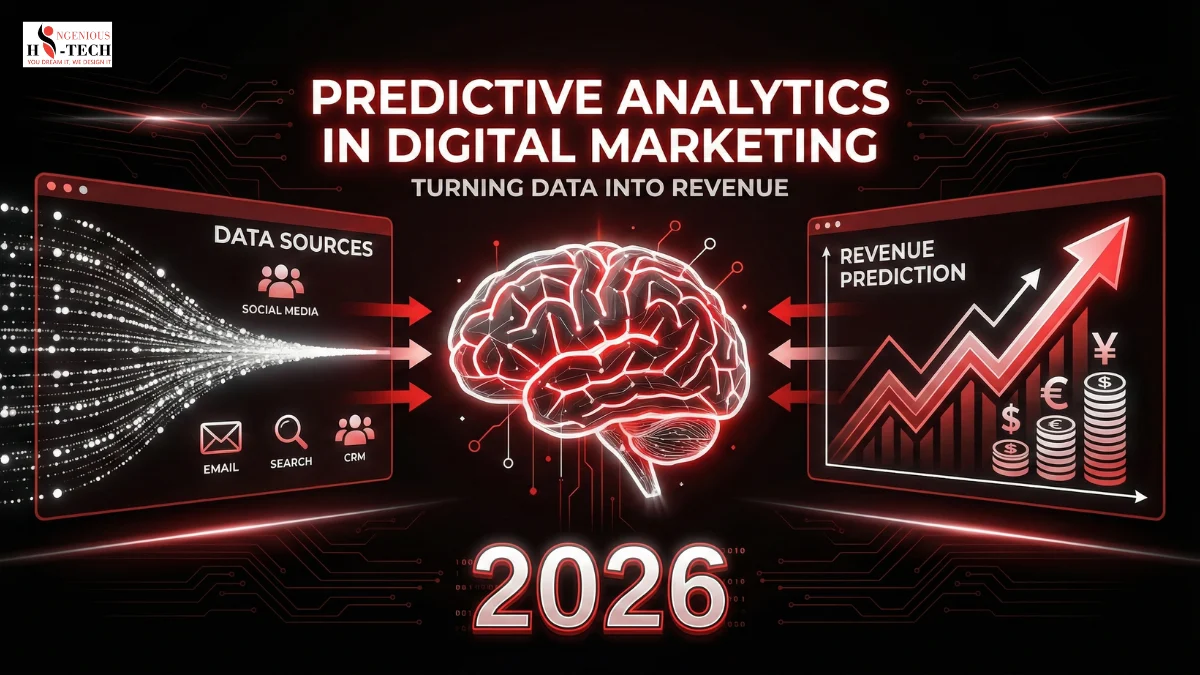
By using analytics, businesses are not guessing anymore; they are making informed decisions.
Here's what you need to know about this technology and how it is changing marketing in 2026.
- Predictive analytics helps businesses make choices.
- It does this by using data and statistics to forecast what might happen in the future.
- This technology is changing marketing.
- They use it to understand their customers
- They also use it to know what customers will do next.
- This helps businesses make plans.
- They can then make changes to their marketing.
- This is why predictive analytics is game-changing.
- It helps businesses stay ahead.
What Is Predictive Analytics in Digital Marketing?
Predictive analytics is what we use to figure out what will happen in the future. We look at what happened using some math and special computer programs, and then we make a guess about what will happen next. When it comes to marketing, we use information about what our customers did before, like what they clicked on, what they bought, and how long they stayed on a page. We even look at how many times they opened our emails.
We use all this information to guess what our customers will do next. Then we get ready for that moment. It is like we are one step ahead of them. Think of it like this: of waiting to see what our customers do and then reacting, we are already where they are going to be. This gives us an advantage over other companies. By 2026, predictive analytics will not be something we can ignore; it will be something we have to do to keep up.
Why Predictive Analytics Matters More Than Ever in 2026
The digital marketing landscape has undergone a complete paradigm shift. With third-party cookies being phased out, privacy laws becoming stricter (hello, state-level data privacy laws), and the attention span of consumers shrinking, marketers simply can’t afford to spray and pray with their ad spend anymore. Every dollar has to work smarter.
According to industry reports, companies that adopt predictive analytics in their marketing strategies see up to 20–30% improvement in ROI on their campaigns compared to those relying on traditional analytics alone. That's not a marginal gain, that's a revenue revolution.
Here's why 2026 is the defining year for predictive analytics in digital marketing:
- AI tools are more accessible than ever: even small and mid-size businesses (SMBs) can now leverage enterprise-grade predictive platforms without massive IT budgets.
- First-party data is king: as third-party cookies fade out, brands that predict behavior from their own customer data hold a decisive advantage.
- Personalization expectations are sky-high: modern consumers expect experiences tailored to them. Predictive analytics makes hyper-personalization scalable.
- Competition is fierce: in virtually every vertical, using data-driven decision-making is the difference between growth and getting left behind.
How Predictive Analytics Works: The Core Process

Before diving into use cases, it helps to understand the basic workflow behind predictive analytics in a marketing context.
Step 1
Data Collection: It all begins with data. We are talking about data from customer relationship management, website analytics, social media engagement, purchase history, email behavior, customer support interactions, and a lot more. The more data you have, the better your data will be. This means your predictions will be more accurate because you have a lot of data to work with.
Step 2
Data Cleaning & Preparation: The data we collect is not very clean. So before we can use it, we need to clean it up and make it nice and tidy. This is where data scientists or automated platforms come in. They make sure the data is clean, organized, and ready for the algorithms to work with.
Step 3
Model Building: Now we use techniques like looking at how things are related, making decision trees using neural networks, and understanding natural language to build models that can predict things. These models are based on what happened in the past.
Step 4
Prediction & Scoring: Each customer or potential customer gets a score. For example, we might give them a score that shows how likely they are to stop doing business with us or a score that shows how likely they are to make a purchase. This tells our marketing team who to focus on and when.
Step 5
Action & Optimization: Predictions are only useful if we do something with them. So we use these scores to send emails, show targeted ads, and change the content on our website in real time. This helps us get the most out of our predictions and make our marketing efforts more effective. We use data to make our marketing better. Data is what makes it all work.
Key Use Cases: Where Predictive Analytics Drives Real Revenue
1. Customer Lifetime Value (CLV) Prediction
One of the most powerful uses. By predicting which customers are most likely to spend the most over time, marketers can better allocate customer acquisition budgets, doubling down on high-CLV segments and not wasting money on low-value leads.
2. Churn Prediction & Prevention
The cost of lost customers is high. Predictive analytics can identify customers who are displaying initial indicators of disengagement, such as declining open rates, reduced logins, abandoned carts, and initiate re-engagement campaigns before they churn. In subscription businesses, this by itself can translate to millions saved every year.
3. Lead Scoring
Not all leads are equal. Predictive lead scoring uses dozens of variables in behavioral and demographic data to score leads on their likelihood of conversion. Sales teams can prioritize their efforts on the most qualified leads rather than pursuing unqualified leads.
4. Personalized Content & Product Recommendations
Platforms like Netflix, Amazon, and Spotify have built empires on recommendation engines. In 2026, this same technology will be available to brands of all sizes. Predictive analytics powers dynamic content blocks, personalized email product recommendations, and website experiences that adapt in real time to each visitor.
5. Ad Campaign Optimization
Predictive models can identify which ad creatives, audiences, bidding strategies, and channels will perform best, before you spend a dollar. This cuts wasted ad spend and improves conversion rates for paid search, social media, and programmatic advertising.
6. Demand Forecasting
For e-commerce and retail brands, predicting demand spikes, tied to seasonality, economic trends, or marketing pushes, allows for smarter inventory management, more efficient ad scheduling, and better staffing decisions.
7. Pricing Optimization
Dynamic pricing powered by predictive analytics lets brands maximize revenue by adjusting prices based on predicted demand, competitor pricing, and individual customer price sensitivity.
Top Predictive Analytics Tools Marketers Are Using in 2026
The market is full of capable platforms. Here are some of the most widely used in the marketing space:
- Salesforce Einstein Analytics is really good at working with CRM data. It is excellent for figuring out how good a lead is and what customers will do.
- HubSpot AI Features are great for medium-sized businesses. They have a way to guess which leads are good and when to send emails.
- Adobe Marketo Engage is good for companies. It can predict what content to show and help with account-based marketing.
- Google Analytics 4 has some features that can guess who will buy something and when.
- Klaviyo is really good for stores. It can guess how much money a customer will spend and when they will buy again.
- Segment plus AI Integrations is a tool that helps get good data to use for predictions.
Predictive Analytics vs. Traditional Analytics: What's the Real Difference?
Many marketers get confused about descriptive analytics (what happened), diagnostic analytics (why it happened), and predictive analytics (what will happen). Here is the bottom line:
Traditional analytics says that your email open rate is down 15% last month. Predictive analytics says who is going to unsubscribe from your email list in the next 30 days, so you can prevent it from happening. One is a rearview mirror. The other is GPS navigation. Both are important, but in today’s competitive landscape of 2026, it’s where the money is made.
Challenges to Watch Out For
Predictive analytics isn't without its hurdles. Here are the most common obstacles marketers face:
Data Quality Issues are a problem. If your Customer Relationship Management system is full of records, or if it has a lot of incomplete fields, or if the information is outdated, then your predictions will not be reliable. You have to make sure your data is clean before you start using tools. This is something you cannot avoid.
Privacy and compliance are also very important. There are laws like the California Consumer Privacy Act that say how you can collect and use data. More and more states are making laws about this. You have to be very careful and make sure you are doing everything correctly. You have to be honest with your customers about how you're using their data. This will help you build trust with them and stay out of trouble.
Organizational Buy-In is necessary for Predictive Analytics to work. This means that different departments like marketing, data science, sales, and information technology have to work together. If the people in charge do not support this and the teams are not working together, then it will not be successful.
Model Drift is another issue. If your Predictive Models are trained on data, they might not be accurate after a while because people's behavior changes. You have to update your models and check how well they are working. This is very important for Predictive Analytics to be useful. You have to keep an eye on your Predictive Models and make sure they are still working well.
How to Get Started With Predictive Analytics (Even If You're New to It)
.webp)
You don't need a data science Ph.D. or a seven-figure tech budget to start using predictive analytics.
Here's a practical starting point:
Audit Your Data First: Identify what first-party data you're already collecting. Website behavior, email engagement, purchase history, and CRM records are all gold mines.
Start with a Single Use Case. Don't try to boil the ocean. Pick one high-impact area, like churn prediction or lead scoring, and run a pilot.
Choose the Right Platform. Many modern marketing platforms, like HubSpot, Klaviyo, and GA4, have predictive features baked in. You may not need a standalone data science solution right away.
Measure & Iterate Set clear KPIs before you launch (e.g., reduced churn rate, higher email conversion rate, lower CAC). Measure results, learn, and optimize.
The Future of Predictive Analytics in Digital Marketing
Time predictive analytics is becoming the norm, which means predictions are made instantly, not overnight. This allows for personalization, at scale, which is what digital marketers really want. The AI generates a custom email. Targets the customer with a tailored ad, making it more likely for them to stay.
Predictive analytics happening in time is a game-changer. It helps to personalize the user experience when they interact with your brand. Generative AI and predictive analytics working together are really powerful. It helps brands to connect with their customers in a personal way.
Final Thoughts: Data Is the New Revenue Engine
In 2026, the brands that win are not the ones with the money; they are the brands that make the best decisions with their data. Using analytics in digital marketing is not just something big companies do. It is an effective way for brands to turn customer data into money they can measure.
If you have an online store that is growing, or a company that sells software to other businesses, or a local business that offers services, now is the time to learn what your data is saying about what is going to happen next. Because in today's market, knowing what is coming next is not a good thing to know; it is necessary for digital marketing and for the brands to stay in business. Digital marketing and predictive analytics in marketing are important for brands to make the best decisions with their data.
Frequently Asked Questions:
1. What is predictive analytics in digital marketing?
Predictive analytics in digital marketing is the use of historical data, machine learning, and AI to predict future customer behavior.
It helps businesses forecast:
- Customer purchases
- Churn rates
- Conversion probability
- Campaign performance
Tools powered by AI analyze large datasets to identify patterns and trends that humans cannot easily detect.
2. How does predictive analytics increase revenue in 2026?
Predictive analytics increases revenue by helping businesses:
- Target high-intent customers
- Personalize marketing campaigns
- Optimize ad spend
- Reduce customer churn
- Improve conversion rates
By predicting what customers are likely to do next, companies can send the right message at the right time.
3. What tools are used for predictive analytics in digital marketing?
Popular tools include:
- Google Analytics 4
- HubSpot
- Salesforce Marketing Cloud
- Adobe Analytics
These platforms use AI and machine learning to generate predictive insights.
4. Is predictive analytics important for small businesses in 2026?
Yes. Predictive analytics is no longer limited to large enterprises.
With AI-powered marketing tools becoming affordable, small businesses can:
- Predict customer behavior
- Improve email targeting
- Reduce wasted ad spend
- Compete with larger brands
Cloud-based solutions have made advanced analytics accessible to all.
5. What data is required for predictive analytics?
Predictive analytics uses:
- Website behavior data
- Purchase history
- Customer demographics
- Email engagement data
- Social media interactions
- CRM data
The more accurate and structured the data, the better the predictions.
6. How does AI improve predictive marketing in 2026?
AI improves predictive marketing by:
- Automating data analysis
- Identifying hidden patterns
- Improving audience segmentation
- Optimizing bidding strategies
- Forecasting trends in real time
AI-driven algorithms learn continuously, improving prediction accuracy over time.
7. What is the difference between predictive analytics and traditional analytics?
Traditional analytics explains what happened in the past.
Predictive analytics forecasts what will happen next.
For example:
- Traditional analytics: Last month’s conversion rate was 3%.
- Predictive analytics: Next month’s conversion rate is expected to increase by 1.5% based on current trends.
8. Can predictive analytics improve ad performance?
Yes. Predictive analytics helps:
- Identify high-value audiences
- Predict which users are likely to convert
- Allocate the budget more efficiently
- Optimize campaigns in real time
This reduces cost per acquisition (CPA) and increases return on ad spend (ROAS).
9. How does predictive analytics help with customer retention?
Predictive models can identify customers who are likely to stop buying.
Businesses can then:
- Send personalized offers
- Offer loyalty rewards
- Improve customer support
- Launch retention campaigns
This reduces churn and increases lifetime value (LTV).
10. Is predictive analytics the future of digital marketing?
Yes. In 2026, predictive analytics will become a core strategy in digital marketing.
With increasing competition and AI-driven search engines, businesses that use predictive insights will outperform those relying only on basic analytics.
11. What industries benefit most from predictive analytics?
Industries that benefit include:
- E-commerce
- SaaS
- Finance
- Healthcare
- Real estate
- Education
Any industry that collects customer data can use predictive analytics to improve marketing ROI.
12. How accurate is predictive analytics?
The accuracy depends on:
- Data quality
- Volume of data
- Model complexity
- Algorithm optimization
With high-quality data and AI-powered tools, predictive models can achieve very high accuracy rates.
13. Does predictive analytics require coding knowledge?
Not necessarily.
Many modern platforms provide:
- No-code dashboards
- Automated insights
- Built-in predictive models
However, advanced customization may require data science expertise.
14. How does predictive analytics support personalization?
Predictive analytics enables hyper-personalization by:
- Recommending products
- Sending personalized emails
- Customizing website experiences
- Delivering targeted ads
Customers receive content based on predicted interests and behavior.
15. What are the biggest challenges of predictive analytics in 2026?
Major challenges include:
- Data privacy regulations
- Incomplete data
- Poor data integration
- Over-reliance on automation
- High implementation costs
Businesses must ensure compliance with data protection laws and maintain data accuracy.