

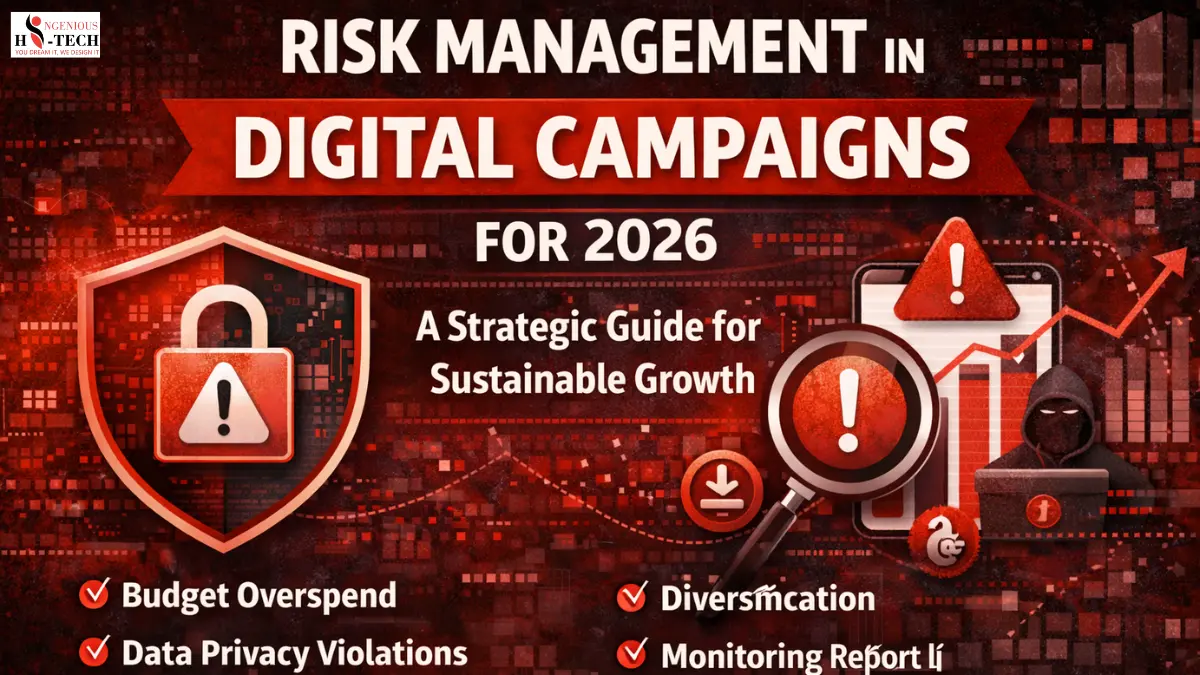
Digital marketing in 2026 is more powerful than ever, but with that, it has been made more complex and risky. AI, data privacy regulation, platform dependency, automation, and the always-changing consumer behavior largely influence the way businesses operate nowadays. Even though digital campaigns grant the brands extraordinary reach and personalization, at the same time, the brands get exposed to financial, reputational, legal, and operational risks.
Risk management of digital campaigns is no longer something optional or reactive. It has become one of the main core strategic disciplines that decides whether or not marketing investments bring returns that are sustainable, or if they bring losses and damage the brand. Having a grasp on how to identify, evaluate, and mitigate risks is crucial for digital success in the long term.
Why Risk Management Matters More in 2026.
The digital ecosystem in 2026 is quicker, more automatic, and more heavily monitored than it was a few years ago. AI-powered ad platforms decide in milliseconds, algorithms update without warning, and consumers are increasingly concerned about privacy and the genuineness of brands. A single error can rapidly turn into losing budgets, poor results, or public criticism.
Those companies that disregard risk management are often confronted with problems like sudden declines in the effectiveness of campaigns, escalating costs for acquiring customers, suspension of their accounts, or receiving fines for non-compliance. Whereas, enterprises that take charge of the risks in advance secure stability, predictability, and strength.
Through risk management, it is possible to make sure that digital campaigns, besides being aggressive in striving for growth, are also controlled, ethical, and capable of adapting.
Identifying Key Risks in Digital Campaigns.
One of the main tools of risk assessment is the recognition of its origin. The digital campaign risks of 2026 are not only related to spending overruns or low rates of conversion.
Among the most significant risks is platform dependency. A lot of businesses rely on one advertising platform or traffic source. Performance may be disrupted immediately by algorithm changes, policy updates, or account restrictions. Campaigns become fragile and unpredictable if a channel is relied on heavily to the exclusion of others.
Due to stricter regulations globally and more consumer awareness, data privacy and compliance risks have been amplified. The misuse of data, incorrect tracking, or a lack of obtaining consent may lead to legal penalties and loss of trust. Even a non-intentional breach can have serious consequences.
AI-driven automation presents a dilemma of possibilities and uncertainties. On the one hand, automation reduces inefficiencies, and on the other hand, it takes away manual control. Misguided algorithms, biased data, or faulty decisions may lead to inefficient usage of funds or a mismatch between the targeted and the actual audiences without prompt recognition of the issue.
Increased social sensitivity is bringing companies' creative and messaging risk to the forefront. A component not synchronized with the brand identity is likely to receive a negative reaction from one segment and the opposite reaction from another. A well-received performance in one market can generate a backlash in another.
Strategic Planning as the Foundation of Risk Control.
The effective management of risks is mainly a matter of the initial planning stage. Initiatives that lack a strategic element are, by their very nature, exposed to risks. In 2026, any digital campaign should be based on clearly set objectives, have realistic expectations, and outline precise limits.
Strategic planning means lining up your campaigns with the main corporate goals instead of focusing on getting the numbers of the short-term metrics. There is an increasing risk when the only way you judge performance is by the clicks or impressions. Understanding the quality of revenue, estimating the customer lifetime value, and acknowledging the importance of brand equity ought to be the pointers for campaign decisions.
Scenario planning is a very important factor also. Digital marketers need to figure out what will happen in case the performance of the campaign is not up to the mark, changes in the platform, or market disruptions. Having alternative strategies ready will allow you to keep the business going even if the conditions change suddenly.
A clearly laid out plan serves as a control that restricts volatile behavior and expenditures that are made as reactions.
Managing Financial and Budgetary Risks.
Budget misallocation is still one of the leading risks faced by digital campaigns. If correct supervision is lacking, the impact of automated bidding, dynamic pricing, and AI optimization can be a rapid and indiscriminate increase in expenses.
One of the key pillars of financial risk management in 2026 is the ability to strike a good balance between automation and human intervention. As AI takes over the execution, it is the humans who set the boundaries for spending, define the desired level of performance, and decide when to intervene. To minimize risk and exposure, budgets must be spread across the different marketing channels.
Performance reviews conducted at regular intervals will reveal the inefficiencies that are not yet evident. Keeping an eye on such parameters as the cost per acquisition, the return on ad spend, and the quality of conversion will guarantee that expenditures match the obtained results.
Budgetary rigor can turn the marketing campaigns from ventures based on hope into reliable sources of growth.
Addressing Data Privacy and Compliance Risks.
Data is at the core of digital marketing, yet it remains one of the most regulated and sensitive areas. Managing risk in 2026 should focus on prioritizing ethical and compliant data usage.
Transparency plays a pivotal role. Users have a right to be informed about the ways in which their data is collected, stored, and utilized. Brands that do not communicate risk distrust transparently, even if they abide by the law.
Mitigating risks through first-party data strategies is becoming a major feature. By minimizing dependency on third-party cookies and external data, companies are securing more control and a higher degree of sustainability. Data collection through user consent and data storage security are no longer options, but requirements.
Compliance should not be treated as a limitation, but rather as a tool that can be used to create a competitive edge and foster customer loyalty in the long term.
Controlling AI and Automation Risks.
In 2026, artificial intelligence will be the key driver of digital campaigns. However, besides facilitating the efficiency of such campaigns, the AI also brings in dilemmas related to transparency, bias, and lack of control.
To manage the risk effectively, there should be a well-defined governance over AI-powered systems. Marketers need to grasp how algorithms come up with their decisions and confirm that the set optimization goals are in line with the business objectives. Relying fully on automation may give rise to unintended consequences such as wastage of marketing efforts on unreachable audiences or overemphasis on quantity rather than quality.
Besides that, human oversight is still a necessity. The continuous examinations of AI performance, input data, and results can help detect any signs or issues even before the matter starts to grow. The role of AI should be to complement human decision-making, not to take over completely.
Through responsible use of automation, both the monetary investment and the good reputation of the brand are safeguarded.
Protecting Brand Reputation in Digital Campaigns
One of the toughest yet most essential parts of managing digital risks is dealing with the brand reputation risk. Campaigns run in public spaces, and thus, the responses are instant and widely shared.
By 2026, brands will have to be aware of cultural sensitivity, ethical messaging, and contextual placement when they think of their campaigns. Ads that are placed next to inappropriate content or using controversial messaging can have a damaging effect on the trust of the audience right away.
Being consistent across different channels is also important. When the messages are disconnected, the audience gets confused, and the brand identity becomes weak. Having clear brand guidelines and a good system for getting approval from the higher-ups will help reduce the risk of damage to the brand's reputation.
Trust is essential for growth in the long run, and not having a trusted relationship with customers can come from careless campaign execution that is easily lost.
Monitoring, Measurement, and Continuous Risk Assessment
Risk management cannot be left as a single effort. Digital campaigns are changing during the interaction period, and risks are also changing when scaling the campaigns.
Constantly watching how the campaign is performing helps the marketers to recognize the cases where the normal functioning is broken, an extreme decline in performance, or unusual behavior of the audience. Powerful analytics and dashboards lay the groundwork to a great extent, but are still only a part of the identification of the opportunities for interventions.
The very same significantly high importance has a post-campaign evaluation. Finding out what was a success, what was a failure, and for what reasons leads to much more informed decisions in the next campaigns. Thus, risk management becomes more efficient if it has access to the data and learnings of the past.
Those organizations that make it a rule to implement the continuous evaluation system have a definite advantage of being less affected by uncertainty.
Building a Resilient Digital Campaign Framework.
Essentially, risk management for digital campaigns in 2026 is about being resilient. Resilience means creating systems that can take shocks, change, and still deliver value.
Campaigns that are resilient have a mix of strategies, base their decisions on data, are in line with regulations, and are set towards achieving their long-term goals. They manage a good balance between innovating and having control, between being fast and being accountable.
Instead of completely steering away from risks, winning brands figure out how to control them smartly. They know that uncertainty is a part of digital marketing, but they are not willing to work in the dark.
Conclusion
People who want to be successful with things for a long time will be the ones who think about managing risks as a good thing. They will use risk management as the foundation to build their success so they can be sure it will last. They want to be successful in a good way, for a long time. Digital success is what they are looking for. They know they need to manage risks to get it.
Frequently Asked Questions:
1. What is risk management in digital marketing campaigns?
Risk management in digital campaigns is the process of identifying, analyzing, and reducing potential risks that could impact marketing performance, brand reputation, or ROI.
In 2026, risks include:
- Budget overspending
- Data privacy violations
- Algorithm updates
- Ad account suspensions
- Cybersecurity threats
Effective risk management ensures sustainable and predictable growth.
2. Why is risk management important for digital campaigns in 2026?
Digital marketing in 2026 is highly AI-driven and competitive. Without proper risk management, businesses may face:
- Sudden traffic drops
- Compliance penalties
- Wasted ad spend
- Brand reputation damage
Strategic risk planning protects revenue and ensures long-term stability.
3. What are the biggest risks in digital advertising today?
Major risks include:
- Platform dependency (e.g., relying only on Google Ads)
- Data privacy violations
- AI automation errors
- Rising cost-per-click (CPC)
- Ad fraud
- Negative customer feedback is going viral
Diversification and monitoring reduce these risks.
4. How can businesses reduce ad budget risks in 2026?
To reduce budget risks:
- Set clear KPIs and conversion tracking
- Use daily budget caps
- Monitor cost per acquisition (CPA)
- Diversify across multiple platforms
- Regularly audit campaigns
Data-driven decision-making minimizes financial loss.
5. How does data privacy affect digital campaign risk management?
Data privacy laws in the U.S. and globally require strict compliance.
Non-compliance can lead to penalties under regulations such as:
- California Consumer Privacy Act
- General Data Protection Regulation
Businesses must ensure secure data collection, consent management, and transparent privacy policies.
6. What role does AI play in campaign risk management?
AI helps by:
- Predicting campaign performance
- Detecting anomalies in ad spend
- Identifying fraud patterns
- Automating risk alerts
However, over-reliance on automation without human oversight can increase risk.
7. How can algorithm updates impact digital campaigns?
Platforms frequently update algorithms, especially Google and Meta Platforms.
Algorithm changes can:
- Reduce organic reach
- Increase ad costs
- Shift ranking positions
A diversified strategy and consistent SEO practices reduce dependency risk.
8. What is platform dependency risk in digital marketing?
Platform dependency risk occurs when a business relies heavily on one channel, such as only SEO or only paid ads.
If the platform changes policies, suspends accounts, or updates algorithms, revenue can drop suddenly.
Diversification across SEO, PPC, email, and social media reduces this risk.
9. How can businesses protect their ad accounts from suspension?
To reduce suspension risk:
- Follow advertising policies carefully
- Avoid misleading claims
- Maintain consistent billing
- Monitor compliance regularly
- Keep communication professional with platform support
Policy violations are one of the most common risks in 2026.
10. What is brand reputation risk in digital campaigns?
Brand reputation risk involves:
- Negative reviews
- Social media backlash
- Poor customer experiences
- Controversial advertisements
Monitoring online sentiment and responding quickly helps protect brand credibility.
11. How does cybersecurity relate to digital campaign risk?
Cybersecurity threats include:
- Data breaches
- Phishing attacks
- Ad account hacking
- Malware
Using two-factor authentication, secure hosting, and encrypted payment systems reduces cybersecurity risk.
12. How can predictive analytics help reduce marketing risk?
Predictive analytics helps by:
- Forecasting campaign performance
- Identifying high-risk customer segments
- Optimizing budget allocation
- Detecting early signs of churn
This allows businesses to adjust strategies before losses occur.
13. What KPIs help measure digital campaign risk?
Key risk-related metrics include:
- Cost per acquisition (CPA)
- Return on ad spend (ROAS)
- Bounce rate
- Conversion rate
- Customer lifetime value (LTV)
- Traffic volatility
Monitoring KPIs regularly ensures early detection of performance issues.
14. How can businesses create a digital campaign risk management plan?
Steps include:
- Identify potential risks
- Assess impact and likelihood
- Develop mitigation strategies
- Implement monitoring systems
- Review and update quarterly
A proactive approach is more effective than reactive problem-solving.
15. Is diversification the best strategy for sustainable digital growth in 2026?
Yes. Sustainable growth requires:
- Multi-channel marketing
- Balanced SEO and paid ads
- Strong data compliance
- AI-powered monitoring
- Crisis response planning
Diversification reduces vulnerability and protects revenue streams.
16. What is the future of risk management in digital marketing?
In 2026 and beyond, risk management will focus on:
- AI-powered monitoring systems
- Real-time analytics
- Stricter privacy compliance
- Ethical AI usage
- Data transparency
Businesses that prioritize risk management will achieve more stable and predictable growth.