
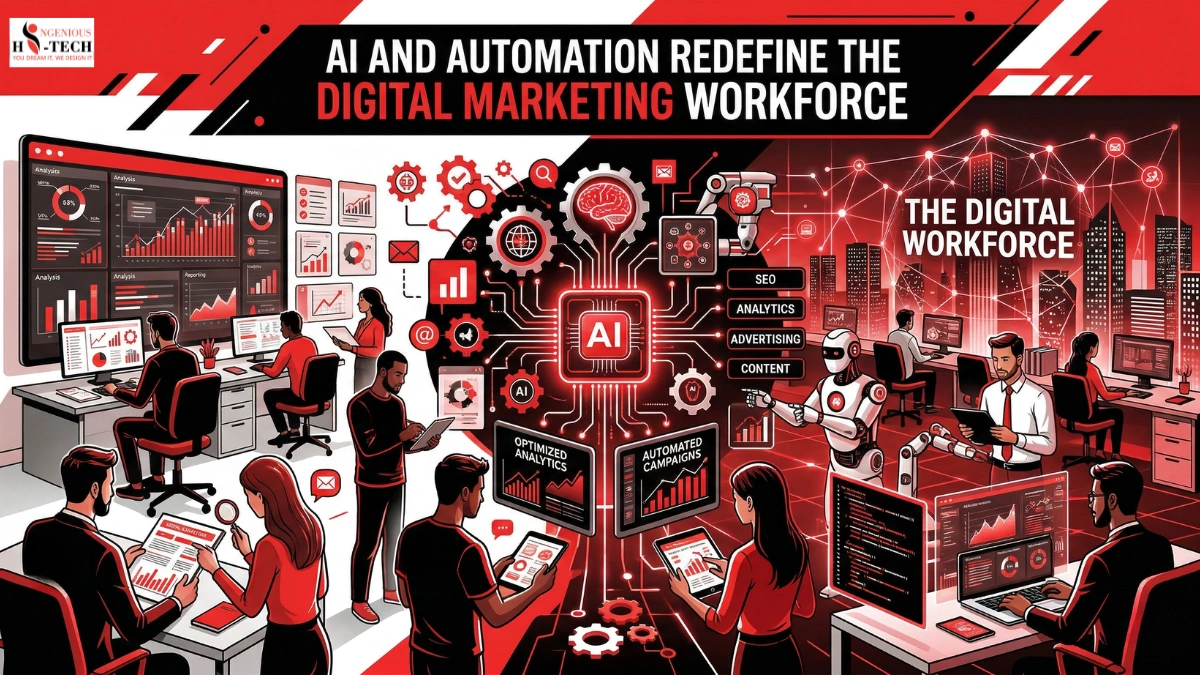
In today's world, AI and automation have taken over the digital marketing workforce. Artificial intelligence is no longer something marketers are preparing for; it is something they are already working inside of, whether they realize it or not. The algorithm deciding which ad you see at 7 PM, the chatbot walking a customer through a product comparison, the email subject line that felt oddly personal, all of it runs on machine learning, automation, and predictive logic. But then different questions arise,
Questions Such as:
- Will AI replace digital marketing jobs or create new opportunities?
- What new skills do marketers need in an AI-driven digital marketing environment?
- How does AI help marketers create personalized customer experiences?
And a lot more, so to clear all your AI and Automation Redefine the Digital Marketing Workforce related doubts from top to bottom, let's begin the journey to understand the digital world of AI or Artificial Intelligence in a simple way.
First, what exactly is AI in Digital Marketing?
Let's start from zero. Artificial Intelligence means software that can learn from data and make decisions about tasks that used to require a human brain. In digital marketing, this shows up in ways you have probably already experienced without realizing it.
When Netflix recommends a show you end up loving, that is AI. When you search for something on Google and the first result is exactly what you needed, that is AI. When you get an email from a brand addressing you by name and recommending a product you almost bought last week that is AI-powered marketing at work.
Think of it this way: AI in marketing is like a very experienced assistant who has read every customer review, studied every campaign result, and memorized the behavior of every visitor to your website and uses all of that to help you make smarter decisions, faster.
For marketers, AI is not a single product you buy. It is a capability built into tools you likely already use: your email platform, your ad manager, your website analytics, your social media scheduler. The difference today is that these tools are getting dramatically smarter, and the marketers who understand what they can do are gaining a serious edge.
What makes this moment genuinely different from past waves of digital change is the scope.
The day social media took place, brands had to learn the technique for sales. When mobile took over, they had to optimize for smaller screens. AI is not a new channel; it is a new operating layer across every channel simultaneously. It is changing how content gets created, how audiences get segmented, how campaigns get measured, and how decisions get made. That means the digital marketing workforce is not just adopting a new tool. It is re-negotiating what a marketing professional actually does for a living.
The good news is that this shift is not a threat to the profession. It is the most significant upgrade the industry has ever seen, but only for marketers who understand what is changing and what skills are worth building right now.
How Did AI Change Digital Marketing, and Why Is It Different This Time?

Digital marketing used to be mostly manual. You would write content by hand for hours, guess which email subject line might work better, wait weeks to see if an ad campaign was performing, and spend days building audience segments inside a spreadsheet. It was slow, expensive, and largely based on gut feeling.
Then, around 2022–2023, something shifted. AI tools became fast enough, affordable enough, and smart enough for everyday marketing teams, not just enterprise tech companies, to use them. The introduction of large language models like ChatGPT made it possible for anyone to generate a draft blog post, an ad headline, or a customer email in seconds.
63% of marketers now use AI tools every week. Content production has become 5 times faster with AI assistance. Around 40% of repetitive marketing tasks can now be automated, and the average marketer is saving roughly 3 hours every single day.
The change is not happening slowly; it is happening all at once, across every marketing channel at the same time. Content creation, paid ads, SEO, email marketing, social media, and customer support AI are all of them simultaneously. That is what makes this moment different from past technology shifts like mobile or social media.
Example: A travel brand used to spend two weeks creating personalised email campaigns for different customer segments. With AI, the same campaign tailored to 12 different audience types is now built and sent in under three hours. The marketing team did not shrink. They redirected their time toward creative strategy and partnerships.
What Does This Actually Mean for People Who Work in Digital Marketing?
This is the question everyone is asking, and honestly, it’s the right one.
The short answer is: AI is not replacing digital marketers. It is changing what digital marketers spend their time doing.
Think about what a typical content marketer's day used to look like. They would spend the morning researching keywords, the afternoon writing a first draft, and the next day editing and formatting it. AI now handles the keyword research in two minutes and produces a first draft in under a minute. The human marketer's job shifts from writing from scratch to reviewing, refining, adding original insights, and making sure the content sounds human and on-brand.
The roles that are shrinking are the ones that were mostly about executing repetitive tasks manually, scheduling posts, writing basic product descriptions, and running the same performance reports every Monday morning. The roles that are growing are the ones that require judgment, creativity, strategy, and relationship-building, which AI is still quite poor at.
Think of it this way: Before calculators, accountants spent most of their time doing arithmetic. After calculators, they spent their time doing what calculators could not: advising clients, spotting patterns, and making strategic decisions. AI is the calculator moment for marketing.
What Skills Do You Actually Need to Stay Ahead in an AI-Driven Marketing World?
Here is where it gets practical. If you are a marketer right now, whether you are just starting or have been in the industry for years, there are specific skills that will make you significantly more valuable as AI becomes the norm. None of these requires a computer science degree. All of them are learnable.
Prompt Writing is the new version of writing a great creative brief. It means knowing how to give AI clear, detailed instructions to get useful output. A vague prompt gives you generic content. A well-structured prompt gives you something you can actually use:
- Data Literacy means reading dashboards, understanding A/B test results, and knowing what a number is actually telling you, not just copying it into a report and presenting it. AI generates a lot of data. Understanding it is a human job.
- Strategic Thinking means deciding what to create, who to target, and why. These are high-level decisions AI cannot make because it lacks real business context. It knows patterns. You know the goal.
- Workflow Automation means setting up pipelines using tools like Zapier so that marketing tasks happen without manual effort every single time a trigger occurs. This is one of the highest-leverage skills a marketer can develop right now.
- Creative Direction means guiding AI tools toward output that matches a brand's voice, visual identity, and emotional tone, not just technically correct content. AI can write. You decide what it should feel like.
- AI-Assisted SEO means using AI tools to research content opportunities, audit existing pages, and optimise for search engines faster and more accurately than manual methods allow.
The most important shift is this: technical execution is becoming less valuable, and strategic judgment is becoming more valuable. A marketer who can look at AI-generated output and immediately know what is wrong with it because they deeply understand their audience is worth far more than one who simply knows how to press the right buttons.
Example: Two marketers both use ChatGPT to write an email campaign. Marketer A enters a vague prompt and pastes whatever comes out. Marketer B gives a detailed brief, including tone, audience pain points, and a specific call to action, then edits the result with their brand voice in mind. Marketer B's email converts three times better. The difference is not the tool. It is a skill.
The AI Marketing Tools That Are Actually Worth Your Time in 2025
There are hundreds of AI tools claiming to revolutionize marketing. Most are not worth the subscription. Here are the ones real marketing teams are using every day, with honest explanations of what each one actually does.
ChatGPT and Claude are general-purpose AI assistants used to write first drafts of blog posts, ad copy, email sequences, or creative briefs. They work best when given detailed context and a specific format to follow. They save roughly 5 hours per week for most content teams.
- Jasper is a marketing-focused writing tool that learns your brand voice and keeps output consistent across every piece of content your team produces. Particularly useful for agencies managing multiple clients with different tones.
- Surfer SEO analyses the top-ranking pages for any keyword and gives you a complete brief on exactly what topics to cover, how long to write, and which terms to include. What used to take a full day now takes ten minutes, saving around 3 hours per article.
- HubSpot AI is built into HubSpot's CRM. It scores your leads, drafts follow-up emails, and suggests the best time to contact a prospect based on their actual behavior history. Teams using it report saving around 6 hours per week on lead management alone.
- Midjourney and DALL·E are AI image generation tools. Describe a visual and receive a professional-quality image in seconds, social media graphics, ad creatives, concept visuals, with no designer or stock photo license needed.
- Zapier and Make connect all your marketing tools so they talk to each other automatically. When a form is filled in, it adds a contact to your CRM, sends a welcome email, and notifies your team on Slack, all without anyone touching it.
- Meta Advantage+ and Google Performance Max are AI-driven ad platforms that automatically test combinations of your headlines, images, and audiences, finding the best-performing variation without you manually setting up split tests. They save an average of 7 hours per campaign.
Example: A small marketing team at a SaaS startup uses Zapier to connect their lead form, HubSpot CRM, and ChatGPT. When someone submits a demo request, the system automatically generates a personalised follow-up email based on which features the lead mentioned and sends it within 90 seconds. No humans were involved. Their demo conversion rate went up by 34%.
How Many Hours Can AI Actually Save You Each Week? Honest, Task-by-Task Numbers
The time savings from AI depend on how well you use it. But when used properly, the numbers are genuinely significant. Here is an honest breakdown based on what marketing teams are actually reporting. Writing a 1,000-word blog post used to take 3 to 4 hours from research to first draft. With AI, research and a usable draft are done in 20 minutes. Human editing takes another 30 to 40 minutes.
Total time saved per post: roughly 2.5 hours.Writing email subject lines for A/B testing used to take 45 to 60 minutes of copywriting and iteration. With AI, 10 high-quality variations are ready in under 60 seconds.
- Total time saved: nearly a full hour per campaign send.Building an SEO content brief used to take 3 to 5 hours of keyword research, competitor analysis, and outline building. With an AI SEO tool, a complete, data-backed brief is ready in 8 to 12 minutes.
- Total time saved: half a working day per piece.Producing the monthly performance report used to involve pulling data from five platforms, building a slide deck, and writing commentary for around 5 to 6 hours of work. With automation, data is pulled and summarised automatically, and a human adds strategic notes in 45 minutes.
- Total time saved: over 4 hours every month.Repurposing one blog post into social content used to mean manually rewriting for LinkedIn, Instagram, and Twitter/X separately for about 90 minutes of work. With AI, five platform-specific versions are generated in 3 minutes.
- Total time saved: over an hour per article published. The average AI-enabled marketer is reclaiming 10 to 15 hours every week and spending that time on the work that actually grows a brand.
Which Marketing Jobs Are Changing, Which Are Growing, and What the Future Actually Looks Like
The honest picture of digital marketing jobs in the AI era is not as scary as the headlines suggest, but it does require honest awareness. Some tasks are disappearing. Some roles are evolving. And entirely new career paths are opening up that did not exist three years ago.
- Roles that are evolving: The content writer is not disappearing; they are shifting from writing from scratch to editing, refining, and directing AI output. The social media manager is becoming more of a performance analyst and creative strategist, using AI to produce and test content at scale. The SEO specialist is moving away from manual keyword research and toward technical site strategy and content architecture.
- Roles that are genuinely growing: AI Marketing Strategist, someone who understands both marketing fundamentals and how to deploy AI tools across a full stack. Automation Workflow Designer someone who builds the systems that connect tools and eliminate manual work. A Prompt Specialist is someone whose entire job is crafting the instructions that produce the best AI output for a team or agency.
- What the future looks like: By 2027, most marketing job descriptions will mention AI tool proficiency the same way they mention Excel or Google Analytics today. It will not be optional; it will be expected. The marketers who start building that fluency now will be the ones getting promoted, not replaced.
Example: A copywriter at a fashion brand was initially worried when her company adopted AI writing tools. Six months later, she leads a team of two junior writers supported by AI, producing three times more content than before. Her role shifted from writer to editor and creative director. Her salary increased. The AI did not take her job. It made her job more senior and more interesting.
So, What Should You Do Right Now? (Final Thought)
You do not need to become a programmer or a data scientist. You do not need to master every AI tool on the market. What you need to start this week is to pick one task in your marketing workflow that feels repetitive and time-consuming, and experiment with an AI tool to speed it up.
Write your next blog brief using ChatGPT. Set up one Zapier automation for a task you do manually every Monday. Use an AI image tool instead of spending 40 minutes searching for a stock photo. Each small experiment builds the fluency that separates the marketers who thrive in this new era from the ones who feel left behind.
The future of digital marketing belongs to the people who combine strong human judgment, genuine creativity, and confident AI tool usage. That combination is not hard to develop; it just requires starting. And the best time to start is right now.
Frequently Asked Questions:
1. What is AI in digital marketing?
AI in digital marketing refers to the use of artificial intelligence technologies to analyze data, predict customer behavior, automate marketing tasks, and improve campaign performance. AI helps marketers make faster decisions and create more personalized marketing strategies.
2. How is AI transforming the digital marketing workforce?
AI is transforming the digital marketing workforce by automating repetitive tasks, improving data analysis, and enabling smarter decision-making. Marketers can focus more on creativity, strategy, and customer engagement while AI handles tasks like data processing, reporting, and campaign optimization.
3. Will AI replace digital marketing jobs?
AI is unlikely to completely replace digital marketing jobs. Instead, it is changing job roles and creating new opportunities. Professionals who learn AI tools and automation platforms will have better career prospects in the evolving marketing industry.
4. What are the benefits of AI and automation in digital marketing?
The main benefits include:
- Faster campaign management
- Better customer targeting
- Personalized marketing experiences
- Improved ROI and performance tracking
- Reduced manual workload
AI helps businesses run smarter and more efficient marketing campaigns.
5. What digital marketing tasks can be automated with AI?
Many marketing tasks can be automated, such as:
- Email marketing campaigns
- Social media scheduling
- Customer segmentation
- Chatbots for customer support
- Content recommendations
- Ad campaign optimization
Automation allows marketers to save time and focus on strategy.
6. How does AI improve customer personalization?
AI analyzes customer data, browsing behavior, and preferences to deliver personalized content, product recommendations, and targeted ads. This improves user experience and increases conversion rates.
7. What are the most popular AI tools used in digital marketing?
Some widely used AI marketing tools include platforms for:
- Content generation
- Marketing automation
- Customer relationship management (CRM)
- Predictive analytics
- AI chatbots
These tools help businesses manage campaigns more efficiently.
8. How can businesses implement AI in their digital marketing strategy?
Businesses can implement AI by:
- Using marketing automation platforms
- Integrating AI analytics tools
- Using chatbots for customer service
- Automating email and ad campaigns
- Analyzing customer behavior with AI insights
Starting with small AI tools can help businesses gradually adopt automation.
9. What skills do digital marketers need in the age of AI?
Modern digital marketers should learn:
- Data analysis and interpretation
- AI marketing tools
- Marketing automation platforms
- Content strategy and storytelling
- Customer experience optimization
Combining technical skills with creativity is essential in the AI era.
10. How does AI improve digital marketing ROI?
AI improves ROI by analyzing data in real time, identifying high-performing campaigns, and optimizing advertising spend. This allows businesses to target the right audience and increase conversions with less wasted budget.
11. Is AI important for the future of digital marketing?
Yes, AI is becoming a core part of digital marketing strategies. Businesses that adopt AI and automation can stay competitive, improve marketing efficiency, and deliver better customer experiences.
12. How does automation improve marketing productivity?
Automation reduces manual work such as reporting, scheduling posts, and sending emails. This allows marketing teams to focus on creative campaigns, brand building, and strategic planning.
13. What industries benefit most from AI in digital marketing?
Industries like e-commerce, real estate, healthcare, finance, education, and SaaS benefit greatly from AI marketing tools because they rely heavily on customer data and personalized marketing.
14. Can small businesses use AI for digital marketing?
Yes, many affordable AI tools allow small businesses to automate marketing tasks, improve customer targeting, and compete with larger companies in the digital marketplace.