
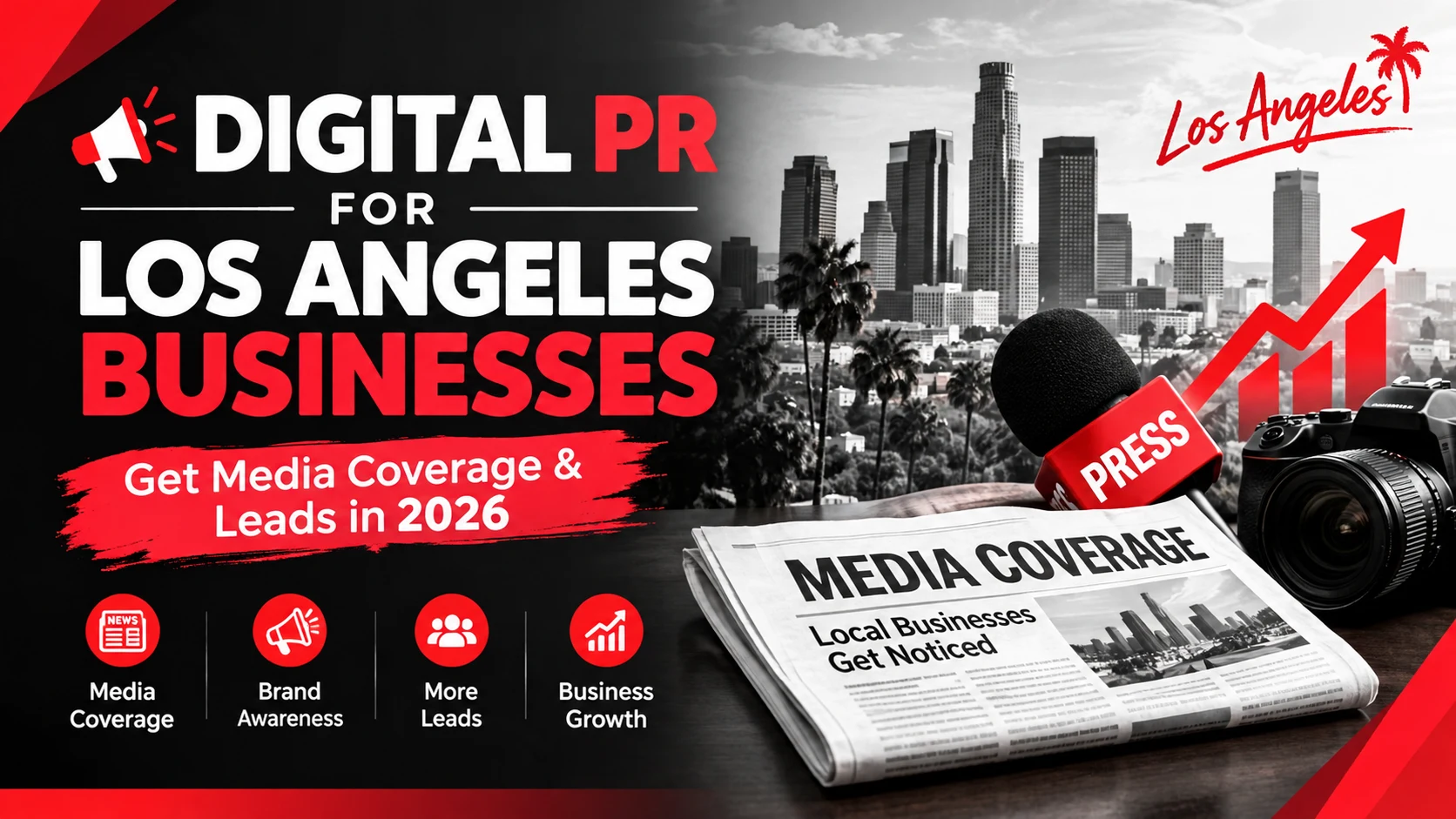
Los Angeles is one of the most crowded markets in the country for almost any type of business, from restaurants and real estate agents to law firms and tech startups. Ranking on Google or running paid ads can put a business in front of people, but it doesn't automatically make that business feel credible or worth choosing over a competitor. That's the gap digital PR is built to close. Digital PR for Los Angeles businesses isn't just a fancy term for link building done well; it combines media coverage, brand visibility, third-party credibility, relevant backlinks, referral traffic, and real lead-generation opportunities into one connected strategy. This article covers what digital PR involves, why it matters in a market as competitive as LA, and how it fits alongside SEO and broader digital marketing, with some practical perspective from Ingenious Hi-Tech.
What Is Digital PR for Los Angeles Businesses?
Digital PR is the practice of earning coverage, mentions, and backlinks from online publications and journalists, rather than paying for placement or relying on traditional channels like print, TV, or radio. It grew out of traditional PR but is built for how people consume information now: through search engines, digital publications, and social platforms.
In practice, this means building relationships with journalists who cover a business's industry or local market, pitching relevant stories, offering expert commentary when a reporter needs a quote, and sometimes producing original data a publication can reference. A successful pitch typically results in an editorial mention, often with a link back to the website and some referral traffic from readers who click through.
Here's the distinction that matters most: digital PR is not simply a method of acquiring backlinks. Treating it that way tends to produce weak coverage. Strong campaigns are built around something genuinely useful, interesting, or newsworthy: a real data point, a fresh take on an industry issue, or expertise a journalist can't easily find elsewhere. The links and mentions are a byproduct of a good story, not the goal itself.
Why Digital PR Matters for Los Angeles Businesses in 2026
Builds Third-Party Credibility
A business can say anything it wants about itself on its own website. A mention in an independent publication carries different weight because it comes from a source the business doesn't control. When a journalist or local outlet chooses to feature a company or quote its founder, that acts as social proof a company's own marketing can't replicate.
Supports Online Visibility
Media coverage, editorial mentions, and the referral traffic they generate can complement a broader SEO strategy. Relevant links from reputable sites, along with more people searching for a brand by name after seeing it covered, are signals that support online visibility over time. One placement won't move rankings on its own, and any pitch promising instant ranking jumps from a single mention deserves scepticism.
Reaches Potential Customers Beyond Search
Search marketing depends on people already knowing they have a problem and looking for a solution. Media coverage works differently: it can put a business in front of people who weren't searching for it yet, through a feature in a Los Angeles publication or a niche outlet a company's audience actually reads.
Supports Lead Generation
Visibility alone doesn't pay the bills, but it's usually the first step toward something that does. When coverage sends relevant readers to a business's website, and that site is set up to capture and follow up on interest, some of that traffic can turn into inquiries, though that connection isn't automatic, a point worth returning to later.
9 Digital PR Strategies to Get Media Coverage & Leads
1. Create Data-Driven Stories
Original data is one of the most reliable ways to earn coverage: a customer survey, an analysis of internal trends, or public data presented in a new way. A Los Angeles property management company analysing its own rental data to spot shifting tenant preferences by neighbourhood has something a local reporter might genuinely want to cite.
2. Build Stories Around Relevant Los Angeles Trends
Local relevance earns attention, but only when it's authentic. Connecting real expertise to an actual development in Los Angeles a shift in consumer behaviour, a local regulation, a challenge small businesses are facing gives a journalist reason to include a local voice. A manufactured connection tends to get ignored.
3. Position Business Owners as Industry Experts
Reporters regularly need expert commentary, and being a reliable, quotable source is one of the most repeatable ways to earn coverage. That means responding to queries quickly and offering specific opinions rather than generic ones. Founders who give sharp commentary tend to get called back.
4. Create Newsworthy Content Assets
Some of the most linkable content isn't a blog post at all. Original reports or clearly formatted statistics give journalists something concrete to reference, and tend to earn mentions for longer than a standard article.
5. Target Relevant Los Angeles Publications
It's tempting to chase the biggest outlet, but relevance and audience fit usually matter more than size. A mention in a smaller, well-read local publication whose readers are real potential customers can be worth more than one somewhere massive and unrelated.
6. Use Newsjacking Carefully
Responding to a current news event with expert analysis or original data can earn fast coverage, since reporters are often racing to add new angles. Speed matters, but usefulness matters more; a rushed comment that adds nothing new rarely gets used.
7. Turn Existing Brand Mentions Into Opportunities
Many businesses already have unlinked mentions scattered across the web: a quote in an old article, a product referenced in a roundup. Finding these and asking for a link, when genuinely appropriate, is a low-effort way to convert existing visibility into referral traffic, unlike demanding links or buying placements.
8. Combine Digital PR With Local SEO
Digital PR and local SEO are different disciplines that reinforce each other. A well-optimised Google Business Profile and strong service pages give media coverage somewhere useful to send people, while coverage can contribute to more branded searches. Running the two together tends to outperform treating them as separate efforts.
9. Connect Media Coverage to Lead Generation
This is where a lot of campaigns fall short, not because the coverage was bad, but because nothing was built to capture the interest it created. The path typically looks like this: media exposure leads to a website visit, which lands on a relevant page, which builds enough trust to prompt an inquiry, which becomes a lead. Getting this right means a clear landing page, a straightforward call to action, a working contact form, conversion tracking, and UTM parameters on shared links. Media coverage does not guarantee leads; the outcome depends on the audience reached, the publication's readership, the offer, and how easy it is to take the next step.
How Digital PR Supports Lead Generation
Digital PR's business value tends to show up in three overlapping ways. Direct value comes from people discovering a business through coverage and visiting the website. Search value comes from relevant editorial mentions and links contributing to overall online visibility, alongside other SEO efforts rather than replacing them. Trust value is harder to measure but still real: seeing that a business has been covered by a recognisable outlet can lower the hesitation before someone reaches out.
None of this is a guarantee. No agency can promise guaranteed leads, guaranteed rankings, guaranteed backlinks, or instant results, and any pitch making those promises is worth questioning. What digital PR can realistically offer is a meaningful contribution to lead generation when paired with a website and follow-up process built to convert the attention it earns.
Digital PR + Digital Marketing in Los Angeles: Why They Work Together
Digital PR rarely performs at its best as a standalone effort. It works better connected to a business's broader digital marketing in Los Angeles strategy, including SEO, content marketing, local SEO, social media, and website conversion optimisation. Coverage that isn't backed by a website ready to convert visitors leaves value on the table.
This is the kind of work Ingenious Hi-Tech does for Los Angeles businesses: helping digital PR connect with on-page SEO, content strategy, and lead-generation infrastructure so coverage becomes more than a temporary traffic spike.
How to Measure a Digital PR Campaign
Publication count is easy to report but doesn't tell you whether a campaign actually worked. A more useful framework moves through several stages: coverage → traffic → engagement → leads → business outcomes.
Worth tracking:
- Relevance and quality of media placements, not just the number
- Referral traffic from the publications that featured the business
- Quality of referring domains, not just the raw count
- Brand mentions and any lift in branded search after coverage
- Leads and inquiries reasonably traceable back to coverage
- Conversion rate on the pages that traffic lands on
- Assisted conversions, where PR traffic contributed earlier in someone's decision without converting immediately
A campaign earning coverage in five relevant, well-read publications and a handful of qualified inquiries has done more than one earning twenty placements nobody in the target audience reads.
Common Digital PR Mistakes Los Angeles Businesses Should Avoid
- Sending generic pitches: A pitch that could apply to any city or business rarely gets a response from a journalist covering a specific beat.
- Targeting irrelevant publications: Chasing prestige over audience fit wastes effort and produces links nobody who matters ever sees.
- Creating stories with no genuine news value: If a story wouldn't interest an outside reader, it likely won't interest a journalist.
- Focusing only on backlinks: Treating every placement as a link target instead of a real relationship produces weak coverage and burned bridges.
- Buying questionable links or placements: Paid or low-quality placements carry real risk to a site's credibility and rarely resemble genuine coverage.
- Ignoring local relevance: A story with no real connection to Los Angeles is a harder sell to LA-focused reporters.
- Failing to track conversions: Without proper analytics and UTM tracking, it's hard to know whether coverage produced any value.
- Sending PR traffic to weak landing pages: Even strong coverage underperforms if the linked page is unclear or gives no obvious next step.
When Should a Los Angeles Business Consider Digital PR?
Digital PR isn't the right fit for every business at every stage, but it tends to make sense when launching a new product or service, entering a new market, building a founder's reputation as an industry voice, publishing original research, or trying to reach an audience search marketing isn't reaching. A company without a genuine story to tell yet, or without the bandwidth to follow up on the interest it generates, may get more value from strengthening other parts of its digital marketing first.
How Ingenious Hi-Tech Can Support Your Digital PR & Lead Generation Strategy
Digital PR works best connected to the rest of a business's digital presence rather than treated as a separate project. Ingenious Hi-Tech works with Los Angeles businesses on SEO and off-page SEO, digital marketing, content strategy, and lead-generation infrastructure the pieces that determine whether coverage turns into something measurable. Results come down to connecting the story, the right audience, a website built to receive that audience, and a clear path to conversion.
Want to improve your online visibility and generate more qualified leads in Los Angeles? Contact Ingenious Hi-Tech to discuss a digital PR and digital marketing strategy for your business.
Frequently Asked Questions About Digital PR in Los Angeles
What is digital PR for a Los Angeles business?
It's the practice of earning media coverage, expert mentions, and editorial backlinks from online publications relevant to a business's industry or local market, aimed at building credibility and referral traffic rather than just acquiring links.
Can digital PR help a local business generate leads?
It can contribute when coverage reaches a relevant audience, and the business's website is set up to capture and follow up on that interest. It's not a guaranteed source of leads, and results depend heavily on what happens after someone clicks through.
Does digital PR help SEO?
It can support SEO by adding quality backlinks, brand mentions, and referral traffic that complement on-page and technical SEO. A single placement won't move rankings by itself.
How can a Los Angeles business get media coverage?
Common approaches include pitching journalists with newsworthy stories or data, offering expert commentary on industry topics, and building genuine relationships with reporters who cover a business's industry or market over time.
What types of businesses can benefit from digital PR?
Businesses launching something new, entering a new market, building a founder's industry reputation, or sitting on genuinely useful data tend to get the most out of it. It's less useful without a real story to tell yet.
How long does digital PR take to produce results?
Timelines vary by industry and publication relationships, with no fixed number that applies to every campaign. Building consistent journalist relationships is generally a longer-term effort, not something that happens overnight.
Conclusion
Digital PR for Los Angeles businesses works best as a bridge between visibility and business results: coverage builds authority, authority earns trust, and trust drives the kind of traffic that can turn into leads when the rest of the experience supports it. The businesses that get the most out of it create something genuinely useful or newsworthy and put it in front of the right audience, not just chasing link counts. If you're weighing whether digital PR fits your 2026 growth plans, Ingenious Hi-Tech can help you think through where it fits alongside your existing SEO and digital marketing efforts.