
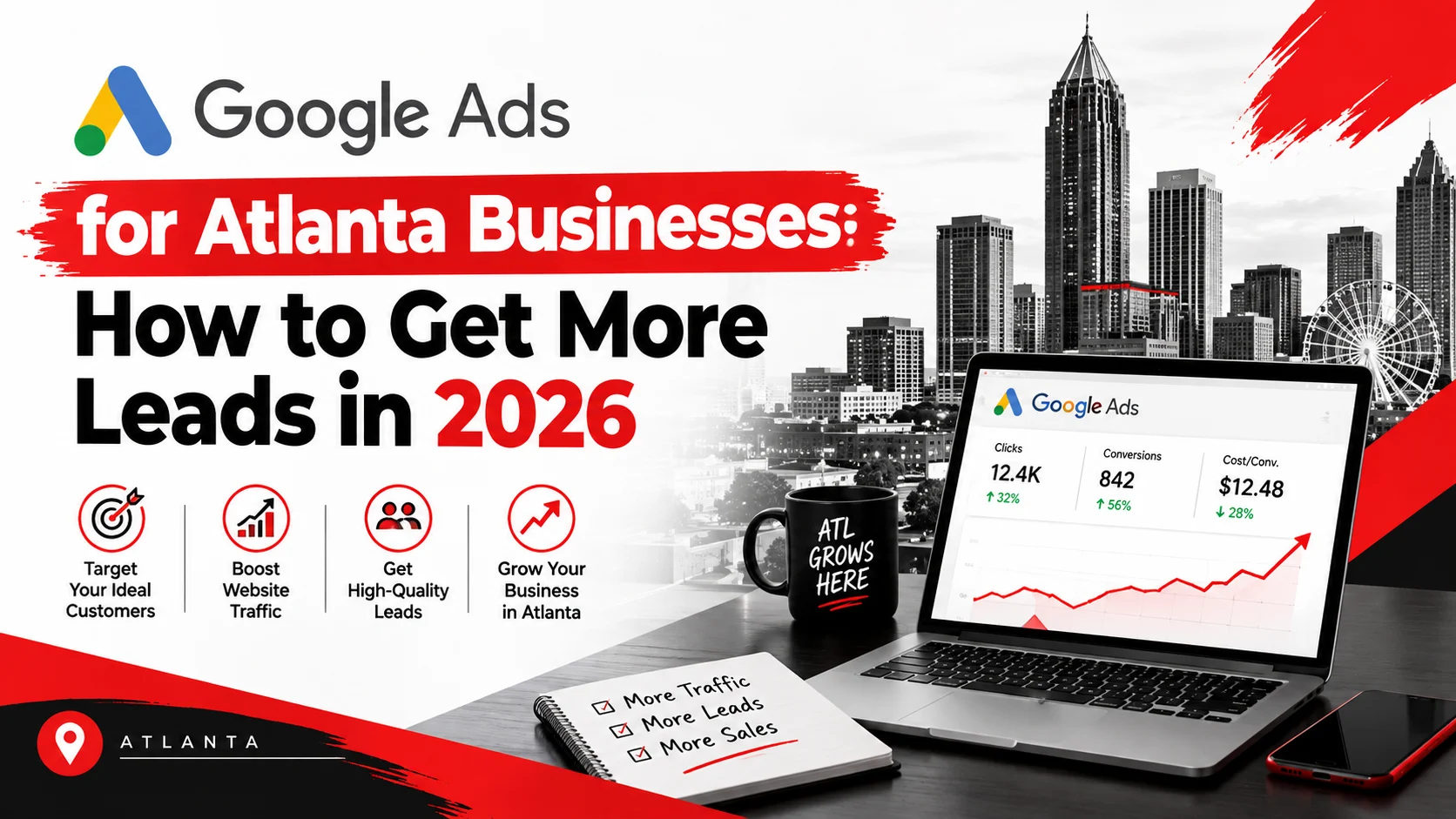
A lot of Atlanta business owners tell us the same thing: the website looks good, the social pages are active, and people are seeing the brand, but the phone isn't ringing enough. Traffic and impressions are easy to come by. Qualified inquiries are a different problem entirely.
That gap between "people know we exist" and "people are asking for a quote" is where Google Ads earns its place. Unlike social content, which reaches people while they're scrolling, it puts your business in front of someone who has already typed what they need into a search bar, a much closer moment to an actual buying decision.
This article breaks down how Google Ads for Atlanta businesses actually works in 2026, what separates a lead-generating campaign from a click-generating one, and how to think about budget, targeting, and tracking so your spend turns into real business.
Why Google Ads Matters for Atlanta Businesses in 2026
Search intent is the whole point. When someone searches "emergency plumber near me" or "commercial roofing contractor Atlanta," they're not browsing; they have a problem and are looking for someone to solve it right now. Google Ads lets you show up at that moment, ahead of organic results that could take months to rank for the same terms.
Location targeting is what makes this useful for a local business. You can set campaigns to reach people in specific Atlanta neighbourhoods, across the metro area, or within a defined service radius, rather than paying to be seen by someone who will never become a customer.
For service businesses, this usually translates into three outcomes: phone calls, form submissions, and quote requests. Those are the actions that move a business forward, and campaigns can be built specifically to drive them.
Google Ads doesn't replace SEO; it works alongside it. Google marketing in Atlanta tends to perform best when paid search captures immediate, high-intent demand while organic content and local SEO build visibility over time. One gives you speed. The other gives you durability.
How Google Ads Generates Leads Instead of Just Clicks
A click by itself isn't worth much. A lead-focused account is a chain of decisions: someone searches, sees your ad, lands on your page, and either takes an action or leaves.
Target high-intent searches
Not every keyword related to your business is worth bidding on. Terms like "digital marketing agency Atlanta," "PPC agency Atlanta," or "Google Ads management Atlanta" carry clear commercial intent; someone is looking to hire, not just to learn. Building campaigns around these kinds of searches, rather than broader informational terms, is one of the biggest differences between an account that produces leads and one that just produces traffic.
Match the advertisement to the search
If someone searches "commercial HVAC repair," the ad and the page they land on should both talk about commercial HVAC repair. When the keyword, ad copy, and landing page all say the same thing, the visitor feels like they found the right business. When they don't line up, visitors bounce, and the spend is wasted.
Give visitors one clear next step
A page with five offers and three navigation menus confuses people. A page built to convert makes the next step obvious: request a consultation, get a quote, call now, or schedule a visit. One clear action performs better than a page trying to do everything at once.
7 Google Ads Strategies to Get More Leads in 2026
1. Build Campaigns Around Atlanta Search Intent
Instead of running one broad campaign for "everything we do," separate campaigns by service and by the type of customer searching for it. A roofing company might run one campaign for storm damage repair, another for new installations, and another for commercial work. Each has a different searcher and urgency level, and lumping them together dilutes performance and makes it harder to see what's working.
2. Use Location Targeting Carefully
It's tempting to set the targeting radius as wide as possible to reach more people. For most local service businesses, that's a mistake. If you only serve metro Atlanta or a specific set of neighbourhoods, targeting the entire state wastes budget on searchers you can't realistically serve. Start with the area you can deliver to, and expand only when data shows it's worth it.
3. Focus on High-Intent Keywords
There's a meaningful difference between commercial and informational intent. Someone searching "what does a digital marketing agency do" is researching. Someone searching "hire digital marketing agency Atlanta" is closer to ready. Long-tail keywords, more specific and less competitive phrases, often bring in searchers further along in their decision, and they tend to convert at a higher rate.
4. Use Negative Keywords to Reduce Wasted Spend
Negative keywords tell Google which searches you don't want your ad to show up for. Without them, budget quietly leaks out on searches like "jobs," "salary," "free," "course," or "DIY," none of which represent someone looking to hire a business. The best lists aren't guessed at ahead of time; they're built from real search data and refined as the campaign runs.
5. Create Landing Pages That Convert
A high-performing landing page shares a few traits: a headline that matches the search, a clear offer, a strong call to action, trust signals like reviews or credentials, and a short form. It also needs to work well on a phone, since a large share of local searches happen on mobile, often from someone standing in front of the problem they need solved. A slow or clunky mobile page loses leads before they ever reach the form.
6. Track Leads, Not Just Clicks
Clicks tell you people are interested. They don't tell you whether your business grew. Conversion tracking, for form submissions, phone calls, and quote requests, is what turns Google Ads from a traffic report into a business tool. From there, the numbers that matter are conversion rate, cost per lead, and cost per qualified lead. A click is not a customer.
7. Combine Google Ads With Social Marketing
Google Ads captures demand that already exists: someone who already knows they have a need and is searching for a solution. Social marketing builds familiarity before that search happens and helps retarget people who visited your site but didn't convert. Used together, one warms up the audience while the other captures them at the moment they're ready to act.
Google Ads vs Social Marketing for Atlanta Lead Generation
The comparison people usually reach for is which channel performs better. That's the wrong question, since the two serve different points in a customer's decision-making process and neither fully replaces the other.
Google Ads tends to work best when there's existing demand, putting you in front of Atlanta searchers at the exact moment they're looking. Social marketing tends to work best for building recognition and trust before that search happens, and for staying visible to people who've shown interest but haven't converted.
A more useful question than "Google Ads or social marketing?" is how the two channels can support the same customer journey. A prospect might first notice your brand through a social post, forget about it for a few weeks, then find you again through a Google search once the need becomes urgent.
How Much Should Atlanta Businesses Spend on Google Ads?
There isn't a single correct Google Ads budget for an Atlanta business, and anyone offering one without knowing your industry is guessing. Budget depends on competition, typical keyword costs, how much a new customer is worth, your conversion rate, how tightly you're targeting geographically, and how long your sales cycle takes.
Think of budget as the start of a chain: budget drives clicks, clicks turn into leads, some leads become qualified, and some of those become paying customers. A small budget can perform well if it's converting efficiently, and a larger one can underperform if it's feeding a leaky funnel. The cheapest lead isn't automatically the best one; a lead that costs more but is far more likely to become a customer is usually the better investment.
Common Google Ads Mistakes Atlanta Businesses Should Avoid
- Targeting overly broad keywords that bring in searchers who were never going to convert.
- Sending all traffic to the homepage instead of a page matched to the search.
- Ignoring negative keywords, letting irrelevant clicks drain budget.
- Ignoring mobile users, so clunky pages lose leads before the form loads.
- Measuring clicks instead of conversions, which says little about results.
- Not tracking calls, missing a large share of local leads.
- Not reviewing search terms, which hides what to add or exclude.
- Making constant campaign changes before the data has time to settle.
- Writing generic ads that could belong to any business.
- Ignoring the landing-page experience, so a strong ad ends in a lost lead.
How to Measure Google Ads Lead Generation in 2026
The right metrics tell you whether campaigns are actually working, not just whether they're active. That starts with total leads, then narrows to qualified leads, the ones that match what your business sells and can serve. Conversion rate shows how well traffic turns into inquiries, cost per lead shows the raw cost of each one, and cost per qualified lead shows the cost of the ones that matter.
Cost per acquisition and conversion value tie ad performance to revenue rather than inquiry volume alone, and for a longer sales process, return on ad spend connects performance back to closed deals.
The core distinction to hold onto: a lead is not the same thing as a customer. Lead Generation is the goal, but it's only the first step. Wherever possible, connect your Google Ads data to what happens after the lead comes in, so you're optimising toward real outcomes rather than surface-level numbers.
When Should You Hire a Google Ads Agency in Atlanta?
Managing Google Ads well takes ongoing attention, and there are a few signs it's time for outside help: campaigns running without producing quality leads, tracking that doesn't seem to capture what's happening, or simply not having time to monitor campaigns regularly.
It's also worth considering if your business needs its own campaign structure for each service, if you're scaling spend without knowing whether it will scale results, or if landing pages aren't converting despite the clicks. None of this means the channel doesn't work. It usually means the account needs a closer look.
How Ingenious Hi-Tech Can Help Atlanta Businesses With Google Ads
At Ingenious Hi-Tech, the approach starts with understanding the business itself, not just the keywords: what services drive revenue, who the ideal customer is, and where existing campaigns, if any, fall short.
From there, the work typically involves identifying the search opportunities most likely to bring qualified inquiries, building a campaign structure around them, and writing ad copy that matches real search intent. Landing pages get reviewed and improved so they're set up to convert, and conversion tracking gets put in place so every call, form, and quote request is counted.
Once a campaign is live, the work shifts to monitoring search terms, evaluating lead quality rather than volume, and scaling the parts of the account that are producing results. Because Google Ads rarely performs in isolation, this can also connect with SEO Services, Social Media Marketing, and Web Development when those genuinely support the broader lead-generation strategy.
Frequently Asked Questions About Google Ads for Atlanta Businesses
1. Is Google Ads worth it for Atlanta businesses in 2026?
For businesses that rely on calls or quote requests, it can be worth it because it puts you in front of people actively searching for what you offer. Its value depends on proper targeting, tracking, and landing pages, not the platform alone.
2. How can Google Ads help an Atlanta business generate leads?
It connects high-intent searches to relevant ads and landing pages with a clear next step, like requesting a quote or calling directly, while conversion tracking confirms which searches actually produce inquiries.
3. How much does Google Ads cost in Atlanta?
Cost varies by industry, keyword competition, and service area, so there's no fixed number for every business. Budget should reflect your typical customer value, conversion rate, and how competitive your market is.
4. What keywords should Atlanta businesses target?
Focus on keywords with clear commercial intent, including long-tail phrases tied to your exact services and service area, rather than broad, generic terms that attract fewer decision-ready searchers.
5. Should I use Google Ads or social marketing?
Both serve different purposes. Google Ads captures people already searching for a solution, while social marketing builds familiarity and trust over time. Most Atlanta businesses benefit from using them together.
6. How long does it take to generate leads from Google Ads?
Campaigns can generate clicks and inquiries within days, but reliable, consistent lead flow usually takes time as the account gathers data and gets optimised.
7. Should I hire a Google Ads agency?
It makes sense if you don't have time to manage campaigns closely, if tracking or lead quality issues aren't getting resolved, or if you're scaling multiple services without a clear campaign structure.
Final Takeaway
Google Ads works when it's built around real search intent, not just visibility. For Atlanta businesses, that means tight location targeting, keywords that reflect what customers are actually looking for, landing pages built to convert, and tracking that shows what's really happening after the click. Lead quality matters more than raw click volume, and Google Ads performs best alongside SEO and social marketing rather than in place of either one.
If your campaigns are generating traffic but not enough qualified inquiries, it's worth a closer look at what's happening between the click and the conversion. Ingenious Hi-Tech works with Atlanta businesses to review that process and find where the strategy can be tightened, so more of your ad spend turns into real leads.