
A regional HVAC company opened its fourth branch and did what most growing businesses do: it copied the original location page, swapped the city name, and hit publish. Three more pages followed the same pattern. Six months later, none of them ranked well, two competed against each other for the same keyword, and the enquiries that did arrive were often from cities the company didn't even serve.
The problem wasn't the decision to build city pages. The problem was that the pages had no real local purpose. A sound multi-location SEO strategy doesn't avoid city pages; it makes sure each one earns its place. This article walks through when location pages help, when they become risky, and how to build a structure that ranks and converts.
Can a business create separate SEO pages for every city?
Yes, but only when each page serves a genuine local need and contains distinct, useful information. Replacing the city name across an otherwise identical template leads to duplication, keyword cannibalisation, a poor user experience, and doorway-page risk, not stronger rankings.
Can You Create a Page for Every City?
A city page should exist because customers in that location need distinct information, not simply because the business wants another geographic keyword in its sitemap. If a plumber can genuinely respond to jobs in Irvine within the hour, an Irvine page has a legitimate reason to exist. If the only difference between the Irvine page and the Anaheim page is the H1, that reason doesn't hold up.
A useful city page answers a local customer's questions. A thin city page only replaces one place name with another.
There's a meaningful difference between building helpful local landing pages and building pages designed to manipulate geographic search results. The first treats the page as a resource for someone deciding whether to call. The second treats it as a keyword container, and both search engines and readers can usually tell the difference.
Identify Your Multi-Location Business Model First
Before writing a single word of content, it helps to be honest about how the business actually operates. The right multi-location website structure depends entirely on this.
True Multi-Location Business
This covers companies with separate, staffed locations where customers can visit dental practices, retail chains, restaurants, law firms, car dealerships, and franchise businesses. Each location typically needs its own page featuring the address, a local phone number, opening hours, staff information, original photographs, and services offered at that branch. These pages are the closest thing to a digital storefront.
Service-Area Business
Plumbers, HVAC contractors, cleaning companies, roofing businesses, security companies, and mobile repair services often work from one central location but travel to customers across a wider region. These businesses can build service-area pages for the cities they genuinely serve, but that doesn't mean a separate Google Business Profile is warranted for every city; profiles for locations without a real, eligible presence create more problems than they solve.
Hybrid Business
Some businesses serve walk-in customers at one address and also deliver services across a broader area, a flooring showroom sending installation crews to nearby towns, for example. Here, the website and Google Business Profile strategy should reflect how the business actually operates, not an idealised version of it.
Duplicate Content, Similar Pages, and Doorway Pages Are Not the Same
These three terms get used interchangeably, but they describe different problems.
- Duplicate or near-duplicate pages: have text, images, services, and calls-to-action that are almost identical from one city to the next. Search engines often pick one version as the primary page, so the others struggle to appear in results not as a penalty, but because there's nothing distinct for them to rank on.
- Doorway pages: are built mainly to capture similar city-based searches and funnel every visitor toward the same generic destination, regardless of which city they searched from. This pattern is explicitly discouraged in Google's own guidance because it prioritises search visibility over genuine usefulness.
- Legitimate location pages: help someone evaluate, visit, contact, or hire the business in a particular place, answering real questions a local customer would ask before deciding.
City-name replacement creates a search-engine page. Local decision-making information creates a customer page. Businesses unsure whether their current city pages are helping or quietly working against them can request a professional location-page audit from Ingenious Hi-Tech before investing in more content.
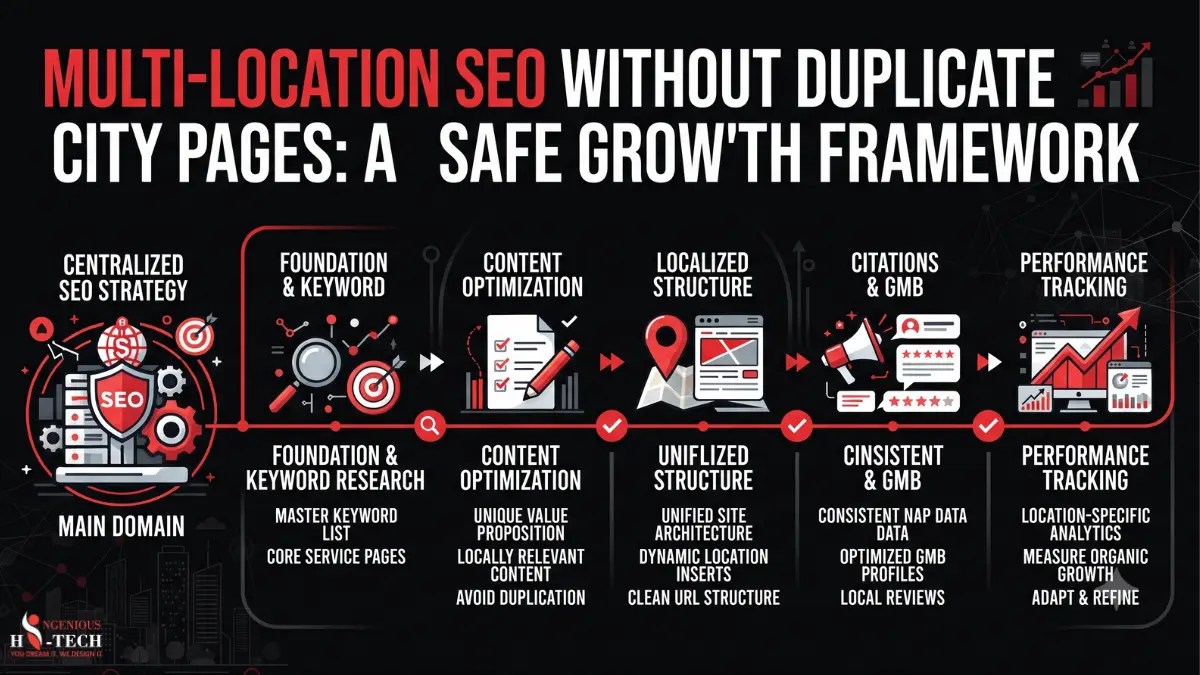
The LOCAL PROOF Multi-Location SEO Framework
To make this process repeatable, it helps to work through a structured framework rather than guessing at what each page needs. We call it LOCAL PROOF checkpoints that keep location pages useful to real customers and easier for search engines to evaluate fairly.
-
L Confirm Location Legitimacy
Before publishing anything, confirm the business actually operates in or serves that area. Physical branches need a correct address, a local phone number, accurate hours, a named team, original photographs, and an honest service list. Service-area businesses need genuine coverage, realistic response times, completed local projects, and real testimonials from that area. Fake offices and virtual addresses created purely to gain local visibility rarely hold up under scrutiny.
-
O Evaluate the Search and Revenue Opportunity
Not every city on a spreadsheet deserves a page. Weigh search demand, competition, existing customers, enquiry volume, service coverage, revenue potential, and strategic importance for each candidate. It also helps to separate local search intent: service-plus-city, problem-plus-city, near-me, brand-plus-branch, and comparison searches. Assigning one keyword group and one clear intent to each page is one of the simplest ways to prevent pages from competing with each other.
-
C Create City-Specific Content That Cannot Be Reused Everywhere
This is where most multi-location websites succeed or fail. A useful guideline is the 70/30 City Page Principle: up to 30% of a page can reuse consistent brand or process information, but most should come from genuine location-specific evidence. This is an editorial guideline, not an official search-engine rule.
To make each page genuinely different, draw on local service context, real project examples, team information for that branch, local testimonials, original photography instead of stock images, realistic response-time information, FAQs about local scheduling or access, and pricing guidance that explains what affects cost. Generic paragraphs about a city's history or weather rarely help unless they influence the buying decision.
-
Build a Scalable Multi-Location Website Structure
A logical hierarchy makes pages easier to manage as the business grows: homepage, locations hub, a state or regional hub for larger operations, individual location pages, service pages, and case studies. A national footprint might use /locations/california/irvine/, while smaller operations may be fine with /locations/irvine/.
Internal linking should tie this together: homepage to locations hub, hub to each city page, service pages to relevant city pages and back, and blog content to the right page. Descriptive anchor text matters; "our Irvine team" tells users and search engines more than "click here." Relying solely on a map widget or JavaScript search tool to surface location pages is risky, since these are harder to crawl than a plain text link.
-
L Align Local Listings and Google Business Profiles
Every website page, Google Business Profile, and directory listing should reflect the same real-world structure: consistent business names, addresses, phone numbers, hours, services, and links. A legitimate branch profile is different from service-area coverage, and businesses should avoid creating a multi-location Google Business Profile for a city unless a genuinely eligible location exists there. It's also worth reviewing directories and chamber listings for duplicate entries, closed locations, or inconsistent data.
-
P Improve Technical SEO and Page Experience
Every location page benefits from a practical technical checklist: unique title tag and meta description, one clear H1, a self-referencing canonical tag, indexable status, sitemap inclusion, crawlable internal links, mobile-friendly design, and fast load times. Valuable city pages should not all canonicalise back to a generic parent page; doing so tells search engines to ignore the pages the business is trying to rank. Structured data, where used, should match what's visible on the page.
-
R Turn Location Pages Into Revenue Pages
A location page shouldn't be built for rankings alone. Every page should answer: Do you serve my city? Can you solve my problem? Why should I trust you? How quickly can you help? What should I do next? Specific calls-to-action, "Request an Irvine SEO Audit," "Call Our San Diego Team," perform better than generic buttons. Pairing these with a local phone number, a short contact form, and a testimonial gives visitors what they need without sending them back to the homepage.
-
O Observe and Measure Performance by Location
Location-level performance should be tracked using Search Console, GA4 landing-page reports, call tracking, form tracking, and Google Business Profile insights, watching impressions, clicks, rankings, calls, enquiries, and close rate. A simple formula helps:
Location Page Value = Qualified Leads × Close Rate × Average Customer Value.
Traffic alone doesn't tell the full story. A page with modest traffic but consistently qualified enquiries can be worth more than a high-traffic page attracting visitors outside the actual service area.
-
O Optimise Existing Pages Before Creating More
Before expanding into new cities, it's worth strengthening what already exists. Search-query data, customer questions, and sales-team feedback often reveal what's missing: fresh local photos, updated testimonials, better calls-to-action, or stronger internal links. Scaling should happen once the first few pages prove they can rank and convert, not before.
-
F Expand Into New Locations Safely
A new city deserves its own page only when the business has genuine service coverage, a real search opportunity, credible revenue potential, local proof, operational capacity, and a defined conversion path. Testing the framework on three to five priority locations first tends to produce better results than expanding everywhere at once.
Businesses planning expansion into additional U.S. cities can request a scalable location-page architecture plan from Ingenious Hi-Tech before publishing more pages.
A High-Converting City Landing Page Template
A reliable city landing page template follows a consistent order: unique SEO title and H1, location-specific introduction, main service and value proposition, proof of local operation, services available in that city, a local project example, how the process works, team information, neighbourhoods served, testimonials, original photographs, pricing guidance, location-specific FAQs, a call-to-action section, and related and nearby locations.
The difference between a weak and strong introduction is usually the first thing a visitor notices. A weak version reads like this:
We provide high-quality digital marketing services in Dallas. Contact us today for the best services.
A stronger version names the audience, the service, the problem, and the outcome, without stuffing the city name into every sentence:
Dallas retailers competing for local search visibility often lose ground to national chains with bigger marketing budgets. Our team builds location-focused SEO and content campaigns that help independent Dallas businesses appear in front of nearby shoppers who are ready to buy, not just browse.
10 Multi-Location SEO Mistakes That Block Growth
- Replacing only the city name across an identical template.
- Publishing pages for areas the company can't serve, damaging trust immediately.
- Creating fake or virtual office profiles to appear local.
- Reusing identical title tags across city pages.
- Canonicalising every city page to one parent page, telling search engines to ignore them.
- Targeting the same keyword with multiple pages, causing internal competition.
- Using identical testimonials and images everywhere.
- Leaving pages orphaned, with no internal links pointing to them.
- Creating unnecessary Google Business Profiles without an eligible presence.
- Tracking rankings without measuring qualified leads.
Together, these mistakes produce weak visibility, cannibalisation, poor conversion rates, and wasted marketing spend.
A 90-Day Multi-Location SEO Action Plan
Days 1–30: Audit and Plan: Verify genuine locations and service areas, audit existing pages for duplication, map keywords, identify cannibalisation, select priority markets, and gather local proof.
Days 31–60: Build and Connect: Create or refine the locations hub, write priority pages first, add internal links, align listings and profiles, improve forms and calls-to-action, and set up analytics and call tracking.
Days 61–90: Measure and Improve: Check indexing, analyse which queries drive traffic, measure calls and forms, review lead quality, strengthen weak pages, and decide whether to expand into more cities.
Frequently Asked Questions
1. Do city pages help local SEO?
Yes, when each page reflects a genuine location with distinct content and proof of operation. Pages built only by swapping a city name rarely help and can create internal competition instead.
2. Is duplicate location-page content a Google penalty?
Not necessarily a formal penalty, but near-duplicate pages often get filtered so only one version appears in results, limiting visibility for the others.
3. Can a service-area business create pages for multiple cities?
Yes, as long as the business genuinely serves those areas. This doesn't automatically justify a separate Google Business Profile for each city.
4. Should every physical location have its own page?
Generally yes, since each branch typically has a unique address, team, hours, and local customer base worth highlighting.
5. How many city pages should a business publish?
As many as can be genuinely supported with local proof and unique content, often starting with three to five priority markets.
6. What is the difference between a location page and a service-area page?
A location page usually represents a physical, staffed branch, while a service-area page represents a region served remotely.
7. Can two city pages target the same service?
Yes, but each page should target a distinct city and avoid competing for the same keyword and search intent.
8. Should every location page have unique content?
Yes. Some brand information can repeat, but most of the page should reflect local evidence specific to that area.
9. How long should a city landing page be?
No fixed word count guarantees results. The right length is whatever answers a local customer's real questions completely.
10. How can I measure whether a location page generates leads?
Track landing-page performance in GA4, pair it with call and form tracking, and connect CRM data back to each page to see which locations produce qualified leads.
Conclusion
A safe multi-location SEO strategy isn't about publishing as many city pages as possible; it's about building pages backed by genuine service coverage, clear search intent, and real local evidence, supported by scalable architecture, accurate listings, solid technical SEO, and consistent lead tracking. Businesses that follow this approach build local visibility that holds up over time, rather than pages that compete with each other or quietly disappear from results.
Request a Free Multi-Location SEO Risk Scan
If you're expanding into new cities or unsure whether your current location pages are helping or hurting your rankings, Ingenious Hi-Tech can review your duplicate location content, city-page structure, keyword cannibalisation, internal linking, canonical tags, Google Business Profile alignment, and local lead-generation opportunities and show you exactly where the gaps are.
Businesses wanting a deeper starting point can also request our 100-Point Multi-Location SEO Scorecard, covering location legitimacy, keyword mapping, content uniqueness, architecture, internal linking, profile alignment, technical SEO, and conversion experience using only a name, business email, website, and number of locations.